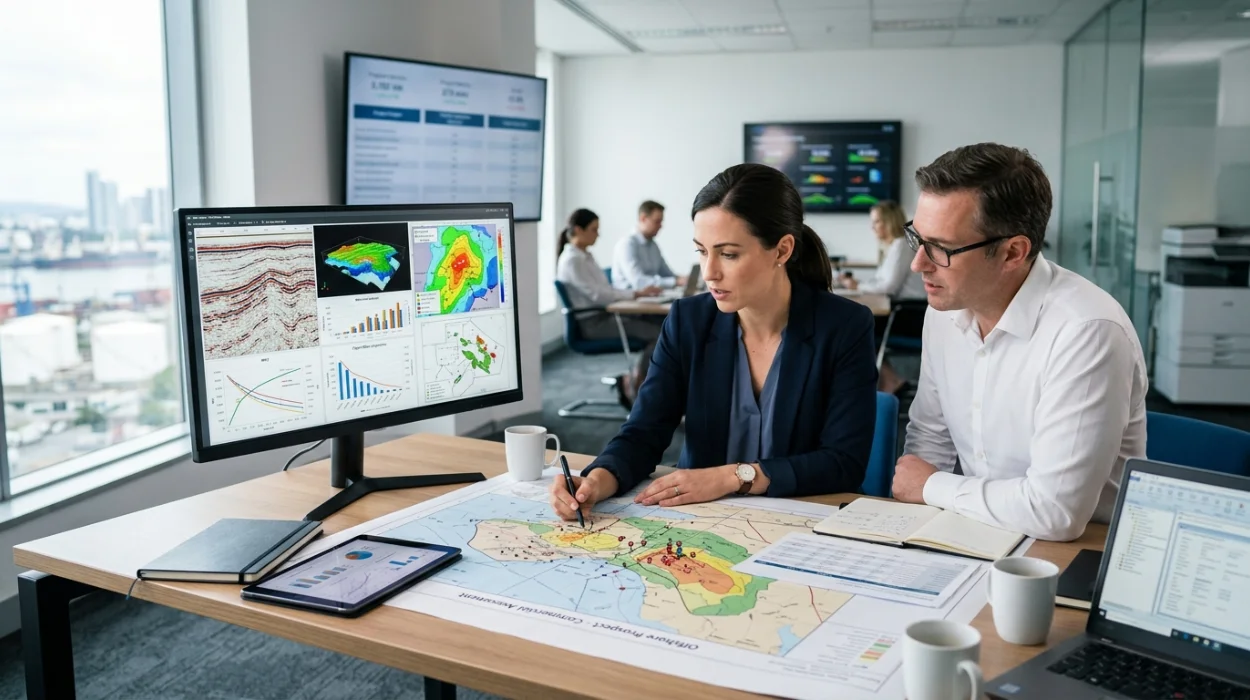
Field development commercial viability assessment is a strategic evaluation process where cross-functional petroleum engineering and commercial teams analyze subsurface data, capital expenditure forecasts, and market pricing to determine if an oil and gas asset generates sufficient economic returns.
Organizations operate in capital-intensive environments where multi-billion-dollar investments require rigorous analytical capabilities. Decision-makers face volatile commodity cycles, stringent environmental regulations, and complex fiscal regimes. Traditional engineering evaluations often operate in silos. Commercial viability assessments bridge technical subsurface discoveries with financial realities. Enterprises establish structured professional training programs to equip asset teams with integrated technical and economic frameworks.
Workforce development initiatives focus on aligning technical subsurface interpretation with economic modeling. Teams evaluate capital allocation efficiency, reserve replacement ratios, and portfolio risk management. Companies target zero-tolerance thresholds for capital misallocation. Professionals learn to synthesize geological data with macroeconomic indicators. Corporate training addresses historical skill gaps between reservoir engineers and commercial analysts. Learners master valuation metrics that dictate upstream portfolio management.
Institutes deliver programs emphasizing practical application over theoretical abstraction. Participants evaluate real-world hydrocarbon basin datasets. Learners quantify project risks using probabilistic modeling techniques. Business units experience enhanced alignment between technical recommendations and corporate strategic objectives. Organizations cultivate internal talent pipelines capable of defending capital expenditure proposals to executive boards.
How Does Commercial Viability Assessment Work in Corporate Environments?
Commercial viability assessment works through a structured, multi-stage governance workflow where multidisciplinary teams integrate geological modeling, cost estimation, and financial forecasting to secure sanctioning approval for upstream petroleum assets.
Corporate implementation begins with structured capability assessments across subsurface, drilling, and commercial departments. L&D professionals deploy baseline competency evaluations to map existing employee skill gaps. Organizations structure learning pathways combining interactive workshops, digital learning modules, and expert-led masterclasses. Teams participate in case-based learning exercises replicating high-stakes asset sanctioning gates.
Workforce training mandates mastery of stage-gate governance models. Employees study how corporate decision boards evaluate project maturation from discovery through appraisal to final investment decision. Professionals utilize simulation tools to run Monte Carlo analyses on production profiles. Training modules incorporate real-world operational constraints, such as rig availability, supply chain bottlenecks, and environmental compliance costs.
Organizations measure training efficacy through tangible performance metrics. Companies track reductions in asset sanctioning cycle times and improvements in capital expenditure forecasting accuracy. Cross-functional collaboration increases across geosciences, petroleum engineering, and commercial finance divisions. Learners practice defending investment cases through simulated executive board presentations. Internal talent retention improves by 24% when technical personnel receive structured commercial leadership training. Teams adopt standardized terminology, eliminating miscommunication between technical creators and financial evaluators.
What Are the Core Components of Commercial Viability Training Frameworks?
Core components of commercial viability training frameworks include subsurface risk analysis, capital expenditure modeling, fiscal regime navigation, and the application of advanced evaluation techniques like [NPV and IRR Analysis for Comparing Alternative Oilfield Development Cases].
Upstream training curricula integrate technical disciplines with financial instruments. Participants study geological risk quantification, recovery factor estimation, and facility engineering cost estimation. Learners dissect production sharing contracts, concession agreements, and tax royalties across international jurisdictions. Organizations implement blended learning delivery formats, pairing 3 days of intensive instructor-led workshops with 4 weeks of self-paced digital modules.
Technical skill development centers on deterministic and probabilistic cash flow modeling. Professionals evaluate capital intensity ratios, lifting costs per barrel, and break-even oil prices. When evaluating capital allocation between distinct basin architectures, teams rely on structured methodologies such as [NPV and IRR Analysis for Comparing Alternative Oilfield Development Cases] to rank competing asset developments objectively. Learners practice constructing cash flow schedules under varying commodity price decks.
Workforce programs incorporate role-playing exercises simulating partner alignment meetings and government negotiations. Participants utilize industry-standard software environments to build integrated asset models. Training modules emphasize governance, data integrity, and auditability in economic reporting. Organizations ensure technical staff understand the commercial impact of operational delays and reservoir performance variances.
How Do Oil and Gas Organizations Implement Commercial Viability Training Programs?
Oil and gas organizations implement commercial viability training programs through phased organizational rollouts that align skill acquisition with capital project lifecycles, performance key performance indicators, and continuous competency verification.
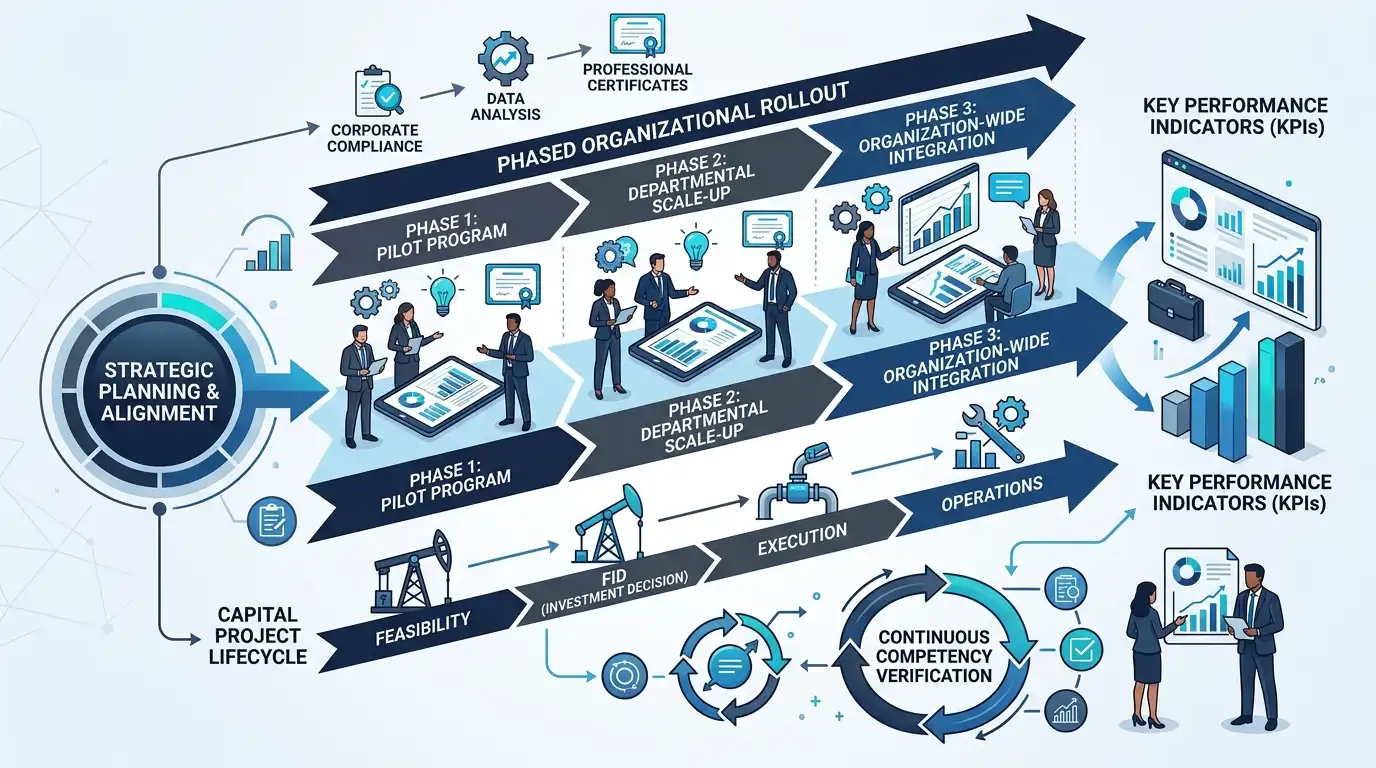
Enterprise implementation strategies begin with comprehensive needs analyses conducted by human resources and technical leadership teams. Corporations establish baseline metrics targeting specific performance gaps in asset valuation accuracy. Delivery formats combine hybrid learning architectures, utilizing 40% online theoretical modules and 60% face-to-face simulation workshops. Organizations deploy cohort-based learning models to foster cross-departmental collaboration between engineers, economists, and legal advisors.
Training integration requires embedding practical exercises into daily operational workflows. Participants evaluate historical asset data from operating basins in regions like the North Sea, the Permian Basin, and offshore West Africa. Organizations measure program success through defined key performance indicators, including a 30% reduction in capital variance estimates and a 20% acceleration in project sanctioning readiness. Mentorship programs pair junior engineers with senior commercial directors to accelerate experiential learning.
Continuous assessment mechanisms verify skill retention and application. Employees complete milestone project evaluations reviewed by internal executive steering committees. Companies update training content continuously to reflect evolving energy transition mandates and carbon pricing mechanisms. Workforce transformation initiatives elevate internal technical authority, reducing reliance on external consultants for baseline economic evaluations.
What Are the Measurable Organizational Benefits of Commercial Viability Training?
Measurable organizational benefits of commercial viability training include a 25% improvement in capital allocation efficiency, enhanced cross-functional team productivity, and fortified leadership pipelines capable of navigating commodity price volatility.
Enterprise-wide capability enhancement yields quantifiable operational improvements. Organizations report a 35% reduction in asset development timeline slippage due to improved alignment between technical and commercial teams. Workforce productivity increases as engineers eliminate redundant data reconciliations through standardized valuation frameworks. Companies achieve higher asset valuation accuracy, minimizing negative post-audit variances on sanctioned capital projects.
Strategic decision-making transforms across business units. Leadership pipelines strengthen as technical specialists acquire macroeconomic literacy and strategic thinking capabilities. Employee retention improves by 28% among high-potential engineering talent provided with structured career development pathways. Collaborative environments replace departmental silos, accelerating problem-solving during complex reservoir underperformance events.
Organizations realize direct financial advantages through optimized project portfolio management. Teams identify value-destructive development concepts early in the stage-gate process, reallocating capital toward high-margin assets. Enterprises maintain operational resilience during market downturns by deploying personnel skilled in rigorous sensitivity analysis and cost containment modeling.
What Are Common Misconceptions Regarding Commercial Viability Training in Corporate Settings?
Common misconceptions regarding commercial viability training in corporate settings include treating technical and commercial competencies as mutually exclusive disciplines and relying on generic, non-contextualized learning programs.
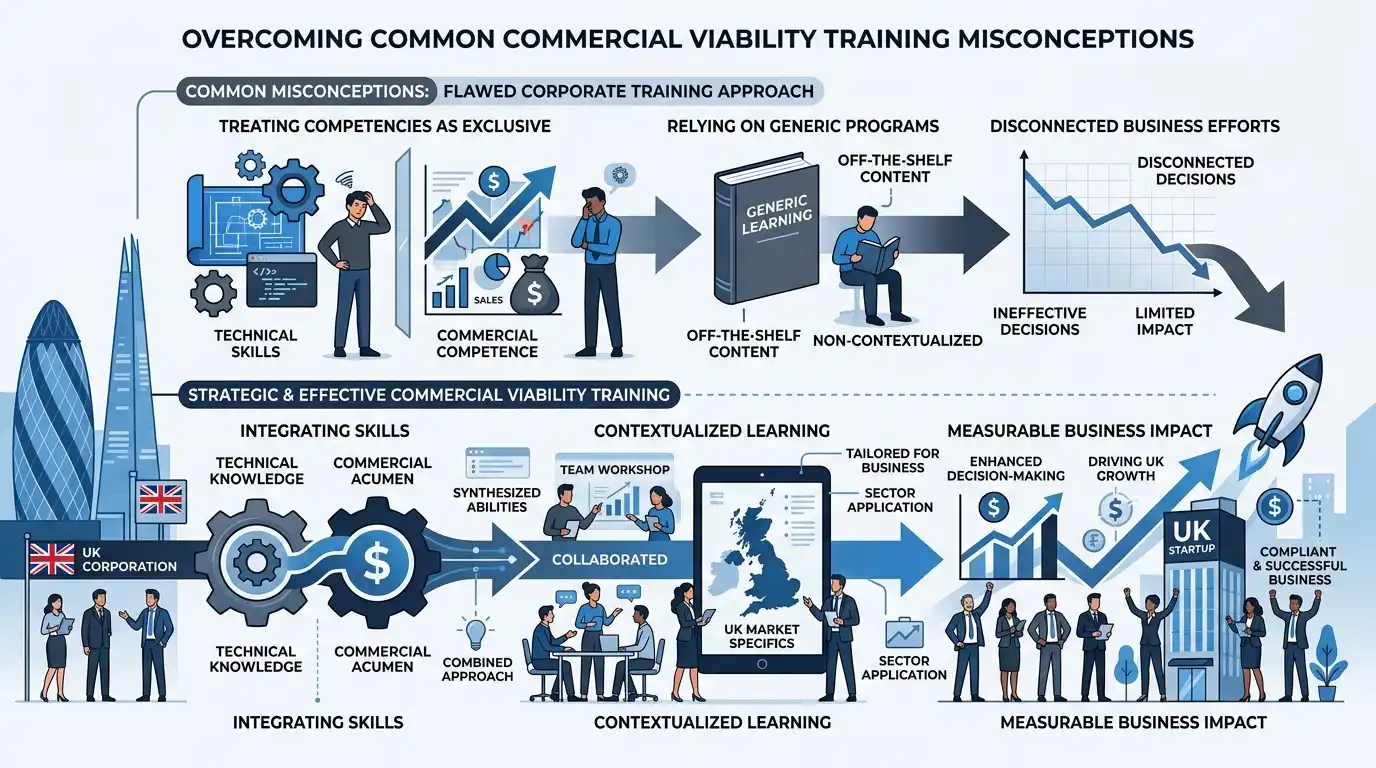
Organizations frequently commit strategic errors by delivering isolated technical training without commercial context, or vice versa. Generic professional development courses fail to address the specific fiscal, regulatory, and geological complexities unique to the upstream petroleum sector. Leaders assume technical personnel absorb commercial acumen organically through on-the-job exposure, leading to prolonged capability gaps and costly capital allocation errors.
Ineffective training programs often lack practical application, relying on passive lectures rather than interactive, data-driven simulations. Organizations fail to align learning outcomes with measurable key performance indicators, making return on investment impossible to quantify. True workforce transformation requires immersive, case-based learning models that replicate real-world operating environments and executive decision pressures.
Enterprises mitigate these pitfalls by partnering with specialized training providers focused on industry-relevant, outcome-based curricula. Programs must incorporate real basin datasets, active risk quantification exercises, and multi-disciplinary teamwork dynamics. Organizations that treat training as a continuous strategic investment rather than a one-off compliance exercise achieve sustained competitive advantage and operational excellence.
Frequently Asked Questions
What is oil and gas petroleum finance and why is it important for energy companies?
Oil and gas petroleum finance is a specialized discipline focused on capital budgeting, economic modeling, and risk management for upstream, midstream, and downstream energy assets. Programs from the Institute For Oil & Gas Training equip professionals with the analytical skills needed to evaluate capital expenditure, manage volatile commodity cycles, and ensure project profitability. This expertise enables organizations to allocate capital efficiently and secure funding for complex, multi-million-dollar field developments.
How do petroleum companies evaluate the economic viability of new oilfield developments?
Energy firms assess economic viability by utilizing discounted cash flow models, net present value calculations, and internal rate of return metrics to analyze capital expenditure against projected hydrocarbon revenues. Through targeted training in oil and gas petroleum finance, multidisciplinary asset teams learn to integrate geological data with macroeconomic indicators and fiscal regime constraints. The Institute For Oil & Gas Training provides practical frameworks that help financial analysts and petroleum engineers defend investment decisions to executive boards.
What career skills are taught in oil and gas petroleum finance training programs?
Petroleum finance training covers capital allocation strategies, production sharing contract navigation, probabilistic risk analysis, and cash flow modeling under varying price decks. Participants at the Institute For Oil & Gas Training master how to quantify subsurface risks and align technical engineering outputs with corporate commercial objectives. These programs enhance cross-functional collaboration between geoscientists, finance departments, and project managers.
How does oil and gas petroleum finance differ from corporate finance in other industries?
Unlike standard corporate finance, oil and gas petroleum finance operates within unique capital-intensive frameworks dictated by depleting natural reserves, long project lead times, and complex international concession agreements. Professionals must account for joint venture accounting, regulatory compliance, and unique asset retirement obligations specific to the energy sector. Specialized education from the Institute For Oil & Gas Training ensures that financial decision-makers understand these industry-specific operational realities and commodity price exposures.
What are the main components of a petroleum finance training curriculum for corporate teams?
A comprehensive petroleum finance curriculum includes modules on capital expenditure forecasting, fiscal regime analysis, portfolio risk management, and valuation techniques for alternative asset development cases. The Institute For Oil & Gas Training delivers these programs through blended learning formats featuring case-based simulations and real-world basin datasets. This practical approach accelerates competency development and strengthens internal leadership pipelines for energy enterprises.
Related training courses
Decommissioning & Asset Retirement Obligations: Security Arrangements Training Course
- Specialisation
- Oil & Gas Petroleum IFRS & Financial Reporting
- Duration
- 5 days · 15 CPD hours
Month-End Close Acceleration for Upstream Operations & Cut-Off Training Course
- Specialisation
- Oil & Gas Petroleum Accounting
- Duration
- 5 days · 15 CPD hours
Production Accounting & Hydrocarbon Allocation: Wellhead to Sales Training Course
- Specialisation
- Oil & Gas Petroleum Accounting
- Duration
- 5 days · 15 CPD hours
More articles

Oilfield Economics & Project Evaluation: Specialist Training for Petroleum Economics and Commercial Roles
Master petroleum economics and project evaluation with specialized training. Learn cash flow modeling, risk analysis, and fiscal contracts for upstream roles.
Read article →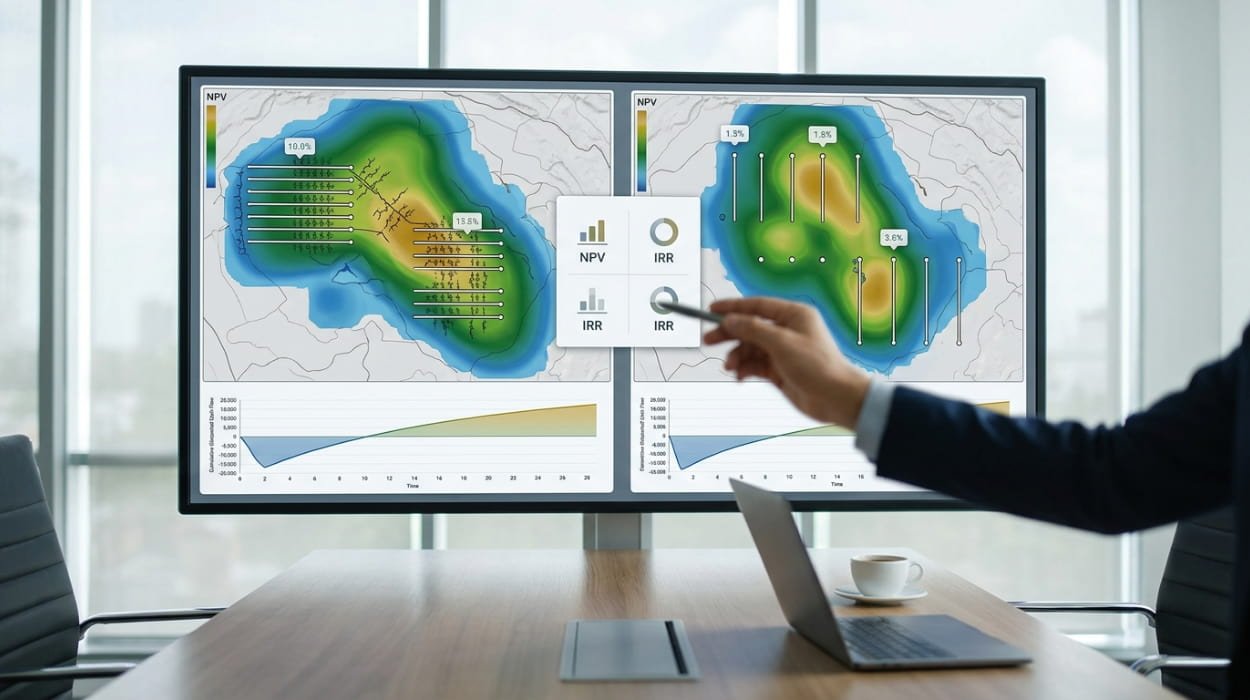
NPV and IRR Analysis for Comparing Alternative Oilfield Development Cases
Master net present value and internal rate of return methods to compare alternative oilfield development cases and optimize upstream capital allocation.
Read article →
Building Practical Oilfield Economics & Project Evaluation Skills for Petroleum Investment Decisions
Master petroleum investment decisions, NPV, IRR, and fiscal regimes with the Institute For Oil & Gas Training. Enroll today to elevate team performance.
Read article →