

Payment controls and treasury governance training for authorisation frameworks in oil and gas provides finance professionals, treasury teams, and internal auditors with structured operational capabilities to prevent unauthorized disbursements, manage bank mandates, mitigate fraud, and enforce strict delegation of authority across complex international petroleum joint ventures.
In capital-intensive petroleum operations, financial transaction volumes are extraordinarily large, highly decentralized, and vulnerable to systemic operational risk. The Institute For Oil & Gas Training developed this specialised curriculum to address structural vulnerabilities in corporate payment workflows, vendor verification protocols, and banking integration systems. Understanding why payment controls and treasury governance matter in oil and gas companies requires a rigorous examination of high-value cash cycles, multi-entity cash pooling, and cross-border regulatory compliance requirements. Without standardized treasury oversight, energy companies face heightened exposure to payment fraud, business email compromise, host to host connectivity failures, and regulatory non-compliance.
This specification document outlines the complete operational framework, curriculum design, assessment methodology, and institutional outcomes of the Payment Controls & Treasury Governance: Authorisation Frameworks Training Course. Designed specifically for corporate finance divisions, internal audit units, and human resource development leads, this program transforms theoretical financial management into verifiable, enterprise-grade workplace performance.
What is the course and what critical corporate risk does it solve?
This course is a technical training program designed to eliminate internal control failures, fraudulent disbursements, and unauthorized wire transfers in petroleum financial operations by establishing standardized delegation of authority matrices, dual authorisation protocols, and secure bank mandate management systems.
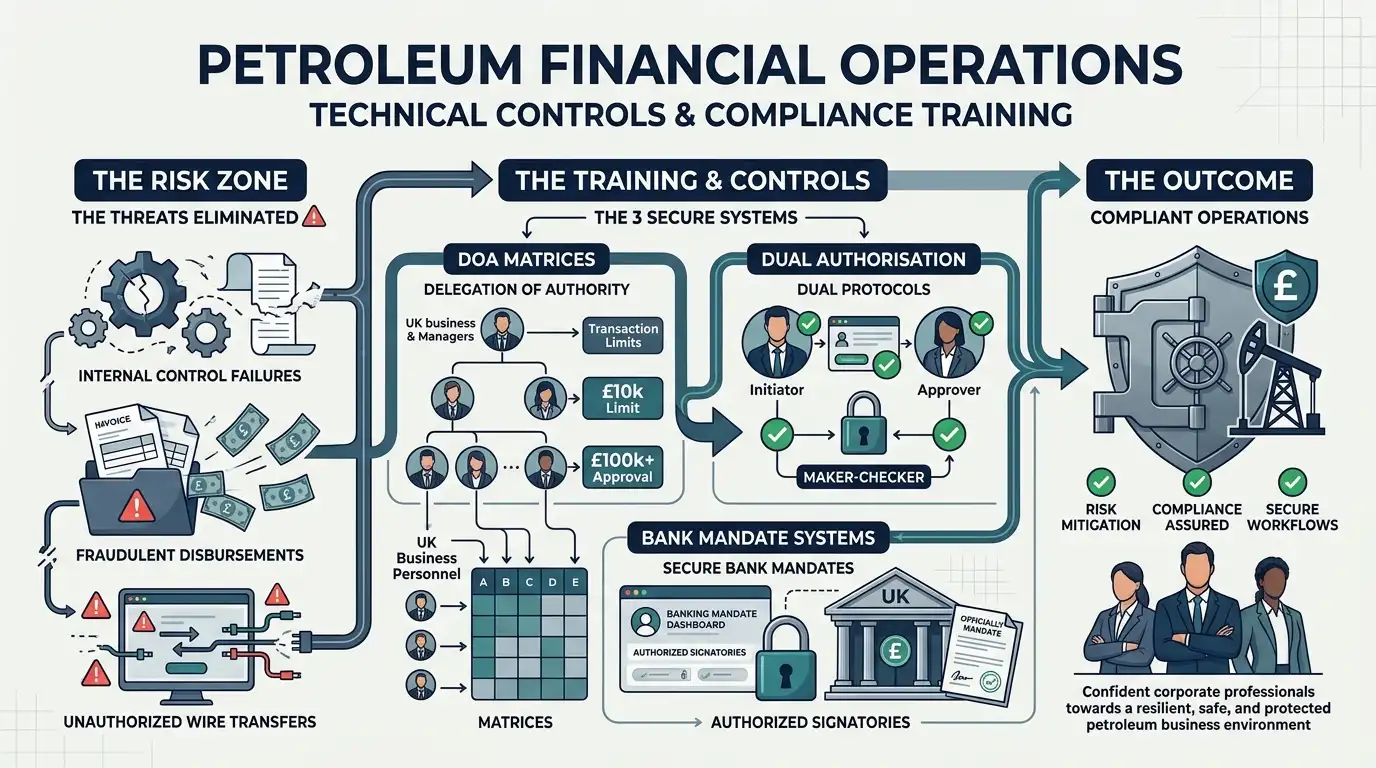
The energy sector operates under complex operational structures involving operating partners, joint venture consortiums, offshore subsidiaries, and multinational supply chains. These conditions create persistent vulnerabilities in transaction validation, vendor management, and treasury processing. Finance departments frequently struggle with fragmented delegation of authority frameworks, inadequate dual authorisation steps, outdated paper-based bank mandate management, and unverified vendor bank detail verification workflows. Consequently, oil and gas organizations incur major financial losses through payment fraud and business email compromise, as well as operational downtime caused by compromised payment file integrity during automated processing.
The Institute For Oil & Gas Training delivers this program to establish uniform operational competencies across corporate finance, risk management, and accounting departments. Participants gain deep technical knowledge regarding modern treasury architectures, secure host to host connectivity, positive pay protocols, and payment approval matrix design. Rather than addressing treasury governance as a theoretical compliance concept, the program provides direct technical instruction on designing, auditing, and enforcing robust payment controls.
When evaluating internal capabilities, finance executives must assess how to evaluate payment authorisation frameworks and treasury controls in petroleum businesses to determine organizational risk levels. By completing this practical training, corporate participants learn to identify control gaps within existing ERP systems, remediate weak segregation of duties, and implement standardized authorization workflows that prevent unauthorized cash outflows across all regional business units.
Why is this curriculum structured for oil and gas operations?
The curriculum is structured around the specific transactional risks of petroleum businesses, progressing logically from foundational payment governance and matrix design to practical bank integration, fraud prevention mechanics, and enterprise-wide financial control implementation.
Financial architecture in the oil and gas industry differs fundamentally from standard commercial enterprises due to capital expenditure scale, joint venture billing mechanisms, cash call cycles, and high-volume vendor disbursements. The Institute For Oil & Gas Training structures the curriculum to mirror the lifecycle of modern corporate payment processes. Learning begins with macro-level corporate governance policies and systematically moves inward to granular operational mechanics, bank connectivity systems, and technical transaction validation protocols. |
This structural progression ensures that learners master governance principles before attempting to configure technical banking controls or audit payment workflows. By mapping modules directly to daily workplace tasks, the Institute For Oil & Gas Training provides a clear educational trajectory that builds measurable competency step by step.
Sequential Skill Progression: Basic governance principles precede advanced technical system integration to ensure complete contextual understanding.
Contextual Alignment: Case studies reflect authentic oil and gas financial scenarios, such as offshore rig lease payments, cash calls, and joint interest billings.
Cross-Functional Relevance: Content bridges the operational gaps between corporate treasury teams, accounting departments, internal audit staff, and HR talent managers.
What are the complete learning modules and technical outcomes?
Participants achieve measurable technical proficiency across four core modules covering payment approval matrix construction, dual authorisation enforcement, secure host to host transmission protocols, positive pay deployment, and advanced business email compromise prevention.
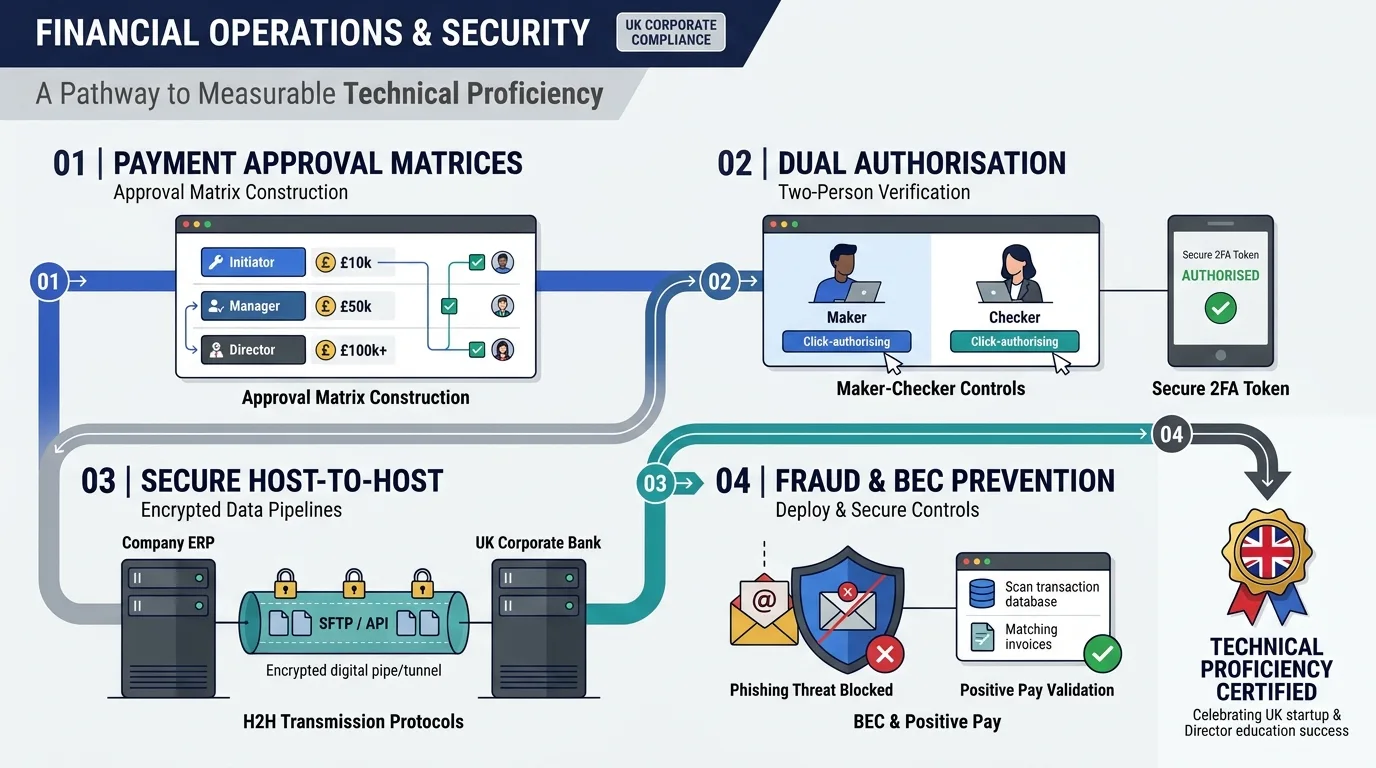
The Payment Controls & Treasury Governance: Authorisation Frameworks Training Course delivers an intensive, specification-led learning plan. Each module targets a critical functional domain within corporate treasury and financial risk management.
Module 1: Governance Frameworks and Delegation of Authority
This module focuses on building robust governance architecture for corporate payment operations. Learners study the statutory, legal, and operational foundations of corporate payment authority within upstream, midstream, and downstream organizations.
Delegation of Authority for Payments: Designing clear threshold tiers, approval limits, and role-based authorisation hierarchies for corporate spend.
Payment Approval Matrix Design: Developing dynamic matrices that account for transaction types, currency thresholds, business unit structures, and joint venture requirements.
Legal and Regulatory Compliance: Aligning internal payment policies with international anti-money laundering, anti-bribery, and financial reporting standards.
Module 2: Operational Payment Controls and Verification
This module covers the execution of secure payment workflows and the control mechanisms necessary to validate payment requests prior to execution.
Dual Authorisation Frameworks: Implementing mandatory multi-party sign-off procedures for high-value disbursements, treasury transfers, and manual ledger adjustments.
Bank Mandate Management: Structuring, auditing, and maintaining valid bank account signatories across global, regional, and subsidiary bank accounts.
Vendor Bank Detail Verification: Setting up rigorous out-of-band verification workflows, call-back procedures, and multi-stage change-request controls for supplier master files.
Module 3: Banking Integration and Payment File Security
This module addresses the technical infrastructure connecting corporate enterprise resource planning (ERP) systems directly with partner financial institutions.
Host to Host Connectivity: Configuring automated, encrypted data pipes between internal ERP software and banking partner clearings.
Payment File Integrity: Utilizing cryptographic hashing, digital signatures, and automated file validation to prevent file tampering between export and transmission.
Positive Pay Systems: Deploying automated daily file matching protocols for check and electronic payment clearings to instantly flag unauthorized items.
Module 4: Fraud Prevention, BEC Defense, and Control Audit
This final module focuses on detecting, mitigating, and responding to sophisticated financial fraud vectors targeting petroleum energy treasuries.
Payment Fraud and Business Email Compromise: Analyzing real-world attack vectors, executive spoofing techniques, supplier invoice redirection schemes, and social engineering methods.
Control Deficiencies and Remediation: Conducting systematic internal control reviews, identifying single-point-of-failure vulnerabilities, and implementing corrective action plans.
Incident Response and Recovery: Establishing immediate operational protocols for freezing compromised payments, initiating recall requests, and filing forensic documentation.
How is the training course delivered and assessed?
The course is delivered through interactive live workshops, online virtual classrooms, hybrid learning modules, or customized onsite corporate sessions, featuring practical simulation exercises, baseline diagnostics, and formal competency testing.
The Institute For Oil & Gas Training utilizes a blended instructional strategy designed for working corporate professionals. The training delivery places primary emphasis on practical execution, hands-on system analysis, and real-world scenario evaluation rather than passive passive instruction.
Delivery Format | Duration | Primary Target Audience | Instructional Focus |
Onsite Corporate Workshop | 3 to 5 Full Days | In-house Treasury, Finance, and Audit Teams | Customized internal policy evaluation, system audit simulations, and company-specific matrix design. |
Virtual Live Classroom | 4 Weeks (2 sessions/week) | Distributed Regional Teams and Finance Managers | Interactive lectures, group case studies, digital workflow testing, and online portal access. |
Hybrid Executive Track | Self-Paced + 2-Day Intensive | Senior Finance Leaders and HR Executives | Distance learning modules covering core governance followed by intensive live practical workshops. |
Assessment methods strictly evaluate practical execution capabilities. Participants complete baseline entry assessments to benchmark current operational knowledge, followed by progressive module assignments. To earn full certification, learners must complete a real-world capstone simulation: designing a complete payment authorisation framework for a multi-entity petroleum operation, configuring dual authorisation parameters, and identifying intentional control gaps within a sample payment file.
What measurable performance results can organizations expect?
Organizations gain immediate operational risk reduction, complete elimination of single-signatory vulnerabilities, improved internal audit pass rates, standardized vendor management protocols, and enhanced resilience against business email compromise.
Sponsoring organizations and HR talent developers receive clear, quantifiable retuns on training investment when enrolling personnel in this program offered by the Institute For Oil & Gas Training. The course builds direct operational capability that translates immediately into daily workplace performance.
Cross-functional impacts strengthen the overall resilience of the organization:
Finance & Treasury Departments: Treasury teams execute daily operations with absolute clarity regarding authorization limits, bank mandate configurations, and payment file security protocols.
Internal Audit & Risk Units: Auditors receive clear audit trail standards, standardized review rubrics, and enhanced methodologies for testing host to host connectivity controls.
Human Resources & Talent Management: HR leads establish a verifiable competency baseline for finance career pathways, enabling clear performance benchmarking and succession planning.
What are the eligibility criteria and enrollment process?
Target participants include finance managers, treasury officers, internal auditors, risk controllers, and corporate governance specialists, with enrollment requiring an active role in corporate financial operations or a formal recommendation from HR.
The Institute For Oil & Gas Training maintains clear entry standards to ensure all course cohorts consist of qualified finance professionals capable of engaging with advanced technical content.
Eligibility Requirements
Professional Experience: Minimum of 2–3 years of active experience in financial management, corporate treasury, internal audit, accounting, or corporate risk oversight within industrial or energy sector firms.
Base Knowledge: Understanding of enterprise accounting principles, standard corporate banking relationships, and general financial software systems.
Corporate Sponsorship: Individual enrollment or group registration submitted through an organization's HR development department, finance director, or audit committee lead.
Program Specifications Summary
This technical specification summary details the core attributes, delivery parameters, and structural components of the payment controls and treasury governance training program.
To secure your organization's financial operations and upgrade your team's treasury controls, apply for course access today.
Frequently Asked Questions
What is covered in the Oil & Gas Petroleum Treasury, Cash and Banking training?
The Oil & Gas Petroleum Treasury, Cash and Banking course by the Institute For Oil & Gas Training covers liquidity management, cash call workflows, joint venture cash pooling, and foreign exchange risk management tailored to energy companies. Participants learn how to construct robust cash forecasting models, maintain global bank mandate controls, and manage multi-currency cross-border transactions. The curriculum focuses on maintaining enterprise financial liquidity while preventing operational cash flow bottlenecks in capital-intensive petroleum projects.
Who should attend the Oil & Gas Petroleum Treasury, Cash and Banking course?
This program is designed for treasury managers, corporate finance professionals, internal auditors, cash accountants, and financial controllers operating within upstream, midstream, and downstream energy sectors. Human resource teams at the Institute For Oil & Gas Training also sponsor this course to upskill corporate finance departments seeking to align regional treasury workflows with international banking standards. It is ideal for personnel responsible for cash management, bank relationship governance, and capital allocation across oil and gas assets.
How does treasury management in oil and gas differ from other industries?
Petroleum treasury operations require specialized oversight due to high capital expenditure cycles, joint interest billing, complex cash call mechanisms, and volatile commodity price exposure. The Institute For Oil & Gas Training addresses these unique challenges through focused training on multi-entity cash pooling, joint venture treasury compliance, and secure host-to-host banking integration. Managing Oil & Gas Petroleum Treasury, Cash and Banking requires precise risk mitigation strategies that account for geopolitical factors and international regulatory frameworks.
What are the main benefits of corporate banking controls in petroleum operations?
Implementing standardized treasury and corporate banking controls eliminates single-signatory risk, reduces payment fraud, and ensures complete compliance with global financial regulations. The Institute For Oil & Gas Training equips teams with practical frameworks for positive pay integration, vendor bank verification protocols, and automated dual authorization systems. These structured controls protect corporate cash reserves and ensure audit-ready visibility across all international banking mandates.
What delivery formats are available for the Oil & Gas Petroleum Treasury, Cash and Banking course?
The Institute For Oil & Gas Training offers flexible delivery formats including interactive live virtual classrooms, self-paced hybrid modules, and customized on-site corporate workshops. Organizations can enroll individual finance leads or arrange tailor-made team sessions that incorporate internal treasury policies and enterprise software systems. All formats feature practical simulation exercises, baseline skill assessments, and formal competency certification upon completion.
Related training courses
Amine Gas Treating and Regeneration Operations Training Course
- Specialisation
- Oil & Gas Process Engineering and Operations
- Duration
- 5 days · 15 CPD hours
API RP 574 Inspection Practices for Piping System Components Training Course
- Specialisation
- Oil & Gas Inspection and Non-Destructive Testing
- Duration
- 5 days · 15 CPD hours
Fiscal Disputes, Cost Recovery and Contract Resolution Training Course
- Specialisation
- Oil & Gas Petroleum Fiscal Regime
- Duration
- 5 days · 15 CPD hours
More articles

Petroleum Taxation Fundamentals Training for Oil and Gas Tax Professionals
Master petroleum taxation fundamentals with Institute For Oil & Gas Training. Explore modules, outcomes, and enrollment paths for tax professionals.
Read article →
How to Evaluate Tax Obligations and Tax Risks Across Upstream Midstream and Downstream Operations
Master evaluation of upstream, midstream, and downstream petroleum tax obligations, ring fencing, capital allowances, and transfer pricing risks.
Read article →
Why Petroleum Taxation Matters Across the Oil and Gas Value Chain
Master petroleum taxation fundamentals across upstream midstream and downstream operations to mitigate tax risks and drive corporate profitability.
Read article →