

The oil and gas sector operates within an environment of severe commodity price volatility, fluctuating foreign exchange rates, and complex interest rate exposures. Managing these financial risks requires robust risk management strategies and precise financial reporting mechanisms. Financial leaders in energy firms must navigate stringent regulatory requirements to reflect risk mitigation activities accurately within their financial statements.
Implementing effective risk management frameworks relies heavily on aligned accounting practices. Understanding Why Hedge Accounting Matters for Oil and Gas Companies enables finance teams to minimize income statement volatility by matching gains and losses on hedging instruments with the underlying hedged exposures.
What Are the Primary IFRS 9 Hedge Accounting Challenges in Oil and Gas?
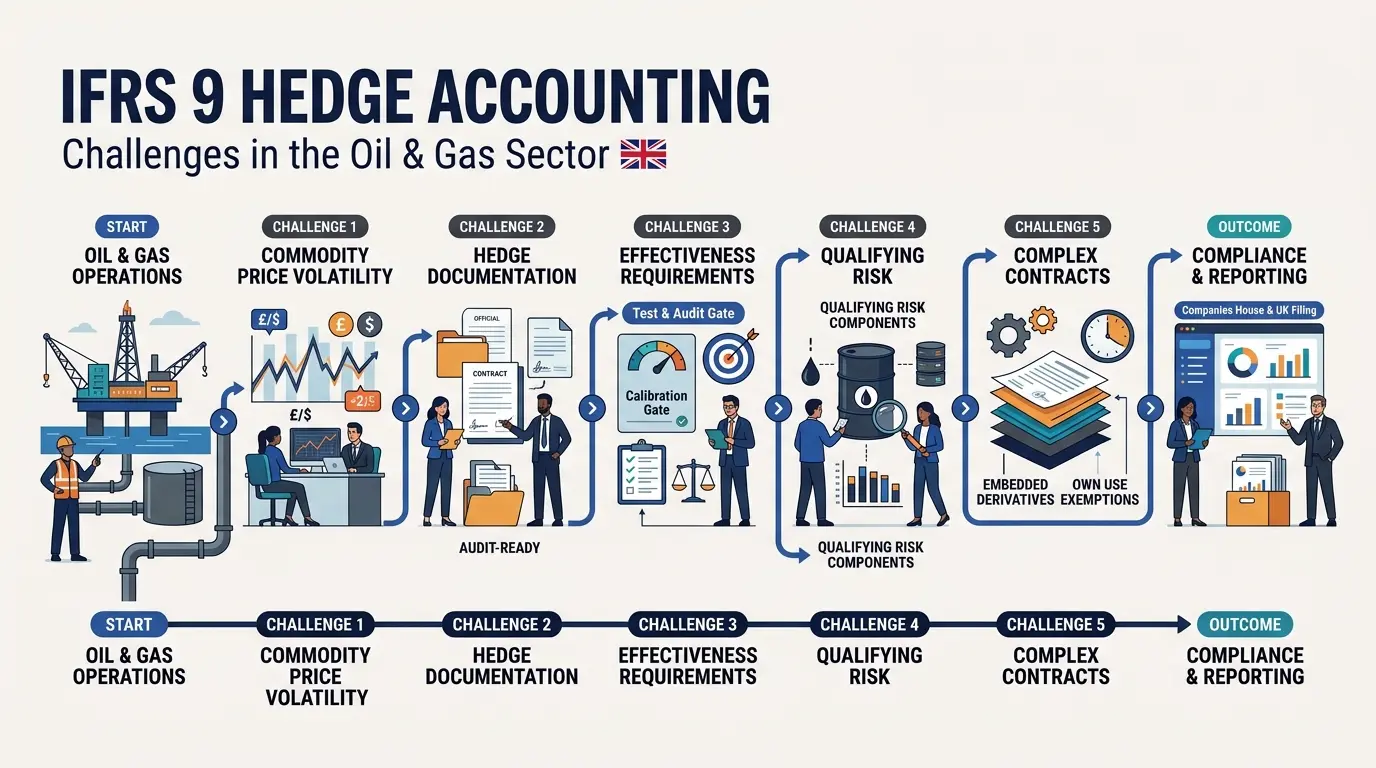
Oil and gas companies face primary IFRS 9 hedge accounting challenges in managing commodity price volatility, documenting hedge relationships, meeting strict effectiveness requirements, qualifying non-financial risk components, and accounting for complex long-term energy contracts, embedded derivatives, and own use exemptions.
Risk Component Designation and Market Liquidity
Designating specific risk components of a non-financial item represents a fundamental challenge under IFRS 9. Energy firms frequently attempt to hedge specific risk components, such as the Brent crude benchmark within a physical crude oil contract. IFRS 9 permits the designation of a risk component only if it is separately identifiable and reliably measurable in the market.
Volatile market dynamics complicate this assessment. Upstream producers and downstream refiners often struggle to isolate pricing components when regional spot premiums or quality differentials lack liquid derivative markets. When a risk component fails the separately identifiable test, the entire contract must be designated, introducing significant ineffective portions into profit or loss statements.
Complex Hedge Documentation and Strategy Alignment
Formal designation and documentation must be established at the inception of a hedge relationship. The documentation must explicitly define the risk management objective, the hedging strategy, the hedging instrument and hedged item, the nature of the risk being hedged, and how hedge effectiveness will be assessed.
Energy firms maintain dynamic corporate hedging programs that adjust contracts as production forecasts shift. Retrospective changes to hedge documentation are strictly prohibited under IFRS 9. Misalignment between operational hedging practices and formal accounting records leads directly to the loss of hedge accounting status.
Own Use Exemption and Embedded Derivatives
Oil and gas companies enter into volume-heavy physical purchase and sales contracts. Standard physical contracts fall under the own use exemption (IFRS 9.2.4) if they are entered into and held for the receipt or delivery of a non-financial item in accordance with the entity’s expected purchase, sale, or usage requirements.
Physical contracts containing pricing formulas linked to commodities other than the underlying physical item contain embedded derivatives. If an embedded derivative is not closely related to the host contract, it must be bifurcated and accounted for at fair value through profit or loss. Distinguishing between genuine physical own-use supply contracts and derivative contracts requires constant legal and accounting evaluation.
How Do IFRS 9 Classifications Impact Oil and Gas Risk Management?
IFRS 9 classifications impact oil and gas risk management by determining whether hedge gains and losses appear in profit or loss or other comprehensive income, directly influencing reported earnings volatility, key financial metrics, leverage ratios, and stakeholder financial risk perception.
Cash Flow Hedge Mechanics in Energy Trading
A cash flow hedge applies to exposure to variability in cash flows associated with a recognized asset, liability, or a highly probable forecast transaction. Oil and gas producers routinely utilize cash flow hedges to lock in revenue floors for future crude oil or natural gas production.
Under this model, the effective portion of the gain or loss on the hedging instrument is recognized in other comprehensive income (OCI) and accumulated in the hedge reserve recycling account. The ineffective portion enters profit or loss immediately. Once the forecast physical sale occurs, the accumulated gain or loss in OCI is recycled out of the hedge reserve and reclassified into profit or loss, matching the revenue timing of the physical volume.
Fair Value Hedge Accounting for Inventory and Fixed Rate Debt
A fair value hedge addresses exposure to changes in the fair value of a recognized asset or liability or an unrecognized firm commitment. Energy firms use fair value hedges when protecting stored inventory or fixed-rate debt against market price movements or interest rate fluctuations.
In a fair value hedge, the gain or loss from re-measuring the hedging instrument at fair value is recognized immediately in profit or loss. Simultaneously, the carrying amount of the hedged item is adjusted for the gain or loss attributable to the hedged risk, with that adjustment also entering profit or loss. Perfect hedging relationships offset each other entirely within the income statement.
Hedge of Net Investment in Foreign Operations
Energy multinationals operate across international jurisdictions, generating foreign currency exposures through overseas subsidiaries. A hedge of net investment protects the foreign exchange risk arising from net assets held in foreign operations.
Accounting treatment mirrors cash flow hedge mechanics. Foreign exchange gains or losses on the hedging instrument corresponding to the effective portion are held in OCI under the foreign currency translation reserve. Reclassification into profit or loss occurs only upon the disposal or partial liquidation of the foreign operation.
What Are the Technical Requirements for Establishing Hedge Effectiveness?
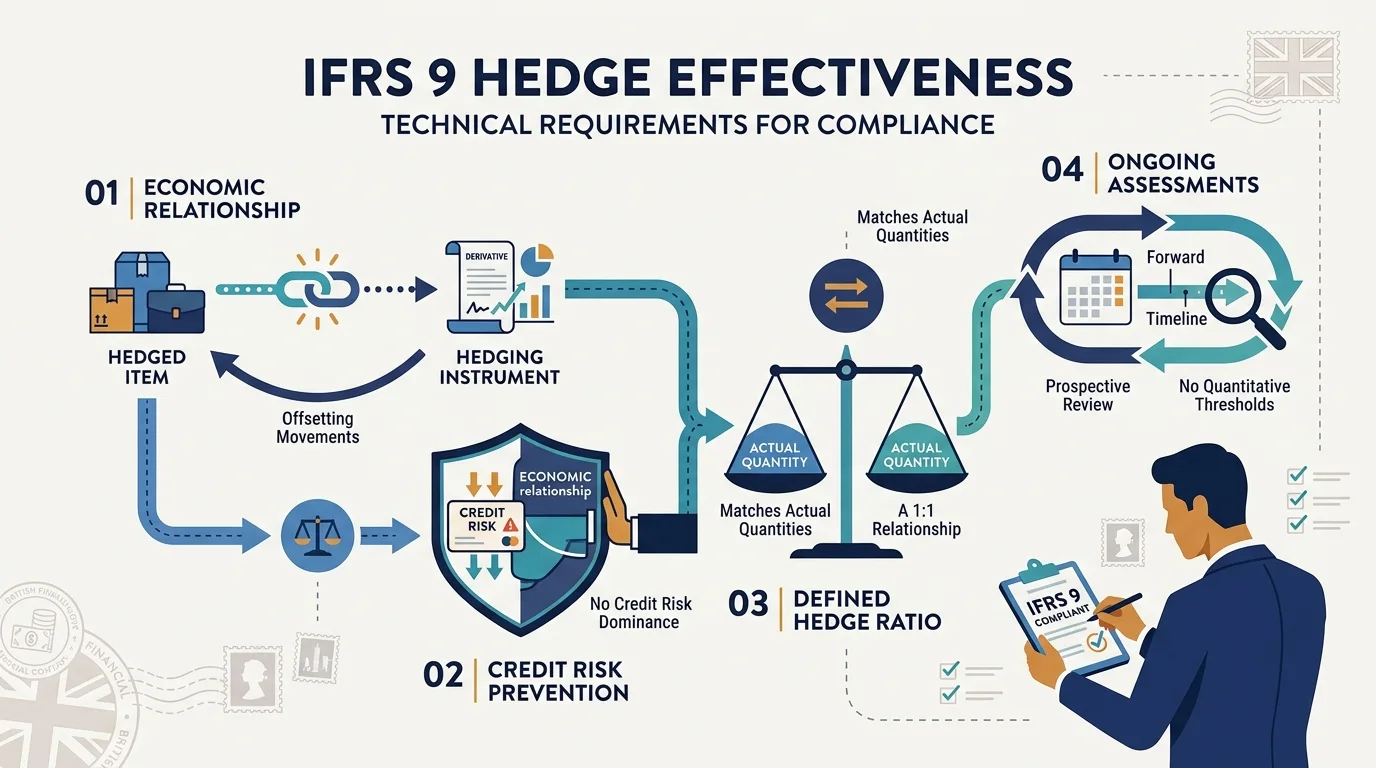
Technical requirements for establishing hedge effectiveness under IFRS 9 require an economic relationship between hedged item and hedging instrument, credit risk dominance prevention, a defined hedge ratio matching actual quantities used, and ongoing prospective effectiveness assessments without quantitative thresholds.
Demonstrating Economic Relationship
IFRS 9 replaced the rigid 80–125% quantitative effectiveness test from IAS 39 with an objective-based prospective assessment. Entities must prove an economic relationship exists between the hedged item and the hedging instrument. Both instruments must move in opposite directions in response to the same underlying risk factor.
Basis risk creates challenges in meeting this requirement. An oil producer hedging physical West Texas Intermediate (WTI) delivery using Gulf Coast Brent futures introduces basis risk. Finance teams must perform regression analyses or qualitative assessments proving the pricing series share strong, continuous statistical correlation.
Managing Credit Risk Dominance
An economic relationship loses qualification if credit risk dominates the value changes resulting from the hedge. Even if underlying commodity prices move in correlation, a sharp deterioration in counterparty creditworthiness alters derivative fair values independently of the commodity risk.
Energy firms must evaluate counterparty credit risk continuously. Credit valuation adjustments (CVA) and debit valuation adjustments (DVA) must be monitored. If counterparty default risk becomes the primary driver of derivative price movement, hedge accounting must be discontinued immediately.
Establishing the Correct Hedge Ratio
The hedge designation must reflect the actual quantity of the hedged item and the quantity of the hedging instrument used operationally. Artificial hedge ratios created to bypass accounting outcomes violate IFRS 9 requirements.
When underlying contract quantities diverge, firms must rebalance the hedge relationship rather than discontinuing it. Rebalancing involves adjusting the quantities of the hedging instrument or the hedged item included in the ongoing documentation, maintaining alignment with corporate risk management strategies.
How Can Energy Firms Address IFRS 9 Workforce Skill Gaps?
Energy firms can address IFRS 9 workforce skill gaps by evaluating structured internal learning frameworks, comparing external technical training against specialized advisory solutions, establishing clear performance metrics, and implementing practical corporate learning programs tailored to complex commodity derivative operations.
Training Approaches for Energy Finance Teams
Resolving accounting bottlenecks requires targeted workforce development. Organizations must select learning delivery models that bridge the gap between technical accounting standards and daily commodity trading operations.
Standard accounting workshops explain standard definitions but lack industry context. Customized corporate training programs integrate actual energy contracts, physical delivery terms, and specific risk management strategies. For finance teams seeking tailored technical competence, enrolling in the IFRS 9 – Financial Instruments: Hedge Accounting Training Course equips professionals with practical models to execute compliance tasks accurately.
Structured learning formats build internal technical ownership. When internal teams master hedge documentation and hedge effectiveness testing, reliance on expensive external consulting firms drops significantly.
Evaluating Learning Delivery Frameworks
Human Resources and finance executives must compare learning formats to select the optimal model for corporate finance, risk management, and treasury teams.
Learning Framework | Technical Depth | Customization Level | Operational Impact | Time to Autonomy |
Generic Off-the-Shelf E-Learning | Low | None | Minimal impact on complex derivative decisions | 12–18 Months |
External Audit / Advisory Workshops | High | Low–Medium | Theoretical awareness without direct process ownership | 6–12 Months |
Specialized Oil & Gas Corporate Training | High | High | Immediate process integration and audit-ready documentation | 1–3 Months |
On-the-Job Mentorship & Peer Review | Medium | Medium | Inconsistent standardization across enterprise units | 6–9 Months |
What Frameworks Support Effective IFRS 9 Compliance and Implementation?
Frameworks supporting effective IFRS 9 compliance combine integrated risk management policies, valuation system integration, audit-ready documentation workflows, cross-functional finance communication, and continuous workforce capability assessments to deliver measurable business outcomes and reporting stability.
Building an Integrated Compliance Framework
Achieving seamless compliance requires aligning risk management policies, trading desks, treasury systems, and financial accounting units.
Policy Alignment: Update corporate risk management mandates to align operational hedging targets directly with IFRS 9 hedge accounting definitions.
System Valuation Capabilities: Implement Treasury Management Systems (TMS) and Energy Trading and Risk Management (ETRM) platforms capable of calculating derivative fair values, CVA/DVA adjustments, and prospective effectiveness assessments.
Documentation Standardization: Establish standardized templates for immediate hedge designation upon trade execution to eliminate documentation backlogs.
Governance and Cross-Functional Review: Form joint committees between trading desks, risk managers, and accounting leads to assess physical contracts for embedded derivatives and own-use qualification.
Decision Matrix: Implementation & Training Solutions
HR leaders and Chief Financial Officers evaluating corporate capability solutions must weigh key selection criteria against enterprise objectives. Implementing structured, professional programs like IFRS 9 Hedge Accounting Training for Oil and Gas Financial Professionals ensures that cross-functional teams build practical capabilities directly aligned with industry compliance standards.
Evaluation Criterion | Internal Capability Building | Outsource to Advisory Firms | Software Automation Only |
Primary Goal | Sustainable internal expertise | Immediate project-based audit compliance | System-driven valuation processing |
Cost Structure | Predictable upfront training investment | High ongoing billable hourly fees | Significant software licensing & implementation costs |
Long-Term Enterprise ROI | High (retained institutional knowledge) | Low (knowledge leaves when engagement ends) | Medium (requires skilled operator input) |
Risk Mitigation Focus | Prevents operational execution errors at trade origin | Corrects reporting errors post-execution | Automates math; cannot evaluate contract intent |
Target Audience Fit | Corporate Finance, Treasury, HR Skill Plans | Executive Audit Committees | IT & Quantitative Risk Analysts |
Measuring Business ROI from IFRS 9 Competency Development
Investing in advanced technical capabilities yields quantifiable financial returns. Organizations measure implementation success across four key performance metrics:
P&L Volatility Reduction: Proper designation of cash flow hedges isolates non-operating commodity swings inside OCI, stabilizing reported EBITDA.
Audit Efficiency and Fee Savings: Complete, error-free hedge documentation reduces external audit review hours and prevents costly accounting re-statements.
Reduction in External Advisory Dependence: Upskilling internal treasury and accounting staff lowers ongoing reliance on third-party technical accounting consultants by up to 60%.
Speed of Contract Evaluation: Trained cross-functional teams evaluate complex physical supply deals for embedded derivatives in days rather than weeks, accelerating commercial deal execution.
Developing robust internal technical mastery transforms complex regulatory requirements into structured, repeatable corporate risk management processes.
Frequently Asked Questions
What does the Oil and Gas Petroleum IFRS & Financial Reporting program cover?
The Oil and Gas Petroleum IFRS & Financial Reporting program delivered by the Institute For Oil & Gas Training provides comprehensive guidance on energy accounting standards, including IFRS 6, IFRS 9, IFRS 15, and IFRS 16. Participants gain practical insight into accounting for exploration and evaluation assets, complex commodity derivatives, joint venture operations, and decommissioning liabilities. This structured framework helps finance teams align operational energy contracts with international financial reporting compliance requirements.
Why is specialized financial reporting training critical for energy sector professionals?
Energy sector financial reporting involves unique industry complexities such as volatile commodity pricing, embedded derivatives, joint interest billing, and impairment testing for reserve assets. Through the Oil and Gas Petroleum IFRS & Financial Reporting course at the Institute For Oil & Gas Training, finance managers and corporate accountants master the technical requirements necessary to reduce income statement volatility. Developing internal accounting expertise ensures audit-ready financial statements and transparent reporting for external stakeholders.
How does IFRS 9 hedge accounting apply to oil and gas financial statements?
Under IFRS 9, oil and gas companies can apply cash flow hedges and fair value hedges to insulate earnings from extreme commodity price fluctuations and foreign exchange risks. The Oil and Gas Petroleum IFRS & Financial Reporting training by the Institute For Oil & Gas Training teaches finance teams how to establish formal hedge documentation, qualify non-financial risk components, and assess hedge effectiveness. Proper application allows gains and losses on hedging instruments to match underlying physical sales timing within profit or loss statements.
Who should attend the Oil and Gas Petroleum IFRS & Financial Reporting course?
The Oil and Gas Petroleum IFRS & Financial Reporting program offered by the Institute For Oil & Gas Training is designed for financial controllers, treasury managers, corporate accountants, internal auditors, and finance business partners in the energy industry. It is also tailored for HR teams seeking structured technical upskilling to close critical workforce capability gaps in energy accounting. The practical curriculum enables participants to directly address real-world financial reporting challenges across upstream, midstream, and downstream operations.
How does practical IFRS training improve corporate financial governance in energy firms?
Standardised IFRS training equips energy accounting teams to systematically identify embedded derivatives in supply agreements, interpret own-use exemptions, and calculate asset retirement obligations accurately. By building institutional capability through the Institute For Oil & Gas Training's Oil and Gas Petroleum IFRS & Financial Reporting course, organizations minimize external audit adjustments and streamline financial consolidation processes. This structured approach strengthens risk management governance while lowering long-term reliance on expensive external advisory services.
Related training courses
Produced Water Management Training Course
- Specialisation
- Oil & Gas Water Treatment and Management
- Duration
- 5 days · 15 CPD hours
Root Cause Analysis (RCA) Training Course
- Specialisation
- Oil & Gas Reliability and Maintenance Management
- Duration
- 5 days · 15 CPD hours
ISO 55000 Asset Integrity Training Course
- Specialisation
- Oil & Gas Asset Integrity Management
- Duration
- 5 days · 15 CPD hours
More articles

Decommissioning and Asset Retirement Obligation Security Arrangements Training for Oil and Gas Professionals
Master ARO security, letters of credit, trust funds, and liability transfer. Enroll in the Institute For Oil & Gas Training professional course.
Read article →
Key Challenges in Managing Security Arrangements for Oil and Gas Decommissioning Obligations
Examine key challenges in managing security arrangements for oil and gas decommissioning obligations and evaluate strategic solutions.
Read article →
Why Security Arrangements Matter for Oil and Gas Decommissioning Obligations
Learn how security arrangements for oil and gas decommissioning obligations protect organizations, mitigate liabilities, and optimize working capital.
Read article →