
Navigating financial standards in collaborative upstream operations requires absolute clarity on asset obligations. Understanding Why Lease Charging and Modifications Matter in Oil and Gas Joint Ventures establishes the fundamental baseline for operators managing complex exploration assets. Joint venture accounting structures involve multiple non-operators, distinct billing mechanisms, and intricate contractual obligations that complicate standard lease accounting. Oil and gas companies face severe friction when transitioning asset portfolios under international financial reporting guidelines, particularly regarding multi-party billing and shared infrastructure.
How does lease cost allocation to partners function within upstream joint operations?
Lease cost allocation to partners requires proportional billing based on participating interest percentages, yet discrepancies arise when variable lease payments, shared service facilities, and joint operating agreements create conflicting recovery rights. Joint operating agreements dictate how exploration and production expenses divide among partners, but IFRS 16 introduces strict capitalization rules for right-of-use assets that do not always align with traditional cash-call mechanisms. Operators must distribute right-of-use asset depreciation and interest expenses across non-operators accurately.
This financial distribution directly impacts operating expenditure versus capital expenditure classifications. Financial controllers must handle audit scrutiny when partner audits challenge the inclusion of certain asset components in joint account billings. When handling complex collaborative assets, organizations benefit from structured capability development such as the IFRS 16 – Leases: JV Charging & Modifications Training Course to align accounting teams and operational partners on shared cost frameworks. Mismanaged allocations trigger formal disputes, delayed cash calls, and significant compliance penalties during statutory audits.
What specific compliance hurdles emerge during joint operation lease treatment?
Joint operation lease treatment demands separating lease components from non-lease service components within complex master service agreements, often forcing operators to re-evaluate rig contracts, seismic vessel charters, and pipeline capacity leases. Upstream contracts frequently combine vessel or drilling rig provisions with crew, maintenance, and operational services. Accountants must isolate the pure lease payment component to calculate the initial right-of-use asset and corresponding lease liability.
This separation becomes significantly harder when contracts involve variable lease payments tied to production output or usage milestones. Operators struggle to establish reliable estimates for variable indices at commencement date. Consequently, financial statements often require retroactive adjustments that distort period-on-period performance metrics. Internal audit teams frequently identify systemic errors in how joint venture operators account for short-term lease exemptions versus long-term capitalizations. Organizations mitigating these compliance hurdles rely on targeted frameworks explored in IFRS 16 – Leases: JV Charging & Modifications Training Course to standardize data capture across decentralized project offices.
Why does lease modification and remeasurement disrupt established accounting schedules?
Lease modification and remeasurement disrupt established schedules because altering lease terms, extending drilling rights, or changing concession boundaries forces an immediate recalculation of the discount rate and lease liability. Upstream assets experience frequent operational changes, including premature field abandonments, side-track drilling permissions, and early contract terminations. Each operational shift qualifies as a lease modification under international rules.
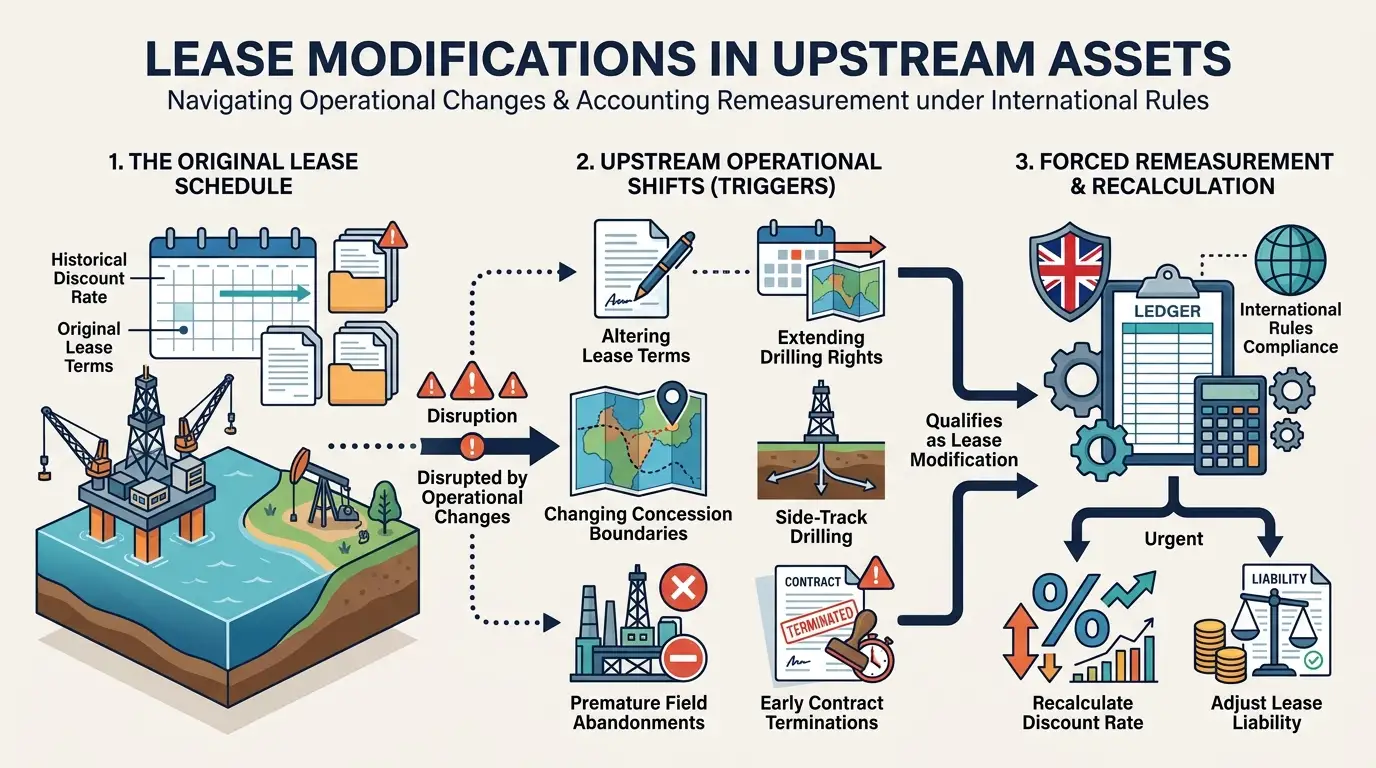
When a modification occurs, the operator adjusts the carrying amount of the right-of-use asset and recalculates the present value of remaining lease payments using a revised discount rate. This process requires seamless communication between field operations, commercial managers, and central finance teams. Field changes communicated late to finance departments lead to unrecorded modifications and distorted balance sheets.
To bridge this operational disconnect, HR and finance leaders deploy specialized learning interventions like IFRS 16 – Leases: JV Charging & Modifications Training Course to train cross-functional teams on real-time event triggers. Without synchronized workflows, multinational operators face material misstatements that compromise investor confidence and trigger regulatory inquiries.
How do variable lease payments and subleasing arrangements affect cost recovery?
Variable lease payments and subleasing arrangements complicate cost recovery because fluctuating index-linked tariffs and complex intermediate lessor structures distort the net recoverable pool shared among joint venture partners. In many upstream arrangements, production facilities or floating production storage and offloading units involve lease payments linked to commodity prices or operational throughput. These variable components are excluded from the initial lease liability calculation, creating timing differences between cash outflows and recognized liabilities.
Furthermore, when an operator subleases an exploration block or shared logistics facility, they must classify the sublease as operating or finance based on the right-of-use asset arising from the head lease. This classification dictates whether the primary operator derecognizes the right-of-use asset or records net investment in the sublease. Partners often dispute whether sublease income should credit the joint account or remain with the primary operator.
Resolving these disputes requires precise contractual wording and rigorous training in advanced cost-recovery mechanics. Organizations addressing these exposures frequently implement IFRS 16 – Leases: JV Charging & Modifications Training Course to establish uniform policies for handling intermediate lessor accounting.
In what ways do sale and leaseback transactions alter joint venture balance sheets?
Sale and leaseback transactions alter joint venture balance sheets by converting fixed assets into right-of-use assets, immediately impacting gearing ratios, debt covenants, and the distribution of gains or losses to non-operating partners. Upstream operators execute sale and leaseback deals on heavy machinery, drilling rigs, and logistics infrastructure to optimize capital liquidity. Under the standard, the accounting treatment depends entirely on whether the transfer of the asset satisfies performance obligations for a sale under revenue recognition principles.
If the transfer qualifies as a sale, the seller-lessee measures the right-of-use asset arising from the leaseback at the proportion of the previous carrying amount that relates to the right retained. This restricts the gain recognized on the sale to the amount relating to the buyer-lessor's rights. In a joint venture context, determining how to distribute this gain across partners holding varying working interests creates complex tax and accounting hurdles.
Failing to account for these structures correctly distorts key financial ratios monitored by lenders and credit rating agencies. Finance directors utilize comprehensive programs such as the IFRS 16 – Leases: JV Charging & Modifications Training Course to ensure corporate treasury and accounting teams execute and report sale-leaseback transactions without breaching joint operating agreements.
How do lease disclosure requirements and impact on cost recovery shape corporate strategy?
Lease disclosure requirements and impact on cost recovery shape corporate strategy by demanding granular transparency regarding off-balance-sheet commitments, maturity analyses, and the exact quantum of expenses recovered from joint venture partners. Regulatory authorities mandate extensive qualitative and quantitative disclosures regarding leasing activities, including significant judgments made in applying the standard. Upstream operators must disclose maturity analyses of lease liabilities, showing undiscounted cash flows on a year-by-year basis.
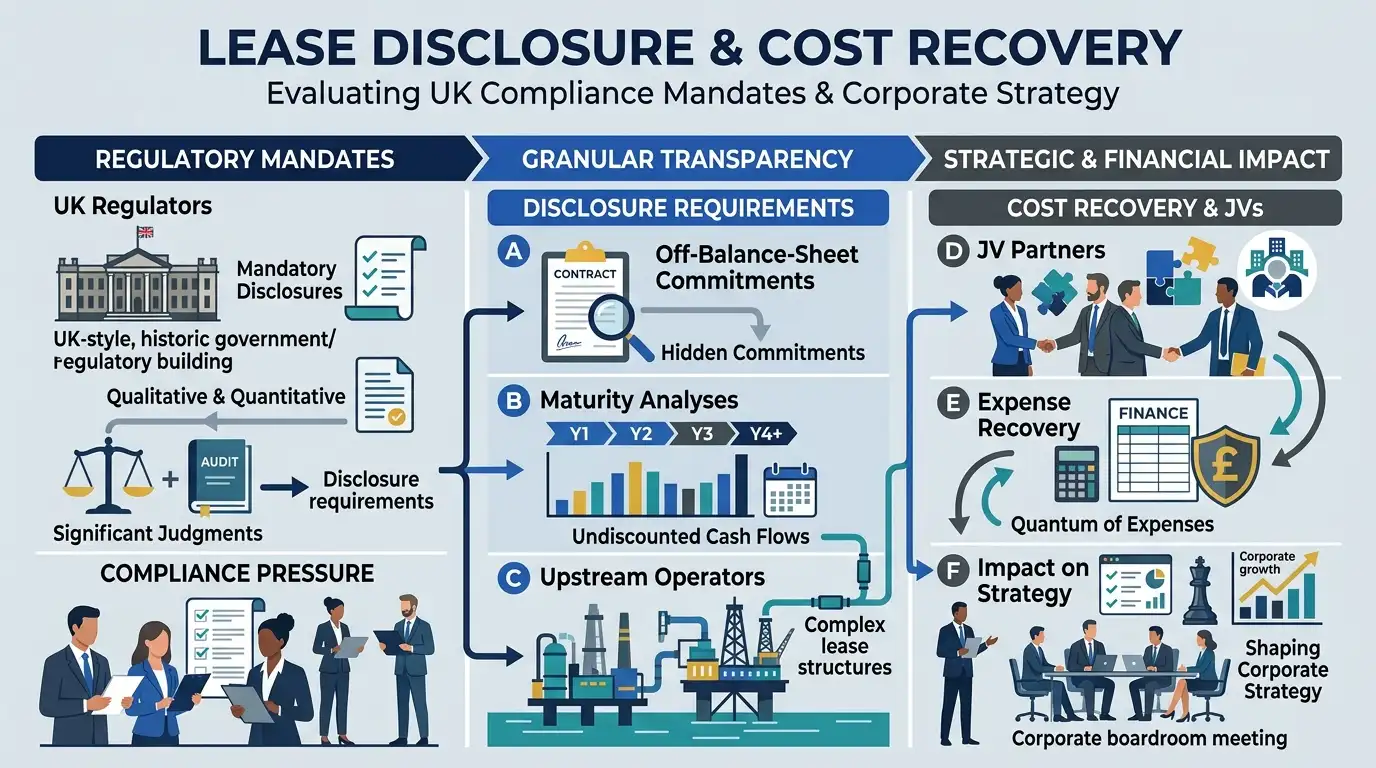
For organizations managing dozens of joint ventures, compiling this data requires automated enterprise resource planning systems and rigorous internal controls. Discrepancies between reported lease liabilities and joint account cost recovery schedules expose companies to audit findings and partner friction. When non-operating partners audit the operator's books, any failure in substantiating lease cost allocations leads to cash withholding and protracted legal disputes.
To eliminate these operational risks, enterprises operationalise specialized learning roadmaps through IFRS 16 Lease Charging and Modifications Training for Oil and Gas Joint Venture Professionals to ensure complete alignment between technical accounting rules, field data collection, and partner billing practices.
Frequently Asked Questions
How does IFRS impact financial reporting for upstream oil and gas companies?
IFRS compliance significantly reshapes upstream financial reporting by standardising how exploration, evaluation, and production assets are recognized, capitalised, and depreciated. Through programs like Oil and Gas Petroleum IFRS & Financial Reporting at the Institute For Oil & Gas Training, finance teams learn to accurately account for complex joint venture billing, decommissioning provisions, and production-sharing contracts. This standardisation ensures transparent balance sheets that meet strict international regulatory requirements and satisfy external auditor scrutiny.
What are the main challenges in accounting for joint venture lease modifications under IFRS 16?
Joint venture lease modifications create financial reporting friction because changing concession boundaries, extending drilling rights, or altering lease terms forces immediate remeasurement of right-of-use assets and lease liabilities. Upstream operators must coordinate complex data flows between field operations and central accounting to recalculate discount rates accurately without disrupting partner billing schedules. The Oil and Gas Petroleum IFRS & Financial Reporting framework taught by the Institute For Oil & Gas Training equips corporate accountants with methodologies to handle these retroactive adjustments seamlessly.
Why is cost recovery allocation difficult to manage in multi-partner petroleum ventures?
Cost recovery allocation is notoriously complex because joint operating agreements often conflict with strict IFRS capitalisation rules regarding shared infrastructure, variable lease payments, and master service agreements. Discrepancies in how non-operating partners audit and interpret shared expenses can trigger cash-call disputes and delayed settlements across exploration blocks. Specialised petroleum accounting instruction from the Institute For Oil & Gas Training helps financial controllers establish uniform cost-recovery models that withstand rigorous joint account audits.
How do upstream producers account for variable lease payments and production-linked tariffs?
Upstream producers typically exclude variable lease payments tied to production output or commodity index milestones from initial lease liability calculations, creating timing differences between cash flows and recognized obligations. Accountants must carefully evaluate whether floating production storage contracts or rig charters contain embedded leases that require separate identification under international reporting standards. Mastering these nuances through the Oil and Gas Petroleum IFRS & Financial Reporting curriculum at the Institute For Oil & Gas Training enables finance professionals to maintain precise financial disclosures.
What are the reporting requirements for decommissioning provisions and asset retirement obligations?
Extractive entities must recognize a decommissioning provision at commencement when a legal or constructive obligation arises to dismantle assets and restore environmental sites. Estimating the present value of future site restoration costs requires complex discounted cash flow models that factor in long-term inflation and risk-adjusted discount rates specific to the energy sector. The Institute For Oil & Gas Training addresses these intricate long-term liability calculations within its comprehensive Oil and Gas Petroleum IFRS & Financial Reporting courses, ensuring compliance with IAS 37 and related standards.
Related training courses
Water Treatment Technology Training Course
- Specialisation
- Oil & Gas Water Treatment and Management
- Duration
- 5 days · 15 CPD hours
Pipeline Integrity Management (API 1160/ASME B31.8) Training Course
- Specialisation
- Oil & Gas Pipeline Integrity and Inspection
- Duration
- 5 days · 15 CPD hours
Asset Integrity Management (ISO 55000/PAS 55) Training Course
- Specialisation
- Oil & Gas Asset Integrity Management
- Duration
- 5 days · 15 CPD hours
More articles

IFRS 9 Expected Credit Loss Training for Oil and Gas Financial Professionals
Master IFRS 9 expected credit loss models for oil and gas assets. Enhance compliance and valuation accuracy. Enroll in our specialized training course today.
Read article →
Key IFRS 9 Expected Credit Loss Challenges for Oil and Gas Companies
Explore key IFRS 9 expected credit loss challenges in oil and gas, covering business model assessments, SPPI tests, and lifetime ECL measurement.
Read article →
Why Expected Credit Loss Matters for Oil and Gas Financial Instruments
Discover how expected credit loss training closes skill gaps, improves financial reporting, and ensures IFRS 9 compliance in oil and gas companies.
Read article →