
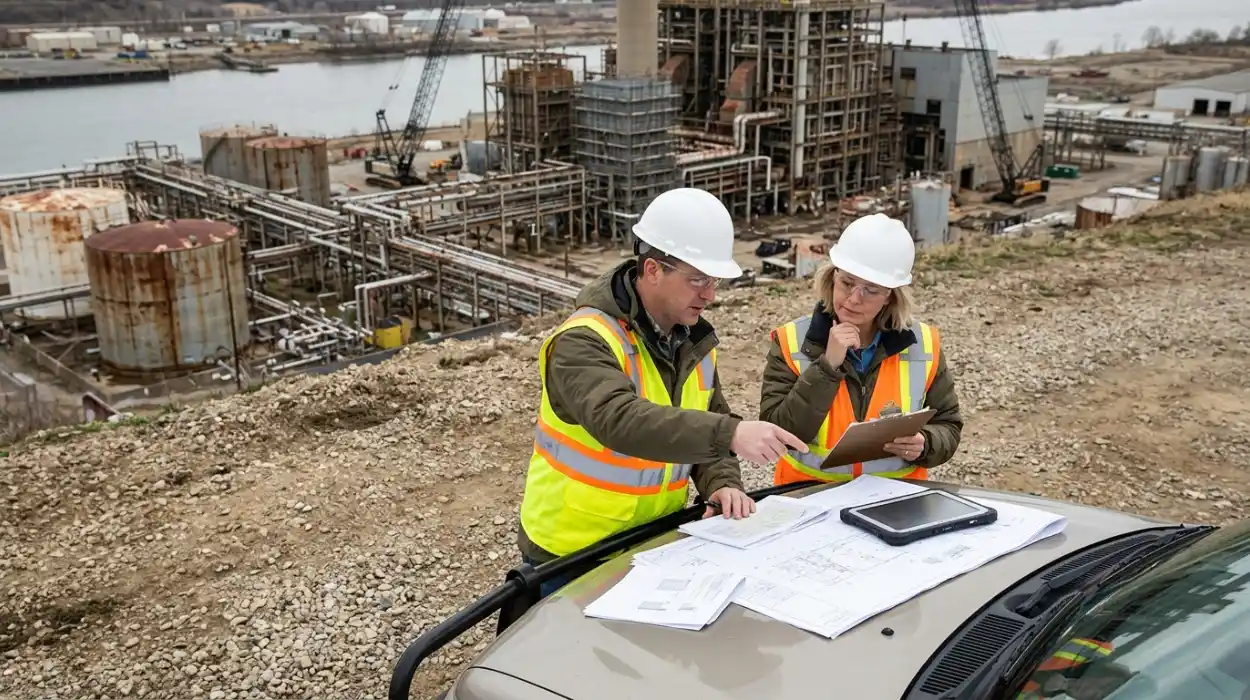
Accounting for asset retirement obligations requires financial leaders to balance stringent regulatory compliance with complex long-term valuation models. Energy sector entities face severe balance sheet volatility when estimating future liabilities for offshore rigs, pipelines, and production facilities.
Accurate provision recognition ensures financial statements reflect true long-term environmental liabilities while protecting enterprise value. Exploring Why Decommissioning Provisions Matter in the Oil and Gas Industry reveals how accounting standards directly shape corporate capital allocation strategies, operational budgeting, and risk mitigation models across global assets.
What Are the Core Valuation Challenges in Asset Retirement Obligations?
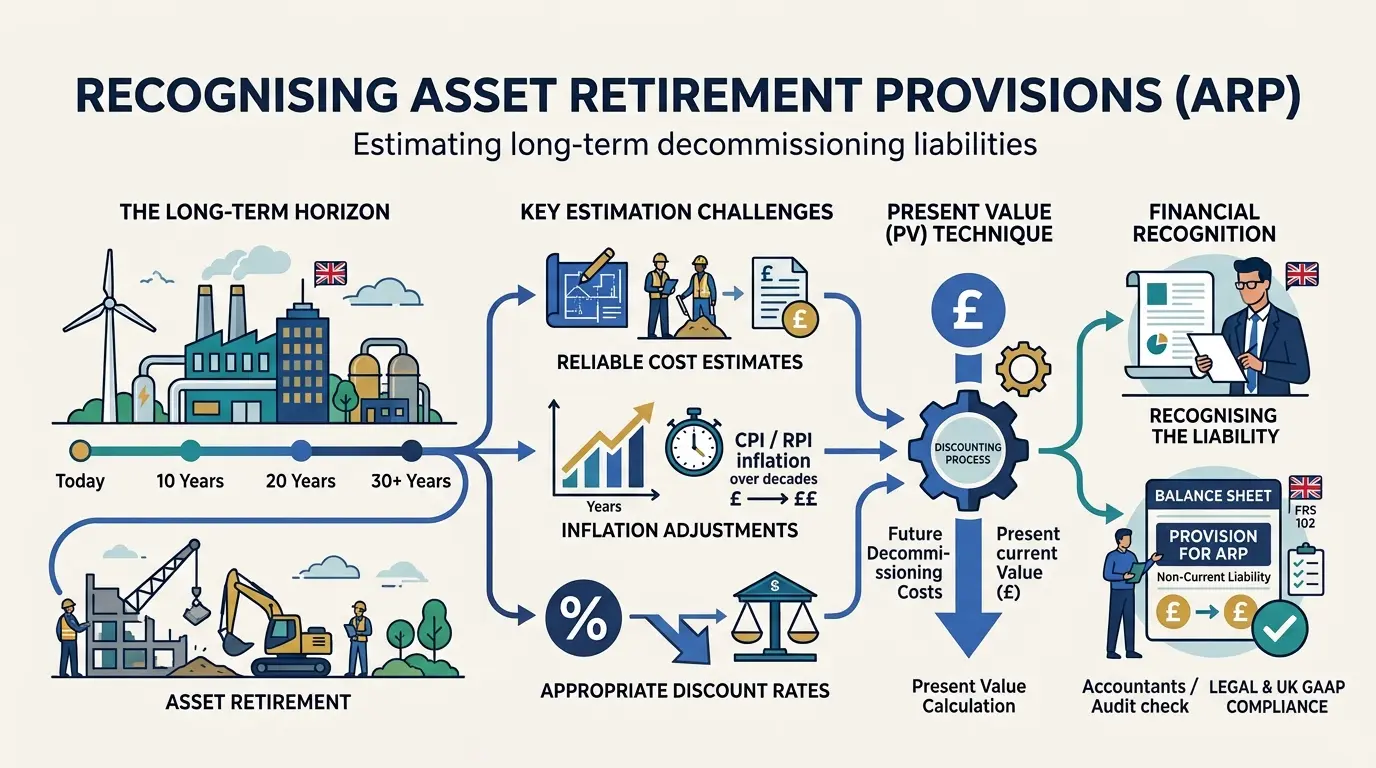
Recognising asset retirement provisions requires accurate estimation of long-term liabilities using present value techniques. Key challenges include establishing reliable cost estimates, determining appropriate discount rates, and adjusting for inflation over operational horizons spanning several decades.
Financial teams must establish whether an obligation arises from a legal requirement or a constructive obligation. A legal obligation stems from contract terms, legislation, or operational permits issued by government bodies. A constructive obligation occurs when published corporate policies or past public statements create a valid expectation that the enterprise will decommission an asset. Distinguishing between these two sources is fundamental to initial recognition under IAS 37 provisions.
Quantifying the initial abandonment cost estimate presents significant technical difficulty. Engineers and financial analysts must project expenditure scheduled decades into the future. Estimating these future cash outflows involves evaluating historical baseline data, technological advancements, site-specific environmental conditions, and anticipated regulatory updates. Miscalculating these initial costs leads to substantial balance sheet distortions.
Applying discounting and unwinding mechanics transforms future estimated cash outflows into present value figures recorded on the financial position statement. Enterprises select discount rates reflecting current market assessments of the time value of money and risks specific to the liability. As time passes, the discount unwinding process increases the carrying amount of the provision, which is recognised as a finance cost in profit or loss.
Accounting professionals frequently encounter complex questions during initial liability setup:
Scope Determination: Identifying whether site restoration obligations arise at asset inception or progressively through ongoing operations.
Inflation Assumptions: Applying realistic cost escalation assumptions that reflect specialised oilfield service price indices rather than general CPI rates.
Discount Rate Selection: Selecting appropriate risk-free interest rates adjusted for liability-specific risks without double-counting cash flow uncertainty.
Establishing continuous professional development for accounting teams mitigates recognition errors. Enrolling technical staff in specialized Decommissioning and Asset Retirement Obligation Provision Recognition Training for Oil and Gas Professionals ensures financial controllers master complex present value calculations and regulatory disclosure frameworks.
How Do Changes in Estimates Impact Financial Statements Under IFRIC 1?
Changes in estimated decommissioning liabilities alter the carrying amount of related assets or profit and loss figures based on the cost model or revaluation model applied under IFRIC 1 changes in existing provisions.
Changes in cash flow timings, cost adjustments, or discount rate fluctuations require immediate reassessment of the recorded liability. International Financial Reporting Interpretations Committee guidance dictates how entities adjust balance sheet figures without creating artificial income statement volatility.
Under the standard cost model, adjustments to the liability increase or decrease the carrying amount of the related decommissioning asset. An increase in liability adds directly to asset book value, increasing future depreciation expense. Conversely, a reduction in liability reduces asset book value down to zero, with any excess credited immediately to the income statement.
When assets are accounted for using the revaluation model, changes in estimated liabilities alter the revaluation surplus or deficit recorded in equity. Financial professionals must track these shifts carefully to maintain accurate deferred tax calculations and ensure clear reporting to financial stakeholders and auditors.
Organizations seeking to upgrade technical competencies across finance and operations teams utilize structured external training solutions. Undertaking the comprehensive Decommissioning & Asset Retirement Obligations: Provision Recognition Training Course equips technical accounting managers, financial directors, and compliance officers with practical techniques for managing complex financial adjustments.
The operational and accounting treatment differs significantly across asset life stages:
Life Cycle Phase | Accounting Requirement | Primary Financial Impact | Risk Exposure |
Initial Installation | Capitalise baseline provision into asset cost | Establishes original decommissioning asset and liability | Underestimating initial baseline scope |
Operational Phase | Unwind discount rate annually and adjust for inflation | Recipient of annual finance cost in profit or loss statement | Inaccurate cost escalation assumptions |
Re-estimation Event | Apply IFRIC 1 changes in existing provisions | Adjusts asset value or revaluation reserve in equity | Discount rate volatility affecting net assets |
Final Cessation | Settle actual restoration obligations cash outflows | Removes liability; records gain or loss on settlement | Unexpected cost overruns during execution |
Which Framework Best Evaluates Provision Recognition Methods?
Selecting an effective provision evaluation approach requires comparing internal accounting models against specialized corporate training, cross-functional auditing, and consultant-led valuation frameworks.
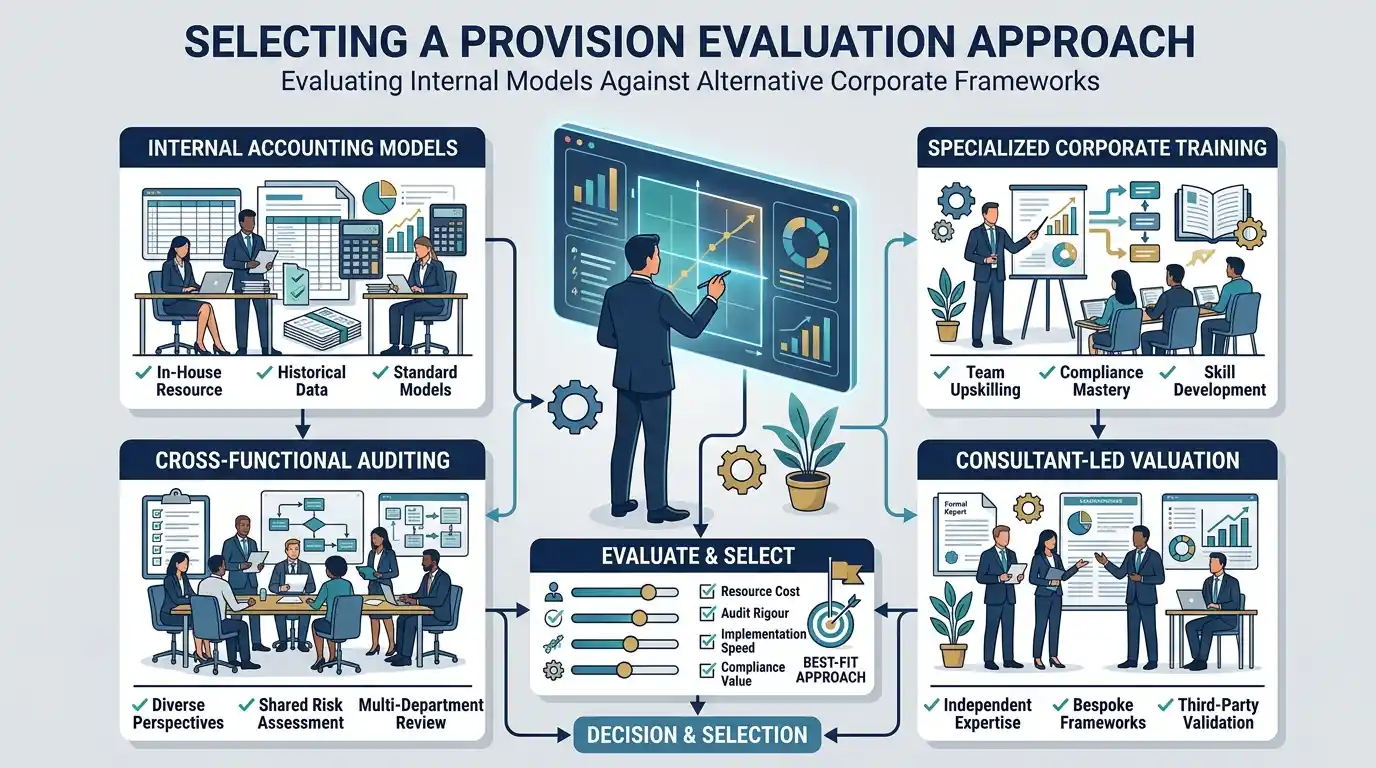
Corporate leadership must decide how to build and maintain technical competency for asset retirement accounting. The table below outlines four practical approaches organizations deploy to master asset retirement obligation recognition:
Strategic Approach | Core Methodology | Operational Impact | Decision Fit |
In-House Standard Operating Procedures | Internal finance teams build manual spreadsheets using past operational data | Low initial cost; relies on legacy technical knowledge | Best for stable, mature onshore assets with minimal regulatory changes |
Third-Party Technical Audits | External accounting firms evaluate and recalculate liability figures annually | High accuracy assurance; expensive recurring annual expenditure | Best for large-scale listed entities facing strict regulatory compliance |
Specialised Corporate Capability Building | Structured external training programs for internal finance and engineering teams | High internal retention; cross-functional alignment between operations and accounting | Best for expanding energy companies seeking scalable internal expertise |
Ad-Hoc External Advisory | Contracting specialized consultants during major decommissioning events | Solves immediate technical gap; zero long-term skill retention | Best for small operators executing isolated asset divestments |
Building internal capability through targeted corporate programs offers the strongest long-term return on investment. Financial managers who understand both technical engineering reports and international reporting standards reduce balance sheet risk while optimizing capital reserves.
Organization-wide adoption of practical accounting frameworks follows four distinct phases:
Gap Identification: HR and finance leaders audit internal capabilities against updated international reporting standards.
Framework Alignment: Finance teams align accounting policies with engineering cost models and risk frameworks.
Skill Acquisition: Key personnel complete structured professional development programs focused on liability recognition.
Implementation and Governance: Teams apply updated measurement models, run sensitivity analysis, and establish clear audit trails.
Enterprise finance teams that standardize their recognition processes minimize audit adjustments, improve analyst forecasting accuracy, and ensure complete regulatory compliance across all operating jurisdictions.
Frequently Asked Questions
What is covered in the Oil and Gas Petroleum IFRS & Financial Reporting training?
The Oil and Gas Petroleum IFRS & Financial Reporting course provided by the Institute For Oil & Gas Training covers key standards including IFRS 6, IAS 37, and IAS 36. Participants learn practical accounting treatments for exploration and evaluation costs, asset retirement obligations, impairment testing, and joint venture financial reporting. The curriculum focuses on aligning technical accounting practices with international compliance frameworks across upstream and midstream operations.
Why is specialized IFRS training necessary for oil and gas financial management?
Petroleum accounting involves unique financial complexities such as volatile commodity prices, high capital expenditure, prolonged exploration timelines, and complex decommissioning liabilities. Generic accounting frameworks fail to address sector-specific requirements like reserve estimation disclosures and production sharing contract reporting. The Institute For Oil & Gas Training delivers targeted instruction on Oil and Gas Petroleum IFRS & Financial Reporting to ensure compliance, reduce audit risks, and accurately reflect asset valuations on corporate balance sheets.
Who should attend the Oil and Gas Petroleum IFRS & Financial Reporting course?
This program is designed for finance directors, corporate controllers, technical accountants, internal auditors, and financial analysts operating within the energy sector. It is equally valuable for HR learning managers seeking to upskill finance departments handling complex joint-venture accounting or joint operating agreements. Attendees gain practical tools to interpret technical IFRS requirements and convert financial data into strategic executive reporting.
How does IFRS 6 impact financial reporting in upstream petroleum operations?
IFRS 6 governs the accounting treatment of exploration and evaluation assets, allowing entities to develop specific accounting policies for capitalising or expensing geological and geophysical costs. The standard requires continuous assessment for asset impairment whenever technical or commercial viability cannot be demonstrated. Through the Oil and Gas Petroleum IFRS & Financial Reporting program at the Institute For Oil & Gas Training, finance professionals learn to establish compliant accounting policies while maintaining clear audit trails.
How does this course address decommissioning and asset retirement obligations under IAS 37?
The course provides practical guidance on calculating, discounting, and recognising long-term environmental liabilities and field restoration obligations under IAS 37 and IFRIC 1. Finance teams learn how changes in discount rates, cost inflation, and liability estimates impact both asset carrying values and profit-and-loss statements. The Institute For Oil & Gas Training equips participants with practical financial modeling techniques to manage balance sheet adjustments accurately throughout the asset life cycle.
Related training courses
Produced Water Management Training Course
- Specialisation
- Oil & Gas Water Treatment and Management
- Duration
- 5 days · 15 CPD hours
Root Cause Analysis (RCA) Training Course
- Specialisation
- Oil & Gas Reliability and Maintenance Management
- Duration
- 5 days · 15 CPD hours
Corrosion Management Systems (CMS) Training Course
- Specialisation
- Oil & Gas Corrosion Management and Control
- Duration
- 5 days · 15 CPD hours
More articles

Decommissioning and Asset Retirement Obligation Security Arrangements Training for Oil and Gas Professionals
Master ARO security, letters of credit, trust funds, and liability transfer. Enroll in the Institute For Oil & Gas Training professional course.
Read article →
Key Challenges in Managing Security Arrangements for Oil and Gas Decommissioning Obligations
Examine key challenges in managing security arrangements for oil and gas decommissioning obligations and evaluate strategic solutions.
Read article →
Why Security Arrangements Matter for Oil and Gas Decommissioning Obligations
Learn how security arrangements for oil and gas decommissioning obligations protect organizations, mitigate liabilities, and optimize working capital.
Read article →