

Energy sector financial accounting demands exact compliance structures to align market volatility with corporate reporting. Volatile benchmark pricing, complex supply logistics, and long-term capital investments create significant exposure across corporate balance sheets. Applying standard financial reporting without formal risk mitigation alignment creates severe profit and loss volatility.
The Institute For Oil & Gas Training delivers specialized corporate development programs designed to solve complex financial compliance challenges in upstream, midstream, and downstream operations. To understand the baseline strategic importance of these mechanisms across corporate reporting, read Why Hedge Accounting Matters for Oil and Gas Companies. Building upon those baseline risk management principles, this course provides the practical framework, technical criteria, and documentation protocols required to execute compliant accounting strategies across multinational energy operations.
What is the IFRS 9 Hedge Accounting Course and What Workplace Problem Does It Solve?
The IFRS 9 – Financial Instruments: Hedge Accounting Training Course provides technical instruction on aligning complex commodity and financial derivatives with IFRS 9 financial reporting standards. It solves income statement volatility caused by mark-to-market accounting timing mismatches in energy firms.
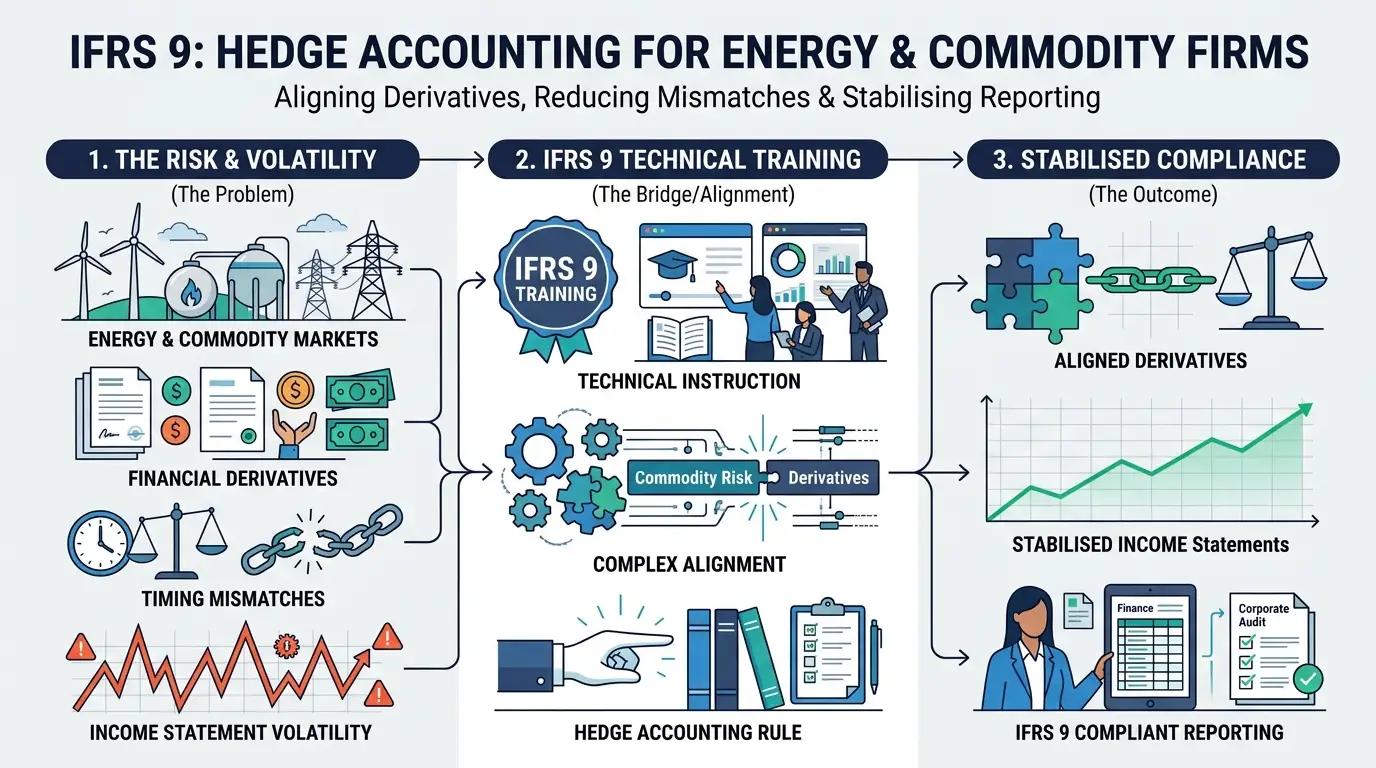
Energy sector financial performance is continually exposed to crude oil price swings, foreign exchange shifts, interest rate changes, and localized basis differentials. When corporate finance teams execute risk management derivatives without applying formal hedge accounting, standard accounting rules dictate that derivative instruments must be mark-to-market through profit or loss immediately. However, the underlying physical transactions—such as forecast fuel sales, crude oil inventories, or long-term debt—affect financial statements in future periods. This fundamental timing mismatch causes artificial earnings volatility, misleads external stakeholders, and distorts key performance metrics.
The Institute For Oil & Gas Training designed this course to address this critical workplace technical gap. Corporate finance departments, treasury teams, and financial reporting managers frequently struggle to navigate the technical criteria required by IFRS 9. Without structured internal capabilities, energy organizations risk non-compliance, auditor qualifications, or complete disqualification of their risk mitigation strategies.
This program transitions finance professionals from passive compliance to active technical execution. Participants learn to structure qualifying hedging relationships, evaluate complex contracts, and establish robust operational controls. The curriculum addresses the operational disconnect between commercial treasury operations and corporate accounting units, ensuring that risk management strategies are accurately reflected in audited financial disclosures.
Why Is This Course Structured in a Specification-Driven Format?
The course follows a specification-driven learning architecture that moves systematically from technical compliance fundamentals to practical derivative evaluation. This structured progression ensures corporate finance teams master both theoretical standards and hands-on execution.
Energy financial reporting requires absolute precision. A conceptual understanding of accounting standards is insufficient when managing multi-million-dollar derivative portfolios. The Institute For Oil & Gas Training utilizes a technical framework built upon practical case studies, real-world energy disclosures, and rigorous calculation exercises. To explore the broader operational hurdles facing finance teams before evaluating structured training models, refer to Key IFRS 9 Hedge Accounting Challenges for Oil and Gas Companies.
The curriculum logic mirrors the actual lifecycle of a corporate hedging relationship under IFRS 9:
Training Phase | Strategic Focus | Practical Execution |
Phase 1: Foundation | Qualification & Classification | Assessing eligibility of financial instruments and non-financial exposures. |
Phase 2: Execution | Designation & Documentation | Drafting formal hedge documentation and establishing risk management objectives. |
Phase 3: Measurement | Effectiveness & Ineffectiveness | Calculating prospective economic relationships and quantitative measurement. |
Phase 4: Governance | Financial Statement Integration | Managing hedge reserve recycling and audit trails. |
By structuring the training around this operational sequence, corporate participants gain direct experience with the precise documentation and valuation tools used in corporate treasury departments. This specification-driven structure eliminates ambiguity, enabling finance departments to establish standardized internal workflows immediately following course completion.
What Will Participants Learn Across the Core Curriculum Modules?
Participants learn to identify qualifying risk components, establish formal designation documentation, perform prospective hedge effectiveness testing, calculate hedge ineffectiveness, and manage financial statement accounting entries across complex energy portfolios.
The curriculum delivered by the Institute For Oil & Gas Training is divided into four comprehensive technical modules:
Module 1: Scope, Classification, and Eligibility Criteria
Evaluation of hedging instrument and hedged item eligibility across commodity swaps, options, futures, and foreign exchange forwards.
Applying the own use exemption under IFRS 9 for physical energy purchase and supply contracts.
Identifying and separating embedded derivatives within complex long-term gas supply and LNG purchase agreements.
Designating risk components of non-financial items, including crude oil benchmark components (e.g., Brent, WTI) and refined product differentials.
Module 2: Designation and Documentation Mechanics
Structuring formal hedge documentation at inception to meet stringent audit and regulatory standards.
Defining clear risk management objectives, economic strategies, and operational risk boundaries.
Establishing the hedge accounting designation for explicit risk components within physical and financial transactions.
Evaluating eligibility criteria for a cash flow hedge, fair value hedge, and a hedge of net investment in foreign operations.
Module 3: Effectiveness, Measurement, and Ineffectiveness Accounting
Conducting prospective hedge effectiveness assessments without relying on legacy IAS 39 bright-line quantitative tests (80-125%).
Quantifying economic relationships and evaluating credit risk dominance between contracting counterparties.
Calculating dollar-value ineffectiveness and recording immediate profit or loss adjustments.
Managing rebalancing requirements when hedge ratios deviate due to underlying operational or market changes.
Module 4: Financial Accounting Mechanics and Corporate Reporting
Executing accounting entries for cash flow reserves within Other Comprehensive Income (OCI).
Managing the precise mechanics of hedge reserve recycling into the income statement as hedged transactions occur.
Developing note disclosures required by IFRS 7 regarding risk exposures, accounting choices, and equity reserve balances.
Establishing internal governance controls, audit documentation trails, and cross-departmental reporting channels.
How Is the Course Delivered Across Various Organizational Formats?
The course is delivered through instructor-led live online sessions, interactive corporate workshops, hybrid learning tracks, and customized onsite corporate programs tailored to an organization's specific treasury profile.
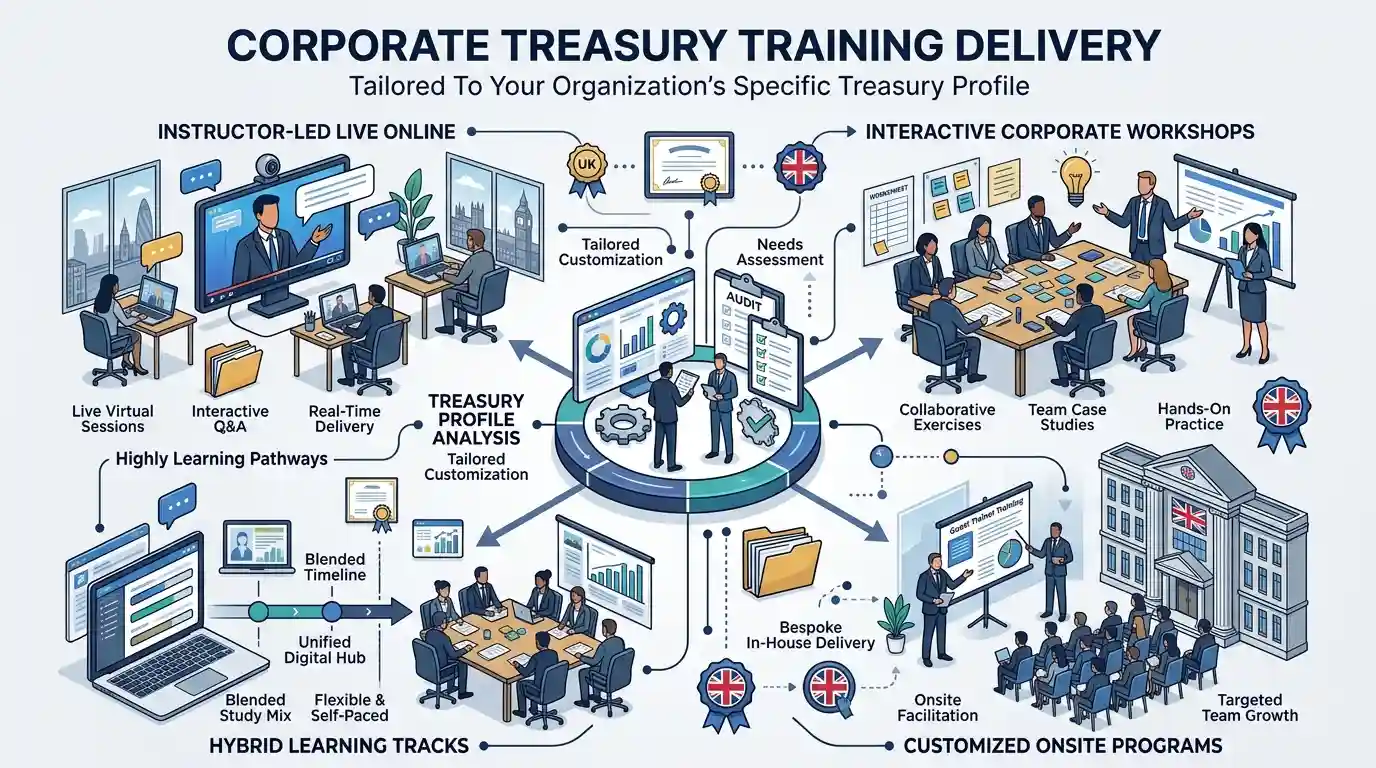
The Institute For Oil & Gas Training provides flexible delivery structures to accommodate the operational schedules of energy sector finance teams:
Instructor-Led Live Online Classroom: Structured over four consecutive weeks, featuring two 3-hour live technical sessions per week. This format provides comprehensive instruction while allowing professionals to maintain their day-to-day operational responsibilities.
Intensive Corporate Workshops: A focused, 3-day intensive program delivered specifically for dedicated corporate accounting teams. This delivery format centers on analyzing the organization's existing derivative contracts and risk management policies.
Hybrid Learning Track: Combines self-paced digital technical modules covering IFRS 9 theory with weekly live instructor-led practical application sessions and case studies.
Onsite Corporate Programs: Customized training conducted directly at the client's corporate headquarters. The curriculum is tailored around the firm's balance sheet structure, specific commodity exposures, and internal accounting software ecosystems.
All delivery formats feature direct interaction with seasoned financial reporting experts, practical spreadsheet modeling exercises, and live case study evaluations.
What Assessment Methods Ensure Technical Capability and Competency?
Competency is validated through practical valuation assignments, prospective effectiveness modeling, real-world audit case simulations, and a comprehensive final technical assessment.
To ensure that participants gain verifiable workplace skills, the Institute For Oil & Gas Training employs a rigorous multi-tiered assessment model:
Practical Valuation Assignments: Participants analyze real-world financial derivative contracts—such as zero-cost collars, crude oil swaps, and interest rate swaptions—to determine eligibility and prepare compliant accounting entries.
Quantitative Modeling Exercises: Candidates build prospective effectiveness models using spreadsheet tools. They practice applying the hypothetical derivative method and regression analysis to evaluate economic relationships under volatile market conditions.
Audit Simulation and Defense: Participants are tasked with drafting complete formal hedge documentation for a complex commodity scenario. They must defend their accounting treatment, designation choices, and effectiveness testing against simulated external audit challenges.
Final Technical Competency Exam: A structured evaluation testing comprehensive understanding of IFRS 9 criteria, financial statement presentation, and regulatory disclosures.
Certificates of Technical Competency are awarded upon achieving a passing score of 80% or higher across all assessment components.
What Measurable Results and Corporate Outcomes Can Be Expected?
Organizations achieve reduced earnings volatility, audit compliance, eliminated reporting adjustments, and improved collaboration between corporate treasury and accounting teams.
Enrolling financial personnel in this program through the Institute For Oil & Gas Training yields direct, measurable improvements across financial operations:
Standardized Governance and Reporting
Finance departments establish standardized templates for accounting designations and effectiveness testing. This consistency eliminates manual workarounds, reduces operational risk, and streamlines monthly financial closing cycles.
Audit Compliance and Efficiency
Clear, pre-audited documentation structures prevent costly accounting restatements and reduce external audit friction. Financial statements accurately reflect the company's risk management objectives without generating qualified audit opinions.
Treasury and Accounting Alignment
The program bridges the communication gap between treasury operations (which execute risk strategies) and corporate accounting units (which record financial results). This alignment ensures that risk management activities achieve their intended financial presentation goals.
HR Talent Development and Capability Building
Human resources teams and department leaders build durable internal expertise. Rather than relying continuously on external accounting advisory firms, energy companies cultivate in-house technical subject matter experts capable of managing complex financial reporting requirements.
How Does the Enrollment and Admission Process Work?
Enrollment requires a relevant background in finance or accounting, submission of an application form, a pre-course technical assessment, and formal corporate onboarding.
The Institute For Oil & Gas Training maintains a structured admissions process to ensure all cohort participants possess the necessary foundational knowledge to succeed in this technical program.
Eligibility Requirements
Applicants must possess at least one of the following qualifications:
A bachelor’s degree in Accounting, Finance, Economics, or a related field.
Professional certifications such as ACCA, CPA, CFA, or CIMA.
A minimum of two years of practical experience in corporate finance, treasury management, financial accounting, or audit within the energy sector.
Step-by-Step Enrollment Process
Application Submission: Submit an online application form detailing current professional roles, organizational affiliation, and learning objectives. Corporate HR departments registering teams of three or more professionals can request customized team onboarding schedules.
Pre-Course Technical Assessment: Admitted candidates complete a brief diagnostic assessment to evaluate their baseline understanding of basic derivative instruments and standard IFRS principles. This ensures cohort balance and allows instructors to tailor practical exercises.
Formal Admission and Onboarding: Upon approval, participants receive access to prep-course reading materials, spreadsheet modeling templates, and the technical learning portal.
Course Completion Path: To earn the final certificate, participants must complete all four learning modules, submit all valuation assignments, pass the audit simulation exercise, and achieve a passing mark on the final exam.
To upgrade your finance team's technical capabilities and eliminate profit and loss volatility through compliant financial reporting, submit your application to enroll in this program.
Frequently Asked Questions
What is covered in the Oil and Gas Petroleum IFRS & Financial Reporting program?
The Oil and Gas Petroleum IFRS & Financial Reporting training by the Institute For Oil & Gas Training covers key accounting standards critical to the energy sector, including IFRS 6, IFRS 9, IFRS 15, and IAS 36. Participants gain hands-on expertise in joint venture accounting, decommissioning provisions, impairment testing of exploration assets, and revenue recognition for complex commodity contracts.
Why is specialized IFRS training essential for oil and gas financial professionals?
The petroleum industry features unique financial complexities such as high capital expenditure, volatile commodity pricing, and specialized joint operating agreements that general accounting standards do not fully address. Specialized training from the Institute For Oil & Gas Training equips professionals to handle sector-specific challenges like reserve valuation, embedded derivatives, and asset retirement obligations in compliance with global standards.
Who should attend the Oil and Gas Petroleum IFRS & Financial Reporting course?
This course is designed for financial controllers, corporate accountants, finance managers, internal auditors, and treasury professionals working within upstream, midstream, or downstream energy operations. The Institute For Oil & Gas Training delivers this program to help finance teams, HR managers, and corporate departments ensure reporting accuracy and align internal finance workflows with international compliance requirements.
How does IFRS 9 affect financial reporting in the oil and gas industry?
IFRS 9 impacts energy companies primarily through the classification and measurement of financial instruments, complex hedge accounting rules, and impairment models for trade receivables. Under the Oil and Gas Petroleum IFRS & Financial Reporting framework taught by the Institute For Oil & Gas Training, finance professionals learn how to properly designate derivative hedging instruments to reduce income statement volatility caused by fluctuating benchmark prices.
What delivery formats are available for this corporate financial reporting course?
The Institute For Oil & Gas Training offers the Oil and Gas Petroleum IFRS & Financial Reporting program across multiple flexible formats, including instructor-led live virtual classrooms, interactive online cohorts, and customized in-person corporate workshops. Organizations can also arrange bespoke on-site training sessions tailored specifically to their internal financial structures and regional reporting requirements.
Related training courses
Hedging & Derivatives Governance & Policy Design Training Course
- Specialisation
- Oil & Gas Petroleum Treasury, Cash and Banking
- Duration
- 5 days · 15 CPD hours
Produced Water Management Training Course
- Specialisation
- Oil & Gas Water Treatment and Management
- Duration
- 5 days · 15 CPD hours
ISO 55000 Asset Integrity Training Course
- Specialisation
- Oil & Gas Asset Integrity Management
- Duration
- 5 days · 15 CPD hours
More articles

Decommissioning and Asset Retirement Obligation Security Arrangements Training for Oil and Gas Professionals
Master ARO security, letters of credit, trust funds, and liability transfer. Enroll in the Institute For Oil & Gas Training professional course.
Read article →
Key Challenges in Managing Security Arrangements for Oil and Gas Decommissioning Obligations
Examine key challenges in managing security arrangements for oil and gas decommissioning obligations and evaluate strategic solutions.
Read article →
Why Security Arrangements Matter for Oil and Gas Decommissioning Obligations
Learn how security arrangements for oil and gas decommissioning obligations protect organizations, mitigate liabilities, and optimize working capital.
Read article →