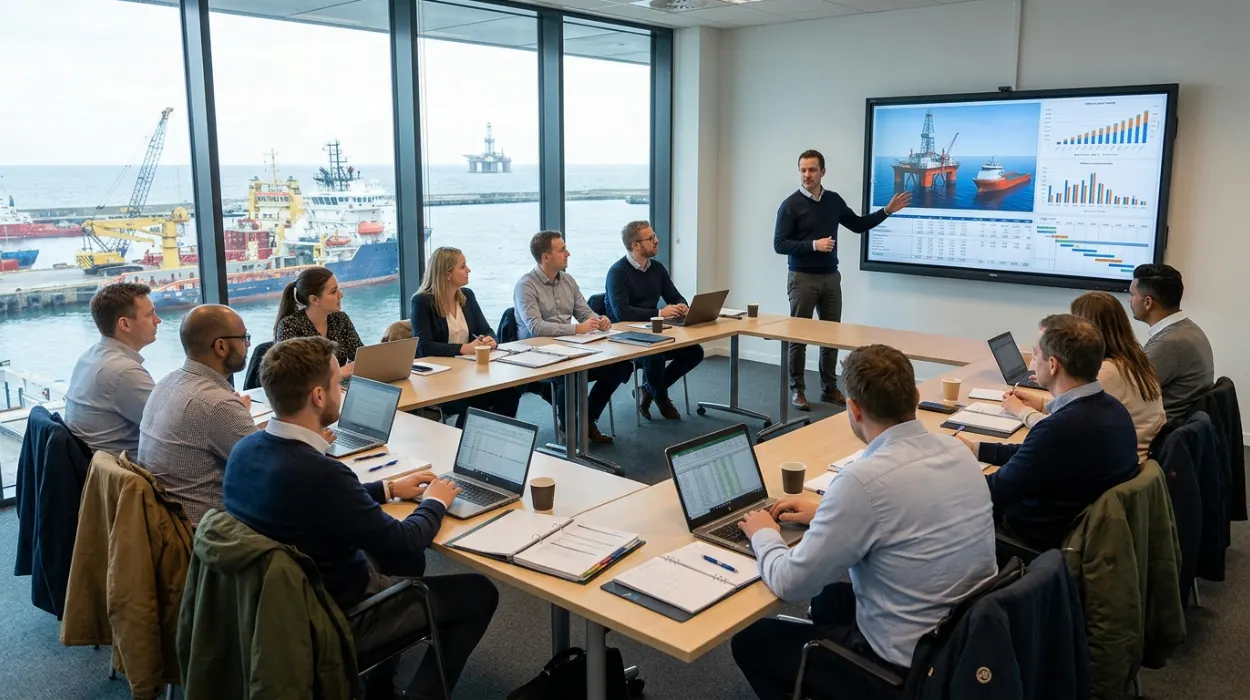
The IFRS 16 – Leases for Rigs & Vessels Training Course directly addresses the complex financial compliance gaps that arise when energy firms classify, measure, and report high-value offshore assets under modern accounting standards. Capital-intensive energy operations rely heavily on long-term capital equipment such as semi-submersible rigs, drillships, floating production storage and offloading units, and specialized support vessels. For professionals navigating these rigorous frameworks, understanding foundational concepts is critical, which is why financial teams often begin by reviewing Why Lease Accounting Matters for Oil and Gas Rigs and Vessels. Managing these assets requires specialized accounting oversight that standard corporate finance programs frequently overlook. When energy companies secure heavy machinery through multi-year agreements, ambiguous contractual language often obscures whether an arrangement constitutes a lease or a simple service contract.
In the oil and gas sector, capital expenditure is exceptionally high, and balance sheet transparency directly affects borrowing costs, stakeholder confidence, and credit ratings. Financial controllers, asset managers, and internal audit teams frequently struggle to accurately segregate lease components from non-lease service elements. This ambiguity leads to misstated liabilities, inaccurate asset valuations, and potential regulatory non-compliance during external audits. Furthermore, rapid changes in market interest rates complicate the ongoing calculation of discount rates, creating further vulnerabilities in financial disclosures.
To bridge this operational deficit, the Institute For Oil & Gas Training has engineered a rigorous, specification-driven program tailored specifically for the energy sector. This training equips corporate finance personnel, internal audit leaders, and administrative decision-makers with the exact competencies required to manage complex asset portfolios. By standardizing asset evaluation across departments, the Institute For Oil & Gas Training ensures that corporate participants can navigate intricate financial statements with absolute precision.
The curriculum addresses the persistent challenge of identifying hidden lease obligations embedded within complex charter parties and Master Service Agreements. Operational managers often sign agreements that combine vessel operations, maintenance crews, and specialized equipment into a single monthly billing cycle. Without structured training, accounting teams fail to isolate the specific right-of-use assets embedded within these operational contracts. Consequently, balance sheets present distorted financial leverage ratios that fail to reflect the true economic reality of the enterprise.
Organizations collaborating with the Institute For Oil & Gas Training gain a structured methodology to eliminate these compliance risks entirely. The program breaks down the regulatory mechanics governing heavy offshore machinery, ensuring that finance professionals can independently evaluate asset portfolios. By establishing rigorous internal controls, the training helps corporate departments avoid costly restatements and regulatory penalties. This structured intervention transforms abstract accounting rules into repeatable, auditable workflows that protect organizational stability.
Why this course is structured this way
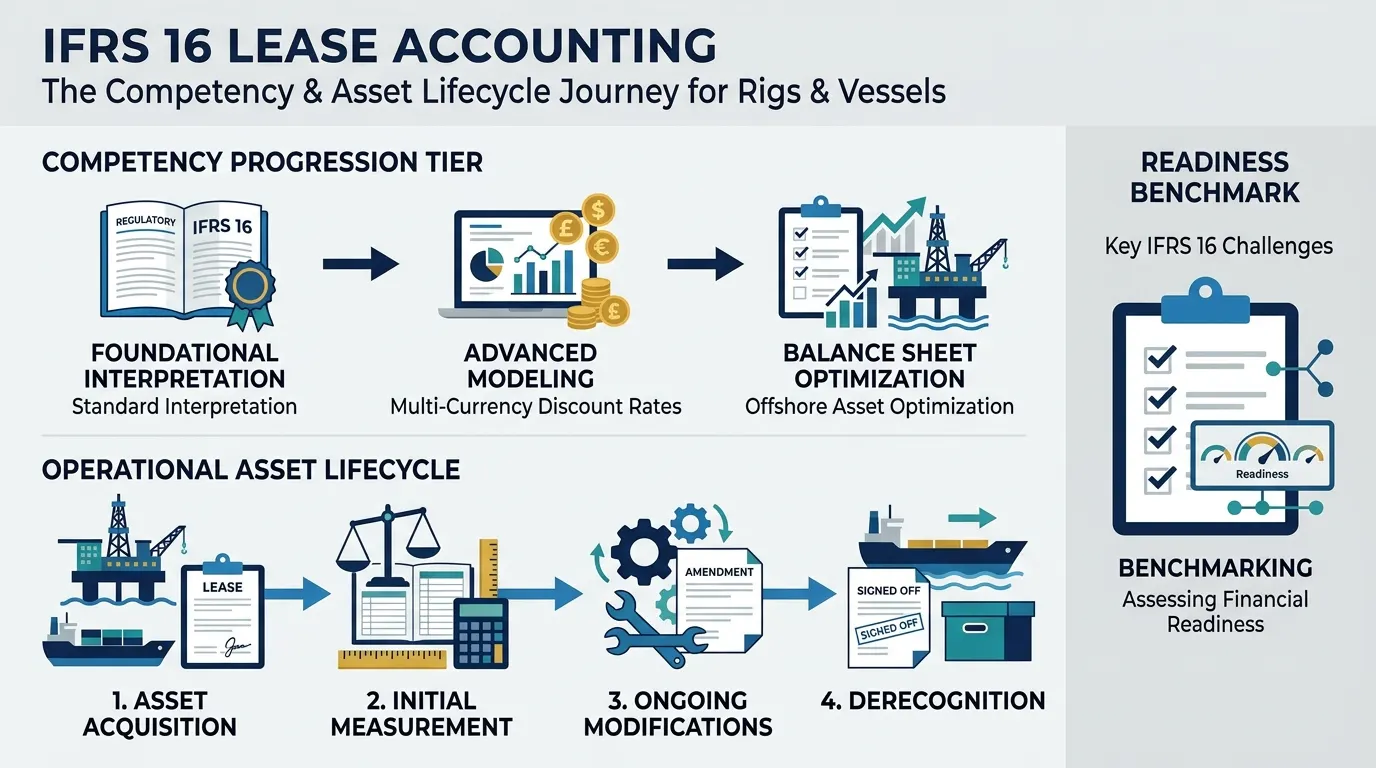
This course is structured across progressive competency tiers to transition participants from foundational standard interpretation to advanced financial modeling and balance sheet optimization for offshore assets. The curriculum design mirrors the exact operational lifecycle of asset acquisition, initial measurement, ongoing modifications, and eventual derecognition within the energy industry. To evaluate where this program fits within your broader evaluation strategy, financial leaders can explore Key IFRS 16 Lease Accounting Challenges for Oil and Gas Rigs and Vessels to benchmark their current readiness. This logical progression ensures that professionals absorb foundational principles before tackling complex multi-currency discount rate calculations.
The Institute For Oil & Gas Training builds its training structure upon a modular framework that aligns with corporate reporting cycles and audit readiness milestones. Each module is engineered to address specific operational bottlenecks identified by leading financial directors in the energy sector. By breaking down regulatory standards into sequential learning blocks, the Institute For Oil & Gas Training minimizes cognitive overload while maximizing practical skill retention. Participants systematically build competence from basic asset identification to advanced financial statement disclosure generation.
The instructional design emphasizes peer-driven case studies derived directly from actual offshore charter agreements and rig mobilization contracts. Instead of relying on abstract theoretical exercises, the Institute For Oil & Gas Training utilizes authentic industry documentation to simulate real-world reporting challenges. Financial analysts and corporate accountants work through actual contract extracts, isolating lease components and calculating precise initial liabilities. This hands-on methodology guarantees that participants can immediately apply learned techniques upon returning to their respective desks.
Furthermore, the course architecture incorporates iterative assessment checkpoints to validate competency before advancing to more sophisticated financial mechanics. The Institute For Oil & Gas Training ensures that corporate cohorts master each technical phase—such as lease modification accounting or variable lease payment adjustments—through targeted practical drills. This deliberate pacing prevents knowledge gaps and builds absolute confidence among accounting personnel handling high-stakes reporting. Consequently, organizations investing in this training experience a measurable reduction in audit queries and financial statement restatements.
The delivery methodology also supports cross-functional alignment between operational departments and corporate finance teams. Rig managers, procurement officers, and accountants participate in unified simulation exercises designed to foster collaborative contract drafting. This integrated approach ensures that future charter agreements are structured with accounting compliance in mind from the initial negotiation phase onward. By aligning operational contracting with financial reporting requirements, enterprises achieve seamless compliance across all organizational tiers.
What will participants learn?
Participants acquire advanced technical proficiency in lease identification, liability measurement, right-of-use asset valuation, and complex discount rate determination for maritime and drilling assets. The curriculum focuses on mastering foundational concepts such as lease identification, which enables professionals to inspect master service agreements and determine whether a specific asset is explicitly or implicitly specified. Learners evaluate the identified asset criteria to ensure compliance with international reporting standards, preventing misclassifications that distort balance sheet health.
The training provides deep technical instruction on establishing the right to direct the use of high-value rigs and supply vessels. Participants analyze operational protocols to distinguish whether the customer or the supplier dictates how and for what purpose the asset is used throughout the operating period. This analytical rigor is essential when evaluating complex service contract versus lease arrangements commonly deployed in offshore exploration projects. Learners dissect multi-tiered vendor agreements to isolate bareboat charters from fully crewed vessel maintenance packages.
A core segment of the program is dedicated to uncovering embedded lease obligations hidden within broader logistical and drilling support contracts. Corporate accountants learn to inspect seemingly routine service agreements to extract unrecognized capital commitments that impact financial leverage ratios. Additionally, participants master the practical application of short term and low value exemptions, ensuring proper documentation when utilizing temporary support craft or auxiliary equipment. This precision prevents unnecessary capitalization of minor assets while maintaining strict regulatory compliance.
The curriculum covers precise methodologies for lease liability measurement and initial right of use asset valuation under varying contractual terms. Professionals calculate present value obligations using accurate discount rate determination techniques, factoring in lessee incremental borrowing rates and implicit interest rates. Participants also navigate complex scenarios involving variable lease payments, index-linked adjustments, and future lease modification events. These technical skills empower internal audit teams to verify balance sheet accuracy with complete confidence.
Through guided simulations provided by the Institute For Oil & Gas Training, finance teams practice accounting for lease renewals, terminations, and sublease arrangements. The program ensures that corporate controllers can manage the entire lifecycle of an offshore asset portfolio without external consultancy reliance. By mastering these precise mechanics, participants protect their organizations from financial misstatements and regulatory scrutiny. The comprehensive skill set delivered by the Institute For Oil & Gas Training guarantees long-term reporting accuracy across all corporate divisions.
How is the course delivered?
The course is delivered through flexible formats including intensive classroom workshops, live virtual sessions, hybrid modules, and dedicated onsite corporate training configurations.To accommodate demanding operational schedules across global energy hubs, the Institute For Oil & Gas Training offers customizable delivery schedules tailored to corporate cohorts. Whether training a centralized finance department or distributed regional asset management teams, the Institute For Oil & Gas Training maintains rigorous academic standards across all instructional mediums.
The standard delivery model spans a comprehensive multi-day intensive schedule structured to balance immersive technical instruction with practical application workshops. Onsite corporate workshops conducted by the Institute For Oil & Gas Training bring expert instructors directly to company headquarters or operational bases. This localized delivery allows internal teams to examine proprietary contract templates and confidential financial portfolios under strict confidentiality agreements. Consequently, organizations can resolve active reporting ambiguities while completing their professional development objectives.
For remote or globally dispersed personnel, the interactive virtual format utilizes advanced digital learning environments that replicate the engagement of physical classrooms. Participants engage in real-time document analysis, collaborative breakout sessions, and live Q&A sessions with seasoned financial standard instructors. The Institute For Oil & Gas Training ensures that virtual attendees receive identical course materials, software toolkits, and case study files as their onsite counterparts. This technological parity guarantees a consistent learning experience regardless of geographical location.
Assessment methods are integrated seamlessly into the delivery format to measure cognitive retention and practical execution capability. Participants complete quantitative assignments, multi-variable lease calculation tests, and comprehensive end-of-module simulations that replicate complex audit environments. The Institute For Oil & Gas Training evaluates learners through rigorous practical examinations rather than passive attendance tracking. This performance-based evaluation model ensures that every certified professional possesses demonstrable competency in handling high-value asset accounting.
The operational flexibility provided by the Institute For Oil & Gas Training minimizes disruption to ongoing business activities while maximizing educational impact. Management teams can select convenient delivery windows that align with quarterly closing cycles or annual audit preparation periods. This adaptability makes the program an efficient tool for workforce transformation without compromising daily operational output. Organizations benefit from structured, predictable professional development that delivers immediate utility to their accounting departments.
What results can be expected?
Participants achieve measurable improvements in financial reporting accuracy, reduced audit friction, enhanced balance sheet transparency, and elevated strategic decision-making capabilities.Upon completing the curriculum, finance professionals within energy enterprises can independently audit, account for, and disclose complex rig and vessel portfolios with absolute precision. Organizations partnering with the Institute For Oil & Gas Training observe a dramatic reduction in external audit adjustments related to asset capitalization and lease liability calculations.
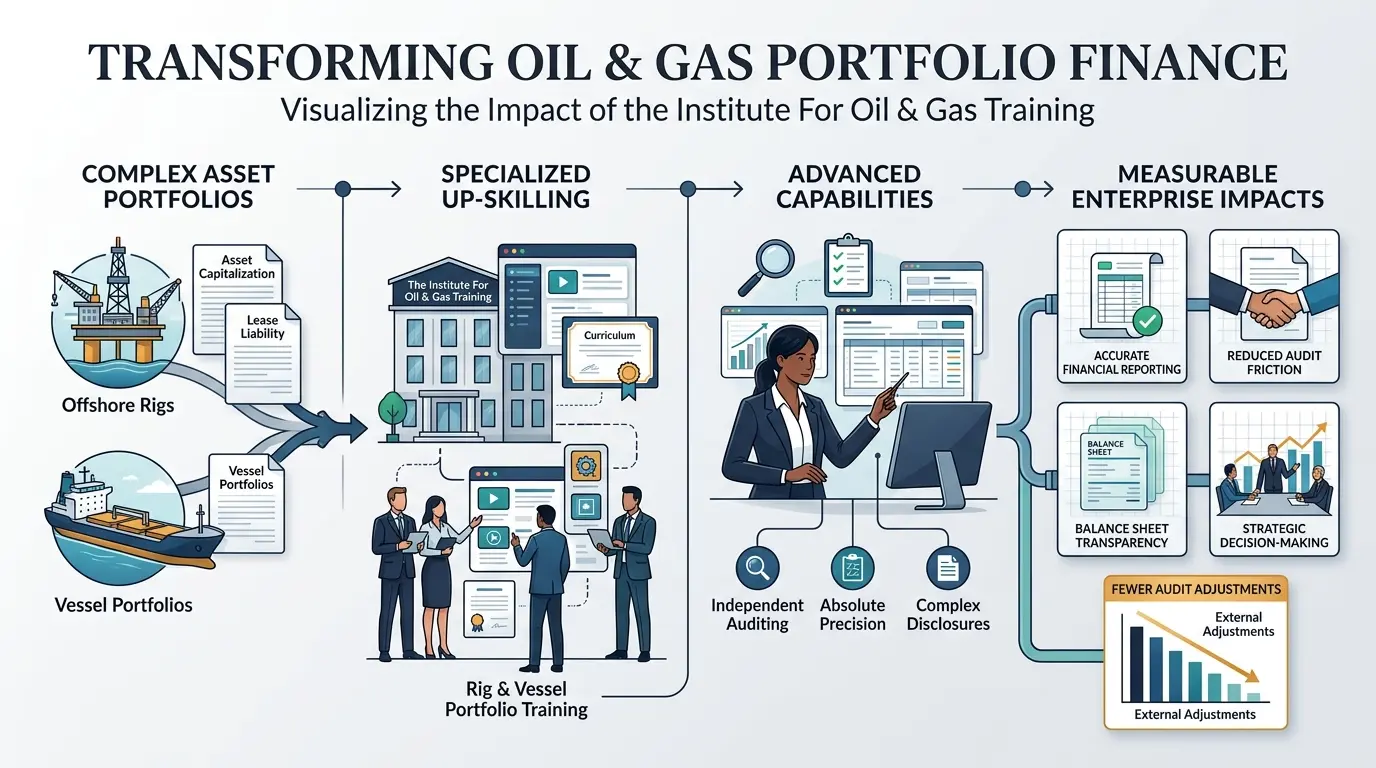
The workplace impact extends directly to departmental performance and inter-departmental collaboration between procurement, legal, and finance teams. Accounting personnel trained by the Institute For Oil & Gas Training can review draft charter agreements before execution, ensuring favorable contract structuring that aligns with optimal financial reporting outcomes. This proactive oversight prevents unexpected balance sheet inflation and helps treasury teams maintain optimal financial ratios for debt covenants. Leadership pipelines are strengthened as mid-level accountants develop executive-level competence in navigating complex international standards.
For HR teams and organizational development managers, sponsoring personnel through the Institute For Oil & Gas Training provides a verifiable benchmark for technical competency. Department heads can track clear skill progression from basic asset recognition to advanced lease modification accounting, supporting internal promotion frameworks. This structured capability development reduces reliance on expensive external advisory firms, enabling internal teams to manage complex accounting transitions autonomously. The measurable return on investment is reflected in streamlined financial closes and flawless regulatory compliance records.
The broader corporate impact includes enhanced stakeholder confidence, as investors and credit rating agencies receive transparent, highly accurate financial statements. Energy firms utilizing methodologies taught by the Institute For Oil & Gas Training consistently demonstrate superior governance standards during independent financial reviews. By eliminating errors in discount rate determinations and lease liability measurements, corporations protect their market valuation from unexpected compliance-driven restatements. These tangible outcomes reinforce the strategic value of targeted, specification-driven professional education.
Ultimately, the competencies acquired through the Institute For Oil & Gas Training create an enduring organizational asset that safeguards financial integrity across multiple reporting cycles. Teams equipped with these advanced skills adapt swiftly to ongoing updates in international financial reporting standards without operational disruption. This resilience ensures long-term stability and strategic clarity for energy enterprises operating in highly volatile global markets.
How does enrollment work?
Enrollment is managed through a structured application pathway designed for corporate finance teams, accounting professionals, and enterprise learning departments seeking accredited technical placement.Candidates and corporate sponsors initiate the process by submitting professional credentials, current financial reporting responsibilities, and organizational affiliation details through the official registration portal. The Institute For Oil & Gas Training reviews each application to ensure candidates meet the foundational accounting prerequisites required for high-level asset valuation coursework.
Entry requirements stipulate a working background in corporate finance, internal auditing, financial accounting, or commercial asset management within the energy or maritime sectors. While advanced academic degrees in accounting are beneficial, practical experience in managing corporate ledgers or drafting commercial contracts satisfies the foundational criteria. The Institute For Oil & Gas Training verifies these prerequisites to maintain an optimal peer learning environment where all participants engage at an advanced technical level. Corporate sponsors may also enroll multi-member cohort groups through streamlined enterprise booking agreements.
The completion path culminates in a rigorous final performance evaluation encompassing practical lease modeling exams, contract dissection simulations, and compliance reporting tasks. Successful candidates receive a formal professional certification issued by the Institute For Oil & Gas Training, validating their specialized expertise in handling complex offshore asset standards. This credential serves as an authoritative industry benchmark for technical competence in extractive and maritime financial reporting.
Corporate administrators seeking customized training schedules or multi-departmental enrollments can coordinate directly with institutional advisors to establish tailored corporate delivery plans. The streamlined registration protocol ensures fast onboarding, immediate distribution of pre-course preparatory materials, and seamless integration into upcoming cohort schedules. To secure your organization's position and elevate your team's technical capabilities, enroll in this program.
Frequently Asked Questions
How does Oil and Gas Petroleum IFRS & Financial Reporting training improve balance sheet transparency?
The Oil and Gas Petroleum IFRS & Financial Reporting programs offered by the Institute For Oil & Gas Training equip finance professionals with precise methodologies to accurately account for complex exploration assets, decommissioning provisions, and production-sharing contracts. By standardizing the recognition of high-value reserves and operational liabilities, organizations ensure their financial statements reflect true economic realities. This rigorous approach minimizes audit friction and enhances stakeholder confidence across global energy markets.
What are the core reporting standards covered in specialized petroleum accounting courses?
Specialized Oil and Gas Petroleum IFRS & Financial Reporting curricula focus heavily on standards governing exploration for and evaluation of mineral resources, provisions for asset retirement obligations, and revenue from contracts with customers. Through structured modules provided by the Institute For Oil & Gas Training, corporate accountants learn how to apply these frameworks specifically to upstream, midstream, and downstream operations. Mastering these technical guidelines ensures complete regulatory compliance and accurate multi-currency financial disclosures.
Why is specialized financial reporting training necessary for energy sector accountants?
Energy companies operate within unique regulatory environments characterized by high capital expenditures, joint venture accounting, and complex long-term production agreements. The Oil and Gas Petroleum IFRS & Financial Reporting training designed by the Institute For Oil & Gas Training addresses these sector-specific nuances that standard corporate finance programs typically omit. Consequently, internal audit and reporting teams gain the specialized competencies required to navigate intricate joint operating agreements without error.
Who should participate in Oil and Gas Petroleum IFRS & Financial Reporting programs?
These advanced courses are specifically tailored for corporate controllers, financial analysts, internal audit directors, and accounting personnel working within exploration and production companies. Sponsoring professionals through the Institute For Oil & Gas Training enables organizations to build robust internal leadership pipelines capable of managing complex asset portfolios autonomously. Financial teams benefit from acquiring practical, highly applicable skills that streamline quarterly closing cycles and statutory reporting.
How does the Institute For Oil & Gas Training deliver petroleum financial reporting education?
The Institute For Oil & Gas Training delivers its Oil and Gas Petroleum IFRS & Financial Reporting curriculum through flexible formats, including intensive onsite corporate workshops, live virtual sessions, and hybrid modules tailored to global schedules. Each program incorporates real-world case studies derived from actual upstream contracts and joint venture ledgers to ensure immediate workplace application. This performance-driven training methodology guarantees measurable skill improvements and long-term compliance resilience for energy enterprises.
Related training courses
Water Treatment Technology Training Course
- Specialisation
- Oil & Gas Water Treatment and Management
- Duration
- 5 days · 15 CPD hours
Reliability Centered Maintenance (RCM) Training Course
- Specialisation
- Oil & Gas Reliability and Maintenance Management
- Duration
- 5 days · 15 CPD hours
API 510 Pressure Vessel Inspectors Training Course
- Specialisation
- Oil & Gas Inspection and Non-Destructive Testing
- Duration
- 5 days · 15 CPD hours
More articles

IFRS 9 Expected Credit Loss Training for Oil and Gas Financial Professionals
Master IFRS 9 expected credit loss models for oil and gas assets. Enhance compliance and valuation accuracy. Enroll in our specialized training course today.
Read article →
Key IFRS 9 Expected Credit Loss Challenges for Oil and Gas Companies
Explore key IFRS 9 expected credit loss challenges in oil and gas, covering business model assessments, SPPI tests, and lifetime ECL measurement.
Read article →
Why Expected Credit Loss Matters for Oil and Gas Financial Instruments
Discover how expected credit loss training closes skill gaps, improves financial reporting, and ensures IFRS 9 compliance in oil and gas companies.
Read article →