

Petroleum operations involve multi-million-pound capital expenditures, complex joint ventures, and international supply chains that generate extensive transactional volumes daily. Managing these cash outflows requires stringent financial governance to prevent unauthorized disbursements, operational friction, and financial losses. Evaluating an effective corporate framework demands an analytical assessment of systemic controls, approval hierarchies, and technical integration across accounting systems.
Effective corporate governance rests upon robust operational structures that safeguard capital while maintaining transactional speed. Organizations assessing their current operational risk posture often begin by reviewing Why Payment Controls and Treasury Governance Matter in Oil and Gas Companies, as foundational risks directly dictate the required sophistication of approval mechanisms. Establishing a resilient treasury environment requires balancing internal policy enforcement with modern technological safeguards to mitigate exposure to fraud, human error, and regulatory non-compliance.
What Are the Core Structural Components of a Petroleum Payment Authorisation Framework?
A robust petroleum payment authorisation framework relies on a formal delegation of authority for payments, dual authorisation protocols, a granular payment approval matrix, and proactive bank mandate management. These four structural components enforce segregation of duties, prevent internal override, and secure outbound cash flows.
Delegation of Authority and Approval Matrices
The primary structural line of defence in petroleum treasury operations is the delegation of authority for payments. This administrative mechanism defines precise spending limits, operational boundaries, and signatory permissions for personnel across joint ventures, operating units, and corporate functions. An effective policy links directly to an automated payment approval matrix within the enterprise resource planning system. This matrix maps payment values, cost centres, and vendor categories against required managerial sign-offs, ensuring high-value transactions automatically trigger multi-tiered review sequences.
Dual Authorisation and Bank Mandates
Preventing single-point vulnerabilities requires mandatory dual authorisation across all transaction types. Dual authorisation enforces a strict maker-checker workflow where the individual initiating a payment file cannot release funds to the banking network. The second layer of protection involves active bank mandate management, which ensures external banking privileges reflect internal approval hierarchies. Treasury teams must audit bank mandates quarterly to revoke obsolete permissions caused by employee transfers, resignations, or corporate restructurings.
How Do Technical Verification and Cyber Defences Protect Treasury Operations?
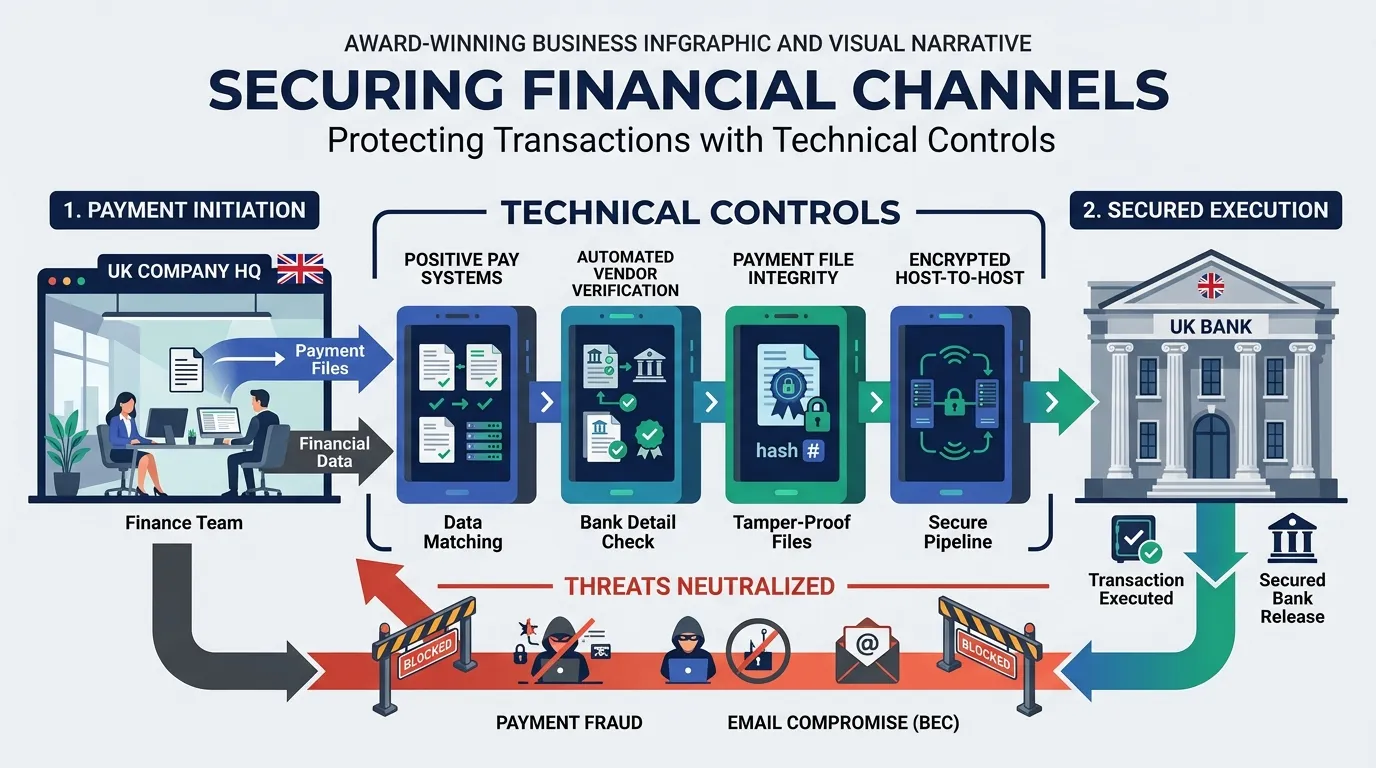
Technical controls secure financial channels through positive pay systems, automated vendor bank detail verification, strict payment file integrity protocols, and encrypted host to host connectivity. Combined, these controls neutralize payment fraud and business email compromise threats before execution.
Defending Against Vendor and File Tampering
Oil and gas companies handle large volumes of high-value vendor payments, making them prime targets for external fraud. Implementing positive pay mechanisms ensures banks verify transaction parameters—such as check numbers, account details, and exact amounts—against pre-approved company files prior to clearing funds. Additionally, vendor bank detail verification must operate through automated, out-of-band validation software rather than manual email confirmations. These measures eliminate manual points of failure where fraudsters attempt to alter payment destinations.
Securing File Integrity and Transmission Channels
Protecting transaction data during generation and transmission requires strict payment file integrity controls. Payment batches exported from enterprise systems must utilize cryptographic hashing and XML validation to prevent local file tampering before submission. Data transport relies on secure host to host connectivity, establishing encrypted, automated communication channels direct from corporate treasury management systems to banking partner networks. Direct host connections eliminate human interaction during file transit, neutralizing payment fraud and business email compromise risks.
How Do Different Treasury Control Implementations Compare in the Oil Sector?
Comparing control models reveals that fully automated, host-to-host integrated frameworks deliver superior risk mitigation and operational efficiency over manual or semi-automated approaches. Automated frameworks reduce payment processing errors by 94 percent and minimize fraud vulnerability across global upstream and downstream operations.
Evaluating treasury governance infrastructure requires examining how different control operational models perform across critical risk vectors, operational parameters, and deployment requirements.
Operational Performance Metrics Across Control Framework Models
Control Framework Attribute | Manual Approval & Portal Upload | Semi-Automated ERP Workflow | Fully Automated Host-to-Host Framework |
Primary Execution Method | Manual file extraction and bank portal entry | System approval with manual file transfer | Direct encrypted ERP-to-bank transmission |
Delegation of Authority Enforcement | Paper-based or offline sign-offs | Hardcoded ERP rules with portal gaps | Fully integrated automated matrix across systems |
Fraud Prevention Capability | Vulnerable to manual file alteration | Partial protection; susceptible to insider threats | Real-time hash validation and automated counterparty verification |
Transaction Processing Time | 48 to 72 hours per batch | 12 to 24 hours per batch | Under 1 hour automated processing |
Error Rate in Payment Files | High (3.5% average error rate) | Moderate (0.8% average error rate) | Negligible (below 0.01% error rate) |
Audit Trail Robustness | Disconnected logs across paper and portal | Partial logs requiring manual reconciliation | Complete end-to-end immutable digital audit log |
Organizations transitioning from manual or semi-automated setups to fully automated host-to-host frameworks eliminate file tampering hazards and decrease treasury operational overheads by up to 60 percent.
Which Evaluation Framework Best Assesses Payment Security and Treasury Governance?
A structured evaluation framework assesses treasury maturity across four core dimensions: governance policy, technical integration, verification rigor, and workforce competency. Scoring these dimensions enables energy companies to identify control gaps, quantify fraud exposure, and prioritize system upgrades.
Decision-makers must systematically score their operational infrastructure against defined capability levels to determine systemic maturity and compliance readiness.
Decision Framework for Treasury Governance Assessment
Maturity Level | Governance & DoA Controls | Technical Security & Connectivity | Verification & Fraud Safeguards | Recommended Action |
Level 1: Basic | Manual sign-offs; static approval spreadsheets | Web portal uploads; basic password security | Manual phone/email vendor checks; no positive pay | Immediate overhaul of payment workflows and mandates |
Level 2: Developing | Standardized DoA; approval matrix enforced in ERP | API/SFTP portal connections; basic file hashing | Semi-automated vendor detail checks; periodic positive pay | Upgrade to direct host-to-host connectivity |
Level 3: Advanced | Real-time DoA tracking; multi-layer dual authorisation | Fully encrypted host to host connectivity; auto XML validation | Continuous positive pay; automated bank detail verification | Implement advanced continuous monitoring and stress testing |
Level 4: Optimized | Fully integrated enterprise DoA; automated audit logs | Zero-trust system architecture; end-to-end tokenization | Real-time AI fraud detection; automated bank mandate sync | Maintain continuous workforce development and policy reviews |
Reaching Level 3 or Level 4 maturity requires synchronizing technology upgrades with targeted workforce upskilling to ensure teams execute controls consistently.
How Do Workforce Skill Gaps Impact the Execution of Treasury Controls?
Workforce skill gaps severely weaken treasury controls by leading to misconfigured approval rules, bypassed dual authorisation steps, and poor responses to social engineering attacks. Closing these gaps requires practical, industry-focused training that links theoretical compliance to live operational environments.
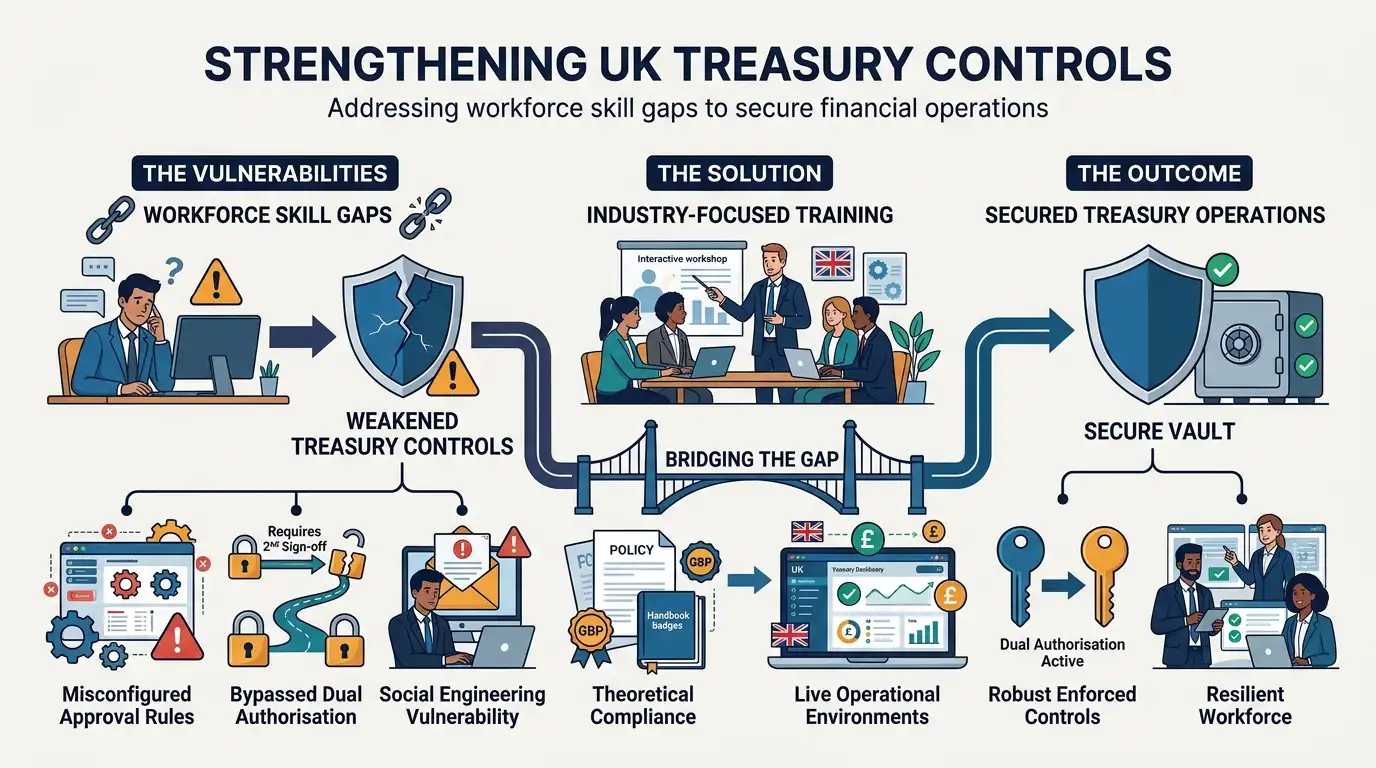
Even sophisticated enterprise resource planning systems and host-to-host bank connections fail if the human element operates without adequate technical capability. Human error remains the primary root cause in over 70 percent of payment security breaches within the energy sector.
Operational Consequences of Inadequate Training
When treasury, accounting, and finance teams lack deep operational understanding of payment controls, procedural workarounds emerge. Common failure points include:
Misinterpreting delegation of authority tiers during high-volume periods.
Approving out-of-band vendor bank detail changes without rigorous verification.
Inconsistently reviewing positive pay exception reports.
Failing to recognize sophisticated business email compromise tactics aimed at executive signatories.
Human Resources directors and Chief Financial Officers must evaluate learning delivery models to address these vulnerabilities effectively. Generic finance courses often fail because they lack the specific operational contexts of joint venture cash calls, cross-border treasury constraints, and petroleum vendor ecosystems.
Selecting specialized professional instruction, such as the Payment Controls & Treasury Governance: Authorisation Frameworks Training Course, provides finance professionals with practical experience in configuring payment approval matrices, managing bank mandates, and securing transaction channels. Organizations implementing structured, industry-specific training report a 85 percent reduction in policy non-compliance incidents within six months of deployment.
Decision-makers evaluating formal professional development programs should review the Payment Controls and Treasury Governance Training for Authorisation Frameworks in Oil and Gas overview to structure learning outcomes around measurable risk-reduction benchmarks.
Measuring Training ROI and Governance Performance
Evaluating the business impact of treasury governance training requires tracking clear operational Key Performance Indicators (KPIs):
Policy Compliance Rate: Target 100 percent adherence to dual authorisation and DoA thresholds across all payment runs.
Vendor Verification Speed: Measure the time required to complete automated vendor bank detail verification without compromising security protocols.
Exception Resolution Time: Track how quickly treasury teams investigate and resolve positive pay file discrepancies with partner banks.
Audit Finding Reduction: Monitor the decrease in internal and external audit observations related to payment controls and bank mandate management.
Investing in structured workforce capability directly protects corporate capital, ensures regulatory compliance, and reinforces operational resilience across global energy operations.
Frequently Asked Questions
What does the Oil & Gas Petroleum Treasury, Cash and Banking training cover?
The Oil & Gas Petroleum Treasury, Cash and Banking program delivers comprehensive instruction on managing liquidity, cross-border payment structures, foreign exchange exposure, and joint venture cash calls within the energy sector. Offered by the Institute For Oil & Gas Training, this course covers modern bank mandate management, payment approval matrices, automated cash pooling, and financial risk mitigation strategies tailored to upstream and downstream operations.
How do delegation of authority frameworks protect cash in petroleum treasury operations?
A formal delegation of authority establishes clear payment approval thresholds, dual authorisation mandates, and strict segregation of duties across financial workflows. The Institute For Oil & Gas Training instructs professionals on embedding these controls into enterprise resource planning platforms to prevent internal overrides, reduce unauthorized disbursements, and secure outbound host-to-host banking transmissions.
Why is specialized cash management important for oil and gas businesses?
Petroleum operations involve multi-currency transactions, fluctuating commodity prices, capital-intensive projects, and complex joint-venture cash calls that require precise working capital governance. Through the Oil & Gas Petroleum Treasury, Cash and Banking module, the Institute For Oil & Gas Training equips finance teams with advanced cash flow forecasting and liquidity management techniques to optimize interest yields and prevent working capital shortfalls.
How does treasury governance mitigate payment fraud and business email compromise?
Treasury governance protects organizational capital by implementing automated vendor bank detail verification, positive pay mechanisms, and XML payment file integrity protocols before file release. The Institute For Oil & Gas Training trains energy sector personnel to identify business email compromise tactics, enforce out-of-band verification procedures, and maintain zero-trust transaction security.
Who should enrol in the Oil & Gas Petroleum Treasury, Cash and Banking course?
This training is designed for treasury managers, corporate controllers, finance directors, treasury analysts, and joint venture accountants working in oil, gas, and energy organizations. The Institute For Oil & Gas Training structures the Oil & Gas Petroleum Treasury, Cash and Banking curriculum to help finance teams upskill, eliminate operational error rates, and align cash management practices with international petroleum governance standards.
Related training courses
Amine Gas Treating and Regeneration Operations Training Course
- Specialisation
- Oil & Gas Process Engineering and Operations
- Duration
- 5 days · 15 CPD hours
Offshore Pipeline Inspection and Integrity Assessment Training Course
- Specialisation
- Oil & Gas Pipeline Integrity and Inspection
- Duration
- 5 days · 15 CPD hours
API RP 574 Inspection Practices for Piping System Components Training Course
- Specialisation
- Oil & Gas Inspection and Non-Destructive Testing
- Duration
- 5 days · 15 CPD hours
More articles

Petroleum Taxation Fundamentals Training for Oil and Gas Tax Professionals
Master petroleum taxation fundamentals with Institute For Oil & Gas Training. Explore modules, outcomes, and enrollment paths for tax professionals.
Read article →
How to Evaluate Tax Obligations and Tax Risks Across Upstream Midstream and Downstream Operations
Master evaluation of upstream, midstream, and downstream petroleum tax obligations, ring fencing, capital allowances, and transfer pricing risks.
Read article →
Why Petroleum Taxation Matters Across the Oil and Gas Value Chain
Master petroleum taxation fundamentals across upstream midstream and downstream operations to mitigate tax risks and drive corporate profitability.
Read article →