

Petroleum joint ventures involve complex cash call mechanisms and high-value capital expenditures that demand strict financial oversight. Joint venture partners must establish robust authorisation frameworks to govern capital calls, operational disbursements, and vendor settlements across international operating environments. Failing to scrutinise these financial channels exposes operating consortiums to severe revenue leakage, regulatory non-compliance, and operational disputes between non-operating partners and the designated operator.
Effective financial governance requires a clear understanding of cash call disbursement controls, treasury policy compliance monitoring, and structural payment audit trails. Organizations must systematically evaluate how internal approval workflows handle capital calls and cash distributions to protect asset value. To understand the foundational mechanics of capital calls and partner exposure, explore Why Joint Venture Disbursement Controls Matter in the Oil and Gas Industry, which outlines the underlying risks present in unincorporated operating agreements.
What Are the Primary Disbursement Risks in Petroleum Joint Ventures?
Petroleum joint venture disbursement risks stem from unverified cash call requests, inadequate segregation of duties in payments, unaligned treasury policies, and non-sanctioned payee transfers, which lead to severe partner disputes, regulatory fines, capital misallocation, and unrecoverable capital losses.
Joint venture operating agreements grant the operator primary administrative control over bank accounts, cash calls, and vendor disbursements. This operational structure introduces systemic risks when non-operating partners lack real-time visibility into account movements. Cash call requests often precede actual operational expenditures by months, creating capital pools susceptible to misallocation or premature drawdown.
Vendor payment risks escalate when sanctions screening of payees is absent or poorly integrated into cash management systems. Joint ventures operating across international boundaries frequently execute payments to local contractors, supply chain vendors, and government bodies. Inadequate payee verification subjects the entire consortium to severe regulatory penalties under international trade sanctions and anti-bribery regulations.
Third-party risk management is further complicated by statutory fiscal obligations. Non-compliance with local tax laws, statutory withholdings, and royalty payment controls can lead to asset seizure or revoked operating licenses. Operator treasury teams that fail to execute due diligence on tax authorities risk incurring penal interest charges that non-operating partners frequently refuse to bear during joint interest audits.
Unauthorised disbursements occur when financial systems lack rigorous segregation of duties in payments. When single individuals possess the authority to initiate, approve, and execute bank transfers, financial leakage becomes inevitable. Consortiums must enforce multi-layered approval thresholds tied to specific expenditure limits to neutralize internal fraud vectors.
How Do You Assess Joint Venture Payment Approval Workflows?
Assessing joint venture payment approval workflows requires analyzing partner payment authorisation limits, verification protocols for cash calls, real-time audit logging capabilities, and automated treasury rule enforcement to identify financial bottlenecks, policy gaps, and operational vulnerabilities.
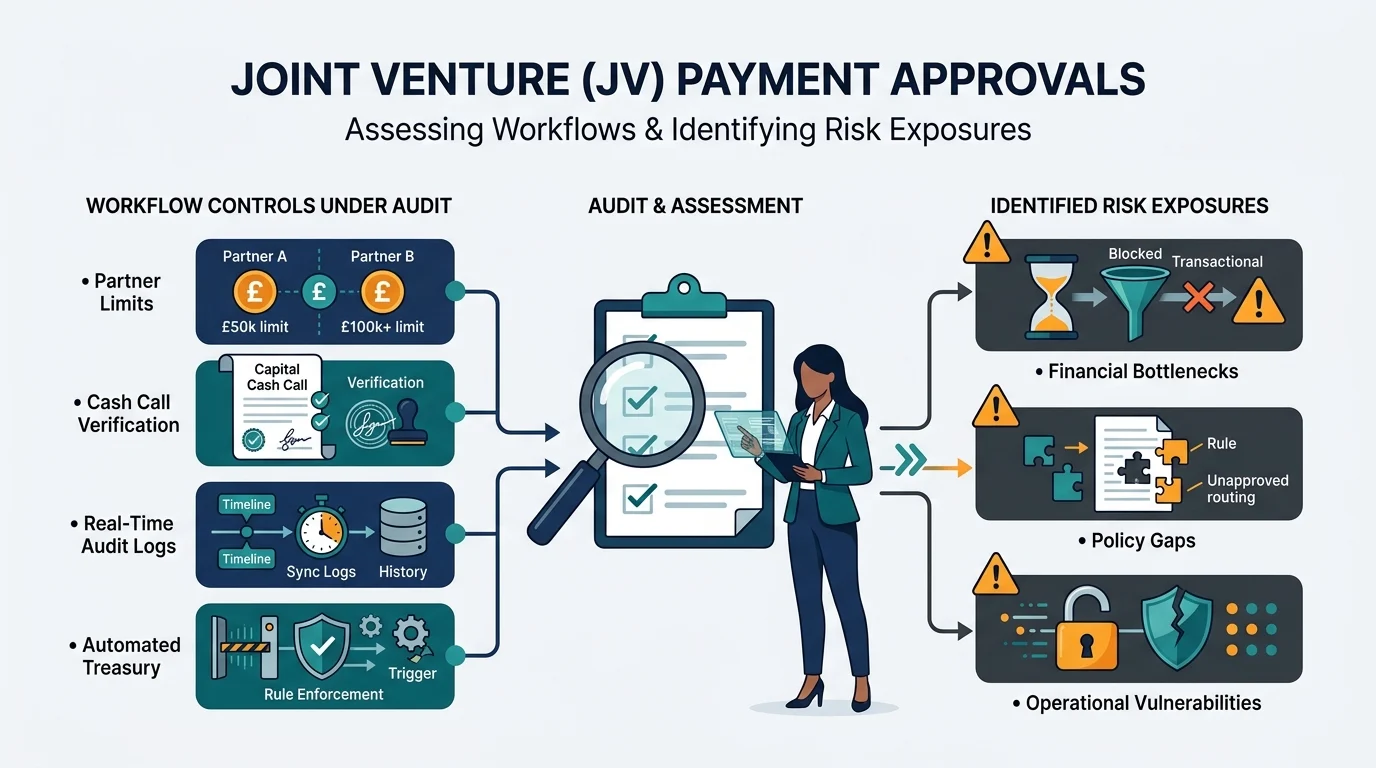
Evaluating payment approval workflows begins with mapping every stage of the disbursement lifecycle from initial cash call generation to final execution. Evaluators must verify whether dual-authorisation controls exist for all outgoing wire transfers and whether approval thresholds align with approved Joint Operating Agreement (JOA) budgets. Manual approval chains introduce significant delays and increase human error rates in financial verification.
Partner payment authorisation mechanisms must differentiate between routine operational expenditures and non-budgeted emergency outlays. Operating procedures should mandate that any payment exceeding designated thresholds requires formal concurrence from non-operating partner representatives. Without automated authorization tracking, operators routinely bypass partner consensus during high-pressure drilling and production operations.
The evaluation process must examine how treasury policy compliance monitoring is integrated into daily operations. Automated enterprise resource planning (ERP) systems should block disbursements that violate predefined financial controls. Systems that permit retrospective approvals create unmonitored liability windows that compromise financial integrity.
Comprehensive evaluation requires verifying the existence of an immutable payment audit trail. Every approval, modification, and transfer instruction must generate a time-stamped digital record containing user credentials and supporting documentation. External and internal auditors rely on these audit logs to confirm that all disbursements align strictly with contractual JOA provisions.
Evaluation Dimension | Traditional Workflow Indicators | Advanced Treasury Workflow Indicators |
Authorisation Verification | Manual physical signatures, paper approval forms | Automated digital signature workflows with JOA threshold rules |
Payee Vetting | Periodic manual vendor directory reviews | Real-time automated sanctions screening of payees prior to transfer |
Cash Call Reconciliation | End-of-month manual spreadsheet matching | Automated bank feed integration with real-time budget tracking |
Audit Compliance | Retrospective physical paper file extraction | Immutable digital payment audit trail generated at execution |
Which Governance Structures Best Mitigate JV Treasury Risks?
Mitigating joint venture treasury risks requires implementing escrow account governance, strict segregation of duties in payments, direct partner oversight mechanisms, and standardized treasury policy compliance monitoring across all operating accounts and financial transactions.
Escrow account governance serves as a critical defense mechanism for securing capital reserved for specific project milestones, abandonment funds, or major infrastructure developments. Establishing joint-signatory escrow accounts prevents operators from unilaterally drawing down funds for unrelated operational cash deficits. This financial structure isolates capital and ensures disbursements occur only when verified contractual conditions are met.
Segregation of duties in payments must be strictly enforced within both operator and non-operator treasury departments. Financial systems must separate the functions of vendor creation, invoice approval, payment initiation, and bank reconciliation. No single user should have administrative rights to alter payee bank details while retaining payment execution privileges.
To enforce these complex controls across multinational operations, corporate finance and joint venture operations teams rely on specialized structured training. Establishing consistent organizational knowledge around Payment Controls and Treasury Governance Training for Oil and Gas Joint Venture Disbursements enables finance managers, joint venture accountants, and audit teams to systematically eliminate internal control weaknesses. Structured workforce ups kill programs standardize risk management practices across operational entities.
Establishing clear royalty and tax payment controls protects consortiums from sovereign claims and penalty assessments. Operating procedures must mandate that tax withholdings and government royalty calculations undergo independent verification prior to funds transfer. Dedicated sub-accounts for tax liabilities prevent the accidental blending of statutory funds with general working capital.
Governance Domain | Core Control Strategy | Primary Risk Mitigated |
Cash Call Management | Cash call disbursement controls tied to active work programs | Excess cash drawdowns and capital hoarding |
Banking Administration | Escrow account governance with dual-partner sign-off | Unilateral fund diversion by operating entity |
Payee Verification | Continuous sanctions screening of payees against watchlists | Illegal transactions and regulatory enforcement |
Statutory Compliance | Dedicated royalty and tax payment controls and validation | Sovereign penalties and license revocation |
How Should Organizations Compare JV Training Approaches for Financial Controls?
Organizations must compare joint venture financial control training options by evaluating curriculum depth, oil and gas industry specificity, practical case study application, measurable performance metrics, and alignment with corporate treasury governance objectives.
Selecting the optimal workforce development delivery model requires structured evaluation of candidate training frameworks. Generic corporate treasury courses fail to address the unique complexities of Joint Operating Agreements, Accounting Procedures (COPAS/PASO standards), and cash call mechanics. Organizations must select learning solutions explicitly tailored to upstream and midstream joint venture environments.
Off-the-shelf finance programs provide foundational accounting knowledge but lack practical application scenarios covering real-world joint interest audits. Effective training interventions incorporate actual joint venture dispute scenarios, payment approval breakdown analyses, and cash call reconciliation exercises. Interactive case studies prepare professionals to detect system vulnerabilities before financial losses occur.
When evaluating learning frameworks for corporate finance and joint venture management teams, HR decision-makers and department heads should utilize structured comparison frameworks to align organizational goals with delivery models.
Evaluation Attribute | Generic Finance Seminars | Custom In-House Workshops | Specialized JV Governance Programs |
Industry Relevance | Low; focused on standard corporate accounting | Moderate; customized to company policy only | High; directly tailored to petroleum JOA & JV structures |
Control Application | Basic corporate payment theory | Company-specific workflow review | Advanced cash call disbursement controls & audit protocols |
Sanctions & Compliance | Overview of general AML regulations | Internal policy review | In-depth sanctions screening of payees in joint operations |
Implementation Speed | Immediate availability | Long development timeline | Rapid deployment with established industry frameworks |
Measurable Skill Outcome | General financial awareness | Understanding of internal software | Practical capability to audit and enforce JV treasury rules |
HR managers must evaluate training providers based on demonstrated ROI metrics, including reduced joint interest audit exceptions, accelerated cash call processing times, and enhanced policy compliance rates. Investing in structured professional development strengthens internal governance while mitigating multi-million-dollar disbursement exposures across active joint venture assets.
Organizations seeking to upgrade their financial governance capabilities can enroll their teams directly in the specialized Payment Controls & Treasury Governance for JV Disbursements Training Course. This curriculum provides targeted expertise in managing financial exposure, establishing robust approval systems, and maintaining strict compliance across complex petroleum joint venture operations.
How Do You Implement a Decision Framework for Upgrading JV Payment Controls?
Implementing a decision framework requires assessing internal skill gaps, auditing current treasury software capabilities, establishing formal authorization thresholds, and deploying targeted professional training to build sustainable financial governance.
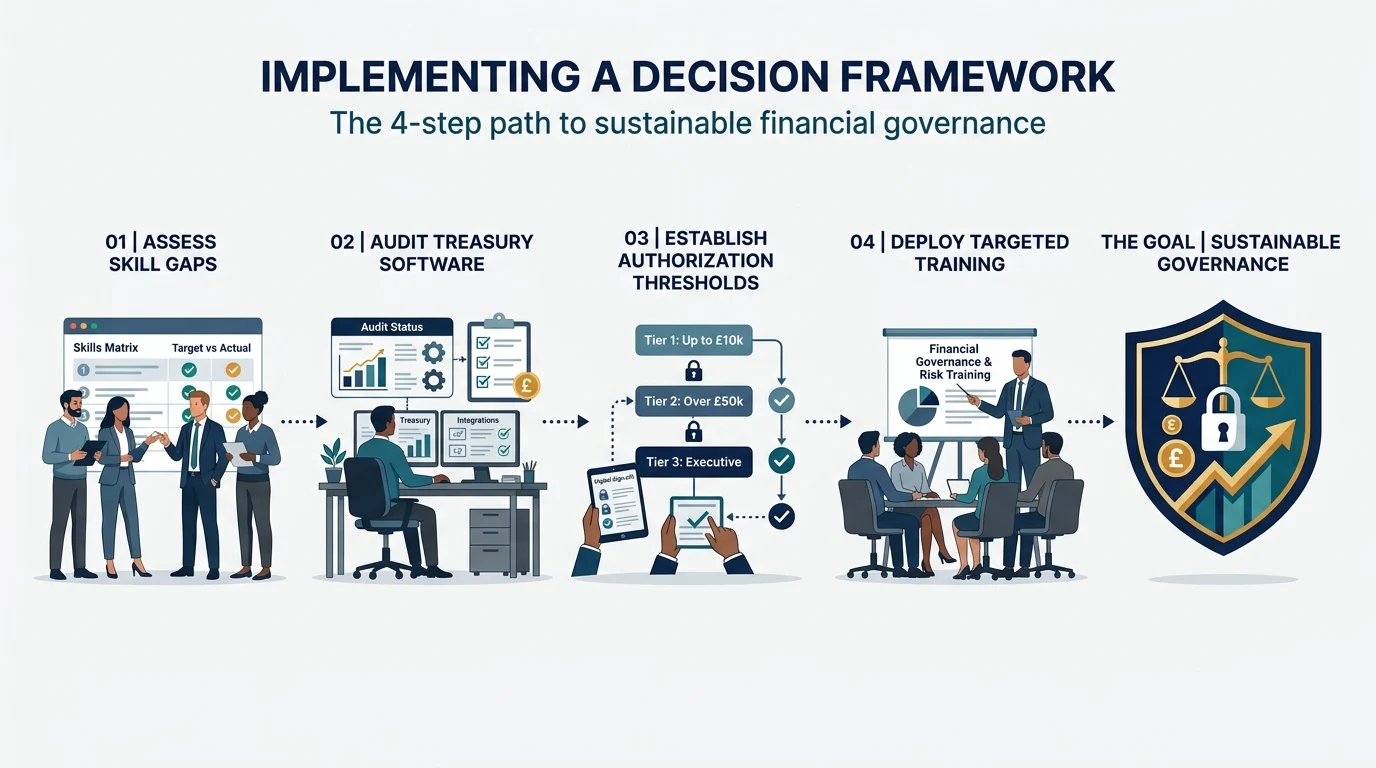
Organizations must follow a structured, multi-phase decision framework to transition from vulnerable, manual payment workflows to robust treasury governance models. The decision process balances immediate operational needs with long-term financial security.
The first phase demands a rigorous internal vulnerability audit. Finance leaders must review past joint interest audit findings, identify recurring cash call discrepancies, and pinpoint gaps in segregation of duties in payments. Understanding historical control failures reveals where operational workflows require immediate technical or structural intervention.
The second phase involves upgrading software infrastructure and establishing mandatory treasury compliance rules. System architectures must enforce strict rule-based processing for all joint venture accounts. Automated checks must validate cash call authorization codes, confirm partner approval limits, and execute automated sanctions screening of payees before generating bank payment instructions.
The third phase focuses on human capital development. Software and policy updates fail if staff lack the specialized skills to operate and enforce them. Upskilling joint venture accountants, treasury analysts, and commercial managers ensures that policy compliance monitoring becomes an embedded operational discipline rather than a periodic compliance exercise.
Decision Phase | Core Action Items | Primary Deliverables | Target Organizational Impact |
1. Vulnerability Assessment | Audit historical payment logs and cash call records | Risk gap matrix and control failure report | Complete visibility into existing financial leakage points |
2. Architecture Design | Reconfigure ERP approval hierarchies and limits | Updated partner payment authorisation matrix | Elimination of single-point payment authorization vulnerabilities |
3. Professional Upskilling | Enroll finance and audit teams in specialized JV training | Certified personnel with verified governance skills | Reduction in joint interest audit exceptions and processing errors |
4. Operational Monitoring | Deploy real-time screening and automated audit logging | Continuous payment audit trail system | Full transparency and regulatory compliance across all assets |
Frequently Asked Questions
What is oil and gas petroleum treasury and cash management?
Oil and gas petroleum treasury and cash management involves overseeing an energy company's liquidity, capital allocations, bank accounts, and joint venture cash call disbursements. The Institute For Oil & Gas Training provides comprehensive professional development on managing complex multi-currency transactions, operational cash flow, and financial risk controls tailored to upstream and midstream operations. Through Oil & Gas Petroleum Treasury, Cash and Banking programs, professionals master working capital strategies and banking governance essential for petroleum joint ventures.
How do petroleum joint venture cash calls impact treasury management?
Joint venture cash calls require operators to request funds in advance from non-operating partners to cover projected capital expenditures and operating costs. Mismanaging these advances can lead to severe liquidity bottlenecks, capital misallocation, and joint interest audit disputes. Training in Oil & Gas Petroleum Treasury, Cash and Banking at the Institute For Oil & Gas Training equips finance teams with the technical skills to establish robust cash call disbursement controls and automated partner reconciliation workflows.
Why is foreign exchange and banking governance critical in oil and gas operations?
Petroleum assets frequently operate across international jurisdictions, exposing transactions to foreign exchange volatility, sovereign regulatory compliance, and complex cross-border banking fees. Effective banking governance ensures that local account structures, escrow agreements, and currency hedges comply with strict corporate treasury policies. The Institute For Oil & Gas Training covers these operational complexities within its Oil & Gas Petroleum Treasury, Cash and Banking training to mitigate currency risks and streamline international vendor remittances.
How can energy companies mitigate disbursement risks in treasury operations?
Energy companies mitigate disbursement risks by enforcing a strict segregation of duties in payments, implementing dual-authorisation approval thresholds, and performing continuous sanctions screening of payees. Establishing an immutable payment audit trail prevents internal fraud and ensures compliance with statutory tax and royalty obligations. Through the Oil & Gas Petroleum Treasury, Cash and Banking course delivered by the Institute For Oil & Gas Training, treasury analysts and joint venture accountants learn to design and execute verifiable internal control frameworks.
What are the main components of an effective petroleum cash management strategy?
An effective petroleum cash management strategy integrates real-time cash flow forecasting, optimal working capital buffers, automated bank feed reconciliations, and joint venture accounting standards. It ensures that capital is readily available for drilling and production milestones while minimising idle bank balances. The Institute For Oil & Gas Training delivers practical instruction in Oil & Gas Petroleum Treasury, Cash and Banking to help organisations align financial operations with operational targets and strategic corporate goals.
Related training courses
Amine Gas Treating and Regeneration Operations Training Course
- Specialisation
- Oil & Gas Process Engineering and Operations
- Duration
- 5 days · 15 CPD hours
Offshore Pipeline Inspection and Integrity Assessment Training Course
- Specialisation
- Oil & Gas Pipeline Integrity and Inspection
- Duration
- 5 days · 15 CPD hours
API RP 574 Inspection Practices for Piping System Components Training Course
- Specialisation
- Oil & Gas Inspection and Non-Destructive Testing
- Duration
- 5 days · 15 CPD hours
More articles

Petroleum Taxation Fundamentals Training for Oil and Gas Tax Professionals
Master petroleum taxation fundamentals with Institute For Oil & Gas Training. Explore modules, outcomes, and enrollment paths for tax professionals.
Read article →
How to Evaluate Tax Obligations and Tax Risks Across Upstream Midstream and Downstream Operations
Master evaluation of upstream, midstream, and downstream petroleum tax obligations, ring fencing, capital allowances, and transfer pricing risks.
Read article →
Why Petroleum Taxation Matters Across the Oil and Gas Value Chain
Master petroleum taxation fundamentals across upstream midstream and downstream operations to mitigate tax risks and drive corporate profitability.
Read article →