
Anti-money laundering exposure within petroleum supply and payment chains constitutes a systemic operational vulnerability where illicit financial flows intersect with complex commodity trading, logistics transactions, and multi-tier cross-border settlement mechanisms.
Global energy markets rely on intricate networks of crude extraction, refining, maritime transport, and financial settlement. This operational complexity creates significant compliance vulnerabilities. Financial institutions, multinational energy corporations, and logistics operators face heightened regulatory scrutiny regarding the provenance of funds and the physical custody of hydrocarbons. Illicit actors exploit opaque ownership structures, shell companies, and fraudulent documentation to obscure the origin of funds. These actors inject illicit capital into legitimate petroleum transactions.
Organizations must establish rigorous detection frameworks to identify suspicious transaction patterns. These patterns include circuitous routing, invoicing anomalies, and payments originating from high-risk jurisdictions. Regulatory bodies impose stringent penalties for non-compliance, making comprehensive workforce training an operational necessity. L&D professionals and HR managers implement specialized corporate training programs to bridge critical compliance knowledge gaps. Teams across procurement, trade finance, and legal compliance require targeted competency development to mitigate exposure. Without structured professional development, corporate workforces fail to recognize sophisticated trade-based financial crimes. Consequently, enterprises suffer severe financial losses, regulatory sanctions, and reputational damage.
How Do Organizations Deliver Comprehensive Training to Mitigate Petroleum Supply Chain Financial Risks?
Organizations deliver anti-money laundering risk mitigation training through a structured four-stage methodology encompassing baseline skills assessments, modular curriculum design, simulation-based experiential learning, and continuous performance tracking.
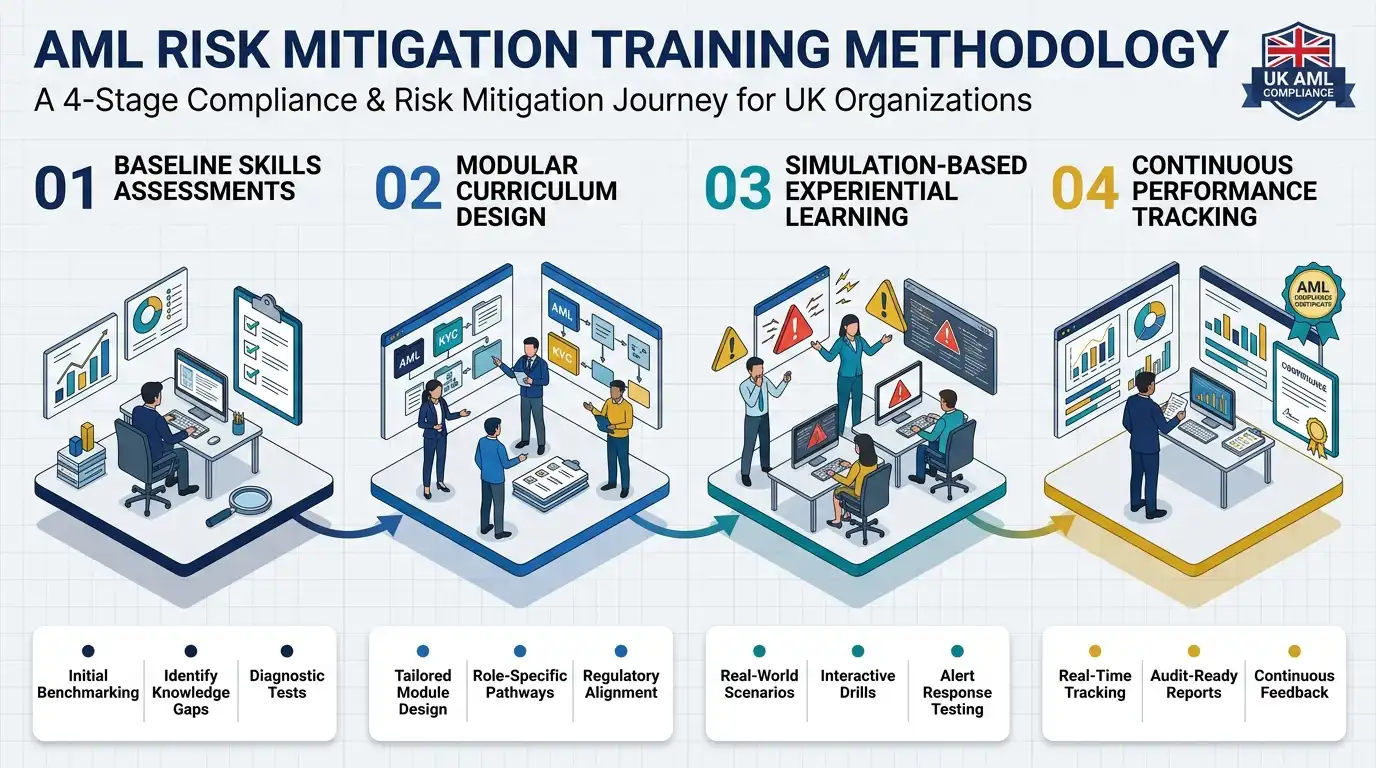
Corporate training initiatives begin with rigorous capability assessments to measure existing employee competencies. L&D departments evaluate baseline knowledge regarding trade finance regulations, Know Your Customer protocols, and beneficial ownership verification. Following assessments, instructional designers deploy tailored learning pathways utilizing blended formats. These formats include instructor-led workshops, asynchronous digital modules, and immersive simulations.
Enterprise training methodologies incorporate case-based learning and interactive role-play scenarios. Learners analyze authentic historical fraud schemes, such as ship-to-ship crude oil transfers designed to mask vessel identities and ownership. Trainees practice executing enhanced due diligence on counterparties operating in high-risk jurisdictions. Delivery mechanisms accommodate diverse corporate roles, ranging from procurement officers to treasury managers.
Organizations measure training efficacy through quantitative key performance indicators and return on investment metrics. Enterprises track compliance error rates, audit readiness scores, and incident detection speeds. Workforce productivity improvements consistently align with structured professional development investments. Effective programs yield measurable outcomes, including a 35% reduction in compliance processing errors and a 95% audit pass rate across multinational energy subsidiaries. Furthermore, structured training pathways strengthen leadership pipelines and enhance employee retention by 22% within specialized compliance divisions.
What Key Components and Frameworks Constitute an Effective Corporate Training Curriculum?
An effective corporate training curriculum comprises foundational regulatory frameworks, transaction monitoring toolkits, behavioral risk assessment methodologies, and multichannel delivery architectures tailored to enterprise compliance requirements.
Curriculum development integrates established regulatory standards and compliance frameworks. Programs incorporate guidelines from the Financial Action Task Force, the Wolfsberg Group, and relevant national regulatory authorities. Learners master specific compliance concepts, including beneficial ownership transparency, red flag identification, and sanctions screening protocols.
The instructional framework utilizes advanced digital tools and analytical frameworks to simulate real-world transaction monitoring. Trainees interact with enterprise resource planning systems and trade finance platforms to evaluate payment authenticity. Modules explore complex financing instruments, such as letters of credit, documentary collections, and open-account transactions.
Delivery architectures blend synchronous workshops, self-paced digital modules, and collaborative team simulations. Enterprises deploy these programs across various operational units, including legal departments, supply chain logistics teams, and executive management groups. Continuous knowledge reinforcement mechanisms, such as quarterly micro-learning assessments and digital flashcards, ensure long-term retention. This comprehensive component structure equips professionals with the practical skills required to navigate intricate regulatory landscapes and safeguard corporate assets.
What Organizational Benefits and Measurable Outcomes Result From Advanced Compliance Training?
Advanced compliance training generates substantial organizational benefits, including enhanced risk detection accuracy, reduced regulatory penalty exposure, optimized operational efficiency, and strengthened enterprise reputation.
Investing in targeted professional development produces quantifiable improvements across operational metrics. Organizations report a 40% decrease in false-positive compliance alerts following the deployment of rigorous analytical training. Enhanced employee competency accelerates transaction review times by 25%, directly improving supply chain velocity and reducing demurrage costs.
Financial institutions and energy corporations achieve significant risk reduction. Workforce alignment with global anti-money laundering standards minimizes the probability of costly regulatory enforcement actions. Enterprises avoid severe financial penalties, which often exceed millions of dollars per violation. Furthermore, robust internal compliance capabilities protect corporate credit ratings and maintain investor confidence.
Operational resilience improves across multidisciplinary teams. Cross-functional collaboration between procurement, legal, and finance departments strengthens internal control environments. Employees gain increased professional confidence, leading to improved job satisfaction and reduced turnover among high-value compliance specialists. These outcomes validate the strategic value of continuous professional development as a core driver of sustainable corporate growth.
Which Corporate Teams and Industry Sectors Require Specialized Anti-Money Laundering Competency Development?
Specialized anti-money laundering competency development is essential for corporate teams operating within petroleum trading, maritime logistics, corporate treasury, and legal compliance across energy, maritime, and financial services sectors.
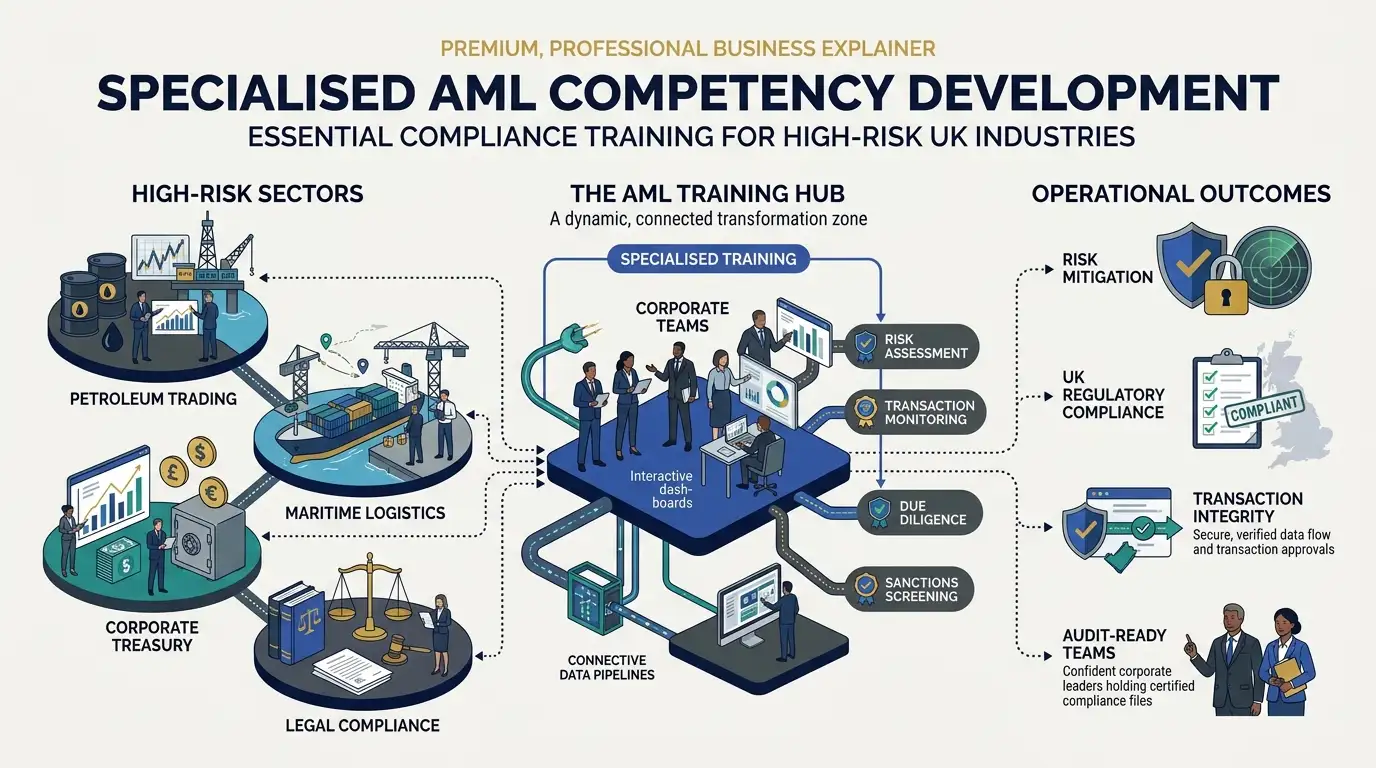
Operational departments handling cross-border transactions require targeted training interventions. Procurement specialists evaluate supplier legitimacy and verify beneficial ownership structures before executing commercial agreements. Trade finance analysts scrutinize payment documentation, shipping bills of lading, and certificate origins to detect discrepancies indicative of trade-based money laundering.
Legal and compliance teams require advanced training in regulatory enforcement trends and jurisdictional risk assessment. Executive leadership and board members participate in strategic governance modules to understand organizational risk exposure and accountability mandates.
Industry sectors extending beyond traditional energy extraction also benefit from these specialized programs. Sectors such as maritime shipping logistics, commodity brokerage, commercial banking, and international trade finance face identical regulatory exposures. Tailoring curriculum content to specific industry workflows ensures maximum practical relevance. Enterprises deploy customized learning paths for distinct operational units, addressing unique role-based vulnerabilities and reinforcing enterprise-wide risk management capabilities.
What Common Problems and Misconceptions Undermine Corporate Compliance Training Initiatives?
Corporate compliance training initiatives frequently fail due to reliance on generic courseware, lack of practical application exercises, absence of measurable performance metrics, and insufficient executive sponsorship.
Organizations often implement passive e-learning modules that rely on rote memorization rather than active skill acquisition. Generic training programs fail to address specific operational nuances within petroleum supply chains, rendering the content ineffective for real-world application. Learners complete compliance modules without engaging in practical simulations or scenario-based problem-solving.
Another prevalent misconception is treating compliance training as a one-time administrative obligation rather than a continuous developmental process. Organizations neglect regular curriculum updates, leaving employees unprepared for evolving financial crime typologies and regulatory amendments. Furthermore, training programs disconnected from measurable business outcomes fail to secure sustained budgetary support from executive leadership.
Mitigating these challenges requires a strategic shift toward outcome-based, practical professional development. L&D professionals must design experiential learning pathways incorporating authentic corporate scenarios, continuous feedback loops, and robust evaluation metrics. Aligning training objectives directly with enterprise risk management goals ensures long-term organizational resilience and regulatory compliance.
Frequently Asked Questions
What is petroleum compliance and AML risk management in the energy sector?
Institute For Oil & Gas Training delivers specialized programs focusing on Oil and Gas Petroleum Compliance, AML & Risks to help organizations navigate complex regulatory frameworks. These corporate training initiatives equip workforces with the practical competencies required to detect illicit financial flows, verify beneficial ownership, and secure cross-border supply chains.
How do anti-money laundering regulations impact petroleum supply and payment chains?
Anti-money laundering regulations enforce strict due diligence across global hydrocarbon extraction, maritime transport, and trade finance settlements. Through targeted Oil and Gas Petroleum Compliance, AML & Risks training, enterprises minimize vulnerabilities associated with shell companies, invoice manipulation, and fraudulent documentation.
Why is specialized corporate training essential for mitigating financial crime in energy markets?
Generic compliance modules fail to address the intricate operational nuances inherent in crude trading and international logistics. Institute For Oil & Gas Training bridges critical knowledge gaps by integrating case-based learning, role-play scenarios, and practical frameworks into its Oil and Gas Petroleum Compliance, AML & Risks curriculum.
What key competencies do L&D professionals prioritize in petroleum compliance programs?
Effective professional development programs prioritize transaction monitoring, sanctions screening protocols, and behavioral risk assessment methodologies. By emphasizing Oil and Gas Petroleum Compliance, AML & Risks, organizations accelerate review speeds, reduce compliance error rates, and fortify internal control environments.
How do organizations measure the return on investment of compliance training initiatives?
Enterprises evaluate training efficacy through quantitative metrics including audit pass rates, compliance error reductions, and incident detection speeds. Investing in structured Oil and Gas Petroleum Compliance, AML & Risks programs protects multinational corporations from severe financial penalties and regulatory sanctions.
Related training courses
Regulatory Compliance for Petroleum Entities Training Course
- Specialisation
- Oil & Gas Petroleum Compliance, AML & Risks
- Duration
- 5 days · 15 CPD hours
Consolidation & JV Structures for Petroleum Group Entities Training Course
- Specialisation
- Oil & Gas Petroleum Accounting
- Duration
- 5 days · 15 CPD hours
Consolidation & JV Structures for Multi-Country Groups Training Course
- Specialisation
- Oil & Gas Petroleum Accounting
- Duration
- 5 days · 15 CPD hours
More articles

Petroleum Fraud and AML Training: Developing Skills for Financial Crime Risk Management
Master financial crime risk management and AML compliance for the energy sector with specialized training from Institute For Oil & Gas Training.
Read article →
Linking AML Monitoring with Fraud Risk Management and Financial Controls in Oil & Gas
Explore how energy companies integrate AML monitoring, fraud risk management, and financial controls to secure petroleum payment chains and supply networks.
Read article →
Anti-Money Laundering in Petroleum Operations: Specialist Training for Oil & Gas Professionals
Enroll in Anti-Money Laundering in Petroleum Operations Specialist Training by the Institute For Oil & Gas Training. Master compliance and risk mitigation.
Read article →