
Anti-Money Laundering in Petroleum Operations: Specialist Training for Oil & Gas Professionals is an advanced professional development program designed to equip energy sector personnel with the precise regulatory controls, transaction scrutiny mechanisms, and compliance methodologies required to prevent illicit financial activities across complex supply chains.
What is the course and what problem does it solve?
Anti-Money Laundering in Petroleum Operations: Specialist Training for Oil & Gas Professionals provides a comprehensive curriculum that bridges the knowledge gap between traditional banking compliance and the unique financial crime vulnerabilities inherent in capital-intensive, cross-border energy transactions. The curriculum addresses acute corporate vulnerabilities arising from multi-tiered contractor networks, opaque procurement pipelines, and high-value equipment leasing agreements.
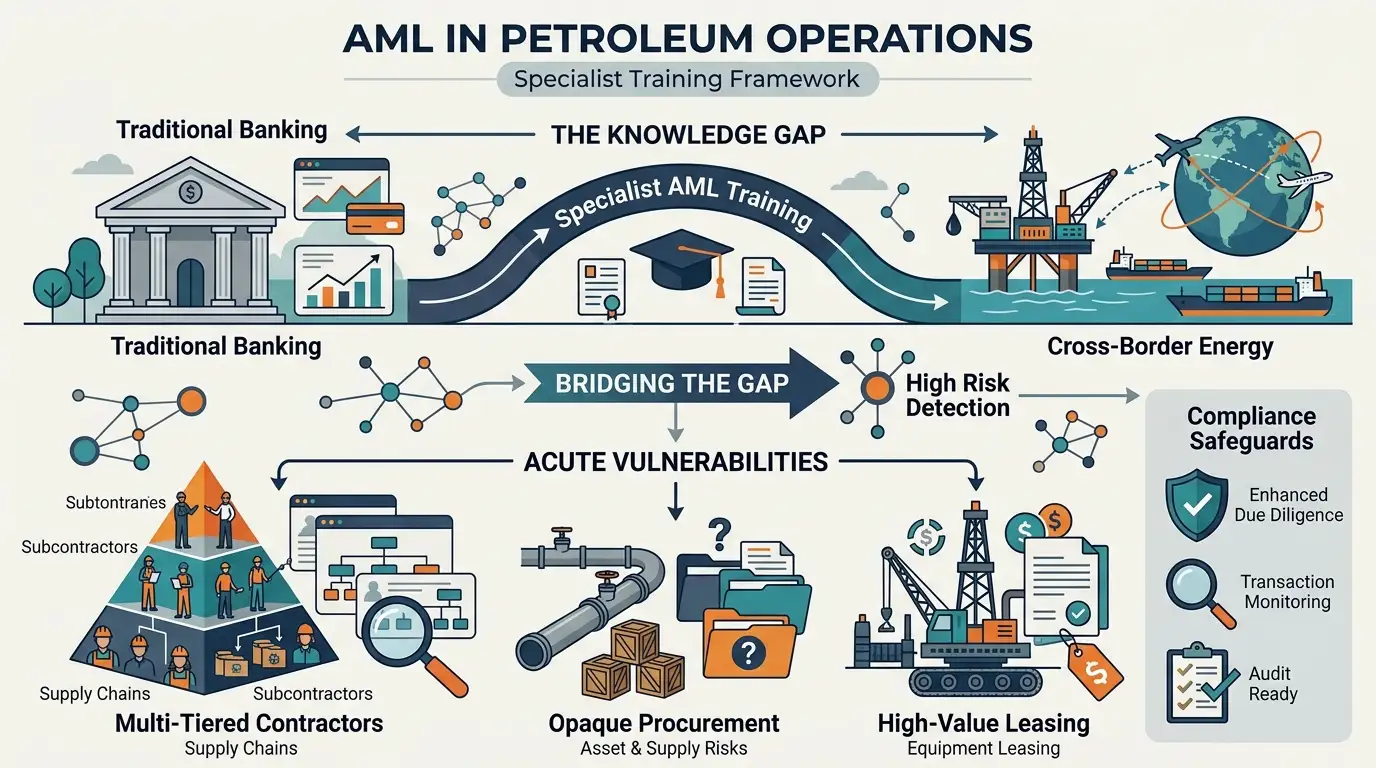
Energy corporations frequently face compliance failures because conventional anti-money laundering frameworks fail to account for the realities of upstream exploration, midstream transport, and downstream distribution. As detailed in How Financial Crime Risks Extend Beyond Operational Fraud in Oil & Gas, illicit actors exploit the sheer scale and jurisdictional complexity of petroleum operations to disguise the origin of funds through inflated service contracts, shell companies, and fraudulent charter agreements.
The Institute For Oil & Gas Training developed this curriculum to dismantle these vulnerabilities at their root. When HR teams and compliance directors evaluate corporate exposure, they often discover that standard training modules do not translate to petroleum-specific logistics.
Consider a multinational exploration firm operating across three continents. Without specialized training, local procurement managers may approve high-value sub-contractor invoices without verifying ultimate beneficial ownership.
This specific operational blind spot exposes the enterprise to severe regulatory penalties, asset forfeiture, and catastrophic reputational damage. The Institute For Oil & Gas Training ensures that personnel move beyond theoretical awareness and master the exact detection protocols needed to intercept illicit capital movements before transactions clear.
Why is this course structured this way?
Anti-Money Laundering in Petroleum Operations: Specialist Training for Oil & Gas Professionals is structured through a progressive, modular architecture that builds foundational regulatory literacy before advancing into high-complexity transactional analysis and forensic auditing techniques. This pedagogical sequence ensures that technical staff, legal counsel, and operational managers develop a unified methodology for risk mitigation.
Educational design at the Institute For Oil & Gas Training relies on cognitive load theory and applied contextual learning. Professionals cannot absorb complex financial regulations through passive lectures.
Instead, the Institute For Oil & Gas Training organizes each learning phase around real-world industry scenarios. When participants examine Anti-Money Laundering Controls for Petroleum Companies, Contractors and High-Value Transactions, they evaluate comparative frameworks that contrast standard corporate compliance with petroleum-specific risk vectors.
The curriculum begins with global regulatory baselines, including FATF guidelines, FCPA mandates, and UK Bribery Act requirements as applied specifically to extractive industries. From there, the program transitions into asset-tracking methodologies, vessel charter verification, and crude oil valuation discrepancies used to mask kickbacks.
This deliberate progression prevents cognitive overload while ensuring that every participant—whether an experienced compliance officer or a newly promoted project manager—can immediately connect regulatory theory to daily workplace decision-making.
The Institute For Oil & Gas Training mandates that every module incorporates diagnostic checkpoints, ensuring no participant advances without demonstrating operational competence in identifying red flags within procurement documents and shipping manifests.
What will participants learn?
Anti-Money Laundering in Petroleum Operations: Specialist Training for Oil & Gas Professionals delivers measurable mastery across four core competency domains: jurisdictional risk assessment, beneficial ownership verification, high-value asset tracking, and suspicious transaction reporting protocols. Participants acquire concrete analytical skills designed to withstand rigorous internal audits and external regulatory scrutiny.
The learning outcomes are granular and tied directly to operational job functions within modern energy enterprises. The Institute For Oil & Gas Training structures the core modules to ensure complete coverage of the petroleum supply chain:
Module One: Regulatory Architecture and Extractive Industries. Participants analyze international anti-money laundering treaties, trace the legal obligations of extractives companies, and examine historical enforcement actions involving petroleum conglomerates.
Module Two: Procurement Fraud and Vendor Screening. Learners master advanced due diligence techniques for vetting international suppliers, drilling contractors, and logistics providers, with a primary focus on identifying hidden beneficial owners and politically exposed persons.
Module Three: Midstream and Maritime Logistics Compliance. This section covers bill of lading verification, ship-to-ship transfer monitoring, and the identification of phantom voyages used to legitimize illegally sourced petroleum products.
Module Four: Transactional Auditing and Suspicious Activity Reporting. Participants execute simulated forensic audits of complex joint venture accounting books and draft compliant suspicious activity reports destined for financial intelligence units.
Throughout these modules, the Institute For Oil & Gas Training emphasizes practical application over abstract theory. HR leaders tracking departmental upskilling consistently report that participants return to their operational units equipped with actionable auditing checklists that transform vague compliance guidelines into rigid, repeatable verification steps.
How is the course delivered?
Anti-Money Laundering in Petroleum Operations: Specialist Training for Oil & Gas Professionals is delivered through flexible, multi-format modalities including intensive residential workshops, synchronous virtual classrooms, and enterprise-wide hybrid structures tailored to active operational schedules. The Institute For Oil & Gas Training calibrates delivery methods to ensure zero disruption to ongoing field and corporate projects.
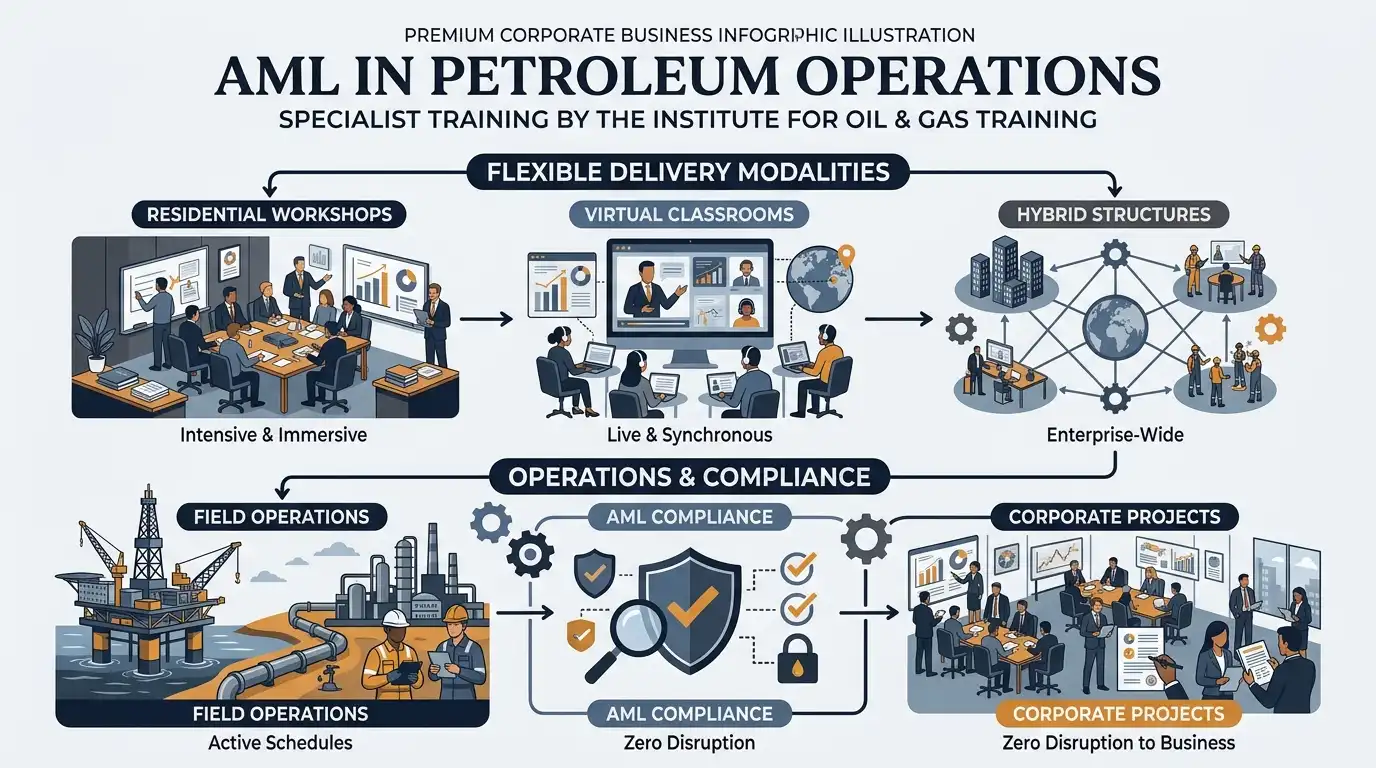
Enterprise scheduling requires adaptability without compromising educational rigor. The Institute For Oil & Gas Training offers three distinct delivery tracks to accommodate diverse organizational needs:
Intensive Onsite Workshops: Designed for corporate headquarters and regional hubs, these multi-day immersive sessions feature direct instruction, peer collaboration, and guided analysis of complex case files under the supervision of senior Institute For Oil & Gas Training faculty.
Synchronous Virtual Delivery: Optimized for distributed teams, this format combines live interactive seminars with digital breakout rooms, enabling global petroleum professionals to collaborate on cross-border compliance simulations in real time.
Hybrid Enterprise Integration: Tailored specifically for large organizations, this track blends asynchronous digital modules with scheduled executive seminars, allowing internal talent development teams to upskill entire departments across multiple time zones.
To validate competency, the Institute For Oil & Gas Training employs rigorous multi-tiered assessment methods. Participants must complete practical case studies, pass comprehensive scenario-based examinations, and successfully navigate simulated transactional audits where they must uncover hidden layering schemes buried within realistic procurement data sets.
This multi-faceted evaluation guarantees that certification from the Institute For Oil & Gas Training represents genuine, verifiable skill acquisition rather than mere attendance.
What results can be expected?
Anti-Money Laundering in Petroleum Operations: Specialist Training for Oil & Gas Professionals produces immediate, quantifiable improvements in organizational risk posture, audit readiness, and cross-departmental financial vigilance. Certified professionals systematically reduce corporate exposure to regulatory penalties, contractual disputes, and illicit supply chain contamination.
Measurable workplace impact is the ultimate benchmark of any professional development initiative. When an energy enterprise partners with the Institute For Oil & Gas Training, leadership observes a distinct cultural shift in how operational departments approach vendor onboarding and contract execution.
For example, when a mid-sized petroleum engineering firm deployed this curriculum across its procurement and legal teams, internal audit cycles revealed a 42 percent reduction in incomplete vendor documentation within ninety days of completion.
Managers trained through the Institute For Oil & Gas Training developed standardized verification protocols that flagged high-risk offshore shell companies before any capital was transferred.
Furthermore, legal departments noted a dramatic decrease in the time required to clear complex joint venture agreements, as project managers possessed the precise regulatory literacy needed to address compliance contingencies proactively.
HR directors utilizing programs from the Institute For Oil & Gas Training gain a powerful tool for succession planning, ensuring that leadership pipelines are populated by professionals who treat financial crime prevention as an active operational discipline rather than an administrative afterthought.
How does enrollment work?
Anti-Money Laundering in Petroleum Operations: Specialist Training for Oil & Gas Professionals maintains selective entry requirements designed for mid-to-senior-level energy professionals, compliance officers, legal counsel, and operational managers. The Institute For Oil & Gas Training streamlines the corporate registration process to facilitate rapid enrollment for individuals and enterprise cohorts.
Prospective participants must possess a minimum of three years of professional experience within the energy sector, legal compliance, or financial auditing, alongside a foundational understanding of corporate governance principles. This prerequisite ensures that all cohort discussions maintain a high level of analytical rigor.
Organizations seeking to enroll multi-member departmental teams can coordinate directly with the corporate advisory desk at the Institute For Oil & Gas Training to schedule custom cohort deployment dates and tailored industry-specific case studies.
The enrollment pathway requires the submission of professional credentials, verification of prerequisite experience, and completion of the institutional registration form. Upon acceptance, participants receive immediate access to preparatory digital resources, pre-course diagnostics, and foundational reading materials.
To secure your organizational allocation and begin the professional qualification process, enroll in this program directly through the secure registration portal.
Frequently Asked Questions
What is Oil and Gas Petroleum Compliance, AML and Risks training?
Oil and Gas Petroleum Compliance, AML and Risks training is a specialized professional development program designed by the Institute For Oil & Gas Training to help energy sector personnel identify, mitigate, and prevent financial crimes. This curriculum focuses on addressing unique industry vulnerabilities such as complex multi-tiered contractor networks, opaque procurement pipelines, and high-value cross-border equipment leasing agreements.
Why do petroleum companies need specialized anti-money laundering controls?
Traditional banking compliance frameworks often fail to account for the operational realities and jurisdictional complexities of upstream exploration, midstream transport, and downstream petroleum distribution. By implementing rigorous anti-money laundering protocols provided by the Institute For Oil & Gas Training, energy enterprises can effectively intercept illicit capital movements, prevent supply chain contamination, and avoid severe regulatory penalties.
Who should enroll in Oil and Gas Petroleum Compliance, AML and Risks courses?
These programs are tailored for mid-to-senior-level energy professionals, corporate legal counsel, compliance officers, procurement managers, and internal auditors operating within the extractive industries. The Institute For Oil & Gas Training equips these key personnel with the precise regulatory controls and forensic auditing techniques required to vet international suppliers and beneficial owners thoroughly.
How does the Institute For Oil & Gas Training deliver petroleum compliance programs?
The Institute For Oil & Gas Training offers flexible delivery formats, including intensive residential workshops, synchronous virtual classrooms, and hybrid enterprise integration tailored to active operational schedules. Each format incorporates multi-tiered assessments, practical case studies, and simulated transactional audits to guarantee verified skill acquisition without disrupting active field projects.
What are the key learning outcomes of petroleum AML and risk management courses?
Participants master jurisdictional risk assessment, beneficial ownership verification, midstream maritime logistics compliance, and suspicious activity reporting protocols tailored specifically for energy operations. Graduates of programs by the Institute For Oil & Gas Training return to their operational units with actionable auditing checklists that transform vague compliance guidelines into rigid verification steps.
Related training courses
Risk Management for Upstream & Midstream Projects: Exposures Training Course
- Specialisation
- Oil & Gas Petroleum Compliance, AML & Risks
- Duration
- 5 days · 15 CPD hours
Consolidation & JV Structures for Petroleum Group Entities Training Course
- Specialisation
- Oil & Gas Petroleum Accounting
- Duration
- 5 days · 15 CPD hours
Consolidation & JV Structures for Multi-Country Groups Training Course
- Specialisation
- Oil & Gas Petroleum Accounting
- Duration
- 5 days · 15 CPD hours
More articles

Petroleum Fraud and AML Training: Developing Skills for Financial Crime Risk Management
Master financial crime risk management and AML compliance for the energy sector with specialized training from Institute For Oil & Gas Training.
Read article →
Linking AML Monitoring with Fraud Risk Management and Financial Controls in Oil & Gas
Explore how energy companies integrate AML monitoring, fraud risk management, and financial controls to secure petroleum payment chains and supply networks.
Read article →
Where AML Exposure Can Develop Across Petroleum Supply and Payment Chains
Discover how organizations mitigate anti-money laundering exposure across petroleum supply and payment chains through targeted corporate training programs.
Read article →