
Contractor cost verification requires structured forensic examination methodologies to detect anomalies, misallocations, and unauthorized expenditures within capital-intensive upstream and downstream operations. Organizations operating within complex supply chains face persistent risks of financial leakage, inflated billing rates, and unverified change orders submitted by engineering, procurement, and construction partners. Traditional financial audits fail to uncover sophisticated billing schemes because standard sample testing misses deep transactional anomalies buried within thousands of line-item entries.
Understanding these vulnerabilities begins with recognizing why complex contractor structures increase fraud risk in petroleum projects, an educational overview detailing how multi-tiered subcontracting hierarchies obscure fund flows and dilute accountability. Operational oversight depends on deploying targeted forensic accounting techniques that systematically inspect general ledgers, payroll records, equipment utilization logs, and third-party vendor invoices. Internal audit teams and commercial managers must transition from passive document inspection to rigorous, data-driven investigative protocols that establish true cost baseline transparency across every project phase.
What are the core forensic accounting techniques used to review contractor cost structures?
Core forensic accounting techniques rely on data analytics, transaction matching, cost-reimbursable audit programs, and Benford’s Law applications to isolate abnormal billing patterns, duplicate invoices, and unauthorized overhead charges within massive contractor ledgers.
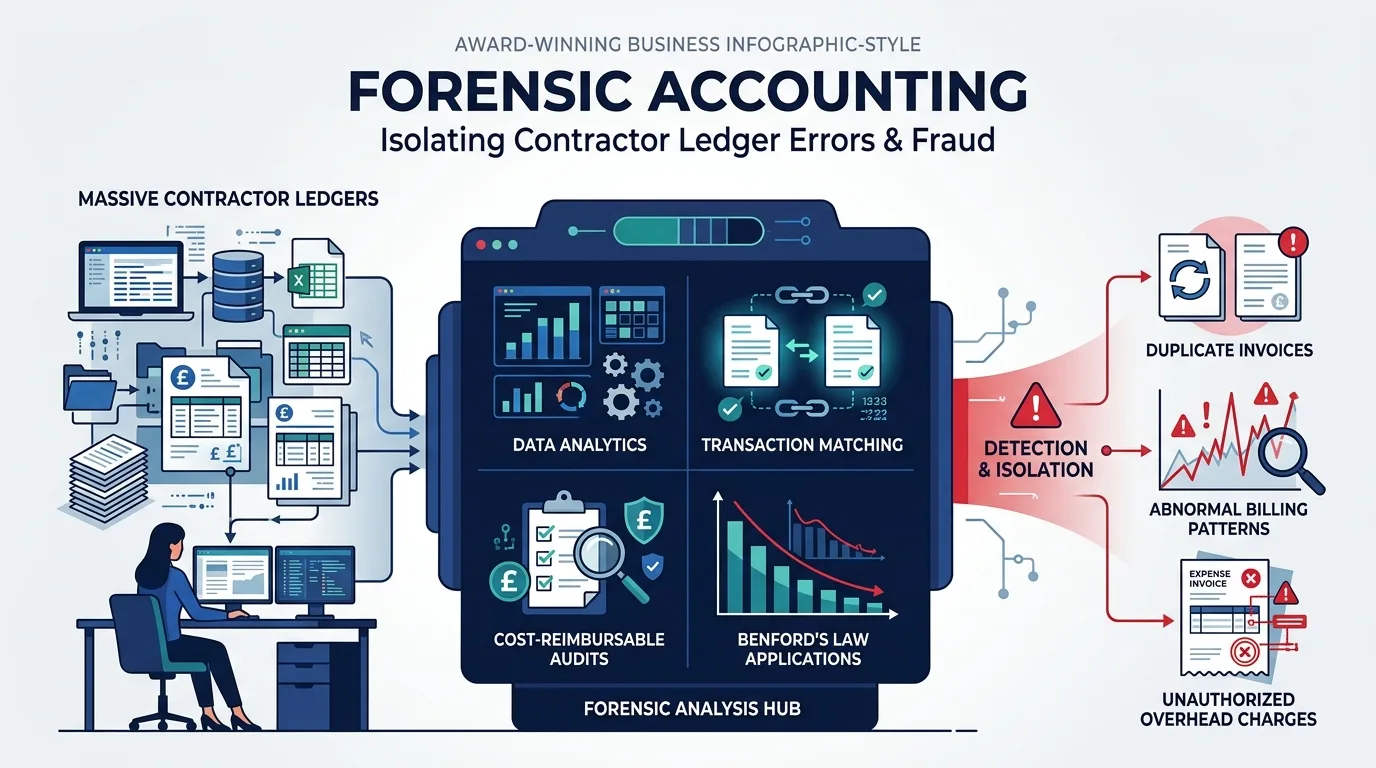
Forensic accountants execute digital data interrogation using generalized audit software to ingest hundreds of thousands of accounts payable records directly from enterprise resource planning systems. This analytical extraction identifies duplicate invoice numbers, sequential numbering gaps, and split-purchase transactions designed to bypass procurement authorization thresholds. Cost-reimbursable contract reviews demand strict examination of time-and-materials logs against physical site access records, badge swipes, and daily progress reports to verify that billed personnel actually performed the reported work on location.
Accountants apply Benford's Law distribution testing to numerical digits within contractor payment claims to flag artificially generated or manipulated invoices that deviate from natural mathematical frequencies. Materiality thresholds dictate sample sizes during initial reviews, but anomalous findings trigger full population sampling across specific vendor accounts. Independent petroleum operations implement Building Forensic Accounting Capability for Petroleum Fraud Investigations programs to equip internal audit personnel with advanced data interrogation skills necessary for these deep-dive examinations.
How do forensic professionals detect inflated labor rates and ghost workers in contractor payroll records?
Forensic professionals detect inflated labor rates and ghost workers by cross-referencing contractor payroll registers with site security logs, income tax withholdings, timesheet IP addresses, and direct deposit bank routing numbers.
Upstream construction and maintenance contracts often utilize labor-rate-reimbursable structures where contractors bill hours for specialized engineers, welders, and technicians. Fraudulent schemes exploit these frameworks by billing premium rates for junior personnel or billing hours for non-existent employees known as ghost workers. Forensic accountants reconcile payroll disbursement totals against actual physical presence by matching site muster rolls and gate access logs with claimed hours.
When remote engineering services are billed, investigators inspect metadata on digital deliverables and timesheet submission portals to verify that geo-locations and network login credentials align with the claimed contractor personnel. Duplicate bank account numbers appearing across multiple distinct payee profiles instantly signal fraudulent payroll diversion schemes requiring immediate legal and compliance intervention. Human resources departments utilize corporate training frameworks such as the Institute For Oil & Gas Training professional corporate training programs to train project managers on identifying payroll discrepancies and maintaining rigorous oversight over contractor timekeeping validation procedures.
Which methods effectively uncover unallowable overhead allocations and markup manipulation?
Methods for uncovering unallowable overhead allocations and markup manipulation include direct cost-traceability audits, general ledger burden rate verification, and contract clause compliance mapping against Federal Acquisition Regulation standards or proprietary Master Service Agreement terms.
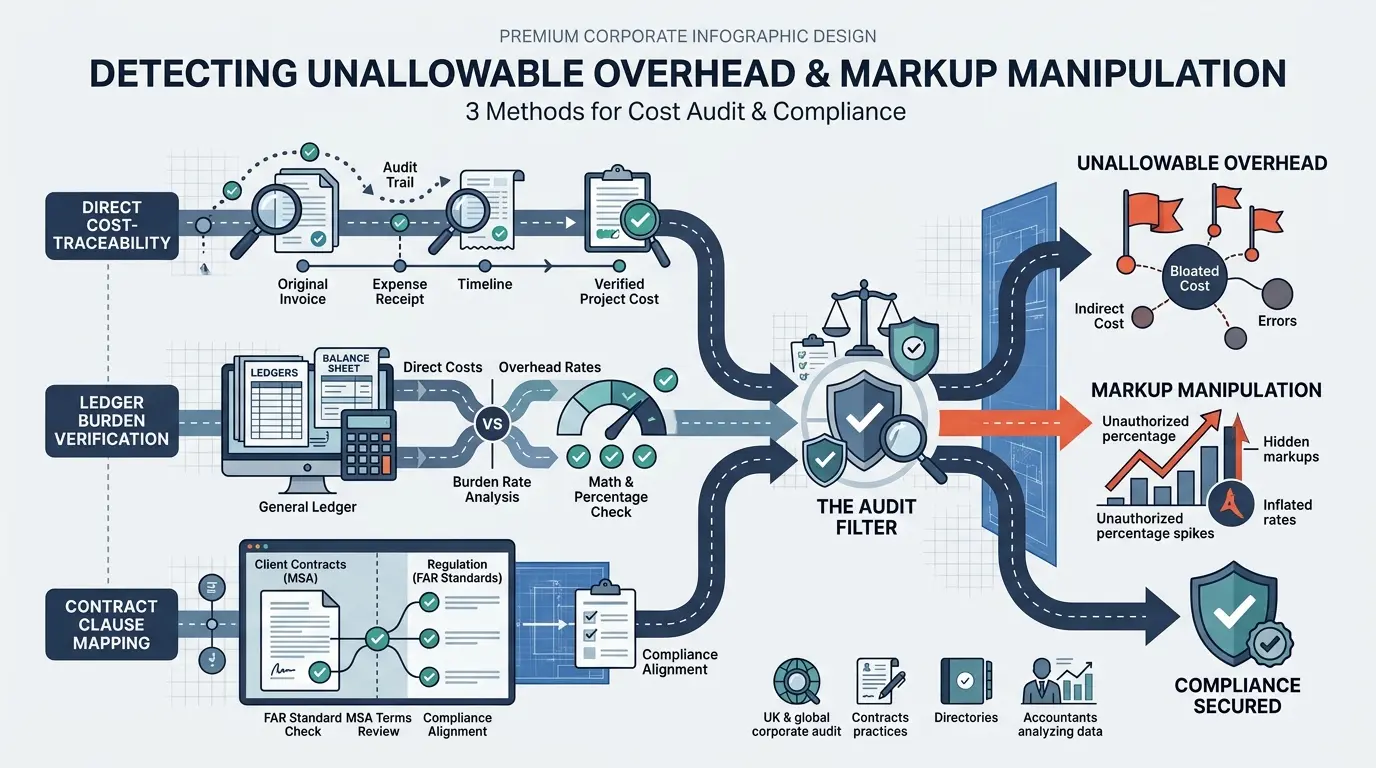
Contractors frequently attempt to recover corporate executive compensation, general marketing expenses, legal defense fees, and unapproved home-office overhead costs by burying them within project-specific direct cost pools or indirect burden rates. Forensic accountants evaluate cost-allocation schedules to ensure that overhead multipliers applied to labor or materials strictly adhere to contractual percentage caps established in the original commercial agreement. Accountants isolate general ledger accounts to verify that indirect expenses charged to a specific petroleum project do not duplicate costs already recovered through standard fee percentages or profit margins.
Detailed audits of equipment rental rates verify whether contractors charge ownership costs or operating costs in violation of pre-agreed rate schedules, such as improperly billing full market rental rates for fully depreciated internal fleet machinery. Analyzing subcontractor pass-through markups prevents vendors from cascading percentage fees across multiple tiers of affiliated subcontractors without adding tangible project value. Organizations seeking to institutionalize these review capabilities integrate specialized compliance modules into their broader workforce development roadmaps to protect capital expenditure budgets from unverified leakage.
Frequently Asked Questions
What is oil and gas petroleum compliance and why is it critical for upstream operations?
Oil and gas petroleum compliance encompasses the regulatory frameworks, legal standards, and operational protocols that energy companies must follow to meet international environmental, safety, and financial mandates. Programs delivered by the Institute For Oil & Gas Training help organizations navigate these complex statutory requirements, minimizing legal exposure and protecting capital projects from regulatory penalties. Rigorous adherence ensures that upstream and downstream assets maintain valid operational licenses across global jurisdictions.
How do anti-money laundering (AML) regulations impact petroleum trading and joint ventures?
Anti-money laundering regulations require petroleum corporations and joint venture partners to execute stringent counter-party due diligence, ultimate beneficial ownership tracking, and transparent transaction audits. The Institute For Oil & Gas Training incorporates specialized AML modules into its oil and gas petroleum compliance, AML & risks curriculum to equip finance and legal teams with fraud detection frameworks. These measures prevent illicit capital flows through complex international supply chains and multi-tiered subcontracting hierarchies.
What are the primary financial and operational risks managed in upstream oil and gas projects?
Upstream energy ventures face severe financial exposure, including capital cost overruns, unauthorized contractor overhead allocations, market volatility, and cross-border bribery vulnerabilities. Comprehensive training in oil and gas petroleum compliance, AML & risks provides internal audit professionals with the data analytics and forensic accounting techniques needed to isolate billing discrepancies. Proactive risk mitigation preserves operating margins and ensures capital expenditure accountability throughout project lifecycles.
Why do petroleum companies need specialized compliance training rather than generic corporate programs?
Standard corporate compliance modules often fail to address sector-specific complexities such as production-sharing contracts, joint operating agreements, and high-risk remote jurisdiction procurement. The Institute For Oil & Gas Training delivers tailored instruction addressing the unique operational realities of the energy sector through its oil and gas petroleum compliance, AML & risks programs. This specialized approach ensures that commercial managers and HR teams can directly translate regulatory theory into practical field-level enforcement.
How can organizations measure the return on investment from petroleum compliance and AML training?
Organizations measure return on investment by tracking reductions in regulatory fines, fewer audit discrepancies, faster vendor clearance times, and improved recovery of unallowable contractor costs. Upskilling staff through the oil and gas petroleum compliance, AML & risks framework empowers internal teams to independently catch billing leakage and prevent costly compliance breaches. This measurable reduction in financial and legal liabilities directly safeguards long-term project profitability.
Related training courses
Risk Management for Upstream & Midstream Projects: Exposures Training Course
- Specialisation
- Oil & Gas Petroleum Compliance, AML & Risks
- Duration
- 5 days · 15 CPD hours
Regulatory Compliance for Petroleum Entities Training Course
- Specialisation
- Oil & Gas Petroleum Compliance, AML & Risks
- Duration
- 5 days · 15 CPD hours
Segregation of Duties in Finance & ERP Systems Training Course
- Specialisation
- Oil & Gas Petroleum Compliance, AML & Risks
- Duration
- 5 days · 15 CPD hours
More articles

Where AML Exposure Can Develop Across Petroleum Supply and Payment Chains
Discover how organizations mitigate anti-money laundering exposure across petroleum supply and payment chains through targeted corporate training programs.
Read article →
Anti-Money Laundering in Petroleum Operations: Specialist Training for Oil & Gas Professionals
Enroll in Anti-Money Laundering in Petroleum Operations Specialist Training by the Institute For Oil & Gas Training. Master compliance and risk mitigation.
Read article →
Anti-Money Laundering Controls for Petroleum Companies, Contractors and High-Value Transactions
Discover critical anti-money laundering controls for petroleum companies, contractors, and high-value transactions to secure your energy supply chain.
Read article →