

The Break Even Oil Price Analysis Training for Oil and Gas Financial Analysis Professionals is a specialized corporate program that resolves critical financial modeling gaps, enabling asset managers and petroleum economists to accurately calculate field-level profitability thresholds and portfolio resilience.
In modern energy sector asset management, corporate decision-makers frequently encounter significant variances between predicted project economics and realized cash flows. This gap stems from inconsistent application of break-even metrics across disparate upstream asset classes. Financial analysts must possess standardized methodologies to stress-test petroleum assets under dynamic market conditions, ensuring capital is allocated exclusively to resilient projects. Understanding Why Break Even Oil Price Analysis Matters for Oil and Gas Field and Portfolio Decisions provides the essential foundational context for addressing these financial modeling challenges across upstream portfolios.
Organizations operating across multi-field portfolios require unified analytical frameworks to compare assets accurately. Without rigorous training in cost accounting and cash flow modeling, internal teams risk misinterpreting field performance, leading to premature asset abandonment or capital misallocation. The Institute For Oil & Gas Training developed the Break-even Oil Price Analysis for Field & Portfolio Training Course to equip finance professionals, petroleum engineers, and planning teams with specification-driven, repeatable financial modeling capabilities.
What Is the Break-even Oil Price Analysis Course and What Problem Does It Solve?
This course is an intensive corporate training program designed to eliminate inconsistencies in petroleum financial modeling by teaching professionals how to calculate, standardize, and apply full-cycle and half-cycle break-even oil prices across complex upstream project portfolios.
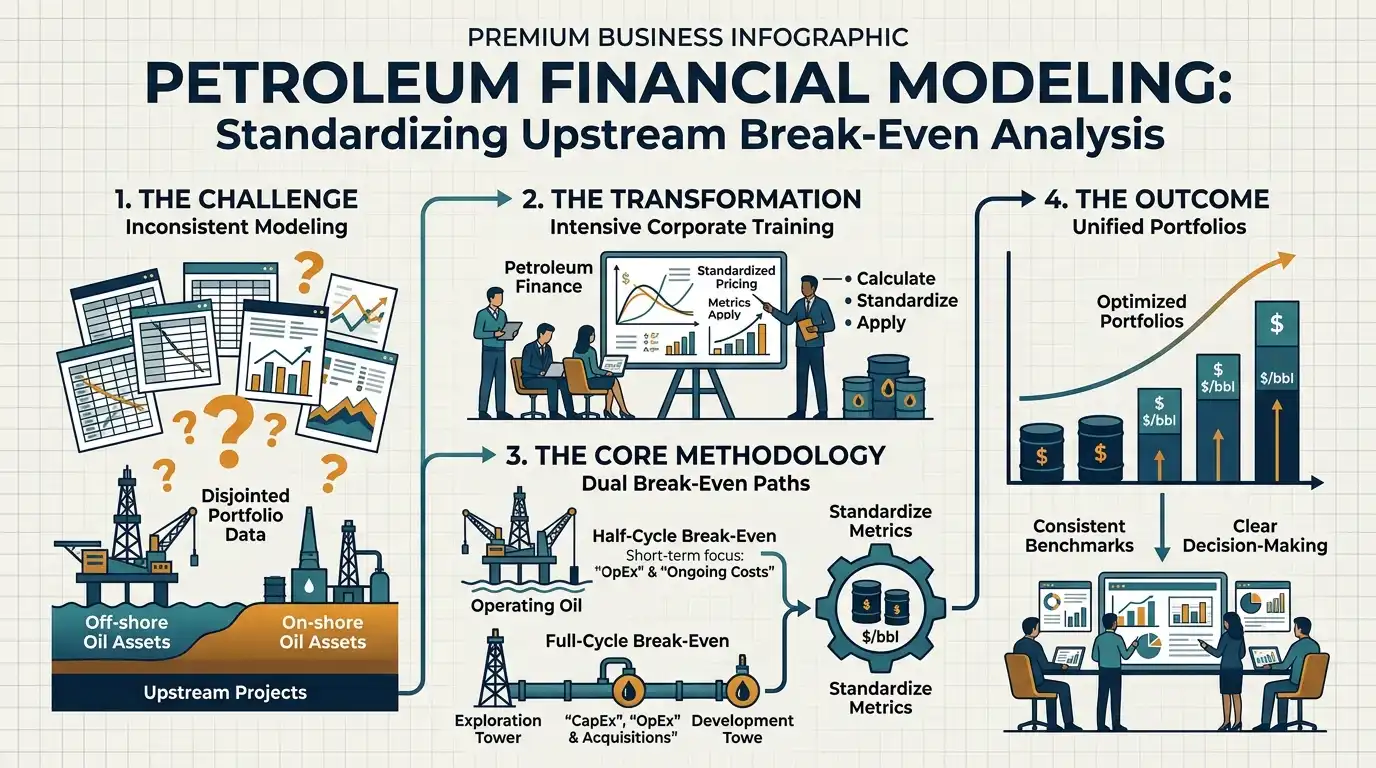
Upstream petroleum finance requires precise distinction between operating liquidity requirements and long-term project profitability. Many corporate finance teams struggle to standardize metric definitions across international operating units. This leads to misaligned capital expenditure requests and inaccurate portfolio risk assessments.
Resolving Critical Financial Modeling Gaps
A primary challenge in upstream financial analysis is the inconsistent treatment of fixed versus variable operational expenditures. Analysts frequently conflate short-term operating liquidity thresholds with total project cost recovery baselines. The Institute For Oil & Gas Training addresses this technical gap directly through practical cash flow modeling exercises. Participants learn to isolate variable operating fees from capital recovery demands across complex production profiles.
Furthermore, corporate planning units often lack standardized formulas for calculating the cost per barrel of oil equivalent across mixed hydrocarbon assets. When gas and natural gas liquids are present, improper energy conversion factors distort the calculated unit operating cost. This program establishes uniform accounting protocols for energy equivalency, ensuring financial analysts deliver accurate reports to investment committees.
Bridging the Engineering-Finance Divide
Corporate multidisciplinary teams often experience friction due to divergent technical terminology. Reservoir engineers present production profiles using volumetric decline curves, whereas corporate finance managers require discounted cash flow projections. This course bridges the gap by translating physical field profiles directly into standardized financial metrics.
Participants gain direct exposure to marginal barrel economics, learning how incremental production volumes impact overall field profitability thresholds. By establishing a shared analytical language, corporate engineering and finance departments reduce project evaluation lead times and improve the precision of budget submissions presented to executive leadership.
Why Is This Course Structured Around Field and Portfolio Decision-Making?
The curriculum follows a progressive structural path from single-well economic metrics to multi-field portfolio optimization, ensuring participants master baseline financial mechanics before evaluating complex corporate capital allocation scenarios and dynamic market risk frameworks.
Effective corporate training must mirror the actual decision-making hierarchy of petroleum enterprises. The Institute For Oil & Gas Training structures learning modules sequentially to build analytical confidence. Technical concepts progress from basic field-level cost accounting to advanced corporate portfolio risk modeling.
Evaluating asset economics requires a clear comparative framework. Financial analysts must master asset-level mechanics before assessing multi-field corporate trade-offs. Reviewing How to Evaluate Break Even Oil Prices Across Petroleum Fields and Investment Portfolios demonstrates how structured evaluation frameworks support multi-asset portfolio optimization.
Sequential Learning Progression
The program begins with asset-level unit economics, focusing on the mechanical components of the unit technical cost. Participants analyze historical field expenditure data to separate past capital outlays from forward-looking operational liabilities. This foundational knowledge prevents common analytical errors, such as including sunk costs in future operational decisions.
Once field-level mechanics are mastered, the curriculum transitions to portfolio-level financial aggregation. Analysts practice constructing corporate cost curve positioning models that display entire field inventories according to their respective break-even price thresholds. This visual approach allows executive committees to identify vulnerable assets during periods of price volatility.
Integration of Real-World Constraints
Corporate investment decisions are rarely made under static market conditions. Therefore, the curriculum incorporates variable tax regimes, production sharing contracts, and royalty sliding scales. Participants construct economic models that account for local fiscal terms affecting net project revenues.
The Institute For Oil & Gas Training designs every module to reflect actual corporate workflow requirements. By modeling fiscal terms within standard financial software, analysts learn how regulatory adjustments alter the cash break-even price of offshore and onshore fields.
What Will Participants Learn in the Break-even Oil Price Analysis Program?
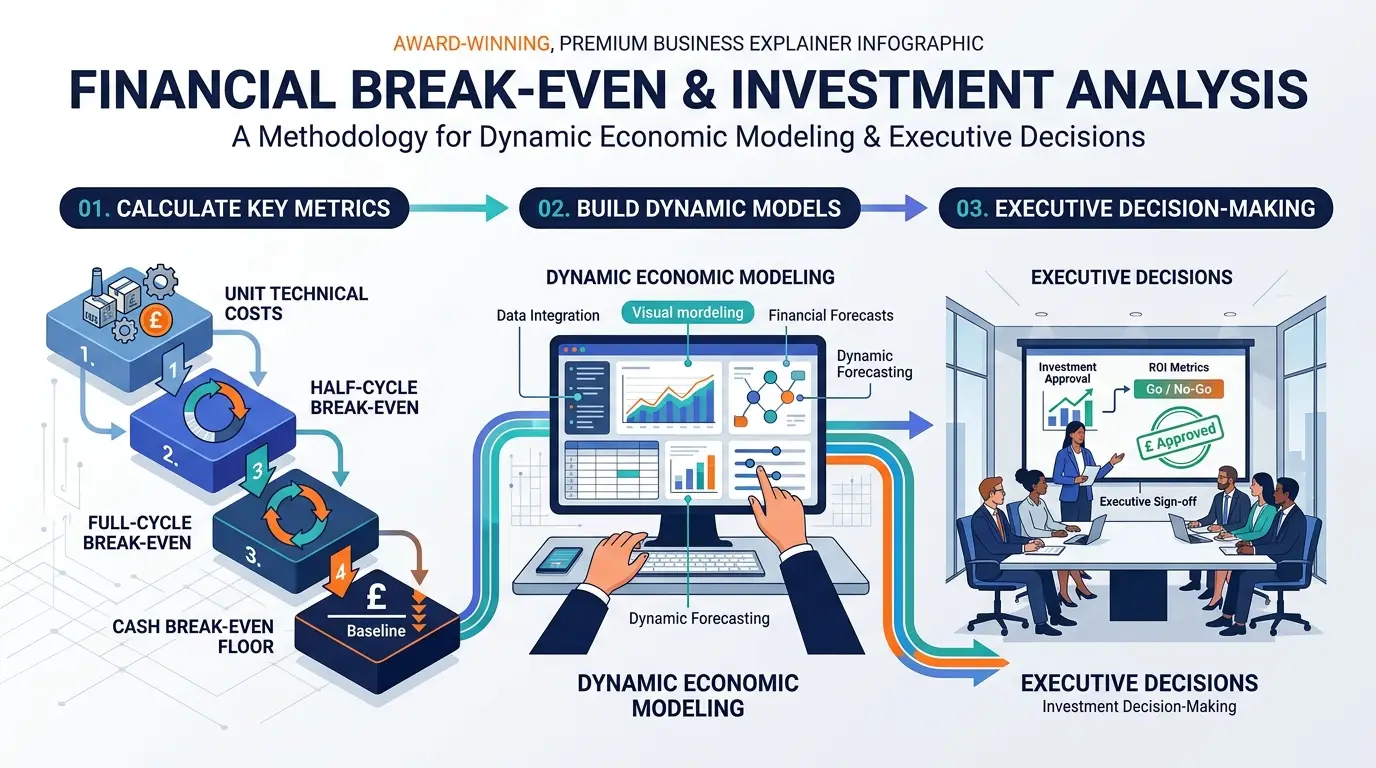
Participants master the step-by-step methodology for calculating unit technical costs, half-cycle break-evens, full-cycle break-evens, and cash break-even price floors while building dynamic economic models for executive investment decision-making.
Module Title | Core Skill Focus | Primary Learning Outcome |
Module 1: Cost Accounting & Baselines | Unit Operating Cost & Cost/BOE | Establish standardized field operating cost baselines. |
Module 2: Field Break-Even Metrics | Half-Cycle vs. Full-Cycle | Differentiate operating floors from full capital recovery. |
Module 3: Portfolio Cost Curves | Cost Curve Positioning | Map multi-field portfolios against price scenarios. |
Module 4: Risk & Price Floor Strategy | Price Floor Determination | Establish hedging baselines and capital allocation rules. |
Module 1: Upstream Cost Accounting and Baseline Metrics
This initial module establishes clear definitions for primary upstream financial metrics. Participants examine field operating statements to calculate the exact unit operating cost under varying production throughput levels.
Standardization of cost per barrel of oil equivalent accounting methods across oil, condensate, and natural gas streams.
Separation of fixed facility maintenance expenses from variable lift and processing expenditures.
Formulation of standardized operating expense baselines for corporate bench-marking reports.
Module 2: Field-Level Break-Even Mechanics
The second module focuses on the mathematical formulation of field-specific economic thresholds. Analysts build dynamic spreadsheet models to determine distinct profitability benchmarks across different asset lifecycles.
Calculation of the half cycle break-even price for mature producing assets with fully amortized capital expenditures.
Derivation of the full cycle break-even price for greenfield exploration and field development projects.
Determination of the cash break-even price required to maintain operational solvent liquidity without capital injection.
Module 3: Portfolio Aggregation and Cost Curve Positioning
In this module, participants aggregate individual field economic models into multi-asset corporate portfolio matrices. The training focuses on evaluating relative competitiveness across diverse operating environments.
Construction of supply-stack cost curves to evaluate corporate cost curve positioning against global peer benchmarks.
Assessment of marginal barrel economics to optimize field production choke settings under reduced oil price regimes.
Application of capital allocation frameworks to prioritize infill drilling campaigns across competing field assets.
Module 4: Risk Mitigation and Price Floor Determination
The final core module addresses executive decision-making under commodity price uncertainty. Analysts learn to establish operational price floors that guide corporate risk management strategies.
Systematic price floor determination to inform corporate commodity hedging and downside protection strategies.
Stress-testing asset portfolios against severe commodity price drops and sustained low-margin environments.
Formulation of clear, data-driven capital allocation recommendations for presentation to corporate investment boards.
How Is the Training Delivered by the Institute For Oil & Gas Training?
The course is delivered through interactive hands-on workshops, live virtual sessions, or customized onsite corporate programs featuring structured financial modeling simulations, peer case reviews, and direct instructor feedback.
To accommodate corporate schedules, the Institute For Oil & Gas Training offers flexible learning formats without compromising instructional rigour. Every format incorporates real-world corporate financial data and practical modeling exercises.
Flexible Delivery Formats
In-Person Intensive Workshops: Held over three consecutive days at corporate regional hubs, offering immersive modeling sessions and peer collaboration.
Live Virtual Classrooms: Structured across four weeks with two three-hour interactive sessions per week, designed for remote corporate finance teams.
Customized Onsite Corporate Training: Tailored specifically for corporate departments, using the enterprise's proprietary field data and fiscal templates.
Interactive Methodology and Assessment
The pedagogical framework emphasizes practical execution over passive instruction. Participants work directly within standard spreadsheet software, constructing fully dynamic economic models from scratch.
Progress is measured through objective assessment checkpoints:
Baseline Modeling Examination: Evaluates technical understanding of upstream cost metrics and mathematical formulas.
Practical Case Simulation: Requires participants to construct a full portfolio model from raw field expenditure inputs.
Executive Board Presentation: Assessment of the participant’s ability to present data-driven asset recommendations clearly.
What Measurable Results Can Organizations Expect After Completion?
Organizations achieve standardized corporate financial reporting, reduced capital misallocation risk, enhanced cross-departmental alignment, and clear price floor visibilities across all field development planning units.
Implementing uniform financial analysis standards generates immediate operational efficiencies across corporate planning units. The Institute For Oil & Gas Training focuses on delivering tangible improvements in team productivity and capital efficiency.
Corporate Workflow Standardization
Following completion of the Break-even Oil Price Analysis for Field & Portfolio Training Course, corporate finance teams operate using a unified set of analytical definitions. This eliminates conflicting economic figures between field operating units and central planning departments.
Elimination of ambiguous cost definitions in corporate capital expenditure proposals.
Faster compilation of quarterly portfolio performance reports for corporate executive committees.
Enhanced capacity to run rapid scenario analyses during unexpected market price shifts.
Measurable Value for Human Resources and L&D Teams
For Human Resources and Learning and Development managers, this program provides a quantifiable skill development pathway for finance and planning personnel.
Defined Skill Progression: Clear metrics for evaluating financial analyst competency levels before and after training.
Targeted Performance Gain: Measurable reduction in the time required for analysts to build field economic models.
Talent Retention: Demonstrated investment in senior analytical staff, improving engagement and corporate retention rates.
How Does Enrollment Work for Individuals and Corporate Teams?
Enrollment involves a formal candidate background assessment, selection of the preferred delivery format, and completion of pre-course quantitative prerequisites to ensure maximum cohort cohesion and learning success.
The Institute For Oil & Gas Training maintains selective enrollment criteria to ensure high-level technical discussions within every participant cohort. Candidates must demonstrate foundational knowledge of financial statements or petroleum engineering concepts prior to admission.
Participant Eligibility Criteria
This program is structured specifically for professionals operating within or supporting upstream energy organizations:
Financial Analysts and Petroleum Economists: Seeking to master advanced field-level cost accounting methodologies.
Asset Managers and Reservoir Engineers: Requiring deeper knowledge of corporate financial trade-offs and capital allocation metrics.
Corporate Planning and Commercial Managers: Responsible for structuring long-term strategy and portfolio risk management.
Finance Leadership and HR Teams: Seeking structured corporate upskilling programs for internal analytics departments.
Step-by-Step Enrollment Process
Candidates complete a brief background application detailing their current role and analytical responsibilities. Corporate HR teams enrolling multi-member departments can coordinate directly with the admissions office to secure customized scheduling and tailored case study materials.
Upon formal verification of prerequisites, participants receive access to pre-course orientation materials covering basic upstream financial accounting definitions. This ensures all cohort members arrive prepared to build advanced economic models from the first instructional session.
To register your team and secure placement in an upcoming training cohort, click here to enroll in this program.
Frequently Asked Questions
What is included in Oil and Gas Petroleum Financial Analysis training?
Oil and Gas Petroleum Financial Analysis training covers asset-level economic evaluation, dynamic cash flow modeling, capital allocation frameworks, and risk management strategies across upstream portfolios. Participants at the Institute For Oil & Gas Training learn to calculate critical financial metrics such as unit operating costs, full-cycle break-even prices, and fiscal regime adjustments. The curriculum combines practical modeling exercises with corporate decision-making frameworks to evaluate field performance under commodity price volatility.
How does petroleum financial analysis help in field development decisions?
Petroleum financial analysis provides a quantitative framework to evaluate capital investments, operational expenditure floors, and projected investment returns prior to committing funds to field development. By standardising metrics like half-cycle break-even prices and unit technical costs, energy finance teams can compare competing projects across diverse fiscal environments. The Institute For Oil & Gas Training equips analysts with the economic tools required to stress-test project viability and optimize portfolio capital allocation.
Who should take a corporate course in Oil and Gas Petroleum Financial Analysis?
A corporate course in Oil and Gas Petroleum Financial Analysis is designed for petroleum economists, financial analysts, asset managers, reservoir engineers, and corporate planning teams. It also provides strategic value for HR departments and L&D managers seeking structured upskilling programs to align cross-functional engineering and finance personnel. Programs delivered by the Institute For Oil & Gas Training cater to both individual financial practitioners and enterprise teams requiring standardized corporate evaluation methodologies.
What is the difference between half-cycle and full-cycle break-even price analysis?
Half-cycle break-even analysis calculates the oil price required to cover ongoing operating expenses and remaining development costs for existing producing assets, ignoring past sunk capital. In contrast, full-cycle break-even analysis includes all historical exploration, land acquisition, appraisal, and field development capital outlays to determine total project profitability. The Institute For Oil & Gas Training teaches professionals how to construct financial models incorporating both metrics to inform operational and strategic asset decisions.
How does the Institute For Oil & Gas Training deliver petroleum financial analysis courses?
The Institute For Oil & Gas Training delivers Oil and Gas Petroleum Financial Analysis through flexible formats, including intensive in-person workshops, live virtual classrooms, and customized on-site corporate training programs. Each course incorporates hands-on financial modeling simulations, real-world case studies, and practical assessments based on actual industry data. This practical structure ensures participants acquire measurable, workplace-ready skills that immediately enhance organizational financial reporting and project evaluation.
Related training courses
Corrosion Control in Petroleum Refineries Training Course
- Specialisation
- Oil & Gas Corrosion Management and Control
- Duration
- 5 days
Asset Integrity Management Systems Training Course
- Specialisation
- Oil & Gas Asset Integrity Management
- Duration
- 5 days · 15 CPD hours
Internal Audit, Risk Management and Compliance Training Course
- Specialisation
- Oil & Gas Petroleum Compliance, AML & Risks
- Duration
- 5 days · 15 CPD hours
More articles

Production Forecasting and Decline Curve Analysis Training for Oil and Gas Finance Professionals
Master production forecasting and decline curve analysis. Evaluate reservoir performance for oil and gas financial planning.
Read article →
How to Evaluate Production Forecasts and Decline Curves for Reliable Financial Analysis
Learn how to evaluate production forecasts and decline curves to improve financial modeling, risk assessments, and asset valuations in oil and gas.
Read article →
Why Production Forecasting and Decline Curve Analysis Matter in Oil and Gas Financial Planning
Discover why production forecasting and decline curve analysis drive oil and gas financial planning, workforce capability, and corporate capital allocation.
Read article →