

Scenario planning in oil and gas financial decision making is a structured strategic framework that evaluates multiple plausible future operating conditions to quantify risk, optimize capital allocation, and protect liquidity against extreme commodity price volatility.
Scenario planning allows energy corporations to model complex macroeconomic variables, regulatory shifts, and geopolitical developments before committing capital expenditure. Traditional forecasting relies on linear extrapolation of current market conditions, which exposes balance sheets to sudden price shocks. Scenario planning evaluates severe downside risks, baseline expectations, and high-margin upside potential simultaneously. This analytical rigor equips corporate leaders to build resilient financial structures and safeguard long-term enterprise value.
Organizations operate within high-risk capital environments where projects require investments spanning decades. Strategic scenario analysis transforms unquantifiable market uncertainty into defined operational parameters. Financial analysts evaluate key variables like crude benchmarks, shipping tariffs, foreign exchange fluctuations, and carbon taxation rates across distinct operating cases. This systematic evaluation process bridges the gap between high-level executive strategy and granular corporate accounting, ensuring continuous alignment with organizational risk tolerance thresholds.
From an organizational performance perspective, mastering scenario planning requires deliberate talent development. Energy firms must train finance managers, treasury professionals, and operational leaders to collaborate using standardized methodologies. Financial decision making improves when cross-functional teams build shared analytical capabilities, replacing isolated departmental assumptions with unified risk models. Organizations that embed scenario planning capabilities across their workforce execute capital deployments faster and protect profit margins during prolonged market downturns.
How Does Scenario Planning Work in Corporate Environments?
Scenario planning works in corporate environments by establishing a systematic five-stage execution process that translates high-level market variables into clear financial decision triggers, dynamic risk models, and proactive capital protection strategies across cross-functional enterprise teams.
The process begins with driver identification, where financial planning and analysis (FP&A) teams pinpoint critical external variables affecting profitability. These drivers include global crude price indexes, interest rates, field depletion schedules, and regional inflation rates. Analysts assess historical correlation data across 10 to 20 years to isolate which variables exert the strongest impact on operating margins. Identifying these core metrics ensures that financial models remain focused on drivers that directly influence enterprise solvency.
The second stage centers on plausible narrative construction. Subject matter experts convert macro data into realistic future operating environments rather than speculative guesses. Teams formulate detailed operational storylines describing specific market conditions, such as a 30% supply shock or rapid regulatory decarbonization mandates. These narratives serve as the underlying qualitative logic for quantitative stress testing, ensuring financial projections reflect real-world operational constraints across global supply chains.
The third stage executes quantitative stress testing across corporate balance sheets and cash flow projections. Financial modeling professionals input narrative parameters into integrated financial statements to observe changes in debt coverage ratios, free cash flow generation, and project net present value (NPV). This stress testing exposes capital vulnerabilities before market downturns occur, allowing leadership teams to establish robust liquidity buffers and revise dividend distribution strategies.
The fourth stage establishes actionable decision triggers tied to specific quantitative thresholds. For example, if crude prices fall below $55 per barrel for two consecutive quarters, a predefined contingency plan automatically halts high-cost exploration drilling. Establishing these strategic triggers eliminates emotional bias and executive delay during market crises, allowing energy firms to execute capital preservation strategies instantly.
The final stage involves ongoing governance and performance tracking. Corporate leadership reviews scenario parameters quarterly to adjust baseline assumptions as geopolitical and economic conditions evolve. Organizations implement structured learning initiatives, such as targeted finance workshops and case-based simulations, to ensure financial controllers, risk officer teams, and project managers maintain full alignment on risk parameters and dynamic capital allocation workflows.
What Key Components Make Up an Effective Scenario Planning Framework?
An effective scenario planning framework comprises driver identification methodologies, plausible narrative construction protocols, base case assumptions, upside and downside case modeling, probability weighting formulas, decision triggers, and structured contingency planning matrices.
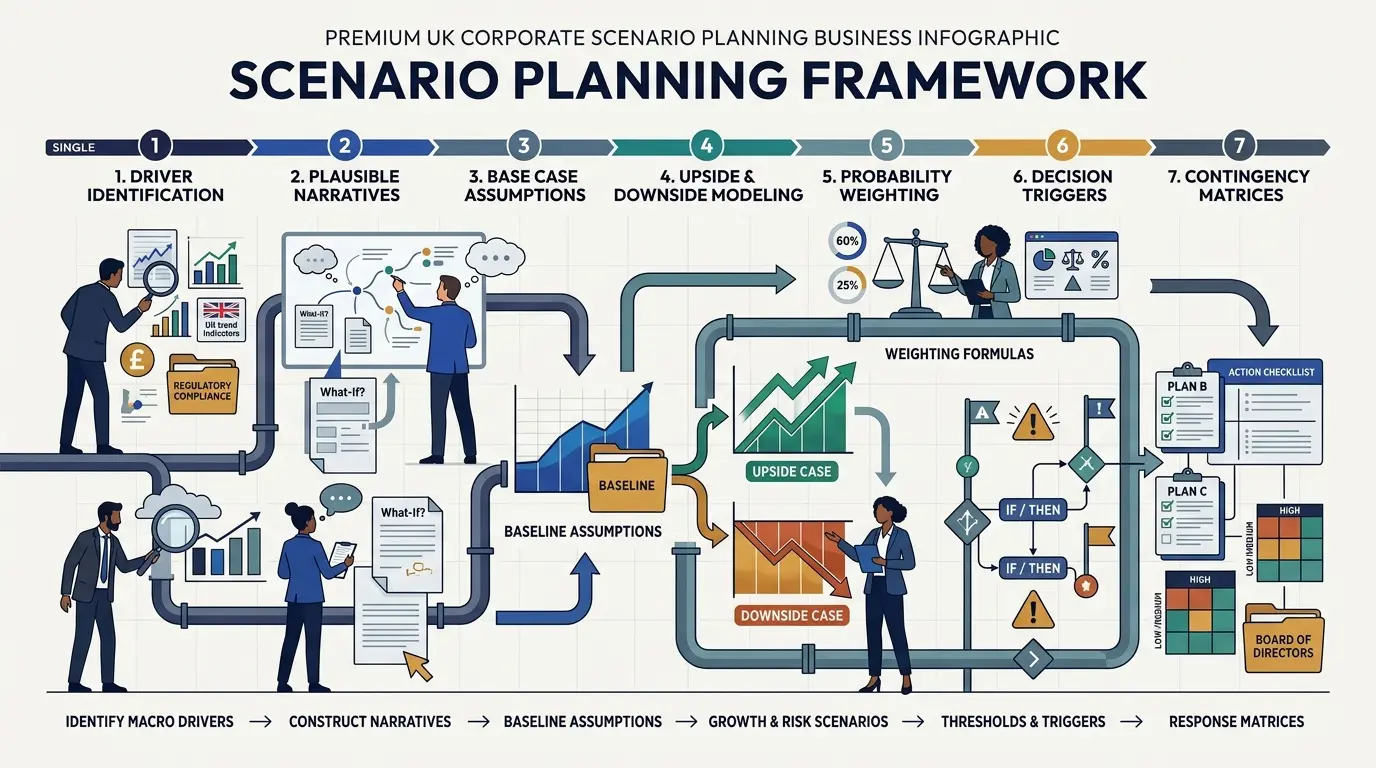
Driver Identification and Narrative Construction
Driver Identification: The analytical process of isolating primary macroeconomic, technological, and regulatory forces that dictate cash flow stability. In capital-intensive sectors like upstream exploration, power generation, and refining, primary drivers include Brent crude benchmarks, regional natural gas hub pricing, shipping freight indexes, and localized labor costs.
Plausible Narrative Construction: The creation of logical, internally consistent qualitative stories describing potential future business environments. These narratives establish clear context for financial models, helping corporate leadership understand how distinct external forces interact during crises.
Scenario Baseline and Extreme Modeling
Base Case Assumptions: The baseline financial projections built on median consensus estimates for commodity pricing, production volume targets, and routine operating expenses. This serves as the operational benchmark for annual budgeting and performance measurement.
Upside and Downside Case: Quantitative models representing best-case growth opportunities and severe economic contraction scenarios. Downside modeling stress-tests debt service capacity during low-margin periods, while upside modeling identifies capacity expansion triggers during demand spikes.
Probability Weighting: The mathematical assignment of likelihood percentages to each modeled case, enabling teams to calculate expected value outcomes across complex capital expenditure decisions.
Strategic Triggers and Execution Plans
Decision Triggers: Defined metric thresholds that automatically activate operational changes, capital realignments, or risk mitigation protocols when breached.
Contingency Planning: Pre-approved action plans detailing cost-reduction protocols, facility preservation strategies, or asset divestments triggered by specific operational thresholds.
Strategic Option Evaluation: The methodology used to score competing corporate initiatives based on their flexibility, capital efficiency, and return profile across all modeled futures.
How Do Organizations Implement Scenario Planning Capabilities?
Organizations implement scenario planning capabilities through a structured rollout incorporating executive governance, modern corporate learning frameworks, cross-functional workshops, integrated software toolkits, and measurable key performance indicators to ensure long-term strategic execution.
Implementation begins with a comprehensive skills gap analysis across finance, treasury, and asset management departments. Corporate learning leaders evaluate current analytical capabilities to identify weaknesses in stress testing, financial modeling, and strategic risk assessment. Organizations then deploy targeted professional development initiatives using a 70-20-10 learning architecture—combining 70% experiential on-the-job application, 20% peer coaching, and 10% formal instructional training.
Formal instruction is delivered through practical, cohort-based formats. Organizations utilize 3-day intensive executive workshops, 6-week hybrid digital learning modules, and immersive simulation labs. During these sessions, finance teams work directly on real historical company data to build dynamic financial models, formulate decision triggers, and stress-test hypothetical corporate acquisitions. This experiential approach bridges the gap between theoretical finance concepts and daily operational decision making.
Organizations seeking to build internal proficiency in modeling complex financial cases often enroll cross-functional planning cohorts in specialized external programs like the Scenario Planning for Base, Upside & Downside Cases Training Course. Structured external training exposes internal teams to industry-best frameworks, ensuring enterprise models align with global corporate governance and financial accounting standards.
Successful implementation requires integrating these scenario methodologies into existing corporate enterprise resource planning (ERP) systems and financial planning software. Finance professionals link quantitative models directly to monthly management reporting cycles, ensuring executive committees evaluate capital requests against multi-case scenarios rather than single-point estimates. This structural alignment elevates financial decision making from reactive budgeting to proactive corporate risk management.
To track implementation success, enterprise learning and HR professionals evaluate specific organizational health and financial performance metrics.
Implementation Dimension | Key Performance Indicator (KPI) | Target Benchmark |
Talent Proficiency | Financial Modeling Skill Assessment Score | 85%+ competency rate |
Decision Velocity | Time Required to Adjust CapEx Budgets | Reduction from 30 days to 5 days |
Risk Mitigation | Balance Sheet Variance in Downside Events | Under 8% variance from projection |
Capital Efficiency | Return on Capital Employed (ROCE) | 12% to 18% improvement over 24 months |
Workforce Retention | Key Finance & Planning Employee Retention | 90%+ annual retention rate |
What Are the Business Benefits and Measurable Outcomes of Scenario Planning?
Scenario planning produces measurable outcomes including up to 35% faster capital allocation decisions, a 20% reduction in unexpected downside margin losses, improved cash flow stability, and enhanced cross-functional leadership alignment.
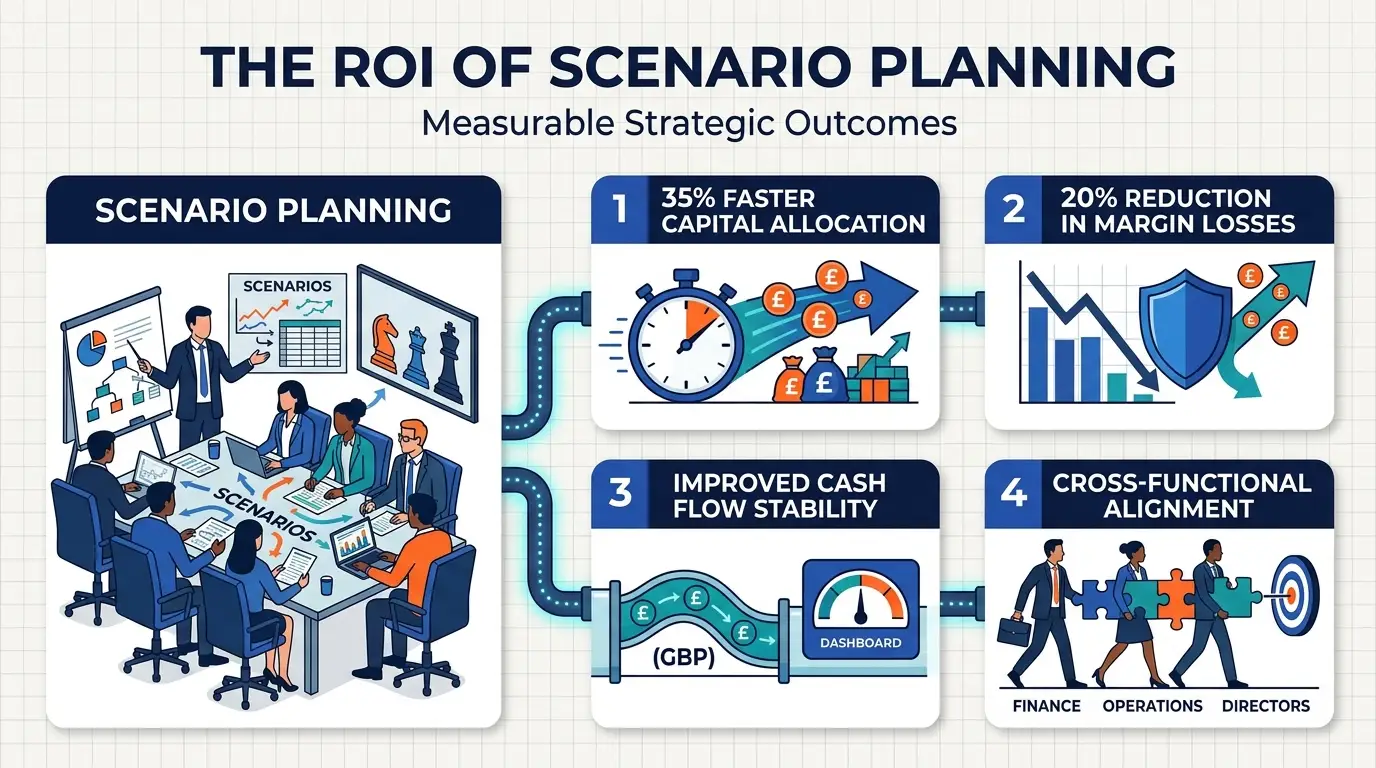
The primary organizational benefit of scenario planning is superior liquidity protection during commodity price shocks. Energy companies operating with stress-tested cash flow models maintain higher credit ratings and lower debt financing costs during industry downturns. By identifying cost reduction measures before market contractions occur, corporations avoid forced asset sales and protect core operating margins.
Scenario planning improves capital allocation efficiency across complex project portfolios. Executive boards evaluate major capital investments—such as refinery modernization, offshore field development, or renewable integration—against diverse market cases. To systematically build this internal capacity, enterprise finance teams often reference complete guidance frameworks like How to Evaluate Base Upside and Downside Scenarios in Petroleum Financial Planning. This structured analysis prevents over-investment during market peaks and ensures sustained project profitability during prolonged troughs.
From a workforce perspective, embedding scenario planning capabilities builds an adaptable executive leadership pipeline. Mid-level finance managers, commercial analysts, and engineering leads develop a deep understanding of corporate strategy and enterprise risk management. Cross-functional communication improves as technical asset teams and corporate treasury departments align around standardized decision metrics, reducing departmental friction and accelerating strategic execution across multi-billion-pound asset portfolios.
What Corporate Challenges and Misconceptions Surround Scenario Planning?
Common corporate challenges surround scenario planning, including treating scenarios as rigid price predictions, relying on static financial spreadsheets, isolating planning within finance silos, failing to establish quantitative triggers, and utilizing generic training programs that lack real-world industry context.
A common misconception is treating scenario planning as an exercise in precise price forecasting. Scenarios are not statistical predictions; they are plausible structural environments designed to test corporate resilience. When organizations focus on chasing single price point accuracy, they fail to prepare for off-model tail-risk events. Strategic success depends on evaluating how balance sheets perform under extreme stress rather than predicting exact benchmark figures.
Another major operational error is confining scenario planning strictly within the central FP&A team. When financial controllers build models without input from operational engineers, supply chain leads, and commercial trading desks, the resulting scenarios lack practical operational reality. Effective scenario execution requires cross-functional alignment across all business units to ensure decision triggers align with real-world plant capabilities, logistics bottlenecks, and contractual obligations.
Organizations frequently waste corporate learning budgets on off-the-shelf management training that lacks sector-specific financial metrics. Generic financial courses fail to address unique industry complexities such as PSC (Production Sharing Contract) accounting, field decline curves, refining crack spreads, and decommissioning liabilities. Workforce development must utilize tailored, practical case studies grounded in real-world energy market dynamics to deliver measurable learning ROI and build genuine organizational capability.
Finally, firms often build robust scenario models but fail to define binding decision triggers. A scenario plan without clear quantitative action thresholds remains a passive theoretical exercise. Executive leadership must commit to pre-approved contingency plans, ensuring that when a key market driver breaches a trigger threshold, the organization executes capital reallocation protocols immediately.
Frequently Asked Questions
What is oil and gas petroleum financial analysis?
Oil and gas petroleum financial analysis is the systematic evaluation of exploration costs, production cash flows, capital expenditure, and fiscal regimes to assess project viability and enterprise risk. Financial controllers, corporate planners, and investment analysts use these specialized modeling methodologies to evaluate asset performance under fluctuating commodity prices. Through its professional development programs, Institute For Oil & Gas Training equips industry professionals with the analytical tools necessary to perform accurate upstream valuation and financial reporting.
How does petroleum financial modeling differ from standard corporate finance?
Petroleum financial modeling differs from general corporate finance because it must account for field depletion schedules, production sharing contracts (PSCs), joint operating agreements, and extreme commodity price volatility. Oil and gas petroleum financial analysis incorporates specialized accounting standards, such as IFRS 6, along with complex decline curve analysis to forecast long-term project profitability. Programs delivered by Institute For Oil & Gas Training teach professionals how to integrate these industry-specific variables into robust dynamic financial models.
What key financial metrics are used in oil and gas investment decisions?
The key financial metrics used in petroleum investment evaluation include Net Present Value (NPV), Internal Rate of Return (IRR), Payback Period, and Capital Intensity per barrel of oil equivalent (BOE). Additionally, analysts evaluate metrics like finding and development (F&D) costs, operating cash flow per share, and break-even crude pricing thresholds to assess downside protection. Institute For Oil & Gas Training trains finance leaders and energy professionals to apply these valuation metrics accurately when structuring multi-million-pound capital allocation decisions.
Why is scenario planning important in petroleum financial decision-making?
Scenario planning is essential in petroleum financial decision-making because capital-intensive energy projects require years of development and face long-term market, geopolitical, and carbon-pricing risks. Evaluating base, upside, and downside scenarios allows corporate treasury and risk management teams to stress-test liquidity, set debt coverage thresholds, and establish proactive decision triggers. Through practical workshops, Institute For Oil & Gas Training helps corporate teams implement comprehensive oil and gas petroleum financial analysis frameworks to safeguard balance sheets against market shocks.
Who should undertake training in oil and gas petroleum financial analysis?
Training in oil and gas petroleum financial analysis is designed for financial analysts, corporate controllers, treasury managers, commercial leads, asset managers, and non-finance managers operating within the energy sector. Developing these specialized skills enables cross-functional teams to align operational planning with corporate financial strategy and risk management guidelines. Institute For Oil & Gas Training delivers tailored corporate training modules to help organizations bridge employee skill gaps, accelerate decision velocity, and improve overall capital efficiency.
Related training courses
Failure Mode and Effects Analysis (FMEA) Training Course
- Specialisation
- Oil & Gas Reliability and Maintenance Management
- Duration
- 5 days · 15 CPD hours
Damage Mechanisms (API 571) Training Course
- Specialisation
- Oil & Gas Asset Integrity Management
- Duration
- 5 days · 15 CPD hours
Oil and Gas Injection Water Treatment Training Course
- Specialisation
- Oil & Gas Water Treatment and Management
- Duration
- 5 days · 15 CPD hours
More articles

Cash Flow Stress Testing Training for Oil and Gas Financial Analysis Professionals
Evaluate financial risks with Cash Flow Stress Testing for Liquidity & Solvency Training Course by Institute For Oil & Gas Training. Enroll now.
Read article →
How to Evaluate Liquidity and Solvency Risks Through Oil and Gas Cash Flow Stress Testing
Compare evaluation models for oil and gas liquidity and solvency stress testing to safeguard corporate financial stability.
Read article →
Why Cash Flow Stress Testing Matters for Oil and Gas Liquidity and Solvency
Discover why cash flow stress testing is vital for oil and gas liquidity and solvency. Learn how workforce training strengthens corporate financial resilience.
Read article →