

Oil and gas companies operate in an environment defined by extreme commodity price volatility, high capital expenditure commitments, and complex debt structures. Maintaining continuous balance sheet resilience requires financial analysis professionals to master quantitative risk modeling techniques that extend beyond basic historical forecasting. The Institute For Oil & Gas Training offers targeted corporate education to bridge technical skill gaps in energy finance, risk management, and treasury operations. A fundamental understanding of Why Cash Flow Stress Testing Matters for Oil and Gas Liquidity and Solvency serves as the groundwork for implementing advanced balance sheet protection mechanisms across upstream, midstream, and downstream operations. This bottom-of-funnel course specification document outlines the curriculum, delivery modalities, skill progression framework, and enrollment parameters for finance teams, corporate risk managers, and treasury professionals seeking measurable analytical competence.
What Is the Cash Flow Stress Testing for Liquidity & Solvency Training Course and What Workplace Problem Does It Solve?
The Cash Flow Stress Testing for Liquidity & Solvency Training Course is a professional development program designed to train energy sector finance teams in building dynamic cash flow risk models, identifying covenant breach points, and establishing actionable balance sheet defense strategies.
Financial analyst teams in energy corporations frequently rely on deterministic discounted cash flow models that assume stable operating margins, predictable production schedules, and accessible capital markets. When market disruptions occur, these linear models fail to calculate liquidity headroom or forecast funding gap analysis requirements under constrained conditions.
This institutional skill gap leaves energy companies vulnerable to unexpected cash shortfalls, sudden credit rating downgrades, and debt default events. Without standardized stress test design capabilities, corporate finance managers cannot quantify how compound risk events impact operational continuity or dividend sustainability.
The program delivered by the Institute For Oil & Gas Training resolves these institutional weaknesses by providing structured technical training in advanced scenario modeling, dynamic balance sheet stress testing, and defensive capital planning. Practitioners transition from passive financial reporting to proactive capital preservation analysis.
Corporate HR departments and executive leadership teams utilize this course to standardize financial risk evaluation standards across sub-units. The curriculum establishes clear analytical protocols that allow treasury staff, project analysts, and corporate planning executives to collaborate using uniform quantitative risk metrics.
By addressing the specific financial mechanics of capital-intensive energy projects, the training ensures participants master practical risk assessment methodologies immediately applicable to upstream asset valuation, pipeline project financing, and refining margin risk management.
Why Is This Corporate Finance Course Structured in a Progressive Learning Logic?
The training structure follows a sequential skill-building framework that advances participants from core risk mechanics and scenario formulation to complex quantitative modeling, liquidity headroom evaluation, covenant monitoring, and executive-level balance sheet mitigation plan execution.
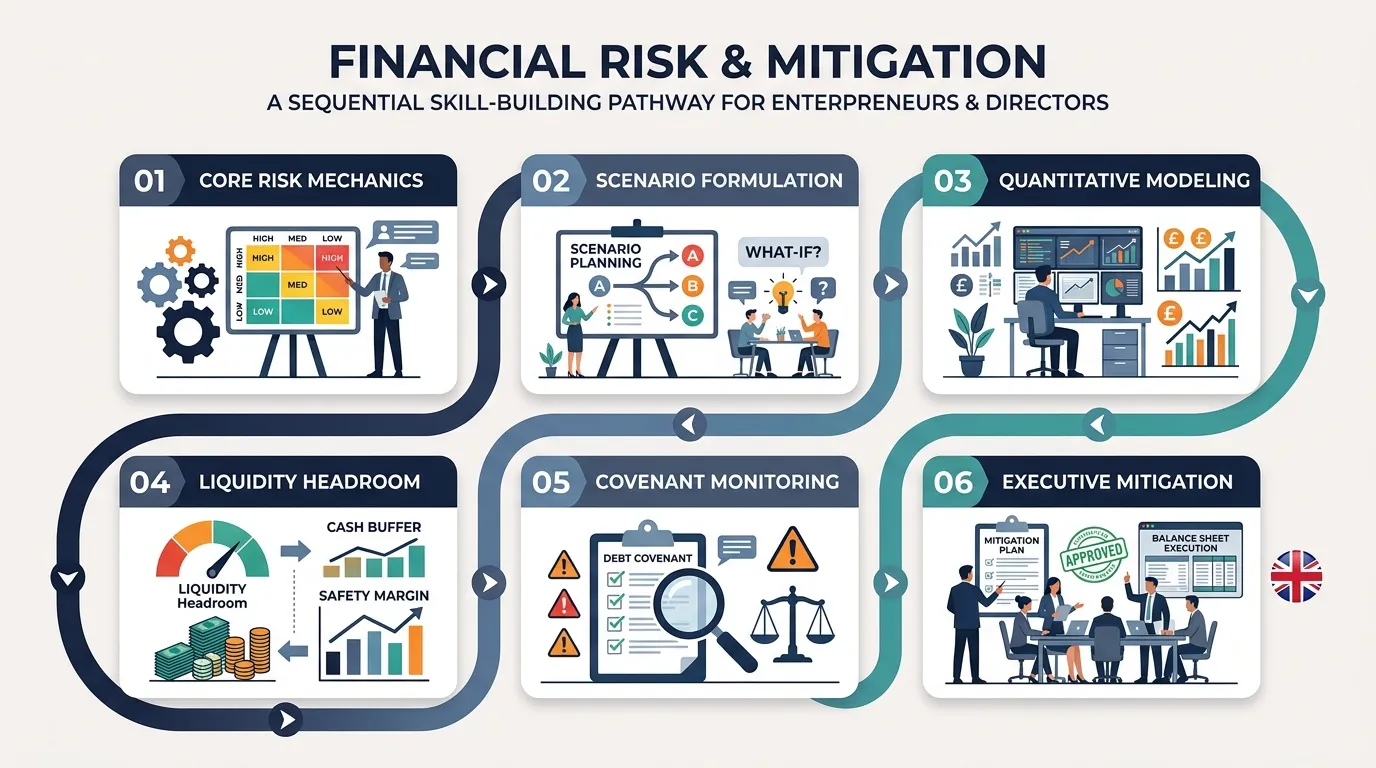
Designing robust financial defense systems requires a deep understanding of macroeconomic transmission channels and asset-level operating leverage. The curriculum developed by the Institute For Oil & Gas Training integrates real-world energy market data, historical crisis metrics, and regulatory compliance standards into every learning stage.
Participants begin by mastering severe but plausible scenario construction before applying these assumptions to dynamic financial models. This ensures that quantitative testing remains grounded in operational reality rather than theoretical abstraction.
Understanding How to Evaluate Liquidity and Solvency Risks Through Oil and Gas Cash Flow Stress Testing requires systematic evaluation of fixed cost structures, debt service schedules, and working capital cycles under severe market contractions. The pedagogical structure guarantees that financial professionals grasp both the underlying mathematical concepts and their strategic corporate applications.
Each module builds directly upon the technical competencies developed in previous units. Learners transition from basic cash flow sensitivity adjustments to multi-variable stress simulations that incorporate foreign exchange volatility, inflation spikes, and joint venture cash calls.
The structured progression culminates in full-scale decision-making exercises where analysts turn model outputs into executive risk reports and capital preservation recommendations. This methodical approach establishes sustainable organizational capability across finance and strategy departments.
What Technical Curriculum and Skill Outcomes Will Participants Master?
Participants develop targeted technical competencies in dynamic cash flow modeling, severe scenario design, reverse stress testing, liquidity headroom determination, covenant breach forecasting, and executive mitigation plan formulation across five practical modules.
Module Title | Core Focus Areas | Technical Competency Acquired |
Module 1: Scenario Architecture | Severe but plausible scenario design, macro variables, oil price shock parameters. | Ability to parameterize multi-variable economic shocks for energy balance sheets. |
Module 2: Dynamic Modeling | Working capital drag, debt service coverage, cash flow sensitivity mechanics. | Capability to build robust, automated stress-testing workbooks in Excel. |
Module 3: Reverse Stress Testing | Survival horizon evaluation, failure point identification, cash depletion metrics. | Proficiency in calculating exact operational failure thresholds and cash runway. |
Module 4: Covenant Analysis | Covenant breach point mapping, liquidity headroom measurement, credit ratings. | Mastery in forecasting leverage ratios and banking restriction triggers. |
Module 5: Mitigation Strategy | Mitigation action plan execution, asset disposition, capital expenditure deferral. | Skill in drafting defensible capital preservation strategies for executive boards. |
Module 1: Stress Test Architecture and Macro Scenario Design
Defining the mechanics of an oil price shock on corporate revenue, inventory valuation, and margin realization.
Establishing severe but plausible scenario parameters across commodity prices, volume curtailments, and counterparty defaults.
Integrating geopolitical risk variables, supply chain disruptions, and sudden foreign exchange fluctuations into core financial planning models.
Differentiating between short-term liquidity contractions and structural solvency impairments in capital-intensive energy assets.
Module 2: Quantitative Cash Flow Stress Modeling Mechanics
Constructing dynamic financial models that isolate variable operating costs, fixed maintenance overheads, and non-discretionary capital expenditures.
Calculating working capital drag under conditions of delayed off-taker payments and tightening trade credit terms.
Modeling debt service coverage ratios (DSCR) and interest coverage ratios under multi-year low-price environments.
Quantifying the impact of hedging contract roll-offs, derivative margin calls, and variable-rate debt obligations on operational cash flows.
Module 3: Reverse Stress Testing and Survival Horizon Determination
Executing reverse stress testing algorithms to identify the precise combination of operational failures that force business model insolvency.
Measuring the exact survival horizon timeframe under total capital market lockout scenarios.
Evaluating asset-level cash flow contributions to pinpoint unviable production units during sustained downturns.
Assessing the financial impact of joint venture cash calls, unexpected abandonment liabilities, and environmental compliance expenditures.
Module 4: Liquidity Headroom and Covenant Breach Mapping
Calculating absolute liquidity headroom across available cash reserves, undrawn revolving credit facilities, and committed credit lines.
Identifying exact covenant breach point thresholds for senior secured debt, unsecured notes, and syndicated loan agreements.
Forecasting credit rating agency downgrade triggers and associated funding cost increases.
Analyzing funding gap analysis outputs to determine immediate capital shortfall windows across 30, 60, 90, and 180-day horizons.
Module 5: Mitigation Action Plans and Strategic Decision-Making
Structuring an actionable mitigation action plan incorporating capital expenditure deferrals, dividend suspensions, and asset monetization options.
Evaluating the speed, execution friction, and net financial yield of emergency cost reduction initiatives.
Drafting clear executive risk dashboards for chief financial officers, board risk committees, and external debt rating agencies.
Aligning financial stress testing results with enterprise risk management (ERM) frameworks and corporate capital allocation policies.
How Is the Training Delivered Across Corporate and Individual Formats?
The Institute For Oil & Gas Training delivers this course through four flexible instructional modalities: interactive live virtual workshops, on-premise corporate cohort training, self-paced online technical modules, and blended hybrid learning schedules.
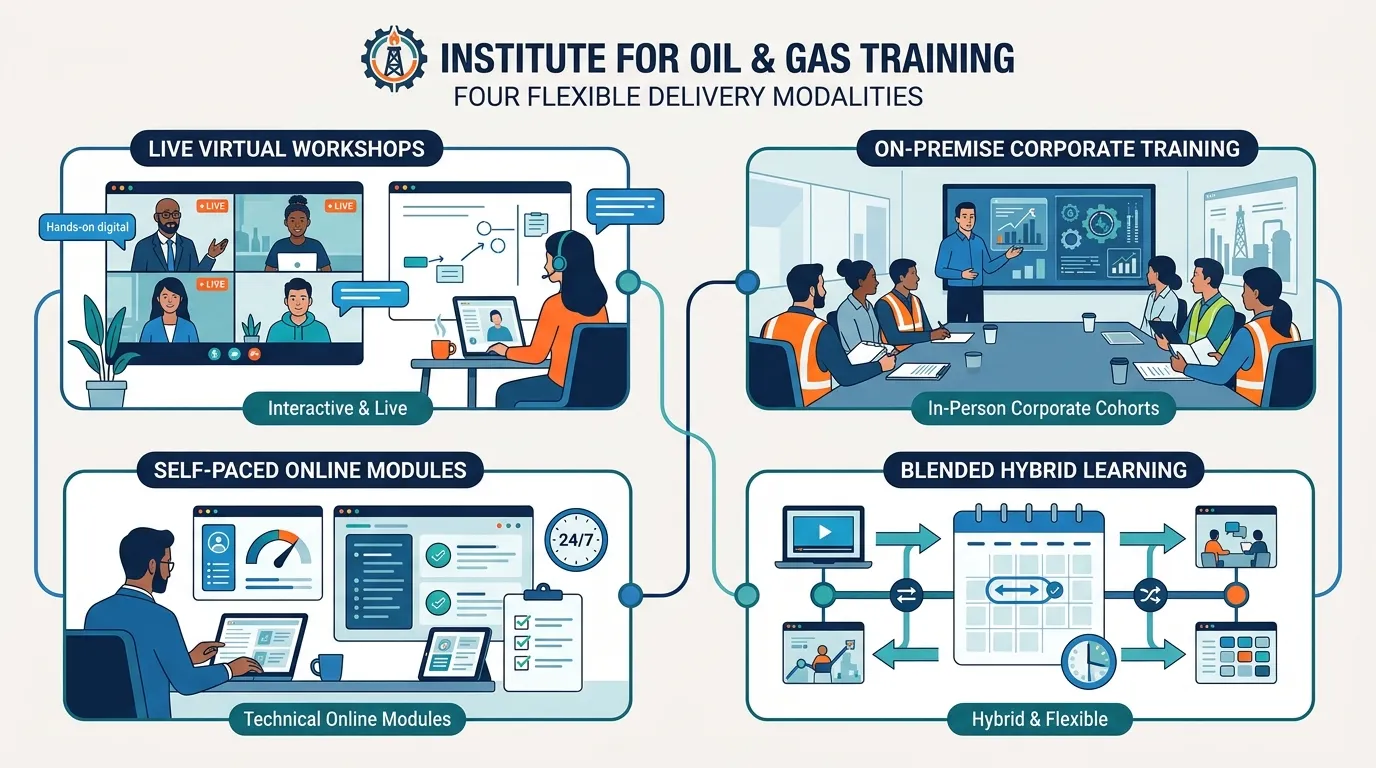
The delivery methodology emphasizes hands-on financial modeling rather than passive lecture consumption. Every delivery channel incorporates step-by-step model building exercises, real-world energy company case studies, and instructor-guided workbook audits.
corporate cohorts benefit from custom-tailored scenario modules reflecting their specific asset mix, debt structures, and operational risk profiles. Facilitators from the Institute For Oil & Gas Training work directly with corporate HR and finance leadership to align practical exercises with institutional capital structures.
Participants receive access to standardized financial model templates, stress testing macros, and scenario sensitivity workbooks. These tools are designed for immediate implementation within corporate finance, treasury, and strategic planning departments following course completion.
Assessment throughout the program utilizes practical, performance-based benchmarks rather than theoretical multiple-choice testing. Participants must build, stress test, and audit complex energy balance sheet models to demonstrate technical proficiency.
Final course evaluation requires the successful completion and defense of a comprehensive capstone simulation. Learners evaluate an energy corporate balance sheet, model severe economic distress, identify liquidity depletion points, and formulate an executive-ready financial mitigation plan.
What Measurable Corporate and Individual Results Can Be Expected?
Completing the program yields direct operational improvements, including accelerated liquidity risk reporting cycles, precise covenant breach forecasting, improved credit risk management, and enhanced strategic alignment between corporate finance and executive leadership.
Organizations that enroll their finance and treasury personnel realize immediate improvements in risk visibility and capital planning rigor. Financial analysts gain the capability to deliver stress testing reports in hours rather than weeks, allowing executive committees to respond rapidly to changing market conditions.
Corporate HR teams and finance directors report significant performance improvements in functional cross-departmental collaboration. Analysts develop a unified language for discussing capital constraints, enabling seamless communication between treasury staff, business unit controllers, and enterprise risk officers.
Measurable Performance Metrics Post-Training
Reduction in Model Execution Time: Finance teams build and run multi-variable stress scenarios up to 60% faster using standardized workbooks.
Early Warning Capability: Precision mapping of covenant breach points provides executive leadership with extended lead time to renegotiate credit facilities.
Accuracy in Capital Forecasting: Enhanced funding gap analysis minimizes the need for high-cost emergency liquidity draws during commodity price troughs.
Audit and Board Compliance: Standardized stress testing methodologies ensure full alignment with institutional investor requirements and banking sector stress-test protocols.
Individual participants enhance their career trajectory by acquiring high-demand quantitative finance skills specific to the energy sector. Finance professionals gain the technical confidence required to present risk evaluations and capital preservation strategies to executive boards, debt providers, and credit rating agencies.
The instructional methodologies deployed by the Institute For Oil & Gas Training ensure that technical competencies translate directly into workplace performance gains, creating immediate return on educational investment for corporate sponsors.
How Does Course Enrollment and Corporate Onboarding Work?
Enrollment involves a structured three-step process consisting of a prerequisite technical assessment, format selection, and immediate access to pre-course foundational modeling materials.
The course is designed for corporate finance analysts, treasury managers, financial planning and analysis (FP&A) specialists, risk managers, and investment professionals working within the oil, gas, and broader energy value chain. Human resources departments utilize the program as a core component of professional development pipelines for senior analytical roles.
Prerequisites and Technical Eligibility Requirements
Demonstrated proficiency in corporate finance fundamentals, balance sheet mechanics, and income statement integration.
Working knowledge of intermediate to advanced Microsoft Excel techniques, including dynamic lookups, index-match functions, and data tables.
Prior experience in financial forecasting, project evaluation, or credit analysis within capital-intensive corporate environments.
No prior programming or VBA experience is required; all modeling frameworks are constructed using standard spreadsheet architecture.
The registration process is streamlined for both corporate enterprise group bookings and individual professional enrollments. Corporate clients registering teams of five or more participants receive custom cohort scheduling options, dedicated organizational reporting, and tailored case study integration.
Upon confirmation of registration, participants receive immediate access to the learning management system (LMS). Pre-course materials include foundational readings on energy market volatility, baseline financial models, and diagnostic self-assessments to ensure cohort readiness.
The Institute For Oil & Gas Training provides full administrative support throughout the onboarding lifecycle. HR teams and department heads receive regular attendance tracking, milestone completion reports, and individual performance evaluation summaries to verify learning outcomes.
To reserve corporate seats, review upcoming cohort schedules, or submit an enterprise training application, professionals and HR managers can directly enroll in this program.
Frequently Asked Questions
What is taught in an Oil and Gas Petroleum Financial Analysis course?
An Oil and Gas Petroleum Financial Analysis course delivered by the Institute For Oil & Gas Training covers economic modeling, cash flow stress testing, asset valuation, capital budgeting, and fiscal regime analysis. Participants learn to evaluate upstream, midstream, and downstream financial performance under volatile commodity price scenarios. The curriculum equips finance professionals and treasury teams with practical skills to assess solvency, liquidity, and project profitability in the energy sector.
Why is petroleum financial analysis critical for energy sector professionals?
Petroleum financial analysis provides capital-intensive energy companies with the quantitative metrics needed to evaluate investment risks, manage balance sheet debt, and navigate market volatility. Mastering these skills allows analysts and corporate finance teams to accurately forecast operational cash flows, model tax and royalty obligations, and prevent covenant breaches. Professional training from the Institute For Oil & Gas Training ensures decision-makers maintain capital discipline and long-term liquidity.
Who should enroll in an Oil and Gas Petroleum Financial Analysis training program?
This specialized training program is tailored for corporate financial analysts, risk managers, treasury officers, investment bankers, and HR personnel building finance leadership pipelines within the energy industry. It is designed for professionals who require advanced skills in financial modeling, project evaluation, and corporate valuation. The Institute For Oil & Gas Training structures the course to support both individual career advancement and enterprise team development.
How does financial analysis for oil and gas differ from general corporate finance?
Oil and gas financial analysis must account for unique industry dynamics, including severe commodity price shocks, high upfront capital expenditure, long project lifecycles, and complex international fiscal regimes. Unlike standard financial modeling, petroleum analysis incorporates dynamic risk variables such as reserve depreciation, joint venture cash calls, and production decline curves. Training provided by the Institute For Oil & Gas Training focuses specifically on these sector-specific financial mechanics.
What are the key tools used in petroleum financial modeling and analysis?
Professionals in Oil and Gas Petroleum Financial Analysis primarily utilize advanced spreadsheet software, dynamic scenario generators, discounted cash flow (DCF) models, and risk simulation tools. These applications enable analysts to conduct sensitivity testing, calculate net present value (NPV), and measure internal rates of return (IRR) across varying energy price environments. Courses at the Institute For Oil & Gas Training emphasize hands-on, practical application using real-world balance sheet datasets.
Related training courses
Failure Mode and Effects Analysis (FMEA) Training Course
- Specialisation
- Oil & Gas Reliability and Maintenance Management
- Duration
- 5 days · 15 CPD hours
API Standard 1163 In-line Inspection Systems Qualification Training Course
- Specialisation
- Oil & Gas Pipeline Integrity and Inspection
- Duration
- 5 days · 15 CPD hours
BPVC Section V Non-Destructive Testing Training Course
- Specialisation
- Oil & Gas Inspection and Non-Destructive Testing
- Duration
- 5 days · 15 CPD hours
More articles

Treasury Operations Training for Funding and Working Capital Management in Oil and Gas
Master liquidity, debt facilities, and cash optimization with the Treasury Operations for Funding & Working Capital Training Course.
Read article →
How to Evaluate Funding Strategies and Working Capital Requirements for Petroleum Companies
Evaluate funding strategies and working capital models for petroleum companies with practical frameworks and structured treasury evaluation.
Read article →
Why Funding and Working Capital Management Matter in the Oil and Gas Industry
Learn how funding and working capital management drive financial stability, mitigate liquidity risks, and strengthen treasury operations in oil and gas.
Read article →