

Production forecasting is the systematic estimation of future hydrocarbon extraction volumes over specific time horizons to establish baseline revenues, direct capital allocations, and minimize financial variance across upstream oil and gas operations.
Hydrocarbon volume projections serve as the foundational dataset for corporate financial models. In corporate environments, production forecasting integrates geological data, reservoir decline characteristics, and operational downtime variables into unified financial frameworks. Upstream business units utilize these volumetric estimates to calculate projected cash flows, determine operational expenditure allocations, and evaluate project viability. Accuracy in volume estimation prevents revenue shortfalls and capital misallocations across multi-year development programs.
Organizations execute volume forecasting to align technical engineering assessments with financial planning frameworks. Petroleum engineers, asset managers, and corporate finance teams utilize production decline models to establish operational targets. Technical skill gaps in decline curve analysis often cause systemic errors in budget baselines. Structured workforce development programs bridge technical sub-surface calculations with corporate financial planning protocols. Effective training enables technical personnel to produce standardized volumetric models that directly feed operating budgets.
The Role of Hydrocarbon Volumetric Estimations
Volumetric forecasting establishes the operational foundation for expenditure authorization. Engineering teams compute expected flow rates across producing assets, field developments, and infill drilling projects. These volumetric estimates determine operating cost structures per barrel of oil equivalent. Accurate baseline figures enable leadership teams to secure project financing, manage debt obligations, and execute risk-mitigation strategies.
Alignment Between Technical Forecasting and Financial Planning
Financial teams require reliable technical inputs to project operational cash flows. Disconnects between petroleum engineering outputs and corporate finance models lead to capital shortfalls or unbudgeted operational expenses. Cross-functional alignment ensures technical variables, such as field depletion rates and artificial lift performance, populate financial models directly. Standardized forecasting workflows eliminate translation errors between reservoir engineering departments and corporate budget committees.
How Does Technical Production Forecasting Work in Upstream Organizations?
Technical production forecasting functions through a structured process of historical data analysis, decline curve modelling, operational assumption integration, and cross-functional review that aligns sub-surface engineering models with enterprise corporate budgeting systems.
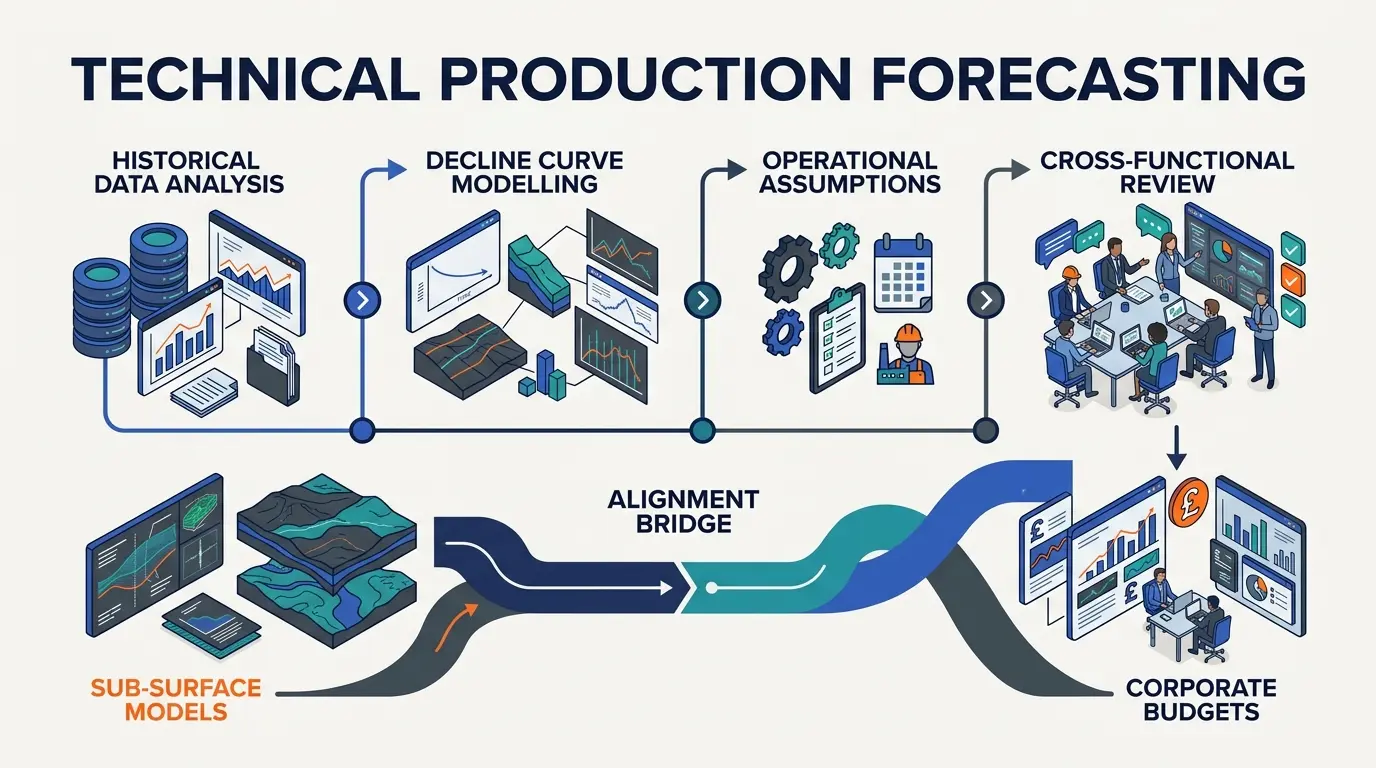
Upstream organizations execute production forecasting through standardized 4-stage technical workflows. Stage 1 involves historical production data gathering, pressure transient analysis, and well test validation. Stage 2 applies decline curve methods, including Arps empirical equations and modified hyperbolic models, to project future depletion rates. Stage 3 integrates field-level operational metrics, such as production efficiency and uptime factors, to adjust theoretical curve outputs. Stage 4 converts net volumetric figures into revenue projections within enterprise financial systems.
Organizational execution relies on structured technical training to maintain workflow consistency across multi-disciplinary teams. Upstream companies deploy systematic professional development initiatives to upskill engineering and planning groups. Professional development programs deliver structured learning through 3-day technical workshops, 6-week blended online modules, and 12-month corporate mentoring frameworks. Structured training ensures technical teams apply uniform reserve definitions and decline parameters. Organizations reduce volumetric error rates by 35% when engineering staff undergo structured technical forecasting training.
Stage 1: Historical Data Aggregation and Quality Control
Engineers aggregate daily flow measurements, bottom-hole pressure surveys, and choke settings. Data validation workflows remove measurement anomalies and temporary field shut-ins from baseline dataset calculations. Clean historical datasets prevent skewed decline parameter estimations during subsequent curve-fitting procedures.
Stage 2: Decline Curve Analysis and Reserve Alignment
Technical teams fit mathematical decline models to validated production histories. Analysts align projected recovery volumes with standardized reserve classifications, ensuring reserves to production alignment. This technical alignment verifies that short-term operating budgets correspond with long-term field development plans and regulatory filings.
Stage 3: Operational Assumption Integration
Raw engineering forecasts require calibration against real-world field constraints. Production teams apply planned maintenance schedules, facility throughput limits, and historical uptime metrics to raw production curves. Factoring in downtime and deferment assumptions converts unadjusted technical potential into realistic, deliverable production volumes.
Stage 4: Financial Model Calibration
The final phase converts net volumetric profiles into cash flow predictions. Corporate planners combine volume forecasts with commodity price decks, hedging positions, and operating cost estimates. Financial managers execute a volume forecast to revenue bridge to isolate the financial impact of production variations from commodity price volatility.
What Key Components Are Required for Accurate Budget Forecasting?
Accurate budget forecasting requires technical decline analysis skills, continuous forecast tracking frameworks, operational efficiency metrics, uplift calculations, and systematic forecast bias analysis tools integrated into standardized organizational workflows.
Effective forecasting systems combine technical analytical tools with structured organizational competencies. Technical capability in decline curve analysis represents the primary foundational requirement. Engineering personnel must master empirical curve fitting, type-curve generation, and numerical simulation principles. Advanced operational modeling incorporates production efficiency and uptime variables directly into volume estimates. Incorporating field-level uptime percentages ensures budgets reflect actual facility capacity rather than theoretical maximum throughput.
Organizations maintain forecast integrity by deploying systematic evaluation tools across planning cycles. Planners implement forecast accuracy tracking workflows to compare monthly production actuals against baseline budget numbers. This continuous monitoring identifies variance sources and refined field assumptions. Technical teams calculate infill and workover uplift potential separately from base production declines to track capital expenditure efficiency. Upstream organizations deploy systematic forecast bias analysis to identify recurring optimism or pessimism in volume estimations across asset teams.
Advanced Analytical Methodologies
Modern forecasting workflows utilize advanced quantitative methodologies to improve budget precision. Engineers employ probabilistic forecasting techniques, such as Monte Carlo simulations, to generate P10, P50, and P90 production distribution profiles. These probabilistic outputs enable finance committees to construct risk-adjusted capital budgets that account for sub-surface uncertainty.
Operational Variance Accounting
Accurate budgets separate natural reservoir decline from operational interruption factors. Production teams track unplanned facility outages, pipeline constraints, and equipment failures using standardized deferment taxonomies. Incorporating historical deferment rates into baseline models prevents systematic overestimation of quarterly cash flows.
How Do Organizations Implement Production Forecasting Training Programs?
Organizations implement forecasting training through capability gap assessments, customized curriculum design, real-world case study execution, hands-on software simulation, and post-training workplace application tracking across cross-functional petroleum asset teams.
Enterprise implementation begins with a formal technical competency audit across engineering and financial departments. Learning and development leaders evaluate current proficiency levels in decline curve fitting, reservoir characterization, and financial model integration. This diagnostic phase identifies specific skill gaps across junior engineers, senior asset specialists, and finance analysts. Organizations use these assessment findings to design contextualized learning paths aligned with specific asset types, including unconventional shale, mature offshore fields, or deepwater developments.
Training execution combines theoretical instruction with practical, hands-on application. Program facilitators deliver real-world case studies using historical production datasets from operating fields. Participants build decline models, calculate deferment factors, and construct financial bridges within dedicated software environments. Cross-functional workshops bring petroleum engineers, asset accountants, and planning managers together to solve complex budgeting scenarios. Teams practice executing a rolling volume reforecast to adjust quarterly operating plans based on real-time production performance data.
Professional development initiatives yield maximum business impact when organizations establish clear post-training application governance. Team leaders track competency adoption through real-world work products, evaluating technical models produced during actual budget cycles. Structured follow-up sessions, peer reviews, and refresher modules reinforce technical standards across the workforce. To master these analytical workflows, technical teams enroll in the Production Forecasting & Decline Curve Analysis for Budgeting Training Course.
Competency Mapping and Curriculum Customization
Learning programs align with corporate operational structures. Training administrators customize instructional modules to address asset-specific challenges faced by participating teams. Curriculum components cover specialized topics, including multi-stage fractured horizontal well decline analysis, artificial lift performance modeling, and complex fiscal regime accounting.
Action-Oriented Learning Methodologies
Participant engagement relies on practical, application-focused delivery formats. Instructor-led workshops utilize real-world production histories to simulate asset performance challenges. Learners perform scenario analysis, model well intervention uplifts, and present budget proposals to mock executive committees, reinforcing multi-disciplinary communication channels.
What Common Problems Occur in Corporate Production Forecasting Training?
Common forecasting training failures stem from generic theoretical curricula, isolated departmental silos, lack of real-world dataset integration, absence of post-training governance, and failure to align technical outputs with corporate budgeting systems.
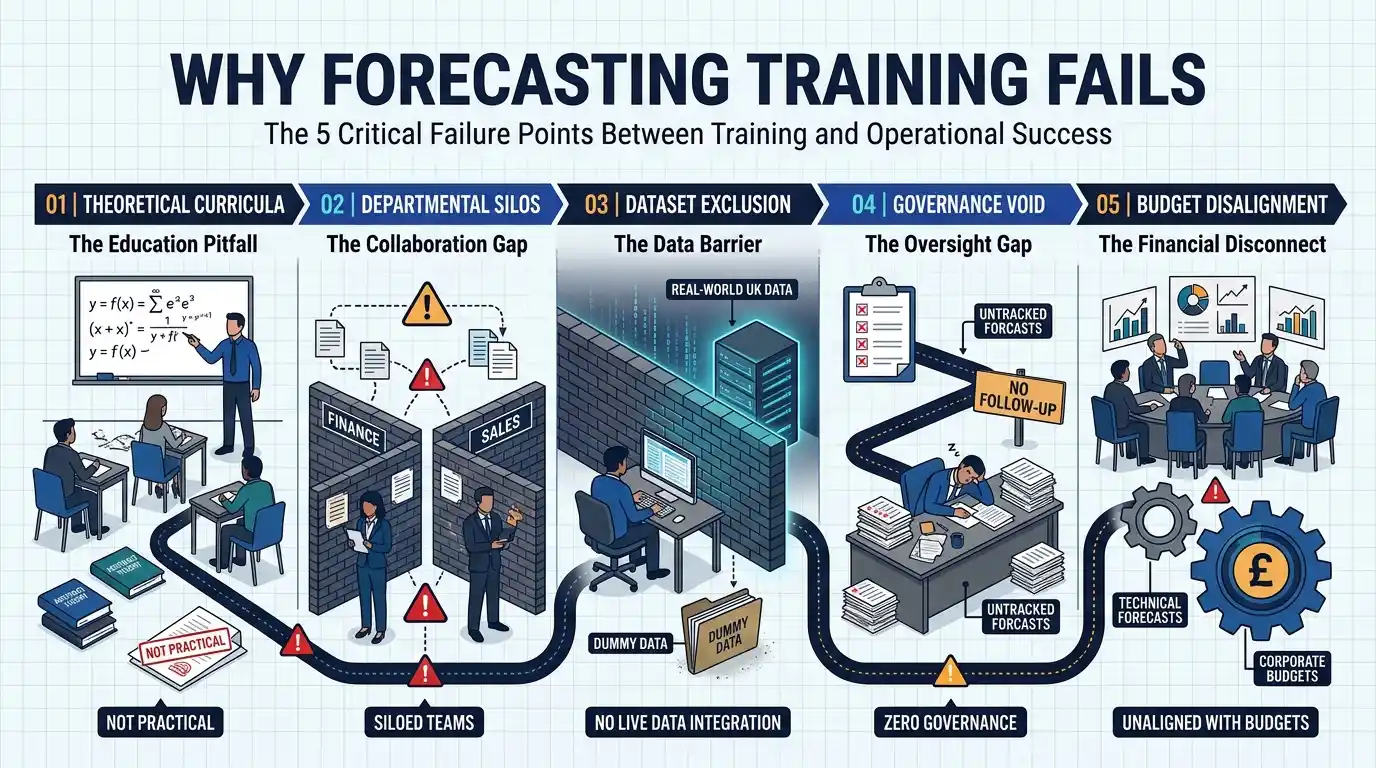
Generic learning programs represent a primary failure point in corporate professional development. Off-the-shelf training courses often utilize idealized theoretical datasets that do not reflect complex field operating conditions. When engineers return to work, they struggle to apply simplified concepts to messy, noisy production data from mature or unconventional fields. Professional development programs must incorporate company-specific production histories, facility constraints, and operational realities to build applicable skills.
Departmental isolation during instruction severely limits corporate training efficacy. Training petroleum engineers independently from corporate finance analysts reinforces communication barriers between technical and commercial groups. Isolated training prevents engineering personnel from understanding how sub-surface volumetric errors distort financial metrics like return on capital employed. Cross-functional training environments ensure technical specialists comprehend commercial requirements, while financial personnel gain insight into sub-surface uncertainty.
A third significant problem involves the absence of post-training execution frameworks. Organizations invest in intensive short-term workshops but fail to establish ongoing skill reinforcement mechanisms. Without structured peer review processes and updated standard operating procedures, technical staff default to inconsistent personal forecasting methods. Unstandardized practices reintroduce individual bias and calculation errors back into enterprise budget baselines.
The Pitfall of Software-Centric Learning
Many corporate programs focus exclusively on teaching software interface navigation rather than underlying engineering principles. Staff learn which buttons to click in commercial software suites without mastering the mathematical principles of Arps equations, material balance, or probabilistic forecasting. This superficial understanding leads to blind acceptance of software outputs, increasing the risk of uncorrected forecast errors in corporate budgets.
Misalignment with Corporate Financial Timelines
Training programs frequently neglect the operational rhythm of corporate budgeting cycles. Technical staff learn how to build complex, time-intensive reservoir models that cannot be updated rapidly during quarterly financial updates. Effective training teaches scalable forecasting techniques that deliver fast, accurate volumetric updates aligned with executive decision-making deadlines.
What Measurable Outcomes Does Technical Forecasting Training Produce?
Technical forecasting training produces measurable outcomes including 40% reductions in budget variance, 25% improvements in capital allocation efficiency, reduced forecast bias, faster budget cycle times, and increased employee retention across technical asset teams.
Upstream organizations measure the impact of technical professional development through quantifiable financial and operational Key Performance Indicators (KPIs). The primary performance metric is the reduction in variance between budgeted and actual production volumes. Structured forecasting capability builds consistency across engineering teams, directly reducing volumetric variance rates from historical averages of 15% down to under 5%. Precise volume forecasts prevent unexpected cash flow shortfalls and stabilize corporate earnings performance.
Capital allocation efficiency improves significantly following structured workforce upskilling. Upstream companies optimize capital expenditure across competing field development projects when technical teams present reliable, risk-adjusted production forecasts. Improved forecast precision allows leadership teams to direct capital toward high-return infill drilling and workover opportunities, yielding a 25% increase in capital efficiency metrics across asset portfolios.
Organizational efficiency gains extend to workflow speed and workforce retention metrics. Upskilled teams streamline budget assembly processes, reducing quarterly forecasting cycle times by 30%. Standardized analytical workflows eliminate redundant internal reconciliations between engineering and finance groups. Furthermore, investing in high-quality technical development increases engineering staff engagement scores by 20% and improves retention rates across key technical disciplines in competitive labor markets.
Variance Reduction and Revenue Predictability
Eliminating systematic forecasting errors stabilizes long-term corporate financial performance. Organizations that achieve lower production variance secure better financing terms from commercial lenders and credit rating agencies. Reliable volume projections protect energy firms against liquidity crises during prolonged commodity price downturns.
Workforce Optimization and Talent Retention
Providing structured professional development pathways strengthens organizational capabilities. Technical professionals prefer working in environments with standardized workflows, modern analytical tools, and clear capability growth frameworks. Structured technical training reduces onboarding duration for new engineering hires by 50%, accelerating full operational productivity.
Where Should Corporate Teams Apply Production Forecasting Methodologies?
Corporate teams apply production forecasting methodologies across mature field management, unconventional shale development, deepwater asset planning, joint venture capital auditing, and merger and acquisition evaluations within petroleum companies, financial institutions, and energy consultancies.
Production forecasting methodologies apply across diverse operational environments within the global energy sector. In mature asset management, technical teams apply decline curve analysis to optimize artificial lift systems, plan secondary recovery operations, and schedule workover programs. Precise decline forecasting in mature fields prevents premature asset abandonment and extends field economic lifespans. Mature asset operators rely on volume accuracy to maintain low-margin profitability across thousands of producing wells.
Unconventional resource operators utilize specialized forecasting methodologies to manage rapid initial well decline rates. Engineering teams in unconventional shale plays model steep early-life depletion curves, fluid loading dynamics, and inter-well interference effects across high-density drilling pads. Applying robust forecasting frameworks enables unconventional operators to optimize well spacing, completion designs, and capital deployment schedules across large land acreage positions.
In corporate mergers, acquisitions, and joint venture management, accurate forecasting methodologies protect capital investments. Financial institutions and corporate M&A teams perform detailed decline curve audits to evaluate acquisition targets and validate seller reserve claims. Joint venture partners apply standardized production forecasting frameworks to review non-operated asset budgets, verify operator performance assertions, and approve joint capital expenditure authorizations across offshore, onshore, and international asset portfolios.
Mature Asset Optimization
Mature field operators employ production decline models to evaluate economic limit thresholds. Engineers calculate the exact point where operating costs exceed net baseline revenues, allowing asset managers to schedule well abandonments or implement tertiary recovery projects, such as waterflooding or gas injection, at optimal capital timing intervals.
Capital Governance in Deepwater Megaprojects
Deepwater offshore developments require billions of dollars in upfront capital investments before first production. Project development teams apply high-resolution reservoir forecasting models to size subsea infrastructure, FPSO processing facilities, and export pipelines correctly. Accurate volume forecasting prevents facility over-design, minimizing capital expenditure while avoiding costly throughput bottlenecks during peak production periods.
Frequently Asked Questions
What is included in an Oil and Gas Petroleum Financial Analysis training programme?
An Oil and Gas Petroleum Financial Analysis course delivered by the Institute For Oil & Gas Training covers upstream fiscal regimes, petroleum economic modelling, cash flow forecasting, and project evaluation metrics like NPV and IRR. Participants learn to analyze capital expenditure, evaluate production sharing contracts, and calculate decommissioning liabilities under international accounting standards. The curriculum bridges technical sub-surface forecasting with corporate financial planning to support strategic decision-making.
How does petroleum financial analysis improve upstream capital budgeting accuracy?
Oil and Gas Petroleum Financial Analysis integrates decline curve models, operational deferments, and commodity price sensitivities into enterprise cash flow frameworks. The Institute For Oil & Gas Training teaches cross-functional teams how to build reliable volume-to-revenue bridges that isolate volumetric variations from price volatility. This structured analytical approach reduces budget variance, eliminates systematic forecast bias, and optimizes capital allocation across competing field development projects.
Who should take an Oil and Gas Petroleum Financial Analysis course?
The Oil and Gas Petroleum Financial Analysis programme from the Institute For Oil & Gas Training is designed for petroleum engineers, asset accountants, financial analysts, L&D managers, and commercial decision-makers. It benefits technical specialists transitioning into managerial roles as well as corporate finance professionals who require a deep understanding of upstream operational dynamics. The training provides the financial literacy needed to evaluate field investments, assess operational risk, and align asset performance with executive targets.
What are the primary methods used in petroleum financial modeling and economic evaluation?
Oil and Gas Petroleum Financial Analysis relies on discounted cash flow (DCF) modeling, sensitivity analysis, Monte Carlo probabilistic simulations, and break-even oil price calculations. At the Institute For Oil & Gas Training, professionals master these analytical methodologies alongside fiscal regime modeling for joint ventures and service contracts. Utilizing these standardized techniques ensures accurate risk assessment, precise reserve valuation, and compliance with corporate governance frameworks.
How do organizations implement petroleum financial analysis training for workforce upskilling?
Organizations implement Oil and Gas Petroleum Financial Analysis through competency gap audits, practical workshops, hands-on software simulations, and real-world case studies using actual asset data. The Institute For Oil & Gas Training delivers these corporate development initiatives via interactive instructor-led sessions, online modules, and structured post-training application reviews. This practical learning framework ensures rapid skill adoption, standardized corporate forecasting workflows, and measurable improvements in operational ROI.
Related training courses
Welding Inspection and Quality Control Training Course
- Specialisation
- Oil & Gas Welding Inspection and Metallurgy
- Duration
- 5 days · 15 CPD hours
Process Safety Risk Assessment Training Course
- Specialisation
- Oil & Gas Process Safety Management
- Duration
- 5 days · 15 CPD hours
Amine Treatment Process and Operation Training Course
- Specialisation
- Oil & Gas Process Engineering and Operations
- Duration
- 5 days · 15 CPD hours
More articles

Cash Flow Stress Testing Training for Oil and Gas Financial Analysis Professionals
Evaluate financial risks with Cash Flow Stress Testing for Liquidity & Solvency Training Course by Institute For Oil & Gas Training. Enroll now.
Read article →
How to Evaluate Liquidity and Solvency Risks Through Oil and Gas Cash Flow Stress Testing
Compare evaluation models for oil and gas liquidity and solvency stress testing to safeguard corporate financial stability.
Read article →
Why Cash Flow Stress Testing Matters for Oil and Gas Liquidity and Solvency
Discover why cash flow stress testing is vital for oil and gas liquidity and solvency. Learn how workforce training strengthens corporate financial resilience.
Read article →