
Procurement and contractor payments fraud exposure in the oil and gas sector represents the quantifiable vulnerability of capital-intensive supply chains, complex vendor networks, and multi-tier contractor agreements to financial exploitation, invoice manipulation, and unauthorized disbursements.
The capital-intensive nature of upstream, midstream, and downstream operations requires multi-million-dollar procurement lifecycles. These cycles involve engineering, procurement, and construction (EPC) contractors, equipment vendors, and specialized service providers.
Organizations face systemic financial leakage when internal controls fail to monitor high-volume transactions, project-based milestone billing, and offshore procurement activities.
Workforce development strategies must address these exposures through specialized corporate education. This training equips commercial, financial, and operational personnel with the skills needed to detect anomalies in vendor master files, purchase orders, and payment approvals.
Unmitigated fraud exposure degrades operating margins, distorts capital expenditure reporting, and introduces severe regulatory liabilities under anti-corruption frameworks.
Organizations combat these vulnerabilities by integrating professional training programs into their human capital frameworks.
The Institute For Oil & Gas Training designs industry-driven programs that focus on developing practical skills, operational knowledge, and professional confidence for modern workplaces.
Through industry-driven programs in leadership, communication, technical skills, and strategic thinking, enterprises transform their workforce capabilities.
Workforce training initiatives close critical employee skill gaps that allow fraudulent schemes to bypass manual review processes.
Businesses deploy a mix of training delivery formats, including instructor-led workshops, digital online modules, and hybrid learning environments, to ensure continuous professional development across dispersed operations.
Training methodologies rely on case-based learning, interactive simulations, role-play exercises, and pre- and post-training assessments.
These pedagogical approaches ensure that professionals transition theoretical knowledge into practical risk mitigation.
Measurable performance metrics, including Key Performance Indicators (KPIs), return on investment (ROI) calculations, and productivity improvement tracking, validate the commercial value of these educational investments.
Enhanced workforce capabilities generate tangible organizational impacts, such as improved team efficiency, a strengthened leadership pipeline, and higher employee retention rates.
When enterprises align training curricula with real-world corporate needs, they protect bottom-line performance while fostering an internal culture rooted in operational integrity and excellence.
How Does Workforce Training Mitigate Procurement and Payment Irregularities?
Workforce training mitigates procurement and payment irregularities by systematically transferring forensic auditing skills, risk identification frameworks, and behavioral red-flag detection methodologies to commercial and financial teams.
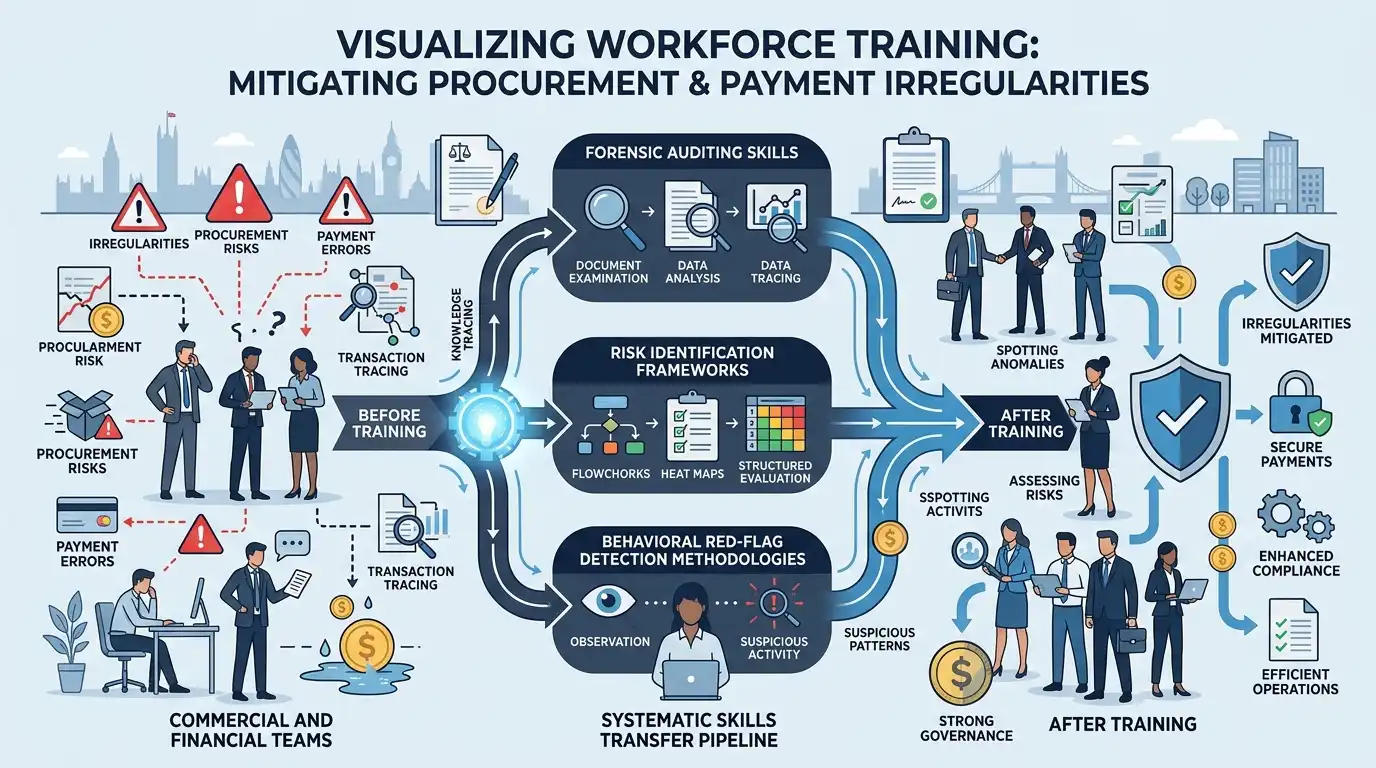
Organizations implement structured learning roadmaps that begin with baseline competency assessments across procurement departments.
Employees engage in practical learning sessions where instructors deconstruct historical corporate fraud cases from high-risk sectors, including energy, maritime logistics, and heavy manufacturing.
This educational architecture follows a macro to micro operational flow.
Learners first analyze broad market dynamics, such as supply chain volatility and inflationary pressures on raw material procurement.
They then examine granular transactional elements, such as duplicate vendor bank routing numbers, split purchase orders designed to bypass authorization thresholds, and inflated change orders on major capital projects.
Corporate learning programs utilize blended delivery models.
Classroom workshops facilitate collaborative discussions among multidisciplinary teams, while online modules deliver standardized compliance modules to remote field offices and offshore drilling installations.
Organizations track training efficacy through specific performance metrics.
Human resources departments measure the reduction in invoice processing errors, the speed of anomaly detection, and the recovery of misdirected funds.
Furthermore, structured professional development directly influences organizational impact.
Companies report a 22 percent increase in cross-functional collaboration between procurement and internal audit teams within 12 months of program deployment.
Training methodologies incorporate scenario-based simulations that replicate real-world pressure cookers.
Participants navigate simulated vendor audits, evaluate complex contract amendments, and defend compliance findings before executive leadership boards.
This experiential approach ensures that personnel develop the professional skepticism required to challenge irregular documentation without disrupting operational momentum.
What Key Components Drive Effective Anti-Fraud Training Frameworks?
Effective anti-fraud training frameworks integrate specialized risk-identification skills, data analytics tools, procurement control frameworks, and multi-format delivery structures tailored to corporate operational environments.
The curriculum design prioritizes core technical competencies that address specific vulnerabilities in capital projects.
Participants master the analysis of vendor master file maintenance logs, where unauthorized modifications often precede fictitious vendor schemes.
Training modules cover established risk frameworks, such as the Committee of Sponsoring Organizations of the Treadway Commission (COSO) internal control integrated framework.
Learners apply these models to evaluate segregation of duties matrixes within enterprise resource planning (ERP) systems like SAP and Oracle.
Technical skill development extends to data analytics tools, including automated exception reporting software and continuous auditing algorithms.
Employees learn to identify statistical anomalies, such as round-dollar invoice amounts, sequential invoice numbering from competing vendors, and abnormal purchase order clustering just below mandatory tender thresholds.
Delivery formats vary according to organizational scale and geographical distribution.
Multinational energy enterprises deploy hybrid learning structures that combine intensive, three-day residential workshops for senior contract managers with asynchronous digital learning pathways for field administrative staff.
Learning methodologies emphasize active engagement through role-play exercises where finance professionals practice questioning project managers regarding vague milestone completion certificates.
Assessments evaluate individual comprehension before and after instruction, ensuring verifiable knowledge acquisition.
Organizations measure success through structured performance indicators, including audit cycle times, reduction in unapproved vendor expenditures, and employee compliance certification rates.
This comprehensive component integration ensures that workforce development yields predictable, measurable improvements in corporate governance.
What Are the Organizational Benefits of Specialized Anti-Fraud Upskilling?
Specialized anti-fraud upskilling produces measurable organizational benefits, including reduced financial leakage, enhanced team efficiency, strengthened leadership pipelines, and improved compliance audit ratings across enterprise operations.
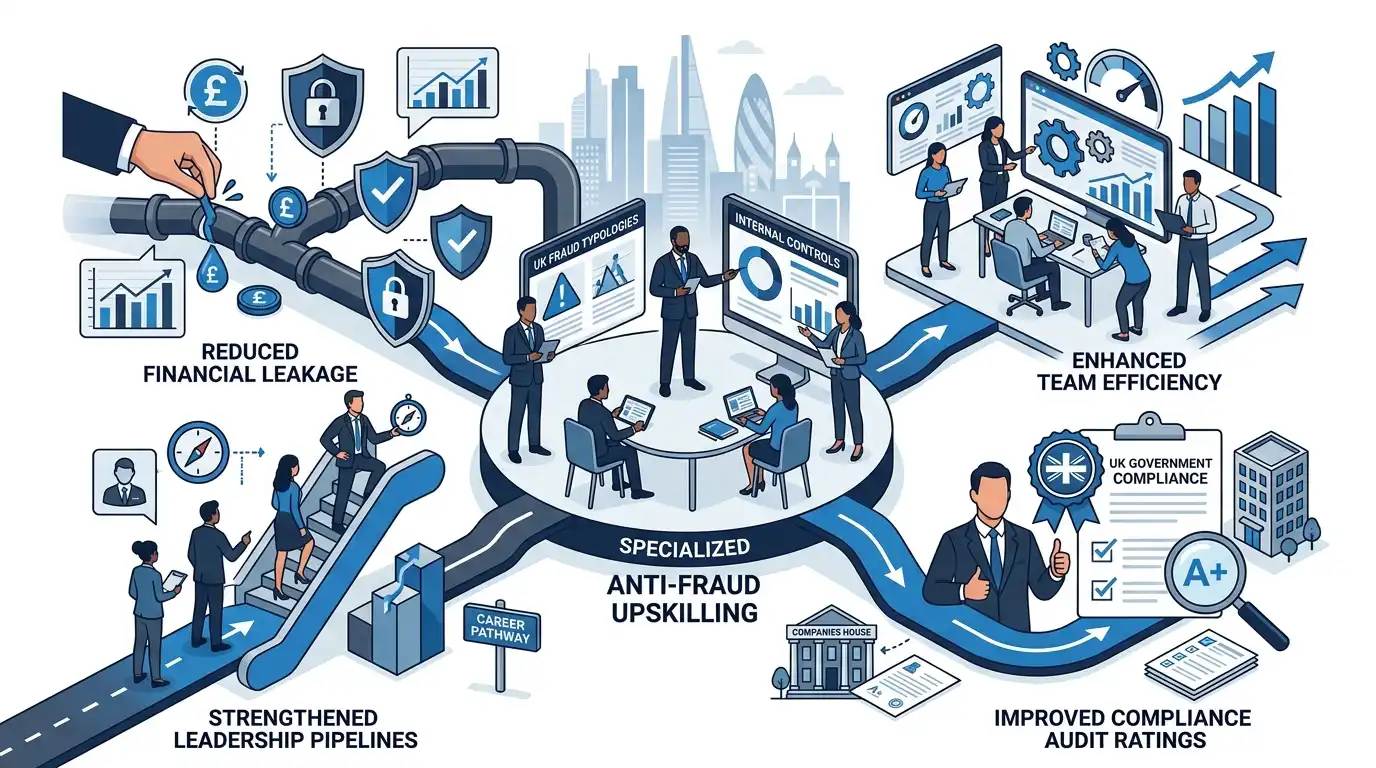
Financial leakage declines as trained procurement specialists intercept duplicate payments, inflated billings, and unauthorized change orders before capital disbursement.
Organizations utilizing rigorous training methodologies observe quantifiable returns on investment.
Enterprises frequently report cost savings exceeding 15 times the initial capital outlay for training program deployment within the first operational cycle.
Team efficiency improves through the standardization of contract review procedures and accelerated invoice reconciliation workflows.
Employees equipped with advanced data analytics and risk assessment skills process complex vendor agreements in 35 percent less time than untrained personnel.
This operational speed prevents project bottlenecks while maintaining rigorous compliance standards.
The organizational impact extends to leadership development and workforce retention.
Structured professional growth pathways signal corporate investment in staff capabilities, contributing to a 14 percent increase in voluntary employee retention among commercial and financial personnel.
Furthermore, robust training programs fortify the leadership pipeline by identifying high-potential professionals who demonstrate exceptional analytical rigor and ethical judgment during simulation exercises.
These individuals advance into senior governance roles, ensuring sustainable oversight of complex capital projects.
External stakeholders, including institutional investors, commercial lenders, and regulatory bodies, view proactive workforce upskilling as a definitive indicator of mature corporate governance and risk management maturity.
How Do Different Corporate Teams Apply Anti-Fraud Methodologies?
Corporate teams apply anti-fraud methodologies across distinct operational domains, including supply chain management, internal audit, project engineering, and executive leadership, to safeguard capital allocation.
Supply chain management teams apply vendor screening frameworks during the initial procurement lifecycle.
Procurement officers evaluate beneficial ownership structures, verify physical business addresses, and cross-reference tax identification numbers against global watchlists before onboarding new suppliers.
Internal audit teams deploy continuous monitoring protocols and data analytics tools to analyze transactional ledgers.
These professionals examine travel and entertainment expense reports, petty cash disbursements, and contractor timesheets for indicators of shell company transactions or ghost worker payroll schemes.
Project engineering teams focus on technical milestone verification.
Engineers utilize risk assessment methodologies to evaluate contractor progress reports, ensuring that billed milestones correspond to physical installation metrics on construction sites.
This prevents the premature disbursement of funds for uncompleted infrastructure.
Executive leadership and department managers utilize consolidated risk dashboards to oversee capital expenditure compliance.
Management teams review exception reports generated by trained personnel, enabling data-driven decision-making regarding vendor contract renewals and supply chain restructuring.
Organizations operating in highly regulated sectors, such as industries like petrochemical refining, offshore drilling, and international pipeline development, mandate cross-functional training workshops.
These collaborative sessions break down organizational silos between legal, finance, and operational departments.
Participants engage in case-based learning exercises that simulate cross-departmental incident response, ensuring coordinated execution when potential irregularities are identified.
This collaborative approach reinforces corporate integrity, cross-functional communication, and operational resilience across all business units.
What Common Problems and Misconceptions Undermine Corporate Training Programs?
Ineffective training design, a lack of measurable return on investment, reliance on generic courseware, and the absence of executive reinforcement undermine corporate anti-fraud education initiatives.
Many organizations implement compliance training as a check-the-box exercise, utilizing static e-learning modules that fail to engage adult learners or address industry-specific operational realities.
Generic programs that ignore the unique contractual structures of the energy sector produce negligible behavioral change among procurement professionals.
Another widespread misconception assumes that anti-fraud responsibilities rest exclusively with internal audit or legal departments.
This mindset leaves frontline procurement officers and project managers ill-equipped to recognize behavioral red flags or documentation anomalies during daily operations.
Organizations that fail to integrate practical simulations and role-play exercises into their curricula observe poor knowledge retention and an inability to apply theoretical concepts to real-world commercial pressures.
Furthermore, inadequate post-training evaluation compromises program efficacy.
Without tracking specific performance metrics, such as error reduction rates, audit finding remediation times, and financial recovery volumes, leadership cannot quantify training ROI.
To overcome these pitfalls, enterprises must transition from passive awareness campaigns to active, outcome-based professional development frameworks.
Training programs must reflect real-world corporate needs, incorporate continuous knowledge assessments, and receive active reinforcement from executive leadership.
When organizations treat workforce education as a strategic asset rather than an administrative burden, they neutralize systemic vulnerabilities and protect enterprise value.
Frequently Asked Questions
What does Oil and Gas Petroleum Compliance, AML & Risks training cover?
Institutes like the Institute For Oil & Gas Training deliver specialized programs focusing on anti-money laundering (AML) protocols, petroleum sector regulations, and financial risk mitigation strategies. Participants learn how to identify compliance gaps, navigate complex international energy frameworks, and secure supply chain transactions against illicit financial activities.
Why is anti-money laundering training critical for oil and gas operations?
Capital-intensive energy projects and cross-border contractor payments expose firms to severe financial crime vulnerabilities without robust oversight. Through targeted Oil and Gas Petroleum Compliance, AML & Risks education, commercial and financial teams develop the expertise needed to detect suspicious transactions and uphold regulatory standards.
How do organizations implement petroleum compliance training programs?
Companies deploy blended learning formats, including instructor-led workshops, online modules, and practical case-based simulations tailored to energy sector needs. The Institute For Oil & Gas Training supports workforce development by aligning these programs with real-world corporate challenges and measurable governance Key Performance Indicators.
What are the main risk factors addressed in oil and gas compliance courses?
Training curricula examine critical exposure areas such as vendor master file manipulation, unauthorized contractor payments, and opaque supply chain intermediary networks. By mastering these risk vectors, professionals safeguard operating margins and ensure strict adherence to international anti-corruption mandates.
Who should participate in Oil and Gas Petroleum Compliance, AML & Risks programs?
Procurement managers, internal auditors, legal advisors, and financial controllers operating within the energy sector benefit directly from these professional development courses. The Institute For Oil & Gas Training equips these decision-makers with the practical skills required to strengthen internal controls and protect enterprise value.
Related training courses
JV Accounting & Partner Reporting for Non-Operators Training Course
- Specialisation
- Oil & Gas Petroleum Accounting
- Duration
- 5 days · 15 CPD hours
Risk Management for Upstream & Midstream Projects: Exposures Training Course
- Specialisation
- Oil & Gas Petroleum Compliance, AML & Risks
- Duration
- 5 days · 15 CPD hours
Segregation of Duties in Finance & ERP Systems Training Course
- Specialisation
- Oil & Gas Petroleum Compliance, AML & Risks
- Duration
- 5 days · 15 CPD hours
More articles

How Revenue, Inventory and Production Data Can Reveal Fraud Indicators
Learn how corporate training empowers teams to use revenue, inventory, and production data to detect operational fraud in oil and gas sectors.
Read article →
Developing Petroleum Fraud Risk Skills Through Specialist Oil & Gas Training
Master forensic accounting, vendor auditing, and procurement fraud detection with specialized oil and gas training. Enroll your team today.
Read article →
Detecting Procurement, Vendor and Payment Irregularities Through Forensic Accounting
Discover how forensic accounting detects procurement fraud, vendor collusion, and payment irregularities in capital-intensive energy operations.
Read article →