
Procurement operations within capital-intensive industries require rigorous oversight because high-value transactions and complex supply chains create distinct vulnerabilities. When organizations manage multi-million-dollar vendor contracts, identifying anomalies early prevents substantial financial loss and reputational damage. To understand the foundational mechanics of how these vulnerabilities emerge across complex operations, read the guide on Why Procurement and Contractor Payments Create Fraud Exposure in Oil & Gas. Addressing these risks requires systematic evaluation frameworks that examine procurement cycles, vendor lifecycles, and accounts payable workflows to isolate unauthorized financial outflows.
Financial statement manipulation and procurement fraud rarely announce themselves through obvious discrepancies. Instead, perpetrators exploit gaps in internal controls, segregation of duties, and authorization hierarchies. Forensic accounting methodologies combine data analytics, document examination, and transaction testing to uncover hidden patterns that routine internal audits miss. Organizations evaluate different forensic techniques to determine which methodologies align best with their operational risk profiles, transaction volumes, and compliance mandates.
How Do Forensic Accountants Identify Procurement Collusion and Bid Rigging?
Forensic accountants detect procurement collusion by analyzing vendor master file anomalies, matching invoice sequencing patterns, and examining bidding histories to uncover coordinated pricing strategies among suppliers.
Bid rigging typically manifests when competing suppliers submit artificially inflated bids or take turns winning contracts while maintaining uniform pricing structures. Forensic investigators examine historical tender documents, Internet Protocol metadata from electronic submissions, and handwriting or formatting similarities across competing proposals. When multiple vendors share registered addresses, telephone numbers, or banking details within the vendor master file, investigators flag these entities for deep-dive reviews.
The vendor onboarding process serves as a primary defense against ghost vendor schemes, where internal employees establish fictitious shell companies to siphon funds through fraudulent invoices. Forensic testing cross-references corporate registry databases with bank account records to verify that active vendors maintain legitimate commercial footprints. Accountants deploy Benford’s Law analysis to examine invoice amounts, testing whether the distribution of leading digits conforms to natural mathematical patterns. Deviations from expected mathematical distributions signal manual manipulation, split invoicing designed to bypass approval thresholds, or systematic rounding of transaction values.
Supply chain fragmentation and decentralized purchasing authorities exacerbate these vulnerabilities by reducing visibility across regional business units. When procurement teams operate in silos, unauthorized purchasing arrangements bypass centralized vetting protocols. Forensic accounting frameworks introduce continuous transaction monitoring tools that evaluate purchase orders against receiving logs and inventory records. Matching three-way documents—purchase orders, receiving reports, and vendor invoices—stops payments on unfulfilled goods or services, closing the window of opportunity for fraudulent disbursements.
What Methods Separate Accidental Accounting Errors From Intentful Vendor Fraud?
Investigators differentiate accidental accounting errors from intentional fraud by evaluating behavioral intent, transaction frequency, recurrence patterns, and the presence of deliberate control circumvention.
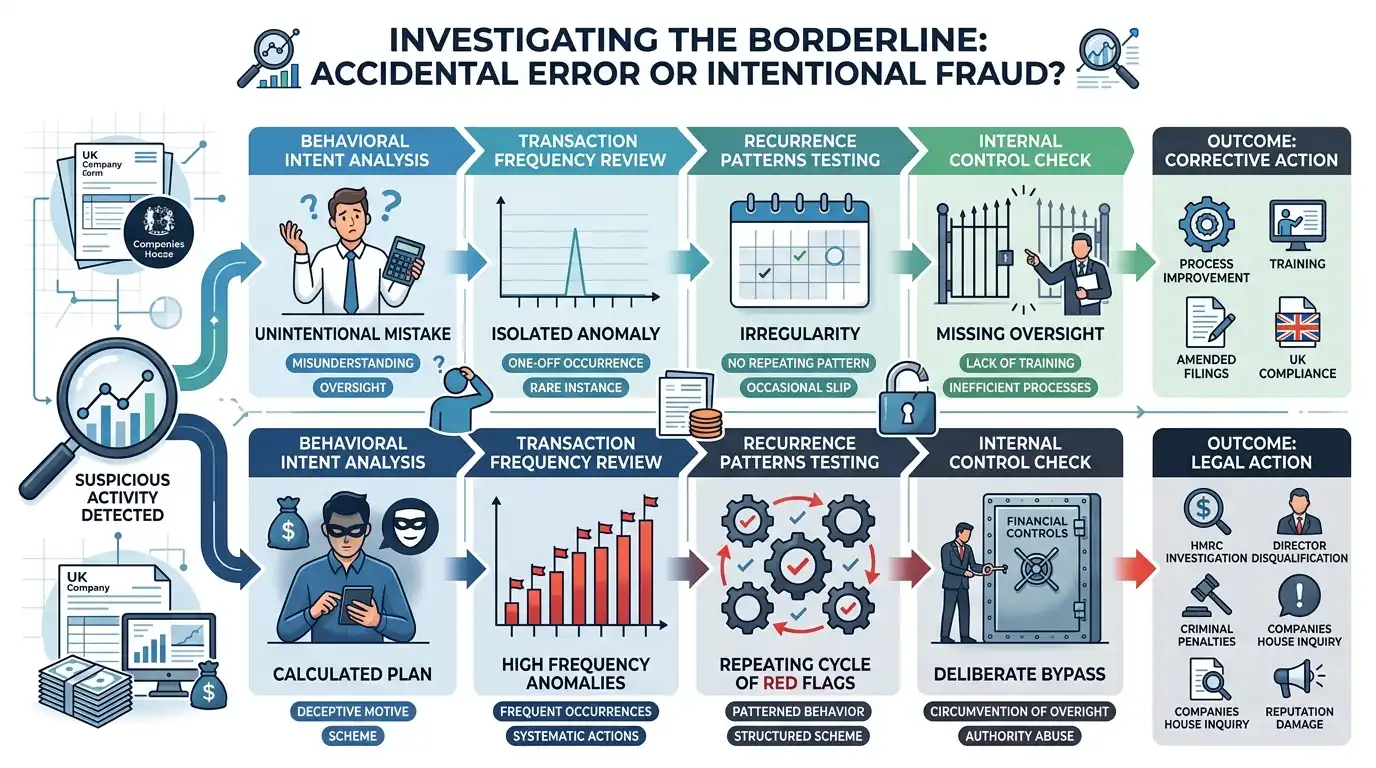
Operational errors typically present as random, isolated discrepancies resulting from data entry mistakes, system migration glitches, or misunderstood tax calculations. These errors correct themselves during routine reconciliation processes or surface when external auditors sample general ledger accounts. Intentional vendor fraud exhibits deliberate persistence, systemic concealment, and precise structuring designed to remain beneath automated authorization thresholds. Perpetrators split large invoices into smaller increments to evade secondary managerial sign-offs, utilizing specific calendar dates such as weekends or fiscal year-end closes when oversight controls experience reduced staffing.
Evaluating internal intent requires examining the communication trails surrounding anomalous transactions. Fraudulent schemes usually involve altered email approvals, missing supporting documentation, or overridden system prompts. Forensic accounting specialists analyze system access logs to determine whether specific users manually bypassed automated three-way matching controls or altered vendor banking parameters immediately prior to disbursement runs.
Evaluation Dimension | Accidental Accounting Errors | Intentional Vendor Fraud |
Transaction Pattern | Random and isolated distribution | Persistent and systematic clustering |
Threshold Behavior | Varies naturally across amounts | Structured strictly below approval limits |
Documentation Quality | Complete records with minor typos | Missing, altered, or artificially reconstructed |
System Interaction | Standard processing workflows | Deliberate override of segregation controls |
Correction Response | Cooperative adjustment upon discovery | Evasive explanations or forged justifications |
Organizations must establish clear analytical protocols to categorize these discrepancies accurately. Misclassifying fraudulent acts as administrative errors leaves structural vulnerabilities open to repeated exploitation. Implementing automated exception-reporting tools ensures that every system override or unmatched invoice receives immediate scrutiny from compliance teams rather than waiting for annual audit cycles.
How Do Accounts Payable Audits Uncover Duplicate Payments and Kickbacks?
Accounts payable audits uncover duplicate payments and kickbacks by deploying advanced data matching algorithms against invoice numbers, tax identification numbers, and remittance banking details.
Duplicate disbursements occur through administrative negligence or intentional manipulation where suppliers submit identical invoices with altered reference numbers. Advanced data analytics scan historical payment files to identify transactions sharing identical amounts, matching vendor names with slight typographical variations, or identical invoice dates across different accounts. Forensic accountants examine bank routing numbers within the vendor master file to detect instances where multiple distinct vendor accounts route funds to the same ultimate beneficiary.
Kickback schemes involve corrupt purchasing agents receiving illicit financial incentives from suppliers in exchange for contract awards or inflated pricing approvals. Uncovering these arrangements requires lifestyle audits, asset declaration reviews, and social network analysis mapping relationships between internal decision-makers and external vendor representatives. Investigators analyze contract pricing trends over multi-year periods, comparing unit costs against industry benchmarks to identify unexplained cost escalations that correlate with specific personnel assignments.
Audit Technique | Primary Focus Area | Target Anomaly |
Fuzzy Logic Matching | Vendor master files | Shell companies and disguised duplicate entries |
Benford's Law Testing | Invoice value distributions | Manually fabricated or split payment amounts |
Bank Account Cross-Reference | Remittance destinations | Multiple vendors sharing single banking rails |
Time-Series Pricing Analysis | Historical purchase orders | Artificial price inflation and kickback margins |
Mitigating these risks requires structured professional development across financial and procurement departments. To build internal expertise in identifying complex financial anomalies, teams utilize Developing Petroleum Fraud Risk Skills Through Specialist Oil & Gas Training. Equipping personnel with advanced detection capabilities transforms passive accounting oversight into an active operational defense against sophisticated supply chain fraud.
What Frameworks Optimize Procurement Risk Management and Corporate Governance?
Optimizing procurement risk management requires integrating continuous transaction monitoring, strict segregation of duties, and comprehensive Institute For Oil & Gas Training programs across operational business units.
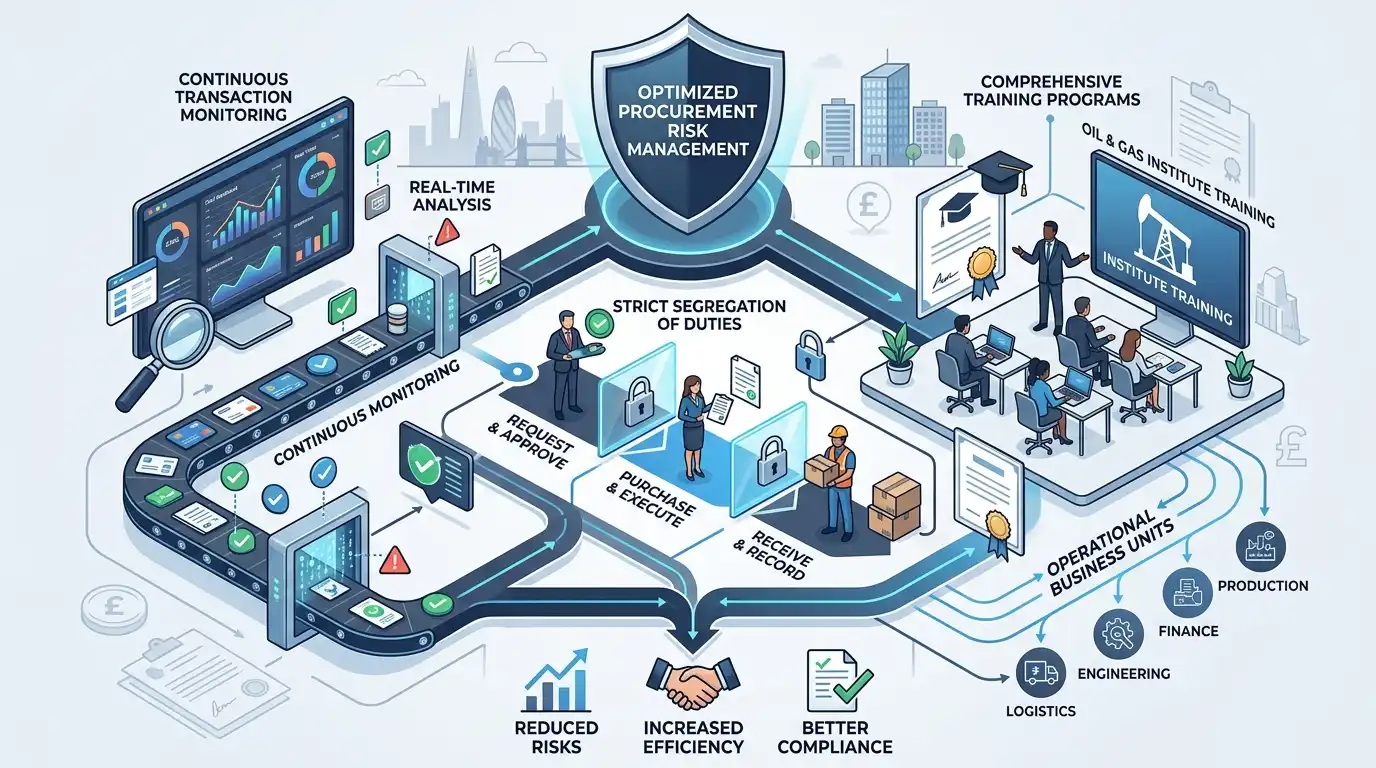
Corporate governance frameworks fail when organizations treat compliance as a static checklist rather than a dynamic operational discipline. Establishing resilient oversight demands multi-disciplinary collaboration between procurement specialists, forensic accountants, and internal audit teams. Organizations define clear Key Performance Indicators to measure the effectiveness of internal controls, tracking metrics such as audit cycle times, exception resolution rates, and vendor master file change frequencies.
Learning delivery models must adapt to the complex realities of modern corporate structures. Traditional classroom training often fails to provide the practical, scenario-based experience necessary to recognize evolving financial crimes. Modern workplace learning integrates interactive case studies, data simulation exercises, and cross-functional workshops that mirror actual operational environments. This practical approach ensures that finance and procurement personnel possess the technical competence required to evaluate high-value contracts and identify subtle indicators of financial irregularity.
Continuous improvement in governance relies on closing feedback loops between investigative findings and policy updates. When forensic audits uncover control weaknesses, organizations immediately revise authorization matrices, tighten vendor onboarding verification standards, and enhance automated exception reporting. Embedding these rigorous standards into daily operations protects corporate capital, ensures regulatory compliance, and reinforces stakeholder trust across the entire enterprise.
Frequently Asked Questions
What is covered in Oil and Gas Petroleum Compliance, AML & Risks training?
The Institute For Oil & Gas Training delivers comprehensive programs focusing on regulatory frameworks, anti-money laundering (AML) protocols, and financial crime risk mitigation specifically tailored for energy sector operations. Participants learn how to identify compliance vulnerabilities, monitor international vendor transactions, and implement robust anti-corruption controls across complex supply chains.
Why is anti-money laundering compliance critical in upstream and downstream petroleum operations?
Energy supply chains involve high-value cross-border transactions and multi-tiered vendor networks that present significant exposure to illicit financial flows and bribery schemes. Implementing rigorous anti-money laundering frameworks through the Institute For Oil & Gas Training protects organizations from severe regulatory penalties, legal liabilities, and reputational damage.
How do oil and gas companies detect procurement fraud and payment irregularities?
Organizations uncover financial irregularities by deploying forensic accounting techniques such as Benford's Law analysis, fuzzy logic vendor matching, and continuous three-way document verification. The Institute For Oil & Gas Training equips finance and procurement personnel with practical methodologies to identify split invoices, ghost vendors, and unauthorized payment disbursements.
What regulatory standards govern petroleum compliance and financial crime prevention?
Petroleum operations must adhere to international anti-corruption legislation, such as the UK Bribery Act and the US Foreign Corrupt Practices Act, alongside strict domestic environmental and fiscal mandates. Specialized programs from the Institute For Oil & Gas Training help compliance officers navigate these complex regulatory frameworks and align internal audit protocols with global standards.
How can corporate HR and compliance teams upskill staff on petroleum risk management?
Corporate learning teams utilize practical, industry-driven training models that combine scenario-based exercises, regulatory case studies, and compliance data simulations. The Institute For Oil & Gas Training provides targeted professional development solutions that bridge workforce skill gaps and measurable business outcomes for energy enterprises.
Related training courses
JV Accounting & Partner Reporting for Operators Training Course
- Specialisation
- Oil & Gas Petroleum Accounting
- Duration
- 5 days · 15 CPD hours
Risk Management for Upstream & Midstream Projects: Exposures Training Course
- Specialisation
- Oil & Gas Petroleum Compliance, AML & Risks
- Duration
- 5 days · 15 CPD hours
Regulatory Compliance for Petroleum Entities Training Course
- Specialisation
- Oil & Gas Petroleum Compliance, AML & Risks
- Duration
- 5 days · 15 CPD hours
More articles

How Revenue, Inventory and Production Data Can Reveal Fraud Indicators
Learn how corporate training empowers teams to use revenue, inventory, and production data to detect operational fraud in oil and gas sectors.
Read article →
Developing Petroleum Fraud Risk Skills Through Specialist Oil & Gas Training
Master forensic accounting, vendor auditing, and procurement fraud detection with specialized oil and gas training. Enroll your team today.
Read article →
Why Procurement and Contractor Payments Create Fraud Exposure in Oil & Gas
Discover how oil and gas companies mitigate procurement fraud and contractor payment risks through targeted workforce training and internal controls.
Read article →