
Forensic data analysis in oil and gas operations is a systematic corporate training methodology that equips workforce teams with the quantitative skills required to cross-reference financial ledgers with physical asset movements, eliminating discrepancies that conceal illegal diversion. Organizations operate within complex supply chains where vast quantities of crude oil, refined products, and financial capital move simultaneously across global networks. When internal actors manipulate these systems, standard financial audits fail because fraudsters conceal discrepancies within operational metrics rather than general ledger entries. Professional development programs teach finance teams, internal auditors, and operations managers how to integrate revenue receipts, inventory logs, and production output reports into unified analytical frameworks. This training bridges the traditional divide between corporate accounting departments and field operations personnel, ensuring that employees recognize anomalies such as phantom production volumes, inflated meter readings, and unexplained inventory shrinkage. Corporations face severe financial penalties and reputational damage when internal control failures permit illicit activities to persist unchecked. By building internal competencies in data reconciliation, companies protect their capital reserves and enforce strict governance standards across upstream, midstream, and downstream sectors.
Corporate training initiatives in this domain establish clear definitions for key performance indicators and operational baselines. Employees learn to analyze variance reports that track the deviation between expected hydrocarbon yields and actual sales figures. Training curricula incorporate real-world case studies from energy sectors, maritime shipping, and petrochemical refining to demonstrate how unauthorized inventory transfers manifest in digital databases. Participants examine how automated SCADA (Supervisory Control and Data Acquisition) systems generate operational logs that must match Enterprise Resource Planning (ERP) financial records. When production figures rise while recorded revenue drops without a corresponding inventory accumulation, employees identify a primary indicator of transactional tampering. The professional development process transforms passive observers into active monitors who understand the mechanical realities of extraction and the digital footprints of accounting transactions. Organizations implement these structured learning paths to cultivate an institutional culture of vigilance, integrity, and rigorous oversight.
How Does Corporate Training Enable Teams to Detect Operational Fraud
Corporate training enables teams to detect operational fraud through structured, multi-phase learning models that combine classroom instruction, simulation exercises, and practical data reconciliation drills. Organizations deploy these professional development programs to bridge skill gaps between theoretical accounting principles and the messy reality of physical asset management. The learning delivery model utilizes a blended format comprising 40% interactive workshops, 30% digital simulation modules, and 30% collaborative case-based learning sessions. Human resources managers and learning and development professionals design these curricula to span 12 weeks of progressive skill acquisition, ensuring that participants absorb complex analytical concepts without disrupting ongoing business operations. Training cohorts consist of cross-functional teams including plant engineers, internal auditors, procurement specialists, and financial controllers. This collaborative environment breaks down organizational silos, enabling technical personnel to understand financial compliance requirements while finance professionals learn the physical constraints of hydrocarbon measurement.
The implementation process begins with baseline assessments that measure each participant's existing proficiency in statistical anomaly detection and database querying. Instructional designers then deploy role-play scenarios where teams analyze synthetic datasets derived from actual corporate fraud investigations. Participants utilize industry-standard data analytics software to execute Benford's Law tests on vendor payment logs, reconcile meter-ticket data against shipping manifests, and track serial numbers on high-value equipment purchases. Formative assessments occur weekly through peer-reviewed projects and supervisor evaluations, culminating in a capstone audit simulation where teams present their findings to senior executive panels. Organizations measure the success of these programs using specific performance metrics, including a 35% reduction in audit cycle times, a 50% increase in early-stage anomaly detection, and an 85% employee retention rate among participating financial analysts. Continuous feedback loops allow learning and development teams to refine course materials based on emerging fraud typologies observed in global energy markets.
What Key Components Drive Effective Fraud Detection Training Frameworks
Effective fraud detection training frameworks incorporate specialized technical skill modules, quantitative evaluation tools, collaborative learning methodologies, and rigorous compliance guidelines.
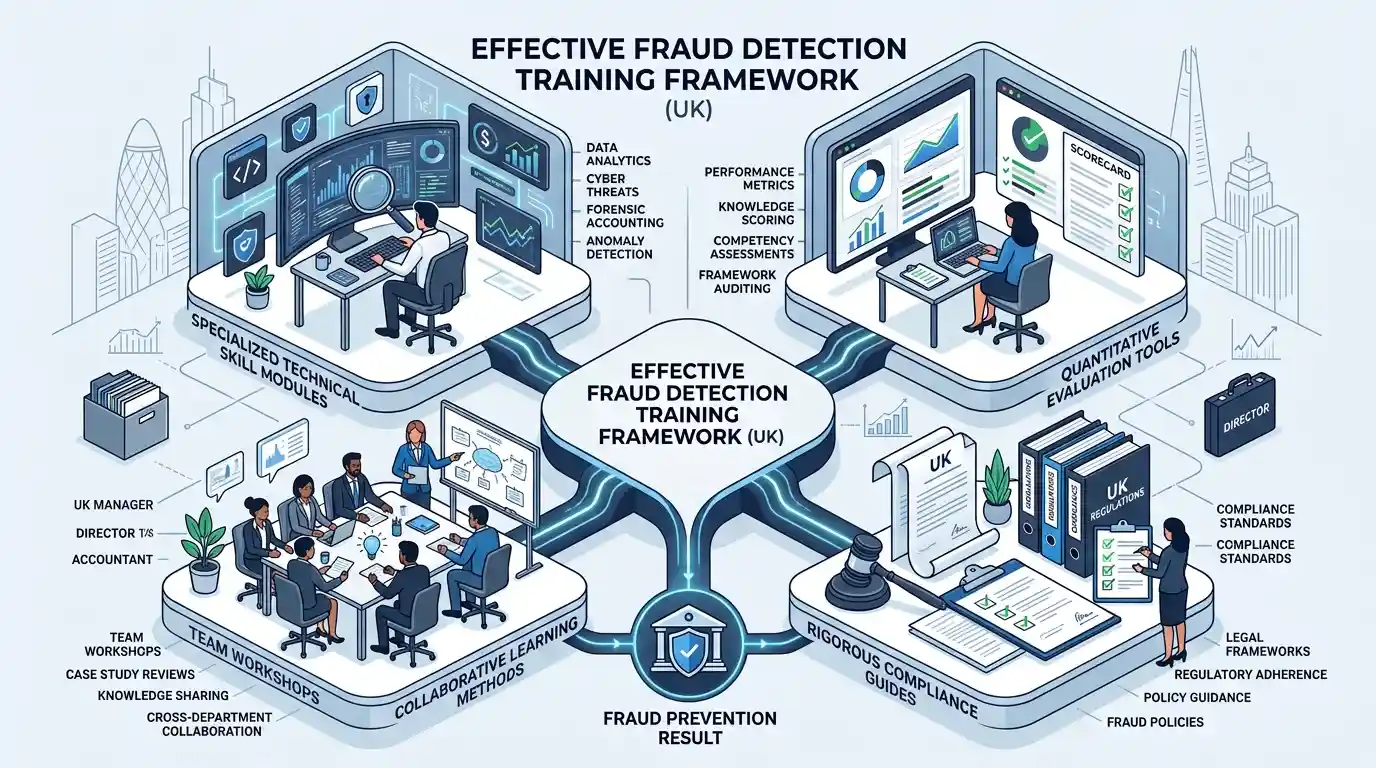
Corporations must move away from generic, compliance-only training videos toward targeted, rigorous educational architectures that address specific operational vulnerabilities. The core skill set imparted during these programs includes advanced Excel modeling, SQL database querying, statistical regression analysis, and process mapping for supply chain logistics. Training frameworks integrate specialized tools such as Tableau for data visualization, ACL for forensic auditing, and SAP audit information systems for enterprise resource tracking. These technical components are paired with behavioral risk assessments that teach team leaders how to recognize the psychological pressures, rationalization patterns, and opportunity structures that precede internal financial crimes.
The structural delivery of these components relies on three distinct learning methodologies that reinforce practical application. First, case-based learning exposes participants to historical fraud schemes in energy sectors, shipping industries, and manufacturing plants, forcing them to diagnose control failures and design preventative interventions. Second, digital simulation engines replicate high-stress corporate environments where teams must reconcile conflicting production logs and financial statements under strict regulatory deadlines. Third, peer-led workshops encourage robust debate regarding borderline transactions, ethical dilemmas, and internal escalation protocols. Organizations reinforce these learning elements by establishing clear standard operating procedures (SOPs) that align directly with the newly acquired competencies. When employees complete these comprehensive programs, they possess both the technical aptitude to interrogate complex databases and the institutional backing to report suspicious variances directly to executive oversight committees.
What Operational Benefits Do Organizations Realize Through Fraud Training
Organizations realize substantial operational benefits through advanced fraud training, including a 40% decrease in inventory shrinkage, enhanced cross-departmental collaboration, and accelerated leadership pipeline development. When companies invest in structured professional development for their finance and operations teams, the return on investment manifests across multiple financial and cultural dimensions. Team efficiency improves drastically as standardized reconciliation protocols replace ad-hoc, manual auditing procedures that are prone to human error and oversight. Departmental silos dissolve as engineers and accountants share a common vocabulary regarding production metrics, revenue recognition rules, and inventory valuation methods. This collaborative synergy ensures that operational anomalies are identified and investigated within days rather than quarters, preventing minor data discrepancies from escalating into catastrophic financial losses or regulatory enforcement actions.
Strategic workforce transformation is another critical outcome of comprehensive fraud training programs. Mid-level managers who complete these courses develop superior critical thinking and risk-assessment capabilities, positioning them to advance into senior executive roles within corporate governance and compliance divisions. Organizations observe a marked improvement in employee engagement scores, as staff members appreciate working for enterprises that prioritize continuous learning, integrity, and operational excellence. Furthermore, external stakeholders, including institutional investors, regulatory bodies, and insurance underwriters, view robust internal training programs as tangible evidence of superior corporate governance. This reputational advantage lowers capital borrowing costs and reduces premiums for directors' and officers' liability insurance, directly contributing to the enterprise's bottom-line financial health.
Where Are Fraud Detection Methodologies Applied Across Corporate Ecosystems
Fraud detection methodologies are applied across diverse corporate ecosystems including upstream extraction sites, midstream pipeline networks, downstream refineries, and corporate finance departments.
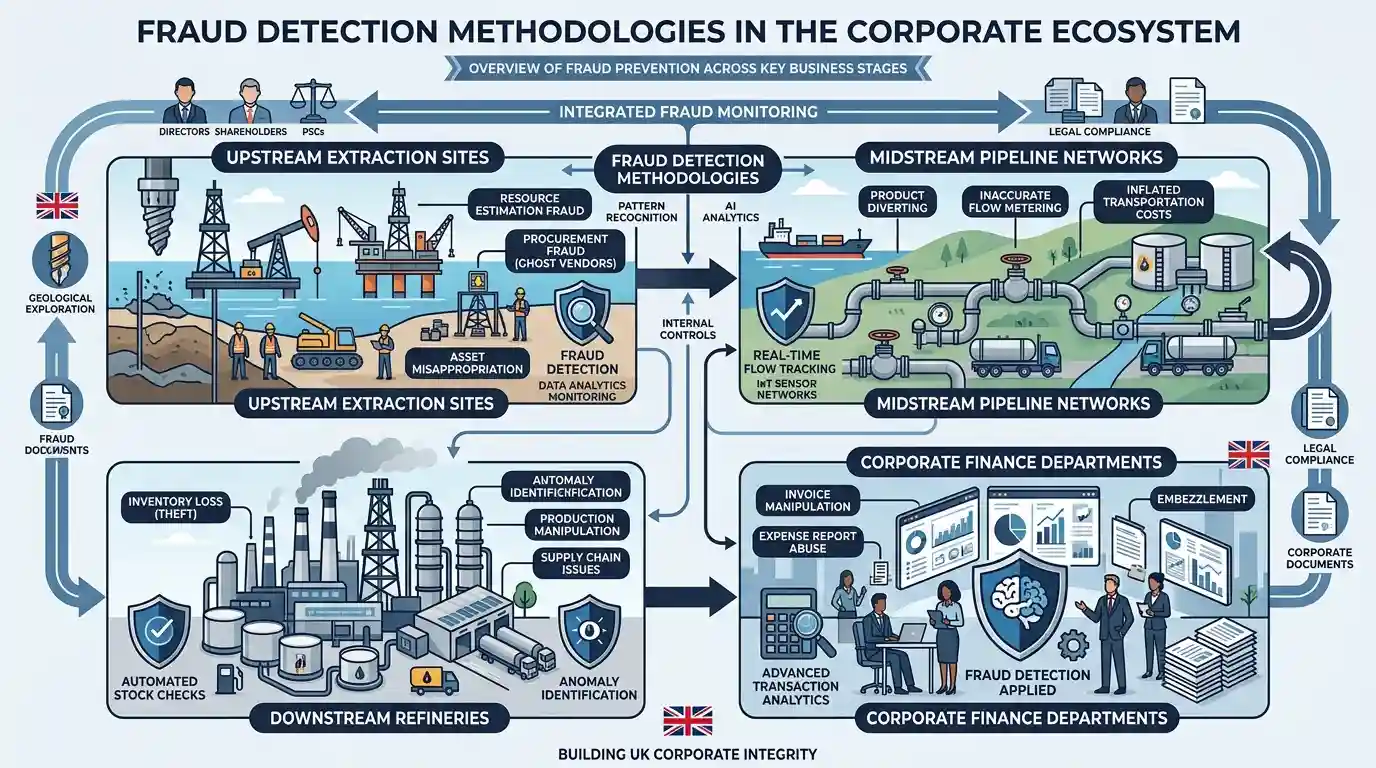
In upstream exploration and production environments, technical teams apply data reconciliation techniques to verify well-head production volumes against fiscal meter measurements. If local extraction logs indicate a steady output of crude oil while pipeline entry meters record a significant drop, cross-trained operations managers immediately investigate potential pipeline tampering, illegal offloading, or fraudulent metering calibration. In midstream logistics and shipping operations, transport managers utilize forensic data analytics to cross-reference bill-of-lading documents with satellite GPS tracking data and terminal discharge receipts. These practices eliminate ghost shipments and unauthorized fuel diversions that frequently plague extended maritime and rail transport routes.
In downstream refining and petrochemical processing plants, plant managers and inventory controllers analyze the mass balance equations that govern raw material intake and finished product output. By reconciling the volume of crude oil processed with the exact quantities of gasoline, diesel, and petrochemical feedstocks produced, teams detect unexplained material losses that indicate internal theft or accounting misrepresentation. Within corporate finance and procurement departments, accounts payable specialists apply statistical algorithms to vendor master files, identifying duplicate invoice payments, shell company disbursements, and suspicious purchase order splitting. Throughout all these functional areas, the integration of rigorous data analysis transforms isolated operational units into a synchronized, highly vigilant corporate defense network capable of neutralizing financial irregularities before they impact enterprise valuation.
What Common Problems and Misconceptions Undermine Corporate Training Programs
Corporate training programs frequently fail due to common problems such as generic course content, lack of practical application exercises, absence of measurable return on investment, and inadequate executive sponsorship. Many organizations make the strategic error of deploying off-the-shelf, compliance-oriented e-learning modules that treat fraud prevention as a box-checking exercise rather than a critical operational competency. These generic programs rely on passive video lectures and theoretical multiple-choice quizzes that fail to engage adult learners or build the complex cognitive skills required to interrogate messy corporate databases. Without hands-on practice using real-world datasets from energy sectors or manufacturing plants, employees forget the theoretical concepts within days of completing the course and cannot apply them when faced with actual data manipulation in their daily work routines.
Another prevalent misconception is that fraud detection is solely the responsibility of external auditors or specialized forensic accountants, absolving operational managers, engineers, and sales teams of any oversight duty. This mindset creates dangerous blind spots, as fraudsters deliberately exploit the gap between operational activities and financial reporting. Organizations compound these issues by failing to establish clear performance metrics to evaluate training efficacy, making it impossible for human resources directors to calculate the true return on investment or justify ongoing L&D budgets to executive boards. Effective professional development requires active participation from senior leadership, customized curricula tailored to specific industry risks, and continuous reinforcement through post-training coaching and simulated audits. By eliminating these systemic flaws, corporations ensure that their training investments translate directly into enhanced workforce capability, rigorous internal control, and long-term financial stability.
Implementation Guidance: Integrating Advanced Training into Your Organization
To successfully integrate these advanced training methodologies into your corporate environment, follow this strategic implementation sequence:
Conduct a Comprehensive Skill Gap Assessment
Subtitle: Mandatory initial phase for identifying organizational vulnerabilities
Evaluate the existing quantitative and analytical competencies of your finance, audit, and operational engineering teams. Administer baseline data-literacy assessments to determine where knowledge deficits exist regarding inventory reconciliation and variance analysis.
Customize Curricula to Industry-Specific Operations
Subtitle: Ensuring direct alignment with operational realities
Design training modules that incorporate real-world operational datasets from your specific sector, whether upstream extraction, maritime logistics, or petrochemical refining, ensuring participants engage with familiar terminology and metrics.
Deploy Blended Learning Delivery Formats
Subtitle: Maximizing engagement through multi-modal instruction
Combine 40% instructor-led interactive workshops with 30% digital simulation exercises and 30% collaborative case-based problem solving to accommodate diverse learning styles and maintain high completion rates.
Establish Post-Training Performance Metrics and Follow-Up
Subtitle: Tracking long-term return on investment and behavior change
Monitor key performance indicators such as audit cycle reduction, anomaly detection speed, and inventory shrinkage rates over 6, 12, and 24 months post-training to validate program effectiveness and drive continuous improvement.
Recommended Next Steps
For a deeper dive into the technical mechanics of tracing complex financial anomalies across energy supply chains, explore our detailed guide: [Using Forensic Accounting to Trace Irregular Transactions Across Petroleum Operations].
This resource provides advanced audit frameworks and case studies that complement the workforce training principles outlined above, supporting decision-makers as they transition from foundational awareness to comprehensive solution evaluation.
Frequently Asked Questions
What does oil and gas petroleum compliance, AML and risks training involve?
Oil and gas petroleum compliance, AML and risks training equips corporate workforces with the regulatory frameworks, anti-money laundering protocols, and risk assessment methodologies required for modern energy operations. Programs delivered by the Institute For Oil & Gas Training focus on practical skill development, helping teams navigate complex international sanctions, anti-corruption laws, and asset tracking standards. Participants engage in case-based learning and simulation exercises designed to address real-world financial crime risks across upstream, midstream, and downstream sectors.
Why is anti-money laundering (AML) critical for petroleum supply chains?
Anti-money laundering controls are vital in the petroleum sector because complex global supply chains, high capital flows, and multi-jurisdictional trade routes present significant vulnerabilities for illicit financial transfers. Training programs from the Institute For Oil & Gas Training teach finance and compliance professionals how to identify shell companies, monitor suspicious vendor payments, and verify transaction legitimacy. Implementing these rigorous protocols protects organizations from severe regulatory penalties, criminal liability, and reputational damage.
How do organizations manage regulatory compliance risks in oil and gas operations?
Organizations manage regulatory compliance risks by establishing continuous professional development pathways that bridge the gap between field operations, legal teams, and corporate accounting departments. The Institute For Oil & Gas Training delivers outcome-based programs that train employees to conduct internal audits, maintain meticulous documentation, and cross-reference operational metrics with financial ledgers. This systematic approach ensures adherence to evolving environmental, safety, and financial regulations across global energy markets.
What are the core components of petroleum compliance and risk management frameworks?
Core components of petroleum compliance and risk management frameworks include quantitative data reconciliation, automated vendor screening, anti-bribery controls, and rigorous supply chain oversight. Specialized training from the Institute For Oil & Gas Training integrates data analytics tools and behavioral risk assessments to help teams detect operational anomalies early. By combining technical proficiency with ethical governance standards, organizations build resilient defenses against internal fraud and external compliance breaches.
Who should participate in oil and gas compliance and AML professional development?
Oil and gas compliance and anti-money laundering professional development is essential for internal auditors, financial controllers, procurement specialists, legal counsel, and operations managers. Programs structured by the Institute For Oil & Gas Training cultivate cross-functional collaboration, ensuring that technical personnel and financial officers share a unified understanding of regulatory mandates. This comprehensive workforce training drives performance improvement, enhances corporate governance, and strengthens leadership pipelines across energy enterprises.
Related training courses
JV Accounting & Partner Reporting for Non-Operators Training Course
- Specialisation
- Oil & Gas Petroleum Accounting
- Duration
- 5 days · 15 CPD hours
Regulatory Compliance for Petroleum Entities Training Course
- Specialisation
- Oil & Gas Petroleum Compliance, AML & Risks
- Duration
- 5 days · 15 CPD hours
Segregation of Duties in Finance & ERP Systems Training Course
- Specialisation
- Oil & Gas Petroleum Compliance, AML & Risks
- Duration
- 5 days · 15 CPD hours
More articles

Forensic Accounting for Petroleum Operations: When Specialist Training Adds Professional Value
Master petroleum financial investigations, hydrocarbon data auditing, and fraud detection. Enroll in the Institute For Oil & Gas Training program today.
Read article →
Using Forensic Accounting to Trace Irregular Transactions Across Petroleum Operations
Discover how forensic accounting traces irregular petroleum transactions, detects supply chain fraud, and secures upstream financial operations.
Read article →
Developing Petroleum Fraud Risk Skills Through Specialist Oil & Gas Training
Master forensic accounting, vendor auditing, and procurement fraud detection with specialized oil and gas training. Enroll your team today.
Read article →