

Energy transition and carbon cost financial planning is a strategic decision-making discipline that integrates decarbonisation targets, carbon pricing, and demand shifting into capital allocation models, long-term price decks, asset valuation frameworks, and corporate risk assessments.
Oil and gas organizations operate within a rapidly shifting macro-economic landscape. Regulatory mandates, institutional investor requirements, and market dynamics force energy firms to account for carbon liabilities directly on their balance sheets. In corporate learning contexts, training on this topic bridges the gap between traditional upstream financial analysis and modern environmental, social, and governance economics.
Financial decision-makers must evaluate carbon not as an external variable, but as a direct operational expense and a capital risk factor. Corporate workforce development programs establish standardized frameworks so finance teams, asset managers, and commercial strategists apply identical shadow pricing models across capital expenditure evaluations.
Without formal training in carbon-adjusted financial modeling, corporate teams misprice capital assets and miscalculate long-term project viability. Training programs address skill gaps in calculating scope 1, scope 2, and scope 3 emissions liabilities across asset lifecycles. Organizations build organizational capability to quantify regulatory exposure, calculate asset impairment risks, and align capital budgets with international climate frameworks like the Task Force on Climate-related Financial Disclosures.
Training builds cross-functional alignment between finance, sustainability, and operational leadership. When commercial teams master carbon valuation techniques, they produce balance sheet projections that accurately reflect transition risks and market fluctuations.
How Does Energy Transition Financial Planning Work in Corporate Environments?
Energy transition financial planning works through a 4-stage corporate workflow: data gathering on operational emissions, applying shadow carbon prices, stress-testing asset cash flows under varied demand scenarios, and reallocating capital toward resilient operational portfolios.
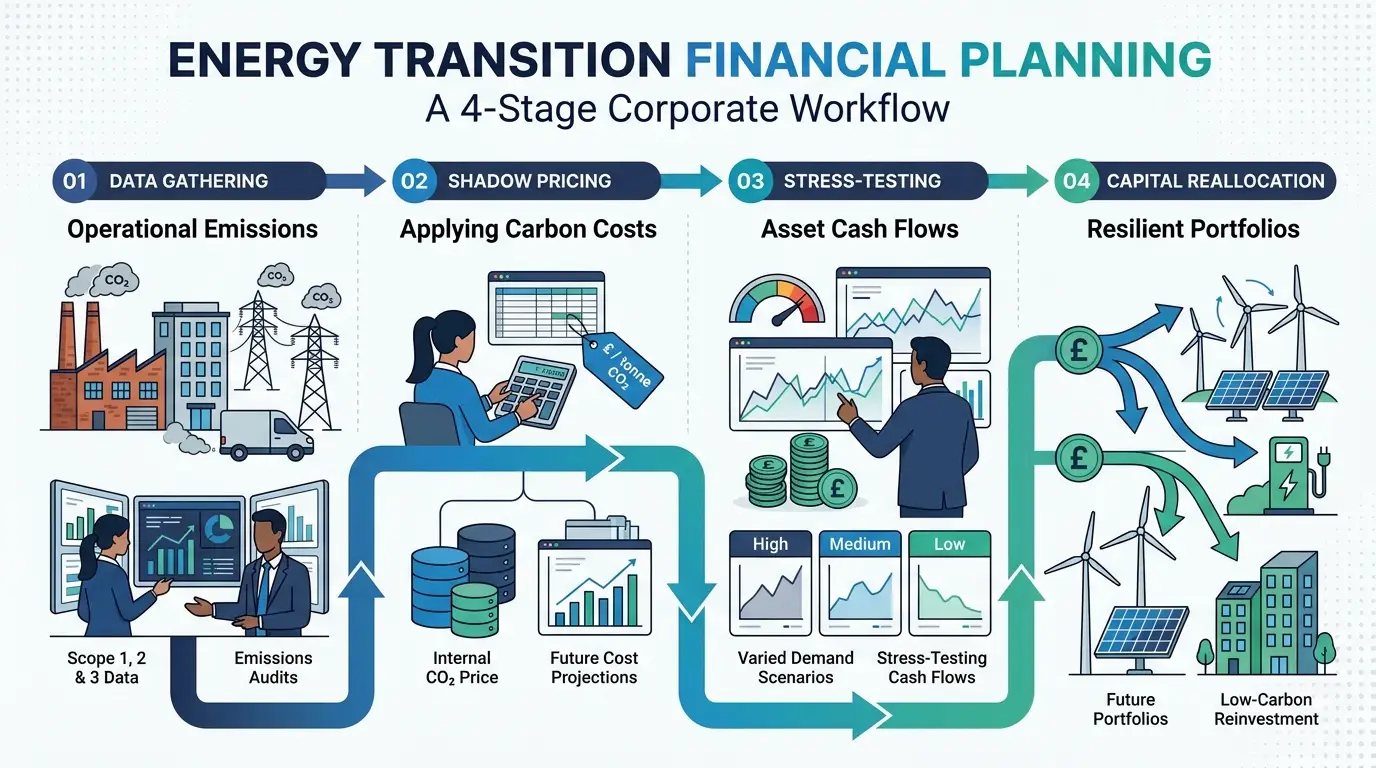
Implementation begins when planning teams audit existing corporate portfolio models. Finance professionals aggregate facility-level emissions data and convert physical units into monetary liabilities. Upstream asset valuations then incorporate variable carbon cost assumptions ranging from $50 per tonne to over $150 per tonne depending on jurisdiction and operational horizon.
Corporate learning initiatives structure this technical transition through sequential module delivery. Training departments deploy 3-day intensive executive workshops, 6-week blended online modules, or interactive hybrid learning environments. Learning paths focus on hands-on financial mechanics, using real-world asset datasets to replace hypothetical exercises with functional modeling experience.
Workforce development programs utilize case-based learning and financial model simulations. Teams build financial stress tests that evaluate how asset returns shift when regulatory regimes impose direct carbon taxes or cap-and-trade obligations. Participants learn to adjust discounted cash flow calculations, debt coverage ratios, and internal rates of return under stringent decarbonization pathways.
Organizational implementation requires embedding these methodologies into annual capital budgeting cycles. Companies establish corporate governance frameworks where project approval committees reject proposals that fail carbon sensitivity stress tests. This operational shift ensures capital flows exclusively toward assets capable of maintaining profitability during structural energy shifts.
What Key Components Are Included in Energy Transition Financial Training?
Energy transition financial training includes core technical frameworks: emissions cost modeling modules, carbon price sensitivity tools, scenario planning methodologies, asset impairment evaluations, transition risk disclosure standards, and capital allocation frameworks.
Training Component | Key Technical Focus Areas | Primary Business Outputs |
Emissions Cost Modeling | Scope 1, 2, & 3 liability integration; direct carbon tax calculations | Asset-level carbon balance sheet reconciliation |
Carbon Price Assumptions | Internal shadow pricing ($50-$150/t); regulatory compliance modeling | Adjusted net present value and internal rate of return metrics |
Scenario Planning Methods | IEA pathways; 1.5°C vs. 2.0°C demand destruction projections | Multi-variable asset resilience matrices |
Stranded Asset Evaluation | Impairment risk indicators; accelerated depreciation schedule analysis | Portfolio tail-risk mitigation plans |
Risk Disclosure Standards | ISSB, TCFD, and CSRD compliance reporting protocols | Audit-ready investor and stakeholder filings |
Corporate training frameworks balance analytical rigor with practical application. Programs break down complex economic inputs into functional corporate toolkits that finance and strategy professionals apply immediately within corporate financial software.
Emissions cost modeling modules teach professionals how to project future carbon taxation liabilities across diverse operating environments. Participants master the deployment of carbon price assumptions within standard long-term price decks. This technical skill ensures that long-term asset evaluations remain accurate even as global carbon compliance costs increase.
Scenario planning methodologies give teams the tools to model structural demand destruction. Finance professionals learn to apply energy transition scenarios published by bodies such as the International Energy Agency. They test portfolio resilience against varying rates of electric vehicle adoption, renewable power expansion, and industrial fuel switching.
Asset impairment modules focus specifically on identifying stranded asset risk early in the capital allocation process. Participants evaluate reserve replacement ratios, accelerated depreciation schedules, and decommissioning liabilities under low-demand conditions. The curriculum concludes with instruction on transition risk disclosure standards, ensuring balance sheet reporting complies with international regulatory authorities.
How Do Organizations Implement Energy Transition Financial Models Across Teams?
Organizations implement energy transition models by auditing internal skill gaps, delivering standardized role-based training programs, integrating carbon pricing into capital management software, and measuring performance through standardized financial KPIs.
Successful corporate rollout requires a systematic, multi-phase approach across corporate finance, business development, and sustainability departments. Companies begin with a comprehensive skills gap analysis to benchmark baseline financial modeling capabilities across upstream, midstream, and downstream business units.
The implementation workflow moves through 4 distinct stages:
Phase 1: Alignment and Scoping: Leadership defines internal carbon pricing guidelines and selects standardized transition scenarios for portfolio testing.
Phase 2: Structured Capability Building: Finance, treasury, and commercial planning teams complete applied learning programs featuring customized corporate case studies and scenario software.
Phase 3: Process Integration: Financial planning software and enterprise resource planning systems are updated to require carbon cost inputs for all capital expenditure requests exceeding $1,000,000.
Phase 4: Governance and Review: Investment committees establish strict hurdle rate criteria that include carbon sensitivity adjustments before funding capital projects.
To evaluate organizational readiness and make informed choices about training scope, decision-makers review structured frameworks such as How to Evaluate Energy Transition Risks and Carbon Costs Across Oil and Gas Scenarios.
Companies build internal capability by linking corporate learning directly to operational governance. Peer-to-peer review sessions and practical project assessments ensure that team members apply standardized capital reallocation decisions consistently across all geographic subsidiaries and operating divisions.
What Measurable Business Outcomes Does This Training Produce for Oil and Gas Companies?
Energy transition financial training produces measurable business outcomes: a 15% to 30% reduction in unhedged carbon exposure, improved capital allocation efficiency, enhanced portfolio resilience, and 100% compliance with corporate transition disclosures.

Investing in structured workforce development yields clear, quantifiable returns for energy enterprises. Organizations that train their financial leadership teams systematically outperform peers in managing transition-related balance sheet volatility.
Enhanced Capital Efficiency: Finance teams calculate risk-adjusted returns accurately, avoiding premature capital deployment into high-emission projects vulnerable to early retirement.
Reduced Impairment Exposure: Portfolios stress-tested against aggressive decarbonization scenarios experience 20% fewer unexpected asset write-downs over 5-year operating cycles.
Streamlined Regulatory Compliance: Standardized training cuts the preparation time for regulatory climate disclosures by 40%, eliminating reliance on external management consultants.
Improved Capital Access: Clear, audit-ready transition disclosures lower the cost of debt capital by demonstrating proactive risk management to institutional lenders and equity investors.
Accelerated Investment Approval Cycles: Cross-functional alignment between finance and operational teams reduces project review and approval timelines by 25%.
The Scenario Planning for Energy Transition & Carbon Cost Training Course equips corporate teams with the practical tools required to execute these financial transformations effectively.
Through rigorous scenario training, energy companies transform regulatory mandates into strategic advantages. Financial professionals acquire the tools necessary to preserve corporate capital, optimize portfolio performance, and navigate structural market transitions with clarity and confidence.
What Common Misconceptions and Failures Exist in Energy Transition Financial Training?
Common training failures stem from treating carbon pricing as a static compliance exercise, using overly generic academic models, isolating finance teams from operational engineering leads, and failing to measure practical business execution post-training.
A primary misconception among corporate executives is that environmental training belongs exclusively to sustainability or HSE departments. When financial planning teams are excluded from carbon mechanics, financial models rely on outdated capital assumptions that ignore regulatory shadow pricing.
Another common pitfall is relying on off-the-shelf, academic training programs that lack industry context. Generic business courses often present simple carbon tax calculations, failing to capture the nuances of upstream production decline curves, midstream tariff structures, or complex refining yield economics. Effective corporate training must utilize operational energy datasets and realistic commodity price decks.
Organizations also fail when they treat transition training as a one-time event rather than an ongoing capability-building framework. Energy markets evolve rapidly; regulatory policies, carbon pricing mechanisms, and technological alternatives shift continuously. Training programs must establish continuous learning mechanisms, post-course assessments, and quarterly model updates to maintain organizational capability.
Finally, training programs fail when they lack executive sponsorship and clear performance integration. If corporate decision-makers do not enforce carbon-adjusted evaluation criteria during annual budget reviews, teams revert to traditional financial modeling practices, rendering the training investment ineffective.
Frequently Asked Questions
What is oil and gas petroleum financial analysis?
Oil and gas petroleum financial analysis is a specialized evaluation discipline that assesses the economic viability, capital allocation, cash flow dynamics, and risk profiles of energy assets across upstream, midstream, and downstream sectors. Professionals analyze commodity price decks, reserve valuations, operational expenditure (OPEX), capital expenditure (CAPEX), and fiscal regimes to determine project profitability. The Institute For Oil & Gas Training provides structured programs in Oil and Gas Petroleum Financial Analysis to help corporate teams master these complex financial models and valuation techniques.
Why is petroleum financial analysis critical for energy investment decisions?
Petroleum financial analysis provides decision-makers with the quantitative insights required to evaluate asset impairment, capital efficiency, and long-term risk-adjusted returns in volatile energy markets. By integrating fiscal terms, depletion curves, and shadow carbon pricing into financial models, organizations mitigate capital misallocation and portfolio risk. Through the Oil and Gas Petroleum Financial Analysis training from the Institute For Oil & Gas Training, finance and strategy professionals learn to build robust cash flow scenarios that support strategic investment decisions.
What key financial metrics are used in oil and gas asset valuation?
Key financial metrics in oil and gas valuation include Net Present Value (NPV), Internal Rate of Return (IRR), Netback per barrel of oil equivalent (BOE), Discounted Cash Flow (DCF), and Finding and Development (F&D) costs. Analysts evaluate these indicators alongside fiscal contract structures, such as Production Sharing Contracts (PSCs) and concessionary regimes, to forecast asset yields accurately. The Institute For Oil & Gas Training incorporates these essential economic indicators into its Oil and Gas Petroleum Financial Analysis coursework for real-world application.
How does carbon pricing impact oil and gas financial models?
Carbon pricing impacts oil and gas financial models by introducing explicit operational cost liabilities and regulatory risk adjustments across an asset’s lifecycle. Incorporating internal shadow carbon prices and emissions cost forecasting allows analysts to stress-test asset resilience against stringent climate policies and shifting demand curves. The Institute For Oil & Gas Training equips corporate finance teams with modern methodology through its Oil and Gas Petroleum Financial Analysis curriculum to incorporate carbon liabilities into standard long-term price decks.
Who should undertake training in oil and gas petroleum financial analysis?
Training in petroleum financial analysis is designed for finance managers, commercial analysts, corporate strategists, investment bankers, and planning leads operating within the energy sector. It is equally valuable for non-financial energy executives seeking to enhance their understanding of corporate valuation, project economics, and risk management. The Institute For Oil & Gas Training delivers practical, outcome-driven instruction in Oil and Gas Petroleum Financial Analysis to build technical competency and alignment across multidisciplinary corporate teams.
Related training courses
Failure Mode and Effects Analysis (FMEA) Training Course
- Specialisation
- Oil & Gas Reliability and Maintenance Management
- Duration
- 5 days · 15 CPD hours
API Standard 1163 In-line Inspection Systems Qualification Training Course
- Specialisation
- Oil & Gas Pipeline Integrity and Inspection
- Duration
- 5 days · 15 CPD hours
BPVC Section V Non-Destructive Testing Training Course
- Specialisation
- Oil & Gas Inspection and Non-Destructive Testing
- Duration
- 5 days · 15 CPD hours
More articles

Cash Flow Stress Testing Training for Oil and Gas Financial Analysis Professionals
Evaluate financial risks with Cash Flow Stress Testing for Liquidity & Solvency Training Course by Institute For Oil & Gas Training. Enroll now.
Read article →
How to Evaluate Liquidity and Solvency Risks Through Oil and Gas Cash Flow Stress Testing
Compare evaluation models for oil and gas liquidity and solvency stress testing to safeguard corporate financial stability.
Read article →
Why Cash Flow Stress Testing Matters for Oil and Gas Liquidity and Solvency
Discover why cash flow stress testing is vital for oil and gas liquidity and solvency. Learn how workforce training strengthens corporate financial resilience.
Read article →