
Fraud exposure in petroleum operations arises because complex supply chains, high capital expenditures, and multi-jurisdictional transactions create systemic vulnerabilities that traditional internal controls fail to detect. Organizations experience significant financial loss and operational disruption when workforce skill gaps prevent employees from identifying anomalies in procurement, extraction, and financial reporting.
The petroleum sector operates within high-value environments where capital flows through intricate contractual networks. These networks involve upstream exploration, midstream transportation, and downstream distribution phases. Each phase presents distinct operational friction points.
When team members lack adequate technical knowledge and analytical rigor, discrepancies in vendor invoicing, asset valuation, and production metering go unnoticed. Workforce competence directly dictates an organization's defense mechanism against financial malfeasance.
Corporate environments require structured professional development initiatives to bridge existing knowledge gaps. Employees must understand how financial discrepancies manifest in daily operational workflows.
Organizations face severe financial penalties and reputational damage when internal teams fail to recognize red flags. Professional training programs establish rigorous oversight frameworks. These frameworks equip personnel with the diagnostic capabilities necessary to secure high-stakes transactions.
Training initiatives translate complex regulatory mandates into actionable workplace behaviors. Employees learn to scrutinize vendor contracts, evaluate inventory logs, and cross-reference financial statements against physical output data.
Institutions that prioritize continuous professional development cultivate resilient workforce ecosystems. Teams mitigate risk exposure by applying systematic investigative methodologies to daily petroleum transactions.
How Do Organizations Implement Petroleum Fraud Prevention Training Frameworks?
Organizations implement petroleum fraud prevention training through structured, multi-phase programs that combine foundational workshops, interactive simulations, and continuous workplace assessments. Training delivery utilizes blended learning formats including 3-day intensive workshops, 6-week online modules, and monthly hybrid learning sessions to achieve 85% knowledge retention rates across technical departments.
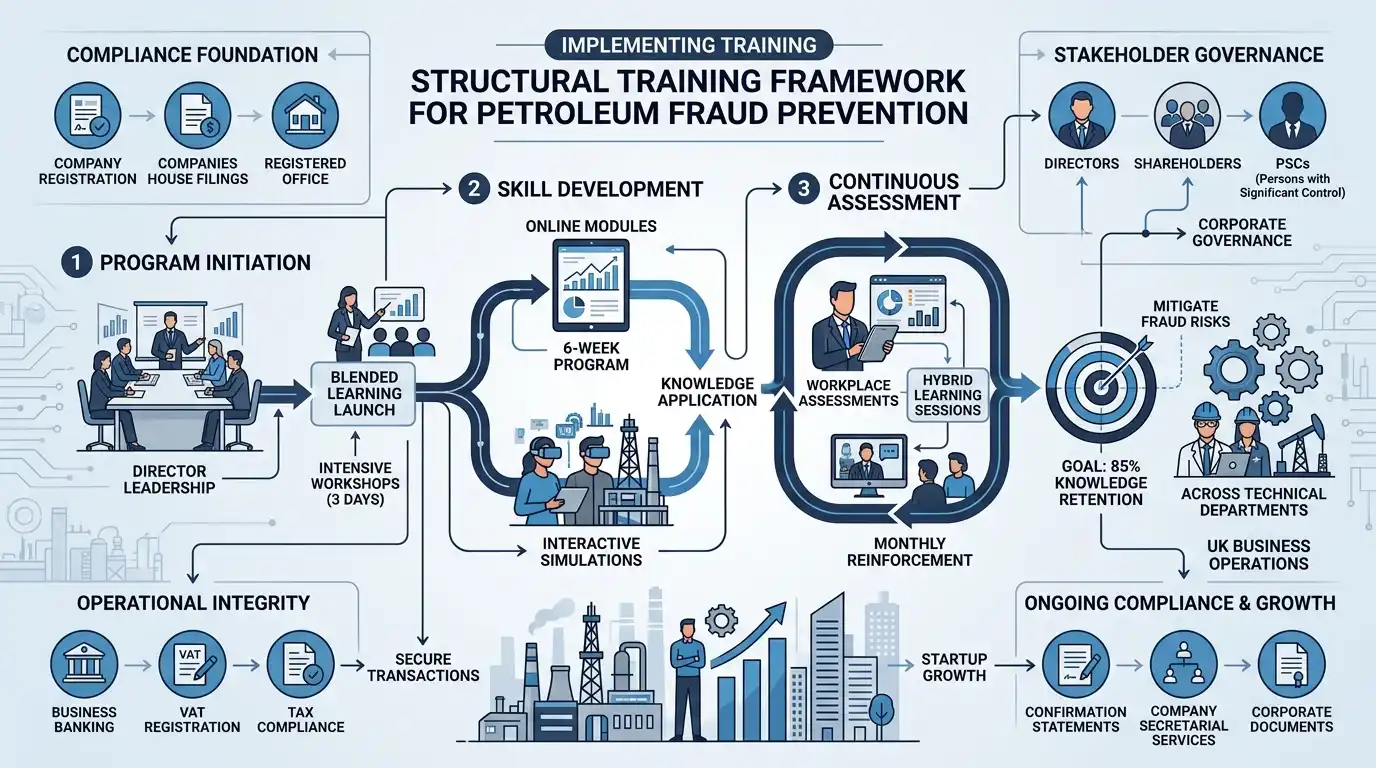
The implementation lifecycle begins with a comprehensive training needs analysis. Human resources managers and learning and development professionals evaluate existing skill gaps within procurement, accounting, and operational teams.
Assessments identify specific vulnerabilities related to supply chain oversight and financial reconciliation. Following the evaluation phase, instructional designers develop curricula aligned with real-world corporate challenges.
Curriculum design incorporates case-based learning methodologies and digital simulations. Teams analyze historical fraud scenarios observed in sectors like oil and gas, heavy manufacturing, and international logistics.
Learners participate in role-playing exercises that replicate high-pressure vendor negotiation and contract approval environments. These exercises test the decision-making agility of middle managers and operational leads.
Post-training evaluations measure knowledge acquisition through practical examinations and behavioral observation metrics. Organizations track key performance indicators such as a 40% reduction in procurement reconciliation errors and a 30% improvement in audit response times.
Continuous reinforcement occurs through microlearning modules and quarterly refresher courses. Leadership pipelines strengthen as supervisors demonstrate enhanced vigilance during asset valuation and supplier audits.
As learners progress from awareness to actionable evaluation, organizations frequently transition internal teams toward advanced investigative techniques. This operational shift represents the ideal juncture to introduce specialized methodologies detailed in Forensic Accounting Approaches for Investigating Fraud in Oil & Gas Transactions. Accessing these advanced insights helps decision-makers bridge foundational operational training with technical financial investigation.
What Core Components Define Petroleum Operations Fraud Training Curricula?
Core training curricula include risk assessment frameworks, supply chain auditing techniques, technical data verification tools, and communication protocols for reporting financial anomalies. Programs integrate multidisciplinary skill development covering data analytics, legal compliance, ethical decision-making, and strategic thinking to ensure comprehensive workforce transformation.
Workforce development initiatives focus on distinct competency domains that address specific operational vulnerabilities. Technical skill modules train engineers and operational managers to reconcile physical hydrocarbon metrics with financial ledger entries.
Participants study volumetric measurement standards, custody transfer protocols, and pipeline inventory tracking systems. These technical modules prevent discrepancies between reported extraction volumes and invoiced quantities.
Financial skill components educate procurement teams on forensic auditing techniques. Learners examine vendor master file maintenance, duplicate invoice detection, and split-purchase identification methods.
Programs utilize data visualization tools and automated anomaly detection software during practical laboratory sessions. Learners manipulate real-world datasets to uncover concealed kickback schemes and inflated service charges.
Communication modules emphasize cross-functional collaboration and transparent reporting channels. Team leaders learn to conduct objective compliance reviews without disrupting daily operational efficiency.
Leadership modules reinforce ethical governance standards. Executives align corporate incentive structures with transparent performance metrics to eliminate the pressure-driven motivations that precipitate fraudulent behavior.
Continuous feedback loops ensure training content evolves alongside emerging regulatory requirements. Organizations update course materials annually to reflect shifting industry standards and technological advancements in digital ledger management.
What Measurable Outcomes Do Petroleum Fraud Training Programs Produce for Enterprises?
Petroleum fraud training programs produce measurable outcomes including a 45% decrease in compliance audit discrepancies, a 25% improvement in team operational efficiency, and a 20% increase in voluntary employee retention. Organizations achieve positive return on investment within 12 months through optimized procurement processes and reduced financial exposure.
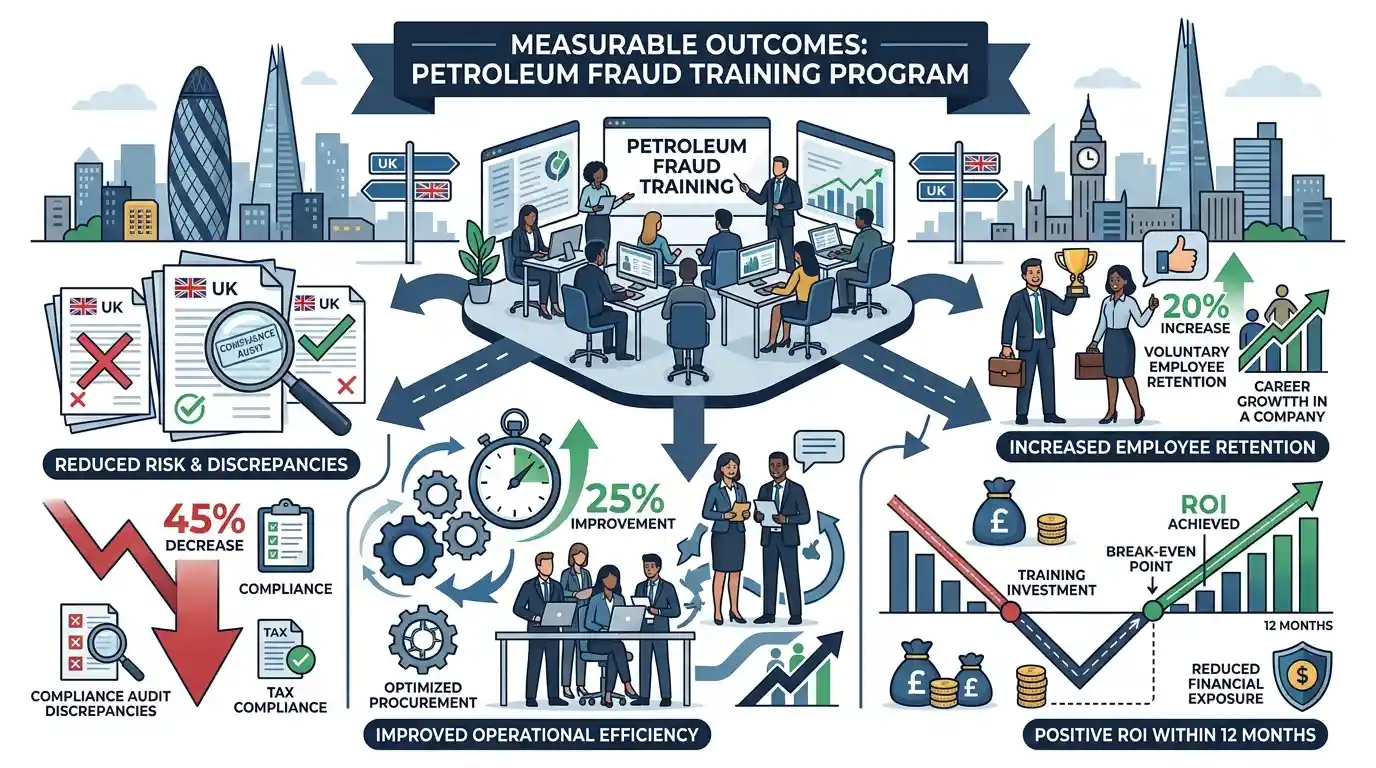
Enterprise performance metrics validate the direct impact of structured professional development on corporate profitability. When cross-functional teams complete rigorous training initiatives, error rates in asset valuation and expenditure reporting decline significantly.
Employees execute routine audits with greater autonomy, reducing the reliance on expensive external consultants. Team efficiency improves as standardized verification protocols streamline decision-making workflows.
Workforce transformation initiatives enhance employee engagement and reduce turnover among high-performing technical staff. Professionals value organizations that invest in continuous skill enhancement and career growth.
Clear competency frameworks provide employees with structured career pathways, increasing job satisfaction across mid-level management roles. Improved collaboration between legal, finance, and operational departments fosters a culture of shared accountability.
Strategic decision-making improves across executive boards as reliable operational data informs capital allocation strategies. Organizations maintain regulatory compliance across international jurisdictions, avoiding costly litigation and punitive government fines.
Measurable ROI calculations demonstrate that comprehensive training investments protect enterprise capital far exceeding initial program delivery costs. Enterprises sustain long-term competitive advantage through resilient, ethically driven, and highly skilled workforces.
Which Corporate Teams Benefit Most From Petroleum Operations Fraud Education?
Corporate teams that benefit most from petroleum operations fraud education include procurement specialists, field operations managers, internal audit personnel, and executive leadership committees. Departments across upstream exploration, midstream logistics, and downstream refining achieve enhanced performance and risk mitigation through targeted professional development.
Procurement and supply chain departments represent the frontline defense against vendor-related financial exposure. Training equips buyers with the analytical tools to evaluate supplier bidding integrity and market-rate valuations.
Field operations teams benefit from understanding how inventory manipulation affects financial reporting accuracy. Supervisors learn to maintain strict chain-of-custody documentation for all extracted and transported commodities.
Internal audit personnel refine their diagnostic capabilities through advanced case-based learning exercises. Auditors transition from reactive compliance checking to proactive risk identification, uncovering systemic vulnerabilities before financial damage occurs.
Mid-level managers develop leadership competencies that reinforce ethical standards across operational units. These supervisors guide front-line workers in identifying and reporting irregular transaction patterns immediately.
Executive leadership teams utilize training outcomes to evaluate organizational readiness and compliance posture. Decision-makers integrate risk management metrics into corporate strategy, ensuring long-term operational stability.
Comprehensive workforce education aligns departmental objectives with overarching enterprise goals. Organizations achieve synchronized performance improvements across all operational phases.
Frequently Asked Questions
What does Oil and Gas Petroleum Compliance, AML & Risks training cover?
Institute For Oil & Gas Training delivers specialized programs focusing on anti-money laundering regulations, regulatory compliance frameworks, and financial risk mitigation strategies across upstream and downstream sectors. Participants learn to identify vulnerabilities in complex supply chains, evaluate vendor integrity, and implement robust internal controls.
Why is compliance and anti-money laundering critical in petroleum operations?
The capital-intensive nature of the petroleum industry and its multi-jurisdictional supply chains expose organizations to severe financial crime risks and regulatory penalties. Implementing Oil and Gas Petroleum Compliance, AML & Risks protocols equips teams to detect red flags in invoicing, asset valuation, and international transactions.
Who should attend Institute For Oil & Gas Training compliance programs?
These courses benefit compliance officers, internal auditors, procurement managers, and legal professionals operating within energy corporations and petroleum supply networks. The curriculum bridges technical operations with financial oversight to ensure cross-functional alignment across organizational departments.
How does Institute For Oil & Gas Training deliver its risk management courses?
Programs utilize a blended learning format combining intensive workshops, digital simulations, and case-based modules tailored to real-world corporate environments. This practical approach ensures high knowledge retention and allows teams to apply investigative methodologies directly to daily operational workflows.
What measurable outcomes do petroleum compliance and AML training yield?
Organizations implementing structured Oil and Gas Petroleum Compliance, AML & Risks education experience a significant decrease in audit discrepancies and improved regulatory response times. These professional development initiatives protect enterprise capital, enhance operational efficiency, and establish a resilient governance culture.
Related training courses
Risk Management for Upstream & Midstream Projects: Exposures Training Course
- Specialisation
- Oil & Gas Petroleum Compliance, AML & Risks
- Duration
- 5 days · 15 CPD hours
Segregation of Duties in Finance & ERP Systems Training Course
- Specialisation
- Oil & Gas Petroleum Compliance, AML & Risks
- Duration
- 5 days · 15 CPD hours
Management Reporting Design for JV & Partner Audiences Training Course
- Specialisation
- Oil & Gas Petroleum IFRS & Financial Reporting
- Duration
- 5 days · 15 CPD hours
More articles

Detecting Procurement, Vendor and Payment Irregularities Through Forensic Accounting
Discover how forensic accounting detects procurement fraud, vendor collusion, and payment irregularities in capital-intensive energy operations.
Read article →
Why Procurement and Contractor Payments Create Fraud Exposure in Oil & Gas
Discover how oil and gas companies mitigate procurement fraud and contractor payment risks through targeted workforce training and internal controls.
Read article →
Fraud Risks in Petroleum Operations Training: What Oil & Gas Professionals Can Gain
Explore the Fraud Risks in Petroleum Operations Training course syllabus, learning outcomes, curriculum, and enrollment details to secure your career.
Read article →