

The Scenario Planning for Base, Upside & Downside Cases Training Course is a specialized professional development program designed to bridge critical skill gaps in petroleum financial analysis, volatility modeling, driver identification, and strategic capital allocation for energy sector decision-makers.
Petroleum financial analysts and investment managers frequently struggle to account for extreme price volatility, geopolitical shifts, and reservoir performance uncertainties within static financial models. Traditional forecasting methods rely on single-point estimates that fail to capture tail-risk exposure or operational flexibility. When financial models omit dynamic driver identification or structured contingency planning, energy organisations face capital misallocation, delayed project sanctioning, and unhedged downside exposure. This technical skill gap directly compromises corporate governance and reduces the accuracy of long-term capital expenditure evaluations across upstream, midstream, and downstream asset portfolios.
The Institute For Oil & Gas Training developed the Scenario Planning for Base, Upside & Downside Cases Training Course to transform linear financial analysis into dynamic, decision-centric evaluation frameworks. Financial professionals must move beyond deterministic spreadsheets toward probabilistic scenario design that reflects real-world market dynamics. By embedding structured base case assumptions alongside rigorous volatility testing, financial teams gain the technical capability to stress-test projects against commodity price collapse, regulatory changes, and cost inflation.
Before evaluating specialized advanced modeling methodologies, financial teams often review fundamental industry frameworks surrounding Why Scenario Planning Matters for Oil and Gas Financial Decision Making. Establishing this conceptual baseline allows analysts to understand how macroeconomic volatility impacts corporate balance sheets. Corporate finance departments require standardized methodologies to quantify risk and evaluate project viability across diverse market environments. Through structured learning at the Institute For Oil & Gas Training, professionals acquire the tools required to construct decision-driven financial models that support executive leadership during volatile market cycles.
Why Is This Financial Analysis Training Program Structured in This Sequence?
This course is structured chronologically to build core analytical competencies systematically, progressing from macro-driver identification to quantitative scenario modeling, probability weighting, and final executive decision-trigger integration for oil and gas assets.
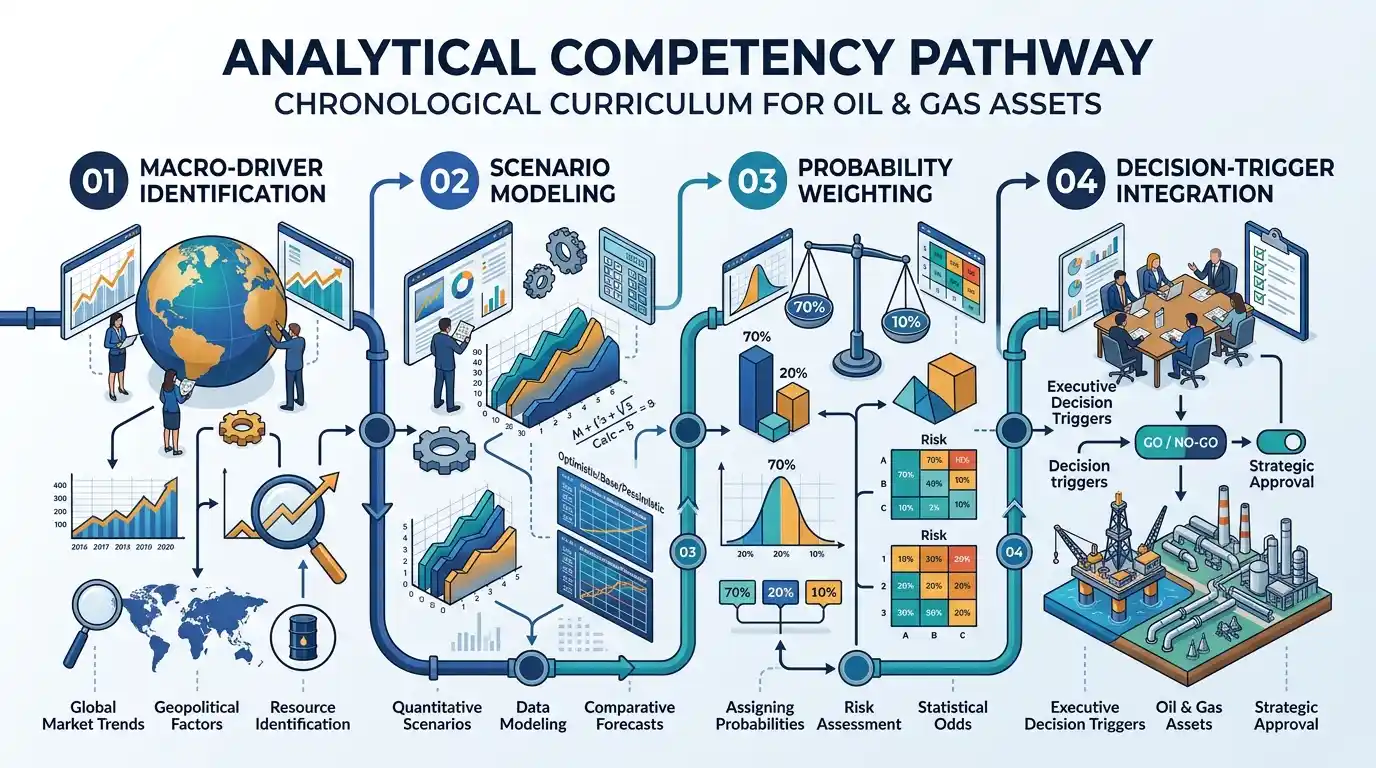
The curriculum design follows a logical progression designed by senior petroleum economists and corporate finance directors. Analysts must first master the mechanics of asset-level risk parameters before attempting complex multi-variable simulations. Without a firm grasp of qualitative narrative development, quantitative financial models risk becoming mechanical exercises detached from operational realities. The Institute For Oil & Gas Training structures each learning module to mirror the actual capital deployment workflow used by international energy companies, national oil companies, and energy-focused private equity firms.
The initial phase of the curriculum focuses on qualitative structural framing and plausible narrative construction. Analysts learn to isolate key external variables, such as OPEC+ production quotas, carbon pricing mechanics, and supply chain bottlenecks, from internal operational variables like decline curves and capital expenditure overruns. Once these variables are categorized, participants transition into quantitative model development, where they construct integrated financial statements capable of dynamically adjusting to shifting macro inputs.
Training Phase | Primary Focus Area | Technical Deliverable | Operational Objective |
Phase 1: Foundations | Macro & Micro Variable Isolations | Driver Matrix & Narrative Framework | Establish structural model inputs |
Phase 2: Quantification | Multi-Variable Model Architecture | Dynamic Integrated Financial Model | Stress-test capital expenditure & cash flow |
Phase 3: Valuation | Probability Weighting & Decision Triggers | Risk-Adjusted NPV & Real Option Matrix | Formulate executive investment recommendations |
As financial analysts evaluate advanced risk modeling options, understanding How to Evaluate Base Upside and Downside Scenarios in Petroleum Financial Planning becomes a key operational objective. The course structure reinforces this evaluation methodology by forcing participants to validate every financial output against operational constraints. In the final modules, participants synthesize analytical outputs into actionable corporate governance frameworks, ensuring that financial modeling directly informs corporate strategy and risk management guidelines.
What Will Participants Learn in the Scenario Planning Training Program?
Participants learn to identify key value drivers, build multi-case financial models, execute probability weighting, formulate decision triggers, and translate quantitative uncertainty into structured strategic options for executive investment committees.
The learning outcomes of the Scenario Planning for Base, Upside & Downside Cases Training Course focus on verifiable, job-ready technical capabilities. The program avoids high-level theoretical instruction, focusing instead on practical financial engineering applied directly to petroleum assets. Analysts master the construction of dynamic financial models that link physical production profiles directly to macro-financial indicators, enabling real-time sensitivity testing.
Module Breakdown and Technical Skill Acquisition
Module 1: Driver Identification and Plausible Narrative Construction
Isolation of macro-economic drivers, including Brent/WTI differentials, natural gas hub pricing, and regional fiscal terms.
Parameterisation of operational drivers, including initial production rates, hyperbolic decline constants, field operating costs, and facility uptime percentages.
Formulation of coherent, internally consistent economic narratives across low-carbon transition paths, high-demand recovery states, and prolonged market downturns.
Module 2: Base Case Assumptions, Upside Case, and Downside Case Financial Modeling
Establishment of standardized baseline financial criteria, including mid-curve inflation, base commodity forecasts, and scheduled capital deployment.
Construction of stress-tested upside and downside case financial models featuring dynamic operational levers for capital expenditure deferral and production throttling.
Automated link integration across income statements, balance sheets, and cash flow statements to preserve financial integrity under extreme stress conditions.
Module 3: Probability Weighting and Risk Quantification
Application of discrete probability distributions to multi-case scenarios to calculate Expected Net Present Value (ENPV) and internal rate of return distributions.
Implementation of risk-adjusted discount rates tailored to specific country-risk profiles, project stage gates, and field development complexities.
Integration of sensitivity matrices and tornado diagrams to highlight variable criticality for senior executive review.
Module 4: Decision Triggers and Contingency Planning
Definition of quantitative decision triggers based on debt service coverage ratios, liquidity thresholds, and project IRR floor limits.
Formulation of actionable contingency planning protocols, detailing capital preservation measures triggered during severe commodity price contractions.
Integration of operational stage-gate milestones with financial liquidity constraints to safeguard corporate balance sheets.
Module 5: Strategic Option Evaluation and Corporate Governance Reporting
Quantifying managerial flexibility through strategic option evaluation, including options to expand, defer, farm-out, or abandon assets early.
Translation of complex quantitative outputs into clear, standardized investment committee memos and corporate risk dashboards.
Governance alignment ensuring financial modeling outputs satisfy institutional lender requirements and internal audit standards.
By completing these modules at the Institute For Oil & Gas Training, participants gain complete autonomy in constructing, auditing, and presenting advanced scenario-based financial models for complex petroleum investments.
How Is the Course Delivered and Evaluated by the Institute For Oil & Gas Training?
The Institute For Oil & Gas Training delivers this program through intensive live workshops, interactive online sessions, hybrid corporate setups, and customized on-site corporate training, using real-world asset datasets and practical financial modeling assessments.
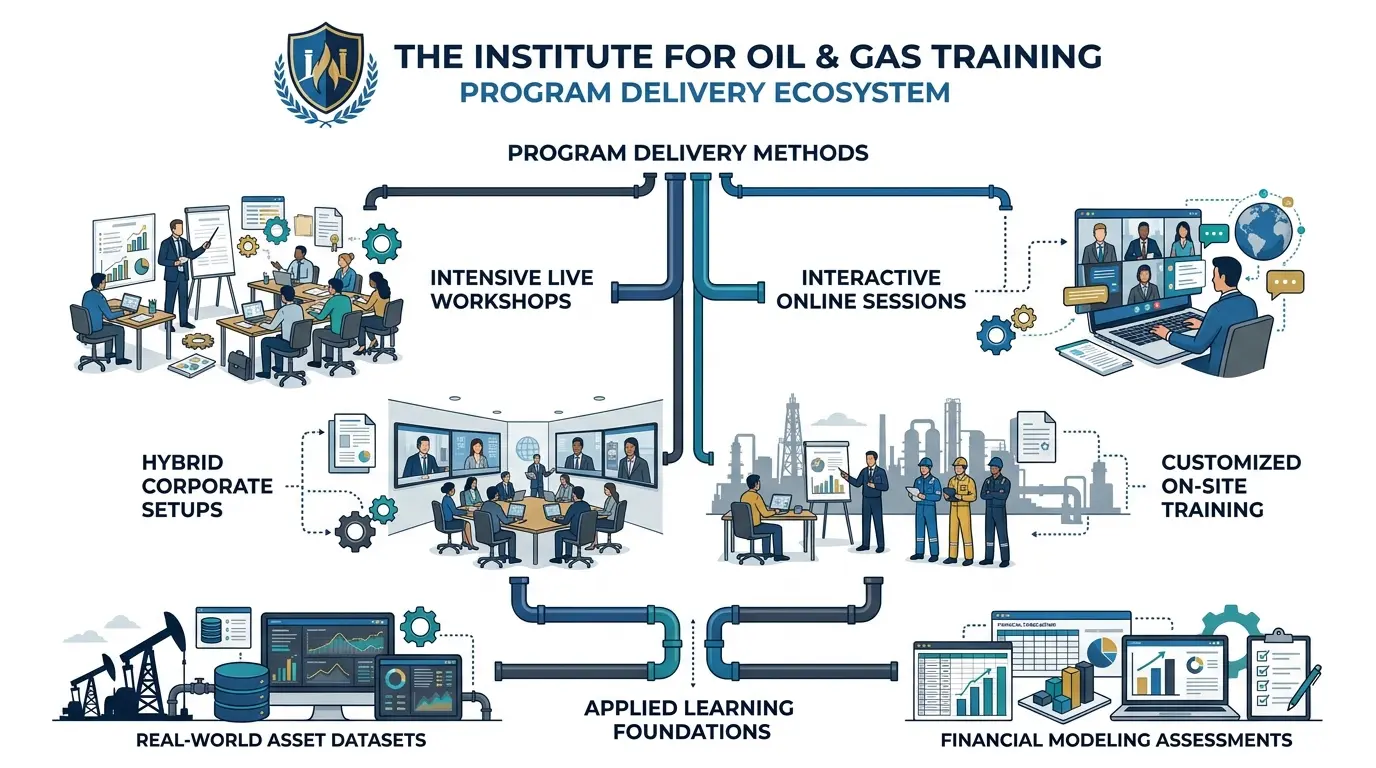
Flexibility and rigor define the delivery framework of the Institute For Oil & Gas Training. Recognizing that energy companies operate across diverse geographical regions and time zones, training options are structured to suit both individual professionals and intact corporate teams. Every delivery channel uses identical core learning materials, financial model templates, and assessment standards to ensure institutional quality consistency.
Delivery Formats and Duration
Intensive Live Workshop: 5 consecutive days of immersive, instructor-led classroom training held at international energy hubs.
Live Virtual Classroom: 4 weeks of structured online delivery, comprising two 3-hour live sessions per week with instructor feedback.
Corporate Hybrid Model: Combination of self-paced digital modeling modules followed by 2 days of live, scenario-testing strategy labs.
On-Site Corporate Training: Customized on-site delivery tailored directly to an organization’s proprietary asset portfolio and internal fiscal templates.
Training Methodology and Practical Application
The educational approach centers on applied financial engineering. Theoretical lectures are minimized to make room for hands-on, terminal-based financial modeling using realistic upstream, midstream, and downstream asset data. Participants spend over 60% of contact hours directly building, modifying, and stress-testing financial models within spreadsheet environments. Instructor oversight ensures immediate correction of structural modeling errors, standardizing financial logic across teams.
Assessment Methods and Certification
Skill mastery is verified through practical, objective evaluation mechanisms rather than multiple-choice testing:
Practical Financial Modeling Assignments: Four individual modeling assignments requiring participants to construct scenario-enabled financial models from raw geological, engineering, and fiscal datasets.
Real-Time Stress-Test Simulations: A timed practical assessment where participants must modify an existing asset model to incorporate a sudden macroeconomic or operational shock within a limited timeframe.
Capstone Scenario Defense: A final group or individual presentation defending an investment decision, model architecture, and recommended decision triggers before a mock Investment Committee comprised of senior faculty members.
Successful completion yields a formal professional credential from the Institute For Oil & Gas Training, confirming technical competence in energy scenario modeling and financial risk evaluation.
What Measurable Performance Results Can Organizations Expect?
Organizations gain improved forecast accuracy, standardized financial modeling protocols across asset teams, reduced capital deployment risk, and faster executive decision-making during volatile market shifts.
Enrolling corporate teams in the Scenario Planning for Base, Upside & Downside Cases Training Course delivers immediate operational benefits for energy sector finance, strategy, and business development divisions. Standardizing scenario planning techniques across departments removes inconsistencies in how risk is evaluated, presented, and managed.
Measurable Workplace Outcomes
Enhanced Forecast Accuracy: Transitioning from static models to probabilistic multi-case frameworks reduces revenue variance during commodity price swings.
Standardized Corporate Governance: Finance teams adopt uniform financial modeling templates, eliminating manual reconciliation, formatting discrepancies, and logic errors across business units.
Accelerated Stage-Gate Approvals: Standardized presentation of downside exposure and contingency planning speeds up project evaluations by executive investment committees.
Improved Capital Preservation: Clear quantification of downside financial risks ensures explicit liquidity buffers and hedging strategies are built into project sanctioning requirements.
Corporate Application: HR, Team Performance, and Leadership Pipelines
Human Resources and Learning & Development leaders utilize this program provided by the Institute For Oil & Gas Training to build clear technical capability pipelines within finance, commercial, and planning departments. Cross-functional alignment improves when asset economists, treasury managers, and corporate strategists share a common analytical language.
By embedding this structured training into professional development plans, energy companies ensure that rising leaders possess the financial discipline required to navigate complex market conditions and maintain financial stability across commodity cycles.
How Does Enrollment Work for Individuals and Corporate Teams?
Enrollment requires a documented background in finance or energy economics, followed by candidate screening, cohort placement, pre-course preparation, and structured program delivery.
The Institute For Oil & Gas Training maintains clear entry standards to preserve the technical rigor of classroom discussions and practical modeling exercises.
Entry Requirements and Prerequisites
Candidates must meet the following baseline professional criteria prior to enrollment:
Professional Experience: Minimum 2 years of active experience in corporate finance, financial analysis, asset management, energy economics, or business development within the energy sector.
Technical Proficiency: Demonstrated working knowledge of intermediate Excel modeling techniques, including dynamic functions, financial statement linkage, and discounted cash flow (DCF) mechanics.
Educational Background: Bachelor’s degree in Finance, Accounting, Economics, Engineering, or a related quantitative discipline.
Corporate Team Enrollment and Customisation
For corporate delegations of 5 or more participants, the Institute For Oil & Gas Training offers tailored corporate onboarding. This includes pre-course technical skill assessments to identify knowledge gaps, customized case studies incorporating corporate fiscal regimes, and post-course executive debriefs evaluating team progress.
Step | Action Item | Responsibility | Outcome |
1. Application | Submit professional profile and modeling experience details | Candidate / HR Manager | Profile logged for technical evaluation |
2. Review | Assess prerequisite alignment and select delivery format | Admissions Committee | Formal confirmation of eligibility |
3. Onboarding | Complete baseline modeling exercises and review pre-reads | Enrolled Candidate | Baseline technical alignment |
4. Execution | Attend intensive instruction and defend final capstone model | Candidate & Faculty | Professional Certification awarded |
To secure seat allocation for upcoming public cohorts or to schedule an enterprise-wide corporate training program for your financial team, submit your application to enroll in this program.
Frequently Asked Questions
What is included in oil and gas petroleum financial analysis?
Oil and gas petroleum financial analysis encompasses cash flow modeling, capital expenditure (CapEx) evaluation, fiscal regime analysis, and risk quantification for energy assets. The Institute For Oil & Gas Training delivers comprehensive instruction on evaluating upstream, midstream, and downstream investments through discounted cash flow (DCF) techniques, sensitivity testing, and production forecasting integrations. These skills enable analysts to calculate asset net present value (NPV) and internal rate of return (IRR) across varying economic cycles.
How do analysts perform risk evaluation in petroleum financial planning?
Analysts perform risk evaluation by incorporating dynamic scenario modeling, Monte Carlo simulations, and sensitivity matrices into core financial spreadsheets. The Institute For Oil & Gas Training teaches professionals to test project resilience against commodity price volatility, operating cost inflation, and geological uncertainties. By establishing clear base, upside, and downside cases, financial teams can establish quantitative decision triggers and formulate robust contingency plans.
Why is specialized financial modeling important for oil and gas projects?
Specialized financial modeling is critical because energy projects involve long capital deployment timelines, volatile commodity markets, and complex fiscal frameworks such as production-sharing contracts or royalty systems. Standard corporate finance frameworks often fail to accurately capture depletion rates, field decline curves, and macroeconomic risks specific to the petroleum sector. Through programs at the Institute For Oil & Gas Training, professionals master tailored financial analysis methodologies that safeguard capital and improve executive decision-making.
Who should undertake training in oil and gas petroleum financial analysis?
Training in oil and gas petroleum financial analysis is ideal for financial analysts, petroleum economists, investment managers, commercial strategists, and corporate planners working within energy companies or financial institutions. The curriculum provided by the Institute For Oil & Gas Training benefits both individual professionals seeking advanced modeling capabilities and corporate teams aiming to standardize financial evaluation protocols across business units.
How does scenario planning improve capital allocation in the energy sector?
Scenario planning improves capital allocation by shifting decision-making from single-point estimates to probabilistic multi-case evaluations. By analyzing distinct economic and operational narratives, finance teams can quantify downside risks and identify high-value upside opportunities before committing major capital expenditure. The Institute For Oil & Gas Training equips teams with systematic scenario planning techniques that align project stage-gate approvals with institutional risk management standards.
Related training courses
API Standard 1163 In-line Inspection Systems Qualification Training Course
- Specialisation
- Oil & Gas Pipeline Integrity and Inspection
- Duration
- 5 days · 15 CPD hours
BPVC Section V Non-Destructive Testing Training Course
- Specialisation
- Oil & Gas Inspection and Non-Destructive Testing
- Duration
- 5 days · 15 CPD hours
Damage Mechanisms (API 571) Training Course
- Specialisation
- Oil & Gas Asset Integrity Management
- Duration
- 5 days · 15 CPD hours
More articles

Cash Flow Stress Testing Training for Oil and Gas Financial Analysis Professionals
Evaluate financial risks with Cash Flow Stress Testing for Liquidity & Solvency Training Course by Institute For Oil & Gas Training. Enroll now.
Read article →
How to Evaluate Liquidity and Solvency Risks Through Oil and Gas Cash Flow Stress Testing
Compare evaluation models for oil and gas liquidity and solvency stress testing to safeguard corporate financial stability.
Read article →
Why Cash Flow Stress Testing Matters for Oil and Gas Liquidity and Solvency
Discover why cash flow stress testing is vital for oil and gas liquidity and solvency. Learn how workforce training strengthens corporate financial resilience.
Read article →