
Why NPV Alone Does Not Capture the Full Risk of an Oilfield Investment represents the foundational awareness required by modern energy asset managers and corporate engineering groups. When petroleum economists evaluate multi-million-dollar upstream developments, relying on static discount metrics creates severe organizational exposure. Traditional capital allocation often overlooks the volatile tax regimes, production declines, and capital expenditure overruns inherent in deepwater or unconventional fields.
Institute For Oil & Gas Training delivers professional development courses designed to resolve this analytical vulnerability. This curriculum equips technical and financial personnel with advanced economic modelling methodologies, enabling organizations to make resilient investment decisions under deep market uncertainty.
What is the course and what problem does it solve?
This specialist training program bridges the critical gap between traditional petroleum engineering and corporate financial decision-making by replacing static capital budgeting methods with dynamic fiscal sensitivity models that protect organizational capital against market volatility.
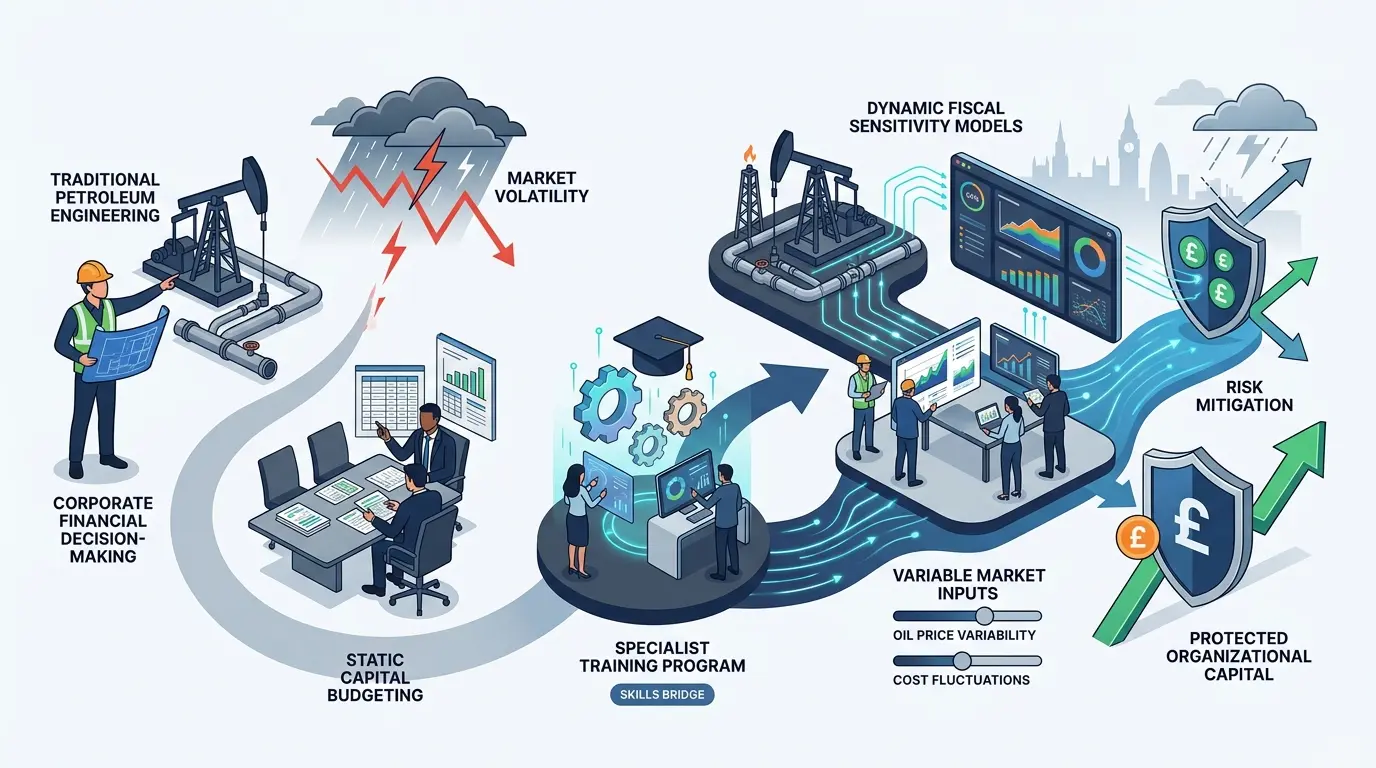
In many energy corporations, financial analysts evaluate capital projects using isolated discount rates and deterministic cash flow streams. However, upstream environments are subjected to rapid commodity price fluctuations, shifting fiscal terms, and complex production sharing contracts. When a development team fails to account for fiscal elasticity, project sponsors frequently approve ventures that appear robust on paper but collapse under minor macroeconomic shifts.
Institute For Oil & Gas Training developed this course to address the prevalent skill deficiency where multidisciplinary teams—comprising reservoir engineers, commercial managers, and HR development planners—fail to communicate using a unified economic vocabulary. Without structured training in fiscal mechanics, corporate groups struggle to isolate the true drivers of project value.
Department heads and financial controllers often report that their technical staff can forecast production profiles with precision, yet lack the commercial acumen required to stress-test fiscal terms against sliding-scale royalties or state participation clauses. This disconnect leads to misallocated capital expenditures and flawed strategic planning.
By integrating economic rigor into daily operations, Institute For Oil & Gas Training ensures that corporate cohorts move beyond simplistic Net Present Value calculations. Participants learn to evaluate asset resilience systematically, ensuring that every proposed field development plan withstands rigorous financial scrutiny before board-level submission.
Why is this curriculum structured this way?
The curriculum follows a logical cognitive progression from deterministic asset valuation to stochastic risk modeling, ensuring that participants build foundational computational habits before tackling complex fiscal contracts and probabilistic sensitivity matrices.
When designing professional engineering and commercial courses, Institute For Oil & Gas Training applies pedagogical principles rooted in applied taxonomy. Adult learners in technical sectors require immediate operational relevance paired with rigorous theoretical scaffolding. The learning architecture moves deliberately from micro-level cash flow construction to macro-level portfolio risk management.
During the initial phase of the program, learners dissect the mechanics of cash flow generation, capital expenditures, operating expenditures, and abandonment liabilities. This establishes a uniform baseline across diverse organizational participants, whether they originate from subsurface engineering, commercial negotiations, or human resources talent pipelines.
As learners progress, the focus shifts toward contractual structures. Institute For Oil & Gas Training structures the intermediate modules around petroleum fiscal systems, distinguishing clearly between concessionary systems and contractual arrangements such as production sharing contracts and risk service agreements.
The final segment of the syllabus introduces advanced risk quantification. Participants synthesize their technical knowledge by constructing multi-variable sensitivity models that evaluate internal rate of return variations against stochastic commodity pricing and capital cost overruns.
This deliberate sequencing prevents cognitive overload and empowers corporate teams to apply sophisticated valuation techniques immediately upon returning to their operational roles.
What will participants learn?
Participants master the mathematical construction of discounted cash flow models, the contractual mechanics of international fiscal regimes, and the execution of tornado charts and Monte Carlo simulations to quantify project downside exposure.
The learning outcomes are partitioned into distinct operational modules, each targeting specific competency benchmarks required by major energy operators and national oil companies.
Module One: Advanced Discounted Cash Flow Modeling
Learners deconstruct the components of project cash generation. The curriculum covers nominal versus real cash flows, weighted average cost of capital applications, and the calculation limitations inherent in standard Net Present Value metrics. Participants build dynamic spreadsheet models that isolate taxable income from gross revenues, incorporating depreciation schedules, tax loss carry-forwards, and corporate tax rates specific to major energy provinces.
Module Two: International Petroleum Fiscal Systems
This component analyzes how host governments capture economic rent. Institute For Oil & Gas Training provides deep exposure to royalty-tax systems, production sharing contracts, and service contracts. Participants learn to calculate cost oil recovery limits, profit oil splits, sliding-scale royalties based on daily production rates, and state participation buy-in mechanisms.
Module Three: Fiscal Sensitivity and Risk Analysis
Moving beyond deterministic forecasting, this module focuses on variance analysis. Professionals explore Combining NPV, IRR and Fiscal Sensitivity Analysis in Petroleum Project Evaluation to map project boundaries under extreme stress. Participants construct tornado diagrams to identify value drivers and execute Monte Carlo simulations to establish probability distributions for economic outcomes.
Module Four: Decision Gate Integration and Portfolio Ranking
The final module translates economic outputs into corporate governance frameworks. Learners evaluate capital rationing scenarios, portfolio optimization techniques, and hurdle rate selection. Through practical exercises, corporate groups assess how to rank competing exploration and production assets when capital budgets are constrained.
How is the course delivered?
The training is delivered through flexible hybrid workshops combining intensive technical lectures, applied spreadsheet simulation labs, and multidisciplinary team case studies tailored to corporate deployment schedules.
Corporate learning requirements demand versatile delivery models that minimize operational downtime while maximizing knowledge retention. Institute For Oil & Gas Training provides multiple structural formats to accommodate global organizations, national petroleum agencies, and independent operating companies.
The standard delivery format utilizes an intensive five-day instructor-led workshop model. This can be conducted on-site at corporate headquarters, within dedicated regional training facilities, or via live virtual platforms for distributed engineering teams. The curriculum balances theoretical presentations with hands-on computational exercises.
Participants utilize industry-standard modeling tools to construct economic evaluations from raw geological and engineering inputs. Institute For Oil & Gas Training embeds collaborative problem-solving into every session, grouping participants into multidisciplinary syndicates mirroring real-world asset development teams.
Assessment is continuous and rigorous. Rather than relying solely on passive attendance, learners must complete practical modeling assignments, analytical quizzes, and a comprehensive capstone evaluation where they defend an asset valuation before a mock investment committee.
This practical assessment model ensures that human resources departments and technical directors receive verifiable proof of competency development across their technical pipelines.
What results can be expected?
Organizations achieve measurable enhancements in capital allocation accuracy, accelerated decision-making cycles, and a standardized commercial vernacular across engineering, finance, and asset management departments.
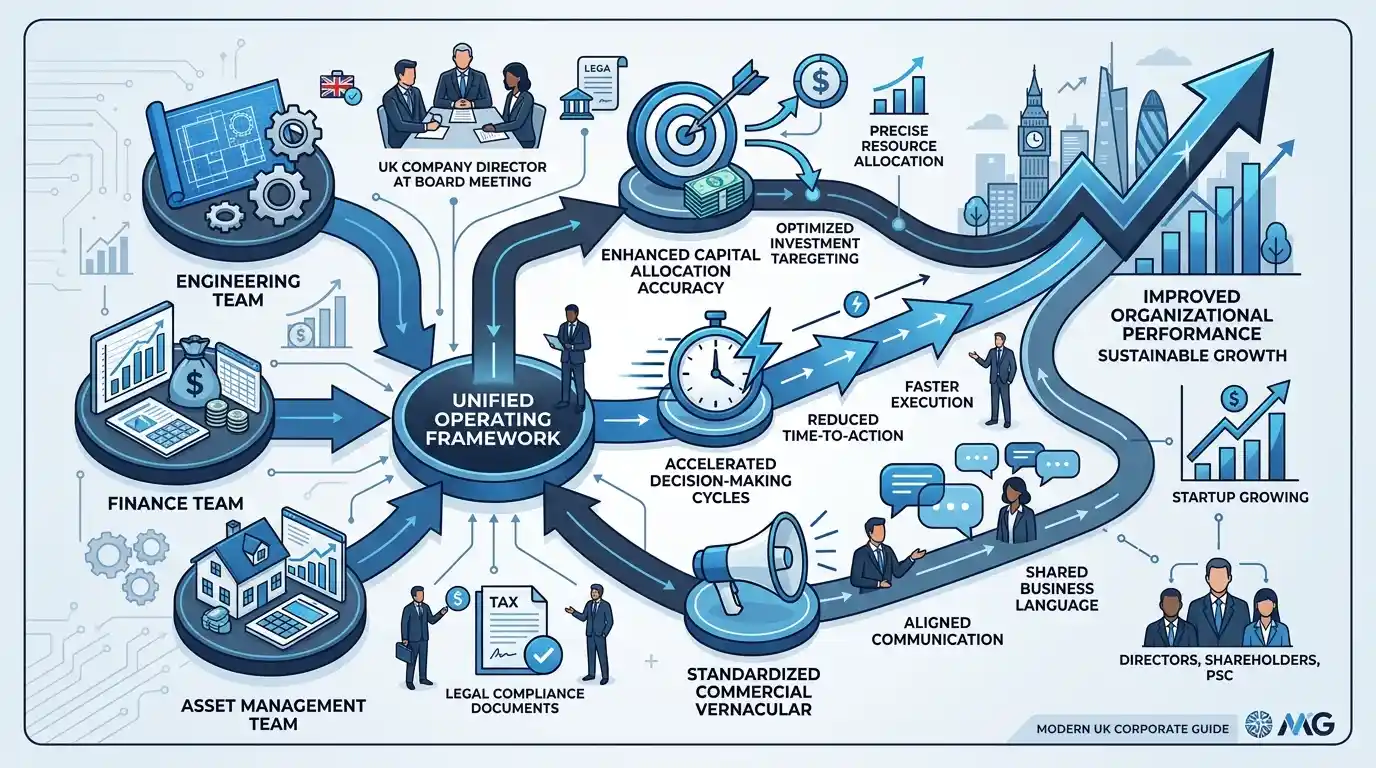
The workplace impact of advanced economic training extends far beyond individual certificate acquisition. When engineering and commercial teams undergo professional development with Institute For Oil & Gas Training, measurable organizational transformation occurs within asset evaluation workflows.
For corporate leadership and HR development teams, the primary return on investment manifests as reduced capital misallocation. Project proposals submitted to investment committees exhibit higher analytical rigor, transparent risk disclosures, and realistic contingency modeling.
Technical managers report that subsurface teams begin incorporating economic constraints early in the field development planning stage, rather than treating financial analysis as an administrative afterthought at the end of the engineering design cycle.
Furthermore, cross-functional communication improves markedly. When petroleum engineers, commercial negotiators, and financial analysts share a unified understanding of fiscal sensitivity parameters, project review cycles shorten significantly.
Junior and mid-level professionals gain the analytical confidence required to challenge unrealistic assumptions in project proposals, safeguarding corporate balance sheets against unprofitable commitments.
Through these targeted performance gains, Institute For Oil & Gas Training empowers energy enterprises to maintain commercial resilience in competitive, capital-constrained operating environments.
How does enrollment work?
Candidates complete a technical background evaluation before submitting organizational sponsorship details, securing placement in upcoming cohort cycles through our structured institutional registration portal.
Enrolling in specialized technical programs requires a transparent administrative pathway designed to ensure professional alignment between candidate capabilities and course prerequisites.
Prospective participants typically possess a background in petroleum engineering, geoscience, finance, commercial management, or corporate strategic planning. While advanced calculus is not required, candidates should possess strong spreadsheet literacy and basic familiarity with corporate finance terminology.
Organizations seeking to enroll cohort groups can coordinate directly with our corporate advisory division to tailor case studies to specific regional assets or fiscal regimes. Institute For Oil & Gas Training provides dedicated account management for corporate HR departments seeking to map employee development paths against internal competency frameworks.
Upon successful completion of the coursework and capstone assessment, participants receive formal professional certification verifying their mastery of upstream economic modeling and fiscal sensitivity analysis.
To secure your organizational placement and review upcoming schedule availability, please enroll in this program today.
Frequently Asked Questions
What topics are covered in oil and gas petroleum finance training?
Oil and gas petroleum finance training covers discounted cash flow modeling, capital expenditure budgeting, production sharing contracts, and international fiscal regimes. Programs provided by the Institute For Oil & Gas Training also focus on risk quantification techniques such as Monte Carlo simulations and fiscal sensitivity analysis for upstream assets.
Why is fiscal sensitivity analysis important in petroleum project evaluation?
Fiscal sensitivity analysis is critical because it models how changes in commodity prices, operating costs, and tax terms impact project profitability under varying market conditions. By studying these variables through specialized petroleum finance courses, analysts can identify downside risks that traditional valuation methods frequently overlook.
Who should enroll in petroleum economics and finance courses?
These courses are designed for petroleum engineers, commercial managers, financial analysts, and asset evaluation teams working within the energy sector. Human resources departments also utilize these programs to upskill multidisciplinary personnel involved in capital allocation and field development planning.
How do production sharing contracts impact upstream project economics?
Production sharing contracts dictate how host governments and operating companies divide the hydrocarbons produced from a specific block after cost recovery limits are applied. Understanding these contractual mechanics is a core component of petroleum finance training, enabling specialists to accurately calculate government take and contractor net revenues.
What are the career benefits of specialized oil and gas finance certification?
Certification in oil and gas petroleum finance equips professionals with advanced commercial acumen and standardized economic modeling skills recognized across global energy markets. Graduates are better prepared to defend asset valuations before investment committees and drive resilient capital investment strategies within their organizations.
Related training courses
Risk Management for Upstream & Midstream Projects Fundamentals Training Course
- Specialisation
- Oil & Gas Petroleum Compliance, AML & Risks
- Duration
- 5 days · 15 CPD hours
Cash Flow Reporting for JVs & PSCs Training Course
- Specialisation
- Oil & Gas Petroleum IFRS & Financial Reporting
- Duration
- 5 days · 15 CPD hours
Payment Controls & Treasury Governance for JV Disbursements Training Course
- Specialisation
- Oil & Gas Petroleum Treasury, Cash and Banking
- Duration
- 5 days · 15 CPD hours
More articles

NPV, IRR & Fiscal Sensitivity Analysis Training for Oil & Gas Project Evaluation Professionals
Master NPV, IRR, and fiscal sensitivity analysis for upstream petroleum projects with structured professional training.
Read article →
Assessing Project Returns Under Changing Oil Prices, Costs and Petroleum Fiscal Terms
Evaluate upstream oil and gas project returns under changing commodity prices, cost inflation, and petroleum fiscal terms with expert financial models.
Read article →
How Fiscal Terms Can Change the Investment Case for an Oil and Gas Project
Discover how fiscal terms training equips oil and gas workforces to evaluate project returns, optimize capital allocation, and navigate regulatory complexity.
Read article →