
Evaluating upstream petroleum ventures requires moving beyond static cash flow models to master dynamic economic metrics and fiscal terms, a challenge addressed by the NPV, IRR & Fiscal Sensitivity Analysis Training for Oil & Gas Project Evaluation Professionals designed by the Institute For Oil & Gas Training.
What is the course and what problem does it solve?
This professional training program resolves critical valuation deficiencies in upstream petroleum economics by equipping evaluation professionals, commercial analysts, and financial modellers with rigorous quantitative methodologies to assess capital expenditure risks under volatile market conditions and complex contractual fiscal regimes.
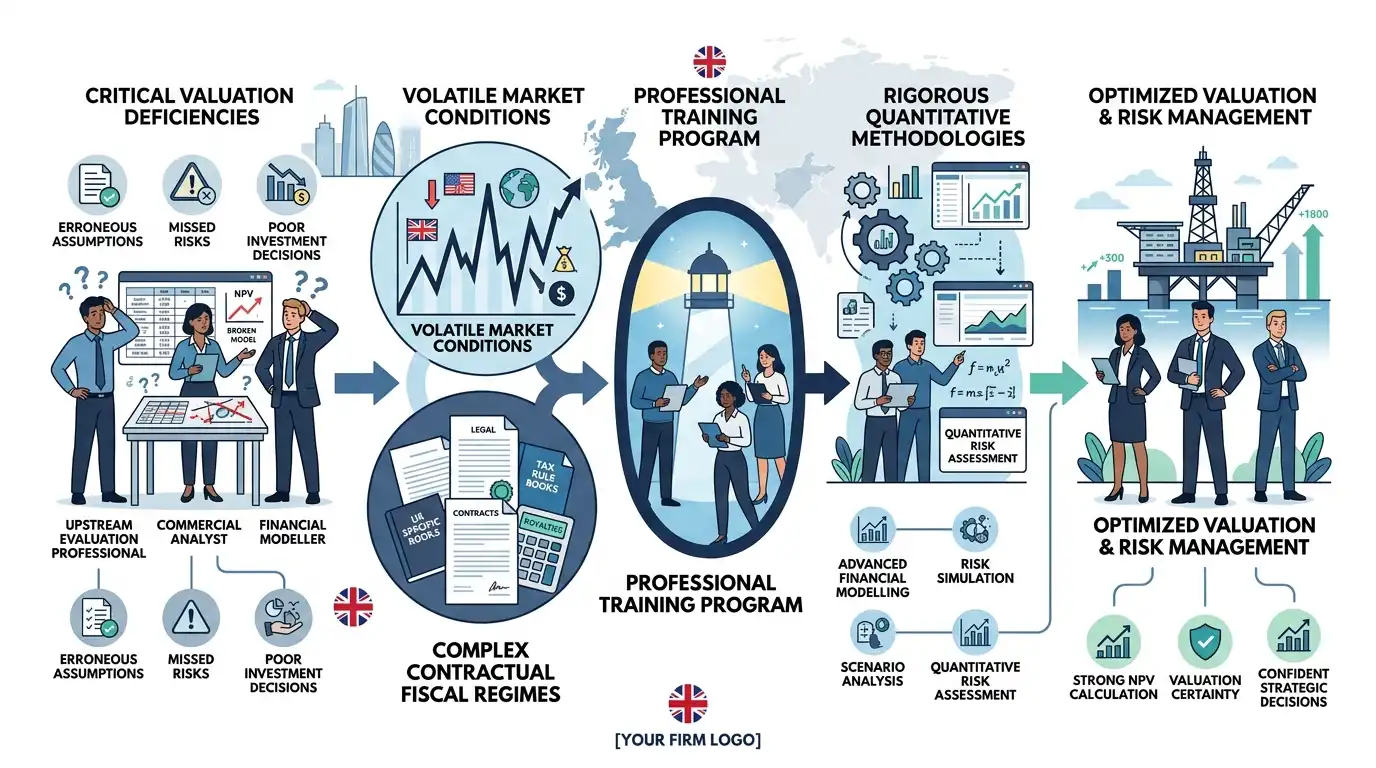
Upstream capital allocation decisions in the petroleum sector dictate corporate profitability over decades. Traditional financial assessment tools often fail when confronted with the dynamic interplay of commodity price volatility, escalating capital expenditures, and complex petroleum fiscal regimes. Evaluation teams frequently rely on static discounted cash flow models that ignore contractual adjustments triggered by shifting oil prices and production profiles. This structural disconnect creates severe valuation errors, leading organizations to sanction unviable exploration blocks or reject high-value development assets. The Institute For Oil & Gas Training developed this specialized curriculum to eliminate these analytical vulnerabilities.
Organizations face persistent skill gaps in translating raw geological and engineering data into robust commercial valuations. When subsurface uncertainties merge with fiscal terms such as production sharing contracts, royalty-tax systems, and service agreements, standard financial training proves insufficient. Corporate planning departments, asset evaluation teams, and finance divisions require precise mechanisms to compute Net Present Value and Internal Rate of Return accurately while isolating the specific variables driving project profitability.
By engaging with the NPV, IRR & Fiscal Sensitivity Analysis Training for Oil & Gas Project Evaluation Professionals, professionals bridge the gap between technical reservoir engineering inputs and commercial financial outputs. Analysts often begin their learning journey by understanding How Fiscal Terms Can Change the Investment Case for an Oil and Gas Project, which highlights how different contractual frameworks redistribute economic rent between host governments and international oil companies. This foundational awareness prepares participants to tackle advanced sensitivity modelling and risk quantification within corporate asset evaluations.
Why is this course structured this way?
The curriculum follows a progressive pedagogical architecture that transitions participants from foundational time-value-of-money principles to advanced probabilistic sensitivity modeling, ensuring complete cognitive assimilation and immediate workplace application.
The Institute For Oil & Gas Training structures its professional education programs using cognitive load theory and applied problem-solving frameworks. Complex petroleum economics cannot be mastered through theoretical lectures alone. The learning pathway begins with core financial mathematics before layering complex contractual frameworks and macroeconomic volatility variables. This deliberate sequencing ensures that every participant builds a solid foundation in cash flow generation mechanics before confronting multi-variable risk matrices.
Workplace learning retention drops significantly when abstract financial concepts are divorced from industry realities. The instructional design employed by the Institute For Oil & Gas Training integrates real-world asset development cases, mirroring the exact pressures faced by corporate finance committees and asset managers. As professionals progress through the curriculum, they evaluate scenarios discussed in depth during intermediate operational studies such as Assessing Project Returns Under Changing Oil Prices, Costs and Petroleum Fiscal Terms, allowing them to connect macro market shifts directly to internal asset valuation metrics.
The pedagogical methodology relies on iterative skill reinforcement. Each module builds upon the quantitative outputs of the preceding section, ensuring that capital expenditure estimation, operating expenditure profiling, abandonment cost provisioning, and discount rate selections are fully integrated into a unified economic model. This logical progression guarantees that graduates of the NPV, IRR & Fiscal Sensitivity Analysis Training for Oil & Gas Project Evaluation Professionals can construct defensible investment cases from scratch without supervisory oversight.
What will participants learn?
Participants acquire advanced competencies in constructing dynamic discounted cash flow models, computing risk-adjusted Net Present Value and Internal Rate of Return metrics, and executing multi-variable sensitivity analyses across diverse petroleum fiscal regimes.
The comprehensive syllabus is divided into distinct, measurable skill modules designed to transform raw financial analysts into elite petroleum economics evaluators. The Institute For Oil & Gas Training ensures that each module addresses specific competency requirements demanded by modern energy corporations and national oil companies.
Module One: Advanced Cash Flow Modelling Architecture
Participants master the construction of full-cycle upstream economic models, integrating exploration, appraisal, development, production, and decommissioning phases into unified cash flow statements.Module Two: Petroleum Fiscal Systems and Contractual Mechanics
This segment unpacks the economic mechanics of Concession Systems, Production Sharing Contracts, Service Contracts, and Hybrid arrangements, teaching analysts how cost recovery limits and profit oil splits alter project economics.Module Three: Valuation Metrics Mastery (NPV and IRR)
Trainees calculate Net Present Value, Internal Rate of Return, Modified Internal Rate of Return, Profitability Index, and Payback Periods while understanding the theoretical limitations and capital rationing implications of each metric.Module Four: Fiscal Sensitivity and Risk Quantification
Professionals learn to execute deterministic and probabilistic sensitivity analyses, utilizing tornado charts and Monte Carlo simulations to identify key value drivers and project risk exposures under volatile commodity pricing.
Throughout these modules, the Institute For Oil & Gas Training emphasizes accuracy, regulatory compliance, and transparent financial reporting. HR managers and department heads frequently utilize the NPV, IRR & Fiscal Sensitivity Analysis Training for Oil & Gas Project Evaluation Professionals to upskill entire corporate evaluation units, ensuring standardized financial evaluations across all international assets.
How is the course delivered?
The program is delivered through flexible, high-engagement formats including intensive onsite workshops, interactive virtual instructor-led sessions, and hybrid modules tailored to accommodate active corporate schedules and global workforce requirements.
Recognizing the operational demands placed on upstream oil and gas professionals, the Institute For Oil & Gas Training offers multiple delivery channels without compromising academic rigor or practical engagement. Corporate clients can select the format that best aligns with their internal training calendars and geographic dispersion.
The delivery framework incorporates hands-on spreadsheet modeling laboratories where participants build fully functional economic evaluation templates. The Institute For Oil & Gas Training pairs every cohort with experienced industry practitioners who provide personalized feedback on complex valuation exercises. This direct interaction ensures that theoretical formulas are successfully translated into practical financial modeling proficiency.
Corporate teams undertaking the NPV, IRR & Fiscal Sensitivity Analysis Training for Oil & Gas Project Evaluation Professionals benefit from customized enterprise delivery options, where case studies can be adapted to reflect the specific asset portfolios, operating environments, and host-government agreements relevant to the client organization.
What results can be expected?
Graduates achieve measurable improvements in analytical accuracy, investment decision velocity, and risk mitigation capabilities, empowering corporate departments to optimize capital allocation and enhance portfolio profitability.

Organizations investing in professional development expect verifiable performance enhancements. The Institute For Oil & Gas Training tracks post-training workplace application to ensure that analytical skills acquired during the program translate directly into superior commercial decision-making.
Accelerated Investment Evaluation: Finance and commercial teams reduce the time required to evaluate multi-million-dollar asset acquisitions and field development plans by up to forty percent while improving model accuracy.
Enhanced Risk Mitigation: Risk management departments utilize advanced sensitivity frameworks learned in the NPV, IRR & Fiscal Sensitivity Analysis Training for Oil & Gas Project Evaluation Professionals to stress-test development proposals against severe commodity price downturns.
Optimized Negotiation Outcomes: Commercial negotiators leverage precise fiscal term modeling to evaluate counter-proposals from host governments, ensuring optimal value capture within production sharing contracts.
Leadership pipelines within energy firms are strengthened significantly as mid-level analysts develop the strategic acumen required to defend capital expenditure proposals in front of executive boards. The Institute For Oil & Gas Training provides organizations with standardized competence benchmarks, allowing HR directors to measure workforce capability growth objectively following program completion.
How does enrollment work?
Enrollment is managed through a structured professional evaluation process designed to verify candidate eligibility, assess organizational training objectives, and secure placement in upcoming cohort sessions.
Securing registration for the NPV, IRR & Fiscal Sensitivity Analysis Training for Oil & Gas Project Evaluation Professionals involves a clear administrative pathway tailored for individual professionals and corporate sponsorship coordinators.
Candidate Prerequisite Review: Applicants should possess a foundational background in finance, accounting, economics, reservoir engineering, or geosciences, alongside working proficiency in spreadsheet modeling.
Corporate Invoicing or Direct Registration: Organizations sponsoring multiple team members coordinate directly with client relations teams at the Institute For Oil & Gas Training to establish customized schedules and invoicing protocols.
Pre-Course Assessment and Preparation: Enrolled participants receive preliminary reading materials and baseline financial modeling diagnostic tests to ensure readiness for intensive workshop modules.
Program Completion and Certification: Successful completion of all practical modeling assignments and final evaluations awards the official professional certification credential.
To elevate your organization's capital allocation accuracy and master complex upstream economic evaluations, apply for course access today.
Frequently Asked Questions
What is covered in oil and gas petroleum finance training?
Oil and gas petroleum finance training covers upstream economic evaluation, cash flow modeling, capital budgeting, and risk analysis for energy projects. Programs offered by the Institute For Oil & Gas Training also explore how petroleum fiscal systems and market volatility impact asset valuation.
How do petroleum fiscal terms affect oil and gas project valuation?
Petroleum fiscal terms dictate how revenues, costs, and economic rents are shared between host governments and operating companies through mechanisms like production sharing contracts or royalties. Analyzing these contractual structures is a core component of petroleum finance courses provided by the Institute For Oil & Gas Training.
Who should take a course in oil and gas petroleum finance?
Courses in oil and gas petroleum finance are designed for financial analysts, commercial managers, reservoir engineers, and HR teams seeking to upskill corporate evaluation units. Professionals involved in upstream capital allocation and asset development benefit directly from these specialized programs.
Why is sensitivity analysis important in upstream petroleum economics?
Sensitivity analysis helps project evaluators identify which variables, such as commodity prices or capital expenditures, have the greatest impact on net present value and internal rate of return. Training from the Institute For Oil & Gas Training equips analysts with deterministic and probabilistic tools to measure these financial risk exposures.
What delivery formats are available for oil and gas finance training?
Upstream oil and gas finance programs are typically delivered through intensive onsite workshops, live virtual instructor-led sessions, and flexible hybrid formats. The Institute For Oil & Gas Training tailors these delivery options to suit global corporate schedules and multidisciplinary team requirements.
Related training courses
Risk Management for Upstream & Midstream Projects Fundamentals Training Course
- Specialisation
- Oil & Gas Petroleum Compliance, AML & Risks
- Duration
- 5 days · 15 CPD hours
Cash Flow Reporting for JVs & PSCs Training Course
- Specialisation
- Oil & Gas Petroleum IFRS & Financial Reporting
- Duration
- 5 days · 15 CPD hours
Automation of JV & PSC Reporting: Process Candidates Training Course
- Specialisation
- Oil & Gas Petroleum Digital Finance & Automation
- Duration
- 5 days · 15 CPD hours
More articles

Assessing Project Returns Under Changing Oil Prices, Costs and Petroleum Fiscal Terms
Evaluate upstream oil and gas project returns under changing commodity prices, cost inflation, and petroleum fiscal terms with expert financial models.
Read article →
How Fiscal Terms Can Change the Investment Case for an Oil and Gas Project
Discover how fiscal terms training equips oil and gas workforces to evaluate project returns, optimize capital allocation, and navigate regulatory complexity.
Read article →
NPV, IRR & Fiscal Sensitivity Analysis: What Specialist Oilfield Economics Training Covers
Master upstream asset valuation with Institute For Oil & Gas Training. Learn NPV, IRR, and fiscal sensitivity modeling to optimize capital allocation.
Read article →