

Oil and gas organizations face unprecedented financial exposure due to shifting climate policies, fluctuating carbon pricing mechanisms, and evolving capital markets. Financial planners, strategy teams, and operational leaders must model complex transition risks to protect asset values, optimize capital allocation, and ensure long-term portfolio resilience. To understand the foundational market forces driving these structural changes, industry leaders should review Why Energy Transition and Carbon Costs Matter in Oil and Gas Financial Planning.
What is the course and what problem does it solve?
The Scenario Planning for Energy Transition & Carbon Cost Training Course solves structural skill gaps in financial modelling, emissions pricing, and strategic risk assessment, equipping energy professionals with technical frameworks to evaluate stranded asset risks and protect long-term capital allocation.
Energy companies operate under regulatory frameworks that integrate carbon costs directly into capital expenditure evaluations. Traditional financial models fail to account for dynamic carbon pricing, demand destruction scenarios, and shift in institutional investor expectations. This creates significant misalignment between operational budgets, corporate strategy, and compliance reporting across global energy operations.
The Institute For Oil & Gas Training developed this program to bridge the gap between technical emissions data and corporate financial planning. Professionals responsible for project economics, corporate strategy, and risk management often lack standardized methodologies to convert climate policies into concrete balance-sheet metrics. Without structured modeling skills, capital allocation decisions risk exposing upstream and downstream assets to sudden regulatory penalties or premature devaluation.
This training program delivers structured technical instruction on carbon price assumptions, emissions cost modelling, and portfolio resilience testing. Participants learn to build dynamic scenario models that incorporate policy shifts, technology adoption curves, and carbon tax variations across multiple jurisdictions. The curriculum translates theoretical transition risks into standardized, actionable financial indicators for executive evaluation.
By addressing institutional capability gaps, the program equips energy teams to execute transition risk disclosure standards, such as TCFD frameworks. The Institute For Oil & Gas Training provides professionals with precise tools to align corporate strategy with global decarbonization pathways, securing enterprise value against carbon-related financial liabilities.
Why is this course structured this way?
This course uses a sequential, module-based learning architecture that progresses from foundational policy analysis to advanced financial modelling, enabling professionals to systematically master complex energy transition mechanics and apply rigorous carbon cost frameworks directly into corporate workflows.
The structural logic of the curriculum reflects how financial planning and strategic decision-making occur within major energy organizations. Complex risk assessment requires a clear progression from external market drivers to internal financial mechanics. The program begins by establishing macroeconomic parameters before introducing project-level valuation and portfolio optimization techniques.
Initial modules focus on energy transition scenarios and policy mechanics to establish a clear analytical foundation. Participants analyze global carbon markets, compliance mechanisms, and regulatory trends. Understanding these macro drivers is necessary before applying quantitative variables to capital allocation models, ensuring participants understand the underlying policy triggers behind numerical shifts.
Subsequent units transition into technical emissions cost modelling and asset valuation under stress-tested market conditions. Professionals learn how to integrate carbon price assumptions directly into discounted cash flow models, net present value calculations, and capital expenditure forecasts. To assess how various analytical methods compare when testing portfolio stress, consult How to Evaluate Energy Transition Risks and Carbon Costs Across Oil and Gas Scenarios.
The final phase emphasizes strategic execution, transition risk disclosure, and governance integration. The Institute For Oil & Gas Training structures this learning progression to match real-world corporate governance requirements. This ensures that participants build technical proficiency step-by-step, resulting in audit-ready strategic recommendations for executive boards and investment committees.
What will participants learn during the program?
Participants gain advanced quantitative competencies in emissions cost modelling, demand destruction scenarios, portfolio resilience testing, and long-term price deck formulation, mastering real-world application through practical exercises, financial stress-testing, and corporate risk evaluation frameworks.
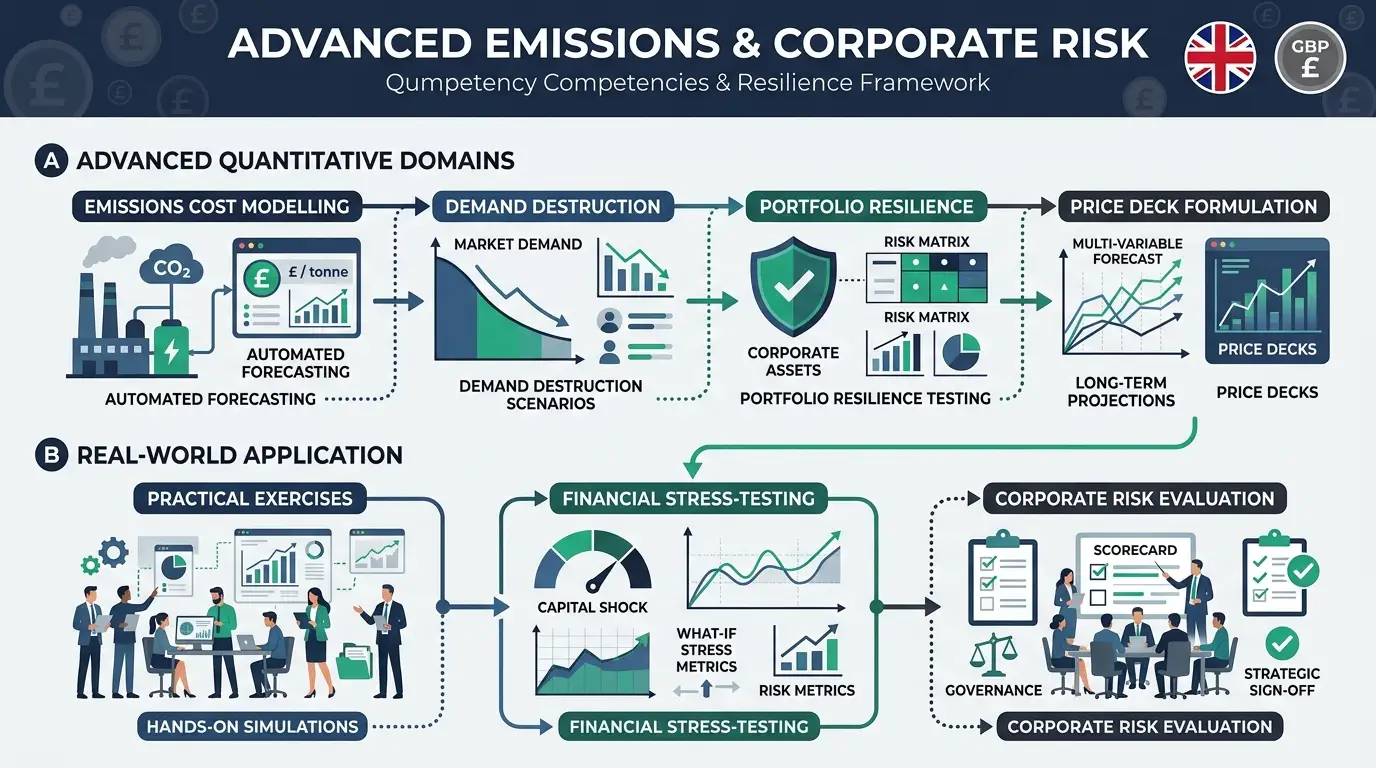
The curriculum contains specialized instructional modules structured to develop high-level decision-making capabilities across key financial and strategic disciplines.
Module 1: Transition Scenarios & Macroeconomic Frameworks
Analysis of global energy transition scenarios including IEA, IPCC, and proprietary corporate pathways.
Quantifying demand destruction scenarios across oil, natural gas, and refined product markets.
Evaluating policy drivers, tax structures, and international carbon border adjustment mechanisms.
Constructing flexible macro environments for corporate stress testing and risk exposure profiling.
Module 2: Carbon Pricing & Emissions Cost Modelling
Formulating short-term and long-term price deck assumptions for regulated and voluntary carbon markets.
Technical mechanics of emissions cost modelling for Scope 1, Scope 2, and Scope 3 emissions.
Integrating carbon tax liabilities and offset credit mechanics into project cash flow models.
Standardizing carbon intensity metrics across diverse operational asset portfolios.
Module 3: Asset Valuation & Stranded Asset Risk
Identifying stranded asset risk across upstream reserves, midstream infrastructure, and downstream processing.
Adjusting discounted cash flow models for variable carbon cost projections and declining asset lifespans.
Evaluating impairment testing parameters under strict net-zero transition constraints.
Developing mitigation strategies for early asset decommissioning and capital recovery.
Module 4: Portfolio Resilience & Capital Reallocation
Executing portfolio resilience testing under divergent climate policy and macroeconomic conditions.
Developing capital reallocation decisions to shift capital toward low-carbon and diversification projects.
Building corporate frameworks for transition risk disclosure aligned with TCFD and ISSB standards.
Designing executive dashboards to communicate complex transition risks to board members and investors.
Through this core structure, the Institute For Oil & Gas Training ensures participants master the end-to-end analytical process required to protect corporate assets against evolving environmental liabilities.
How is the course delivered and evaluated?
The program is delivered through intensive workshops, live virtual sessions, or tailored onsite corporate training, combining direct expert instruction, financial model simulation labs, practical case studies, and rigorous competency-based technical assessments.
The course structure accommodates enterprise scheduling and individual professional schedules without compromising technical depth or learning outcomes.
Delivery Format | Duration | Structure & Methodology | Best Suited For |
In-Person Workshop | 4 Full Days | Intensive classroom lectures, group financial modeling labs, interactive scenario workshops. | Corporate cohorts, cross-functional strategy teams, and executive groups. |
Live Virtual Classroom | 4 Weeks (16 Hours) | Bi-weekly live instructor-led modules, digital spreadsheet labs, facilitated discussion boards. | Distributed international teams, individual professionals, and working specialists. |
Onsite Corporate Training | Flexible Schedule | Customized modules using proprietary corporate datasets, private facility delivery, internal alignment focus. | Enterprise HR teams seeking custom workforce development and internal strategy standardization. |
Instructional delivery relies heavily on practical application rather than passive theoretical instruction. Participants work directly within dynamic financial modeling templates, manipulating carbon price assumptions, cost structures, and operational parameters across diverse asset classes.
Assessment methodologies ensure direct verification of practical skill acquisition throughout the program:
Financial Modeling Labs: Participants construct dynamic valuation models incorporating emissions pricing and asset retirement obligations.
Scenario Stress-Testing Simulations: Teams evaluate a mock energy portfolio against conflicting transition pathways and defend their capital allocation choices.
Technical Knowledge Examinations: Individual assessments verify mastery of regulatory frameworks, carbon market mechanics, and disclosure guidelines.
Applied Capstone Project: Participants produce a comprehensive transition risk report and strategic capital allocation plan based on real-world operational data.
The Institute For Oil & Gas Training maintains strict evaluation standards to guarantee that every certified professional possesses job-ready analytical capabilities.
What measurable results can organizations expect?
Organizations gain immediate operational value through standardized financial risk models, improved capital deployment efficiency, robust compliance disclosures, and enhanced cross-functional alignment between financial, operational, and sustainability leadership teams.
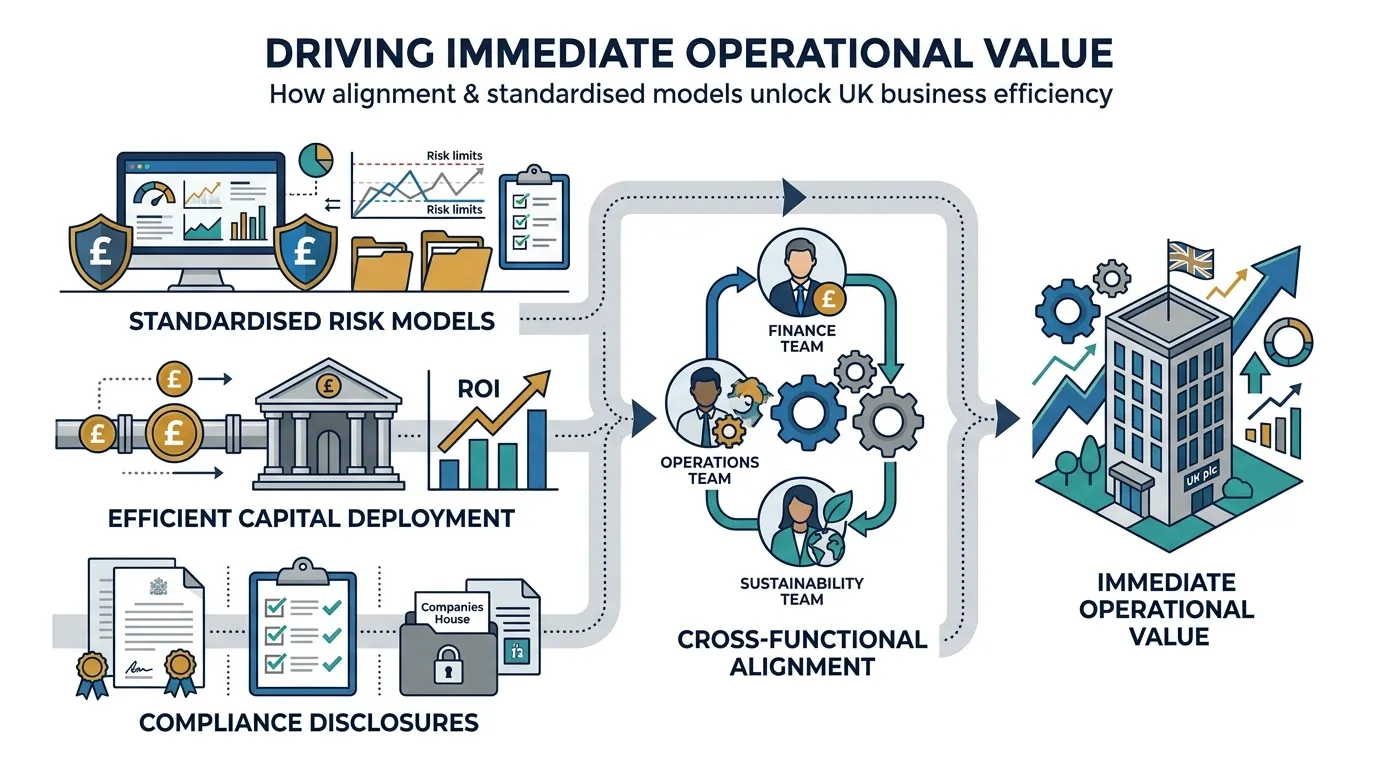
Implementing structured scenario planning capabilities transforms how energy organizations evaluate risk and deploy capital. The Institute For Oil & Gas Training designs its programs to deliver measurable performance improvements across multiple corporate departments.
Human Resources teams and corporate learning leads utilize this program to build clear leadership pipelines and eliminate institutional knowledge gaps. When strategy, finance, and technical teams speak a unified language regarding transition risk, corporate decision-making becomes faster, more consistent, and robust against external scrutiny.
Key enterprise outcomes include:
Enhanced Financial Precision: Integration of dynamic carbon cost variables into standard project appraisal and investment review processes.
Optimized Capital Allocation: Strategic shifting of capital toward resilient, high-margin, lower-carbon operational initiatives.
Mitigated Stranded Asset Risk: Early identification of vulnerable assets allows proactive portfolio restructuring and risk hedging.
Regulatory and Investor Readiness: Standardized transition risk disclosure documentation that satisfies stringent institutional investor mandates.
Workforce Capability Alignment: Human Resource teams establish measurable benchmarks for corporate performance and cross-departmental risk governance.
By training multidisciplinary cohorts, the Institute For Oil & Gas Training assists enterprise clients in establishing robust internal capability, ensuring corporate strategies remain viable under all global energy transition pathways.
How does enrollment and candidate selection work?
Enrollment requires a formal application evaluating professional experience in finance, strategy, engineering, or risk management, ensuring a high-caliber peer group and optimal collaborative learning dynamics throughout the course.
The Scenario Planning for Energy Transition & Carbon Cost Training Course follows a structured entry process designed to maintain high technical standards and meaningful peer interaction.
Eligibility & Candidate Profile
The curriculum targets experienced professionals within the energy, financial, and regulatory sectors. Suitable roles include:
Chief Financial Officers, Financial Controllers, and Corporate Planners
Energy Strategy Directors and Portfolio Risk Managers
Upstream, Midstream, and Downstream Asset Managers
Corporate Sustainability Officers and Environmental Compliance Directors
Investment Bankers, Equity Research Analysts, and Energy Sector Consultants
Enterprise Human Resource leads structuring specialized technical upskilling programs
Professional Prerequisites
Applicants should possess basic proficiency in financial modeling using spreadsheets and a practical understanding of energy industry capital budgeting. Prior exposure to carbon accounting or climate policy is beneficial but not strictly mandatory, as foundational concepts are covered in initial modules.
Enrollment Process & Certification
Application Submission: Candidates or corporate HR representatives submit professional background details and organizational roles.
Profile Evaluation: The admissions committee reviews candidates to ensure alignment with course technical depth.
Pre-Course Preparation: Admitted participants receive preparatory reading materials and baseline financial datasets.
Program Execution: Completion of all lectures, modeling labs, assessments, and the final capstone project.
Professional Certification: Successful participants earn an official credential from the Institute For Oil & Gas Training verifying their skill in energy scenario planning and carbon cost modeling.
Organizations seeking to upskill operational cohorts, optimize strategic planning capabilities, and secure portfolio value are invited to enroll in the Scenario Planning for Energy Transition & Carbon Cost Training Course.
Frequently Asked Questions
What is included in an Oil and Gas Petroleum Financial Analysis training course?
An Oil and Gas Petroleum Financial Analysis course delivered by the Institute For Oil & Gas Training covers capital expenditure (CAPEX) evaluation, discounted cash flow (DCF) modelling, and fiscal regime analysis. Delegates learn practical techniques for fiscal contract evaluation, asset impairment testing under international financial reporting standards (IFRS), and economic risk sensitivity modeling.
How does petroleum financial analysis differ from general corporate finance?
Petroleum financial valuation must account for high capital intensity, geological uncertainty, long project lifecycles, and complex production sharing contracts (PSCs) unique to upstream energy operations. Standardized training from the Institute For Oil & Gas Training teaches professionals how to integrate reserve depreciation, concession royalty regimes, and volatile commodity price decks into financial modeling workflows.
Who should attend an Oil and Gas Petroleum Financial Analysis course?
This professional training program is designed for finance managers, commercial analysts, energy economists, corporate planning leads, and investment bankers evaluating energy assets. The Institute For Oil & Gas Training structures the curriculum to help both technical specialists and financial professionals build job-ready skills in petroleum project economics.
What financial metrics are used to evaluate petroleum exploration and production projects?
Key valuation metrics include Net Present Value (NPV), Internal Rate of Return (IRR), payback period, finding and development (F&D) costs, and break-even oil prices per barrel. The Institute For Oil & Gas Training equips delegates with spreadsheet-based modeling skills to calculate these key performance indicators across complex upstream fiscal frameworks.
What are the career benefits of completing Oil and Gas Petroleum Financial Analysis training?
Completing an Oil and Gas Petroleum Financial Analysis program enhances expertise in energy valuation, capital allocation, and risk management. Certification from the Institute For Oil & Gas Training validates technical competence for corporate finance, asset management, and strategic planning roles across global energy markets.
Related training courses
Failure Mode and Effects Analysis (FMEA) Training Course
- Specialisation
- Oil & Gas Reliability and Maintenance Management
- Duration
- 5 days · 15 CPD hours
Damage Mechanisms (API 571) Training Course
- Specialisation
- Oil & Gas Asset Integrity Management
- Duration
- 5 days · 15 CPD hours
Oil and Gas Injection Water Treatment Training Course
- Specialisation
- Oil & Gas Water Treatment and Management
- Duration
- 5 days · 15 CPD hours
More articles

Treasury Operations Training for Funding and Working Capital Management in Oil and Gas
Master liquidity, debt facilities, and cash optimization with the Treasury Operations for Funding & Working Capital Training Course.
Read article →
How to Evaluate Funding Strategies and Working Capital Requirements for Petroleum Companies
Evaluate funding strategies and working capital models for petroleum companies with practical frameworks and structured treasury evaluation.
Read article →
Why Funding and Working Capital Management Matter in the Oil and Gas Industry
Learn how funding and working capital management drive financial stability, mitigate liquidity risks, and strengthen treasury operations in oil and gas.
Read article →