

Operational performance across petroleum assets depends directly on the clarity, accuracy, and strategic alignment of measurement frameworks. Executive teams, asset managers, and human resources leaders must establish precise evaluation mechanisms to ensure daily maintenance, processing, and safety tasks support enterprise-wide business objectives. Establishing these mechanisms requires moving beyond generic operational metrics and implementing structured selection criteria tailored to complex upstream, midstream, and downstream environments.
Selecting the right operational metrics ensures that technical teams focus on high-impact activities while mitigating systemic operational risks. Organizations seeking foundational context on operational metric frameworks can explore Why Key Performance Indicators Matter in Petroleum Operations, which details how operational metrics drive baseline visibility across extraction and refining assets. Building upon that core understanding, evaluating metrics for long-term operational success demands a rigorous assessment of data integrity, cross-departmental governance, and technical alignment across engineering and management disciplines.
What Defines an Effective Operational KPI in Petroleum Operations?
An effective operational KPI in petroleum operations is a quantifiable, operationally relevant metric aligned with strategic goals, possessing high data integrity, clear operational ownership, and actionable threshold bands that enable immediate corrective action across engineering, safety, and production workflows.
Attributes of High-Impact Operational Metrics
Every candidate metric evaluated for upstream or downstream operations must satisfy rigorous operational criteria. Organizations evaluate candidates against several core parameters:
Data Integrity and Source Clarity: The metric must rely on automated, tamper-proof data sources such as SCADA systems, distributed control systems (DCS), or enterprise asset management (EAM) platforms.
Actionability: A variation in the metric must trigger a predefined operational response, engineering review, or maintenance action item.
Strategic Line of Sight: The metric must directly connect site-level physical performance to asset profitability, safety compliance, or environmental performance.
Organizations maintain consistent measurement protocols across facility locations by recording these core parameters inside a standardized KPI definition document.
Balanced Integration of Leading and Lagging Indicators
Evaluating operational performance requires balancing leading and lagging indicators. Lagging indicators, such as Total Recordable Incident Rate (TRIR) or overall throughput volume, confirm historical outcomes. Leading indicators, such as preventive maintenance completion rates, pressure drop anomaly detection, or operator safety audit completion, predict future performance outcomes and prevent operational failures.
How Do You Select and Structure KPIs Using a Balanced Scorecard Approach?
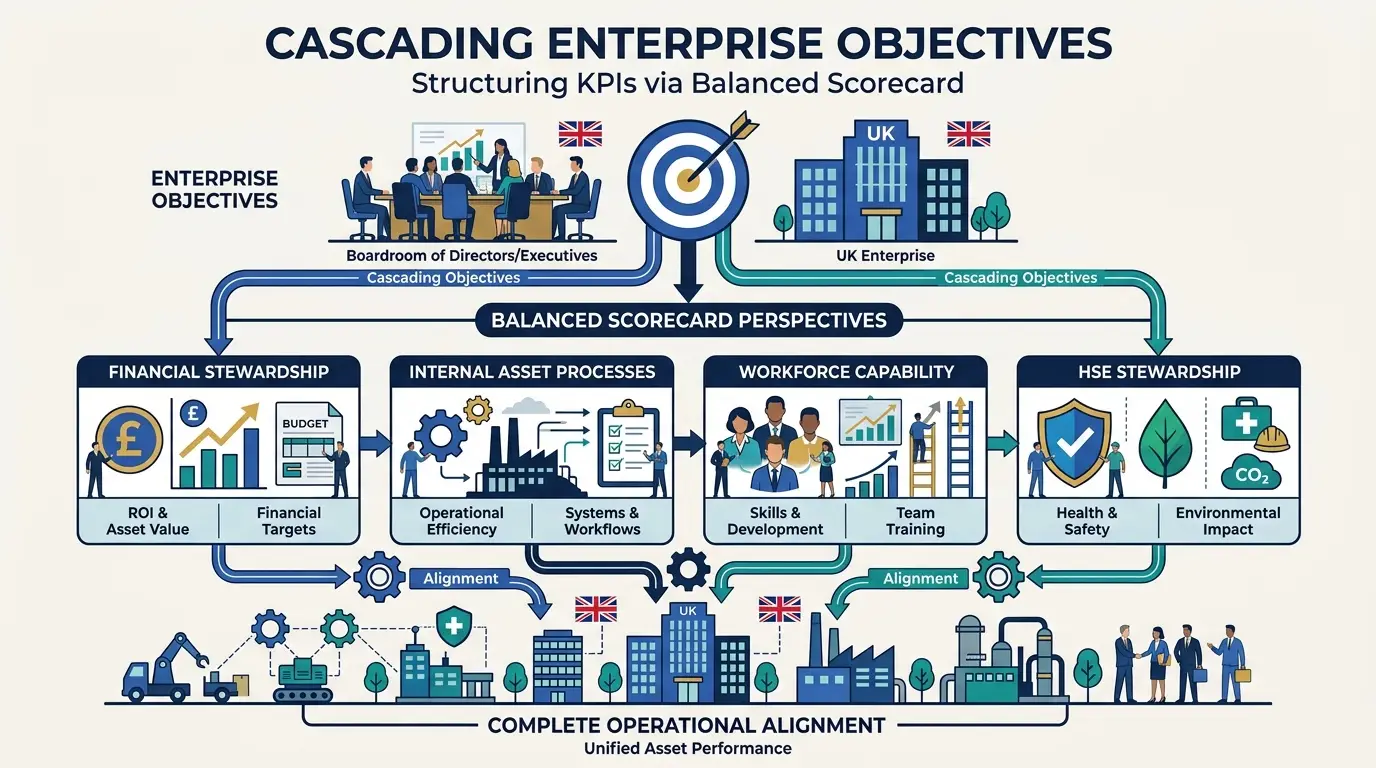
Selecting and structuring KPIs using a balanced scorecard approach requires cascading enterprise objectives into four operational perspectives—financial stewardship, internal asset processes, workforce capability, and health, safety, and environmental stewardship—to ensure complete operational alignment across assets.
The Four Operational Perspectives
Applying a balanced scorecard framework prevents operational teams from optimizing single operational metrics at the expense of broader enterprise performance. Organizations structure their evaluation frameworks across four distinct dimensions:
Internal Asset Processes: Evaluates production efficiency, overall equipment effectiveness (OEE), unplanned downtime, and turnaround duration.
Health, Safety, and Environment (HSE): Measures process safety events, methane intensity, loss of primary containment (LOPC), and regulatory compliance audits.
Financial Stewardship: Tracks operational expenditure (OPEX) variance per barrel of oil equivalent (BOE), lifting costs, and maintenance expenditure per asset unit.
Workforce Capability: Assesses technical competency levels, workforce skill gaps in control room operations, and critical training completion rates.
Structuring Cascading Objectives Across Organizational Levels
Operational goals set at the corporate executive level must transfer down through asset management, facility engineering, and field maintenance teams. Cascading objectives ensures that site-level teams understand how daily tasks support macro-level business targets.
When asset managers align site-level maintenance completion rates with corporate asset uptime targets, control room operators gain a direct line of sight regarding their daily operational choices.
What Measurement Methodology Ensures High Data Source Ownership and Integrity?
A robust measurement methodology ensures data source ownership and integrity by establishing automated ingestion protocols, defining explicit single-point accountability for every data stream, and standardizing verification rules across control systems and enterprise asset databases.
Establishing Data Source Ownership
Data ambiguity degrades performance measurement frameworks. Organizations assign explicit data source ownership to designated engineering or IT roles for every monitored operational variable.
The designated owner verifies data capture accuracy, resolves collection pipeline errors, and validates operational records before monthly governance reviews.
Standardizing the Measurement Methodology
A formal measurement methodology defines exact calculation mathematical formulas, sampling intervals, and data cleansing rules. Calculating Mean Time Between Failures (MTBF) for rotating equipment requires explicit agreement on whether standby periods or low-demand holds count as active operational time. Standardizing these computational rules across all operational assets eliminates conflicting internal reports and ensures consistent site-to-site performance benchmarking.
How Do Threshold and Tolerance Bands Drive Operational Action?
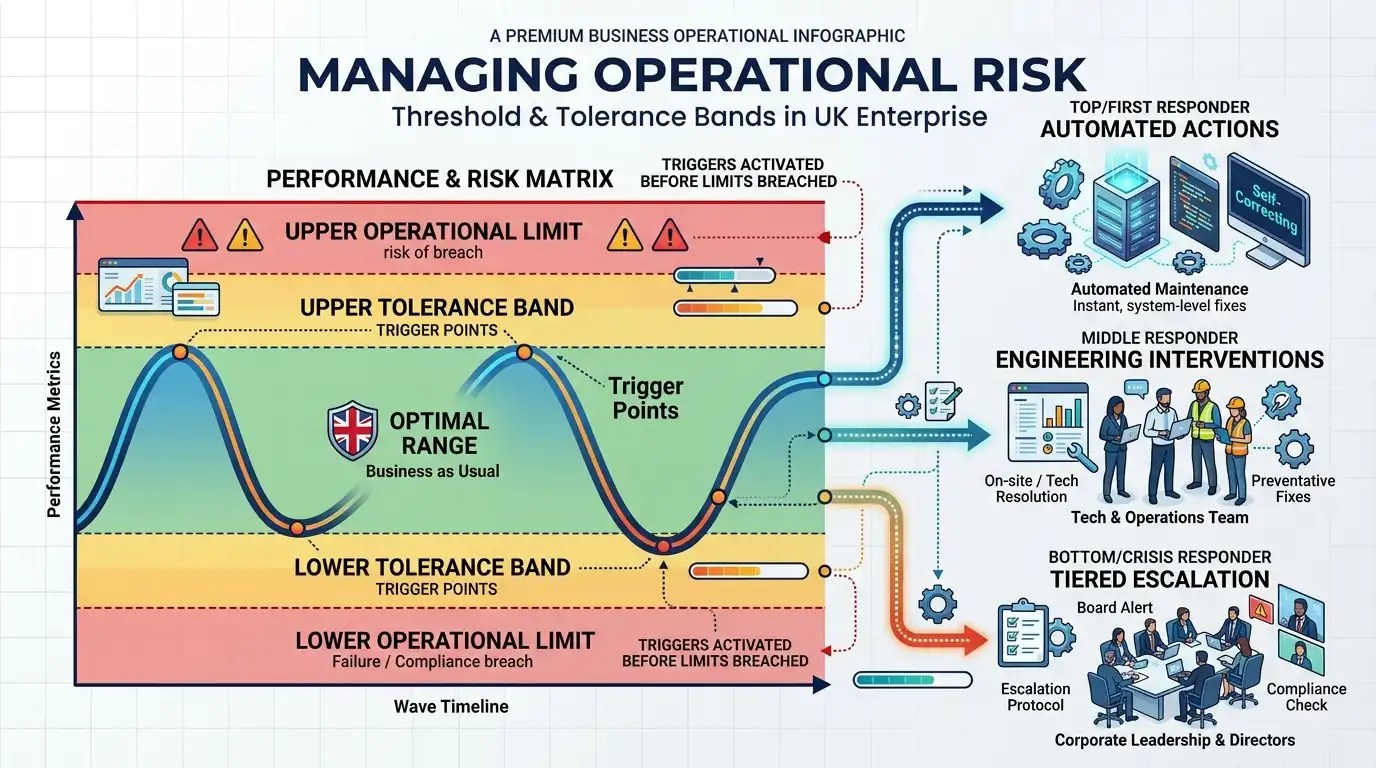
Threshold and tolerance bands drive operational action by defining upper and lower performance boundaries that trigger tiered escalation protocols, engineering interventions, and automated maintenance actions long before operational limits are exceeded.
Defining Threshold and Tolerance Bands
Static targets fail to reflect normal process variations across petroleum processing facilities. Organizations establish multi-tiered threshold and tolerance bands around target values to guide operational responses:
Green Band (Target): Indicates normal operating parameters. No intervention is required.
Yellow Band (Tolerance Boundary): Indicates early operational variance. Triggers engineering reviews, increased sampling, or preventive inspection work orders.
Red Band (Critical Threshold): Indicates an operational limit breach. Mandates immediate executive escalation, emergency operational adjustments, or process shut-in protocols.
Eliminating Target-Setting Ambiguities
Effective target setting incorporates historical asset performance data, original equipment manufacturer (OEM) specifications, and seasonal production variables. Unrealistic target setting demotivates site operators and leads to distorted operational reporting. Setting targets within achievable operational boundaries ensures workforce engagement and maintains high operational standards.
How Do You Establish KPI Governance and Review Mechanisms?
KPI governance and review mechanisms establish structured audit schedules, clear leadership oversight, and formal modification protocols to maintain metric relevance, verify data accuracy, and enforce accountability across technical teams.
Implementing KPI Governance Protocols
Sustained performance measurement requires formal KPI governance and review frameworks. Organizations establish multi-tiered governance meetings to monitor operational progress:
Daily Tier 1 Shift Reviews: Focus on short-term operational targets, shift handovers, and immediate process safety anomalies.
Weekly Tier 2 Asset Reviews: Focus on preventive maintenance compliance, logistics synchronization, and yellow-band operational variances.
Monthly Tier 3 Executive Reviews: Evaluate portfolio-level performance, OPEX allocation, strategic initiative progress, and cascading objective alignment.
Maintaining Framework Adaptability
Operational priorities evolve as field assets age or regulatory constraints shift. The governance committee evaluates the existing metric set annually. Metrics that no longer drive decision-making are retired, while new metrics addressing evolving process safety or decarbonization requirements are incorporated into the enterprise KPI definition document.
How Should Organizations Compare Approaches to Building KPI Capabilities?
Organizations build operational measurement capabilities by evaluating three primary approaches—internal framework development, external management consulting, and structured professional training—based on implementation speed, cost efficiency, skill retention, and long-term sustainability.
When addressing performance measurement gaps across petroleum operations, management and HR leaders evaluate several implementation pathways:
Evaluation Attribute | Option A: Internal Framework Development | Option B: External Management Consulting | Option C: Practical Corporate Training Programs |
Implementation Speed | Slow (6–12 months) | Fast (2–4 months) | Moderate (1–3 months) |
Cost Investment | Low initial direct cost; high indirect staff hours | High consulting fee expenditure | Moderate, highly predictable training expenditure |
Internal Skill Retention | Variable; limited by existing internal capability gaps | Low; knowledge leaves when consultants exit | High; directly embeds capabilities within engineering teams |
Operational Customization | High alignment with existing legacy practices | Standardized corporate templates | Customized around actual asset data and operational workflows |
Long-Term Sustainability | Moderate; vulnerable to staff turnover | Low; requires ongoing consulting support | High; establishes internal ownership and governance skills |
How Do You Select the Right Training Approach for KPI Execution?
Selecting the right training approach requires evaluating delivery models against specific operational environments, workforce skill levels, shift schedules, and technical requirements to ensure immediate job-role application and operational impact.
Decision Framework for Training Delivery Selection
Evaluating workforce development options requires analyzing specific organizational constraints and technical requirements:
Identify Workforce Skill Gaps: Measure current competency levels in data analytics, process safety monitoring, and performance governance among asset managers, field engineers, and HR leaders.
Evaluate Delivery Flexibility: Shift-based control room personnel require modular, practical instruction formats, whereas corporate asset leaders benefit from interactive, scenario-based masterclasses.
Assess Industry Relevance: Generic business management training fails to address petroleum-specific complexities like loss of primary containment metrics or decline curve calculations. Programs must feature practical petroleum engineering contexts.
Confirm Measurable Business Outcomes: The selected training solution must produce functional operational deliverables, including customized metric definition documents, escalation matrices, and governance charter drafts during the training program itself.
Organizations seeking structured, practical capability development should evaluate specialized programs such as KPI Design for Petroleum Operations Fundamentals Training Course. Structured professional development bridges technical skill gaps across production and management divisions.
For organizations preparing to implement a formal measurement framework across operational units, structured capability building ensures aligned execution. The KPI Design for Petroleum Operations Fundamentals Training for Oil and Gas Professionals provides an actionable framework for establishing data-driven governance, defining metrics, and aligning workforce capabilities with overall business strategy.
Frequently Asked Questions
Oil and Gas Petroleum Financial Analysis is the specialized evaluation of capital allocation, project economics, operating expenditures, and financial risks across upstream, midstream, and downstream assets. Through corporate training solutions delivered by the Institute For Oil & Gas Training, professionals learn to model discounted cash flows, assess production sharing contracts, analyze fiscal regimes, and interpret financial statements to support strategic investment decisions.
How does financial analysis differ for petroleum operations compared to other sectors?
Petroleum financial analysis accounts for industry-specific variables including long payback horizons, commodity price volatility, high exploration risk, and complex concession or production-sharing agreements. Training programs at the Institute For Oil & Gas Training focus on key metrics such as net asset value (NAV), finding and development (F&D) costs, reserve replacement ratios, and lifting costs per barrel of oil equivalent.
Why is training in Oil and Gas Petroleum Financial Analysis critical for energy professionals?
Structured training equips commercial managers, petroleum engineers, finance specialists, and enterprise leaders with the skills needed to build robust economic models and navigate international energy fiscal frameworks. The Institute For Oil & Gas Training provides practical instruction on Oil and Gas Petroleum Financial Analysis to help multidisciplinary teams align capital budgets with asset profitability, risk mitigation, and corporate performance targets.
What core skills are developed in the Oil and Gas Petroleum Financial Analysis program?
Participants master capital budgeting techniques, net present value (NPV) calculations, internal rate of return (IRR) sensitivity analysis, discounted cash flow (DCF) modeling, and joint venture financial reporting. Programs offered by the Institute For Oil & Gas Training emphasize real-world energy case studies to bridge technical engineering data with corporate financial strategy.
Who should undertake training in Oil and Gas Petroleum Financial Analysis?
This training is ideal for corporate strategy teams, project managers, petroleum accountants, commercial analysts, and business development executives working within oil and gas operating companies or financial institutions. The Institute For Oil & Gas Training tailors its Oil and Gas Petroleum Financial Analysis instruction to benefit technical non-finance managers seeking to improve capital evaluation and enterprise value creation.
Related training courses
Diesel and Gasoline Quality Testing Training Course
- Specialisation
- Oil & Gas Quality Control and Product Analysis
- Duration
- 5 days · 15 CPD hours
Welding Inspection and Quality Control Training Course
- Specialisation
- Oil & Gas Welding Inspection and Metallurgy
- Duration
- 5 days · 15 CPD hours
Process Safety Risk Assessment Training Course
- Specialisation
- Oil & Gas Process Safety Management
- Duration
- 5 days · 15 CPD hours
More articles

Cash Flow Stress Testing Training for Oil and Gas Financial Analysis Professionals
Evaluate financial risks with Cash Flow Stress Testing for Liquidity & Solvency Training Course by Institute For Oil & Gas Training. Enroll now.
Read article →
How to Evaluate Liquidity and Solvency Risks Through Oil and Gas Cash Flow Stress Testing
Compare evaluation models for oil and gas liquidity and solvency stress testing to safeguard corporate financial stability.
Read article →
Why Cash Flow Stress Testing Matters for Oil and Gas Liquidity and Solvency
Discover why cash flow stress testing is vital for oil and gas liquidity and solvency. Learn how workforce training strengthens corporate financial resilience.
Read article →