
Inventory accuracy represents the precise physical and financial alignment between recorded stock data and actual warehouse materials across drilling sites, production platforms, and processing facilities, directly impacting operational uptime, working capital efficiency, and production continuity.
In the oil and gas sector, inventory accuracy is not merely an administrative bookkeeping function. It operates as a core operational control mechanism. Exploration, production, and refining infrastructure rely on thousands of unique parts, including valves, gaskets, turbines, and drilling chemicals. When physical inventory matches enterprise resource planning records exactly, procurement teams avoid duplicate orders, maintenance schedules run without interruption, and capital stays unlocked. Unrecorded stock variance directly triggers unplanned downtime, deferred production, and inflated holding expenses.
Precision inventory management requires a multi-layered approach across the entire asset lifecycle:
Physical Verification Frameworks: Systematic counting regimes, such as cycle counting and annual wall-to-wall physical audits, verify actual stock counts against system ledgers without shutting down operations.
Material Master Data Governance: Standardised naming conventions, unified stock-keeping unit taxonomy, and clear attribute classification eliminate duplicate ordering and misidentified spare parts.
Stock Categorisation Models: ABC analysis categorises stock based on consumption value, while VED analysis evaluates parts based on operational criticality (Vital, Essential, Desirable). Combining these approaches ensures critical spares receive maximum control.
Traceability and Valuation Controls: Serialisation, batch tracking, and strict valuation methodologies keep financial statements aligned with physical movement across remote depots, offshore rigs, and central yards.
For upstream and midstream operations, stock precision directly governs maintenance performance metrics. When field technicians request critical spares, any inventory discrepancy creates an immediate supply chain bottleneck. Maintenance delays cause equipment downtime, leading to deferred production barrels and direct revenue loss. Establishing rigorous inventory controls secures asset integrity, stabilizes operating expenditures, and protects bottom-line cash flow across volatile energy market cycles.
How Does Inaccurate Materials Accounting Impact Offshore and Onshore Production Economics?
Inaccurate materials accounting inflates operating costs, forces capital lock-up in redundant spare parts, creates stockouts of critical production components, increases emergency logistics expenses, and delays vital asset maintenance, directly degrading production efficiency and cash flow.
The financial consequences of inventory variance compound quickly in capital-intensive energy environments. When enterprise software registers a spare turbine seal as available when it is missing from the field depot, a minor maintenance check turns into an extended shutdown. The immediate operational result is deferred production. A typical offshore platform producing 25,000 barrels per day loses substantial revenue for every hour of uncalculated downtime caused by missing parts.
Secondary financial losses occur through poor working capital management. Unreliable inventory counts force procurement teams to overcompensate by building emergency safety stock. Organizations purchase duplicate high-value assets like replacement drill collars, blowout preventer stack seals, and high-pressure valves. This practice ties up critical working capital that could otherwise support exploration or field development projects.
Financial losses extend to material degradation, obsolescence, and operational inefficiency across field assets:
Furthermore, inaccurate stock valuation distorts financial statements. Overstating asset values leads to inaccurate balance sheets, while sudden stock write-offs destabilize profit margins during quarterly audits. Standardizing materials accounting prevents operational surprises and ensures transparent financial reporting.
What Workforce Skill Gaps Cause Inventory Discrepancies in Industrial Supply Chains?
Inventory discrepancies stem from systemic skill gaps in materials management, improper cataloguing, inadequate ERP system usage, poor understanding of criticality categorization, and inconsistent physical counting methodologies among warehouse personnel, engineers, and procurement specialists.
Even advanced digital inventory platforms fail without properly trained workforce personnel managing raw data inputs. In many energy production facilities, field personnel prioritize immediate mechanical repairs over real-time inventory transactions. Technicians routinely remove critical parts from main storage yards without scanning out items or updating central management software. This creates immediate phantom stock discrepancies.
Organizations face several core capability deficiencies across operational teams:
Material Master Data Standardisation: Warehouse clerks and maintenance engineers often enter duplicate inventory items under inconsistent descriptions, creating fragmented records for identical parts.
ERP and WMS System Proficiency: Supply chain staff frequently use manual spreadsheets alongside automated Enterprise Resource Planning systems, leading to data synchronization failures.
Criticality Evaluation Knowledge: Purchasing teams often lack the operational context needed to balance inventory holding costs against the financial risk of equipment downtime.
Cycle Counting and Reconciliation Execution: Personnel execute physical counts without standardized root-cause variance analysis, repeating identical recording errors across auditing periods.
Closing these capability gaps requires structured professional development across cross-functional teams. Training must unify maintenance technicians, materials managers, procurement buyers, and finance analysts around shared supply chain standards.
How Do Corporate Learning Programs Build High-Accuracy Materials Management Capability?
Corporate learning programs build high-accuracy materials management capabilities through practical, structured training modules combining data governance concepts, warehouse management software mastery, cycle counting frameworks, and cross-functional operational workflows tailored to oil and gas environments.
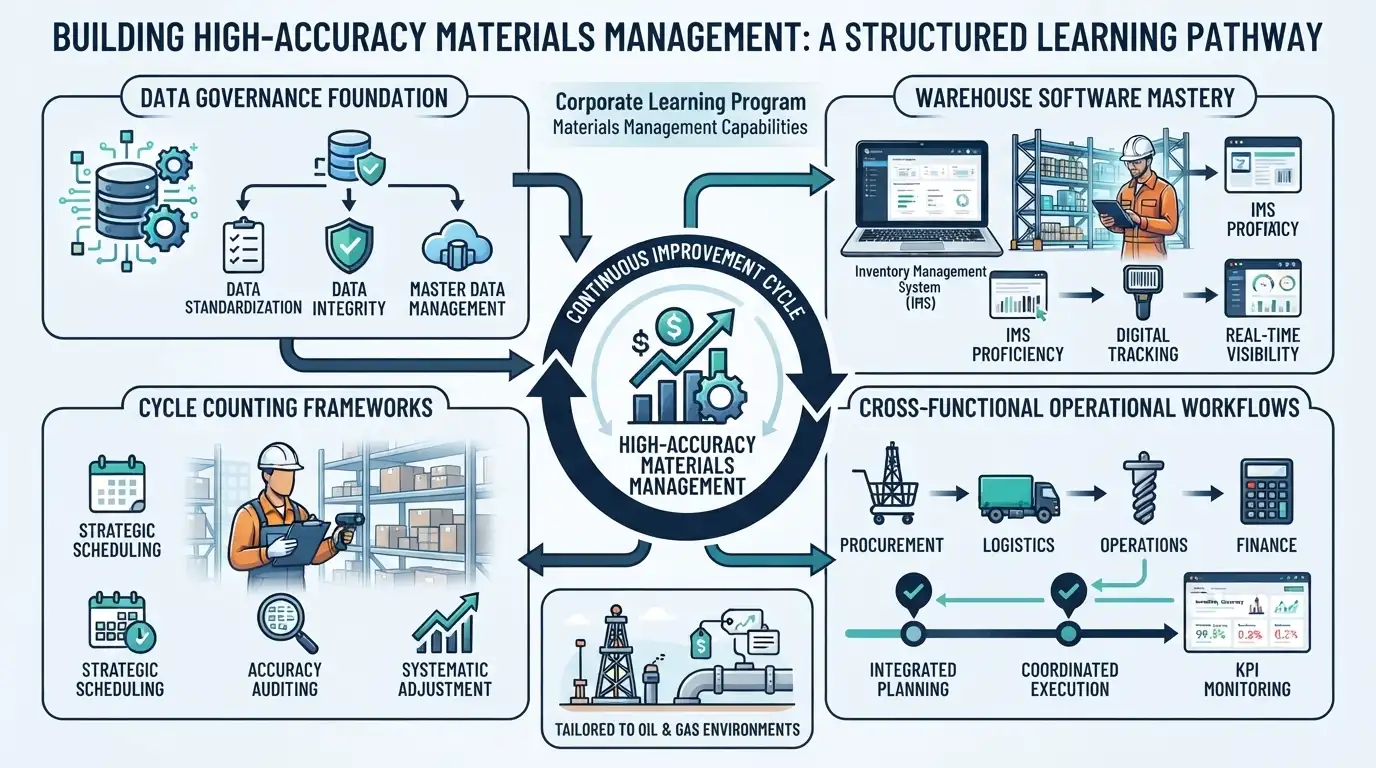
Targeted workforce development programs bridge the gap between theoretical inventory management and daily field operations. Effective corporate training transitions employees from basic operational awareness to complete process execution capability. Training programs align supply chain operations directly with operational reliability and financial performance standards.
Professional development initiatives follow structured, multi-phase delivery models:
1. Supply Chain Diagnostics and Skill Auditing
Before delivering training content, learning architects audit operational workflow data and conduct skill gap assessments across warehouse managers, logistics planners, and procurement engineers. This stage identifies specific execution bottlenecks, such as frequent stockouts, high emergency freight spending, or persistent inventory record variances.
2. Multi-Format Curriculum Execution
Programs deliver targeted instruction through flexible learning structures designed to fit demanding operational schedules:
Interactive Workshops: Multi-day intensive sessions covering material cataloguing standards, ABC/VED analysis, and warehouse design principles.
Practical Field Simulations: Controlled scenarios where participants execute physical audits, variance reconciliations, and ERP data entries under realistic operational constraints.
Hybrid Digital Learning Modules: Self-paced digital coursework covering legal compliance, hazardous material storage standards, and material valuation principles.
3. Applied Workplace Execution and System Integration
Participants apply updated cataloguing rules, cycle-counting schedules, and goods-issue protocols directly within active operating environments. Structured assignments require staff to identify real-world duplicate SKUs, clean up master data sets, and restructure physical depot layouts to streamline picking routines.
4. Post-Training Evaluation and Continuous Assessment
Capability development ends with formal skill verification and process monitoring. Trainees complete practical assessments requiring accurate identification, logging, and categorization of complex industrial spares. Long-term performance monitoring tracks stock accuracy rates, inventory variance levels, and order fulfillment times across participating operational units.
Operational teams build unified skills across procurement, field warehousing, and finance departments by anchoring professional development to real-world operational workflows.
What Core Frameworks and Tools Must an Effective Materials Accounting Course Cover?
An effective materials accounting course must cover master data management, ABC and VED stock categorization, perpetual cycle counting techniques, material requirements planning integration, shelf-life management, and key performance metric tracking frameworks.
Workforce training must equip personnel with actionable frameworks to control complex inventories. Standardized techniques eliminate operational guesswork and establish clear, repeatable supply chain processes.
A comprehensive course integrates these tools directly into standard operating procedures. Employees learn how physical transactions in remote warehouses impact core corporate financial ledgers.
Organizations looking to establish these controls across field units rely on specialized industry training, such as Inventory and Materials Accounting for Critical Spares, Consumables and Operational Stock, to align procurement teams, warehouse personnel, and maintenance managers with international supply chain standards.
How Do Enterprise Inventory Controls Protect Operational Cash Flow Across Major Energy Sectors?
Enterprise inventory controls protect operational cash flow by reducing safety stock requirements, cutting emergency shipping fees, preventing unplanned production shutdowns, eliminating duplicate procurement, and extending the shelf life of operational stock.
Controlling material movement directly improves cash flow across capital-intensive industries like downstream refining, petrochemical manufacturing, offshore drilling, power generation, and heavy manufacturing. Optimizing warehouse management transforms dormant inventory into liquid working capital.
Practical applications yield measurable cash flow improvements across major operational sectors:
Offshore Exploration and Production: Standardizing critical spare cataloguing cuts emergency helicopter freight costs for missing blowout preventer seals, saving hundreds of thousands of dollars per incident.
Downstream Refining Facilities: Synchronizing turnarounds with real-time spare part tracking prevents costly maintenance delays on cracking units, keeping daily output on schedule.
Midstream Pipeline Operations: Structured cycle counting across regional yards prevents excessive safety stock purchases for pipe segments and inline isolation valves.
Petrochemical Processing Plants: Enforcing strict First-Expired, First-Out (FEFO) rules prevents expensive chemical catalyst degradation, reducing inventory write-offs.
Optimizing material control frameworks releases cash locked up in unnecessary buffer stock, lowering holding expenses and protecting long-term profit margins across market cycles.
What Measurable Performance Outcomes Prove the Return on Investment of Supply Chain Training?
Measurable performance outcomes proving supply chain training ROI include reaching 98% inventory record accuracy, cutting stockout-induced downtime by 40%, lowering emergency procurement freight costs, and reducing working capital requirements.
Calculable supply chain improvements provide clear evidence of successful workforce development programs. Organizations measure corporate training returns using definitive key performance indicators across warehouse operations, field maintenance, and financial management.
Long-term organizational returns extend beyond direct cost savings. Structured supply chain training establishes operational discipline, improves cross-departmental coordination, and equips companies to maintain high production levels under volatile market conditions. Investing in workforce capabilities turns supply chain management into a clear strategic advantage.
Frequently Asked Questions
What is Oil and Gas Petroleum Accounting?
Oil and Gas Petroleum Accounting is a specialized financial practice that manages joint venture operations, production revenue distribution, depletion expenses, and complex regulatory compliance across upstream, midstream, and downstream sectors. Unlike standard corporate accounting, it accounts for high operational risk, exploration uncertainty, and intricate joint operating agreements unique to energy assets. The Institute For Oil & Gas Training provides professional development in this discipline to ensure finance teams record lease operating expenses and revenue accounting with absolute precision.
How does petroleum accounting differ from standard corporate accounting?
Petroleum accounting incorporates industry-specific valuation frameworks, such as Successful Efforts and Full Cost accounting methods, to handle volatile exploration costs and asset retirement obligations. It also requires tracking production sharing contracts, windfall profit taxes, and complex unproved property impairments that standard financial reporting excludes. Through structured courses at the Institute For Oil & Gas Training, accounting professionals master these specialized petroleum accounting methodologies to maintain accurate balance sheets and tax filings.
Why is specialized petroleum accounting training important for finance teams?
Specialized petroleum accounting training prevents costly regulatory compliance errors, audit failures, and inaccurate joint venture billing reconciliations in capital-intensive energy projects. It equips corporate accountants and financial managers with the practical skills needed to analyze production economics, calculate depletion, and manage complex joint venture audit rights efficiently. Professionals trained by the Institute For Oil & Gas Training gain the technical expertise required to improve cash flow transparency and maintain rigorous financial controls across energy operations.
What are the main methods of accounting for oil and gas exploration costs?
The two primary methods used in oil and gas petroleum accounting are the Successful Efforts method and the Full Cost method. The Successful Efforts method capitalizes costs associated solely with successful exploratory wells while expensing dry holes immediately, whereas the Full Cost method capitalizes all exploration costs within a specific cost centre. The Institute For Oil & Gas Training covers both accounting frameworks in depth to help finance personnel evaluate financial statements and comply with international accounting standards.
How does petroleum accounting handle joint venture and production sharing contracts?
Petroleum accounting manages joint ventures by tracking shared capital expenditure, operational costs, and working interest percentages according to joint operating agreements. It ensures proper cost recovery calculations, profit oil distribution, and monthly joint interest billings across operating and non-operating partners. The Institute For Oil & Gas Training delivers comprehensive instruction on joint venture accounting protocols to minimize partner disputes and guarantee transparent revenue sharing across joint assets.
Related training courses
Inventory & Materials Accounting: Drilling Consumables & Stock Training Course
- Specialisation
- Oil & Gas Petroleum Accounting
- Duration
- 5 days · 15 CPD hours
Petroleum Industry Accounting Fundamentals Training Course
- Specialisation
- Oil & Gas Petroleum Accounting
- Duration
- 5 days · 15 CPD hours
More articles

Oilfield Economics & Project Evaluation: Specialist Training for Petroleum Economics and Commercial Roles
Master petroleum economics and project evaluation with specialized training. Learn cash flow modeling, risk analysis, and fiscal contracts for upstream roles.
Read article →
NPV and IRR Analysis for Comparing Alternative Oilfield Development Cases
Master net present value and internal rate of return methods to compare alternative oilfield development cases and optimize upstream capital allocation.
Read article →
How Petroleum Companies Assess the Commercial Viability of New Field Developments
Discover how petroleum companies train teams to assess field development commercial viability, optimize capital allocation, and drive project returns.
Read article →