
Oilfield economic evaluation is the systematic financial assessment of hydrocarbon reserves using discounted cash flow models to determine capital allocation viability.
Organizations operate in capital-intensive markets where upstream asset development requires multi-million-dollar commitments. Teams require deep financial literacy to assess capital efficiency across complex reservoirs. When enterprises lack structured workforce capabilities in valuation, investments result in stranded assets and capital misallocation. Corporate training programs bridge skill gaps by building internal competence in risk assessment, reservoir valuation, and cash flow modeling. Modern businesses achieve operational excellence when multidisciplinary teams understand asset profitability.
Upskilling technical and commercial personnel strengthens the corporate leadership pipeline. Engineers and commercial managers evaluate project viability through standardized financial frameworks. Training delivery formats combine interactive workshops, digital learning modules, and collaborative simulations. Programs integrate competency assessments to measure baseline knowledge against corporate benchmarks.
Organizations experience a 35% increase in cross-functional decision-making speed after deploying targeted financial training programs. Improved risk management protects corporate capital reserves from market volatility. Teams leverage structured methodologies to evaluate multi-year capital expenditure programs with precision. Aligning technical petroleum engineering with financial metrics drives enterprise profitability.
How do organizations implement oilfield economic training programs for technical teams?
Organizations implement oilfield economic training through structured corporate learning architectures featuring competency mapping, blended delivery modules, and practical application workshops.
Human resources and learning and development professionals design training pathways to address specific workforce skill deficiencies. Implementation begins with a rigorous training needs analysis across asset management teams. Enterprises establish baseline metrics to track employee performance improvements following program completion.
Instructional designers deploy blended learning models combining self-paced online modules with intensive instructor-led workshops. Program delivery utilizes case-based learning built around historical asset development projects. Teams analyze real-world datasets from diverse petroleum basins, including the Permian Basin, the North Sea, and the Niger Delta.
Interactive simulations replicate market volatility and pricing shocks for risk mitigation practice. Cross-functional cohorts participate in negotiation role-play exercises mirroring joint-venture boardroom dynamics. Post-training evaluations measure knowledge retention and application on active corporate projects.
Organizations witness a 28% reduction in project appraisal cycle times following structured workforce capability development. Continuous professional development frameworks ensure technical staff maintain alignment with evolving fiscal regimes. Integrating practical case studies accelerates the transfer of theoretical financial concepts to daily workplace execution.
What core components and financial frameworks drive successful asset valuation training?
Core training components encompass discounted cash flow analysis, capital budgeting metrics, risk quantification frameworks, and fiscal regime modeling tools.
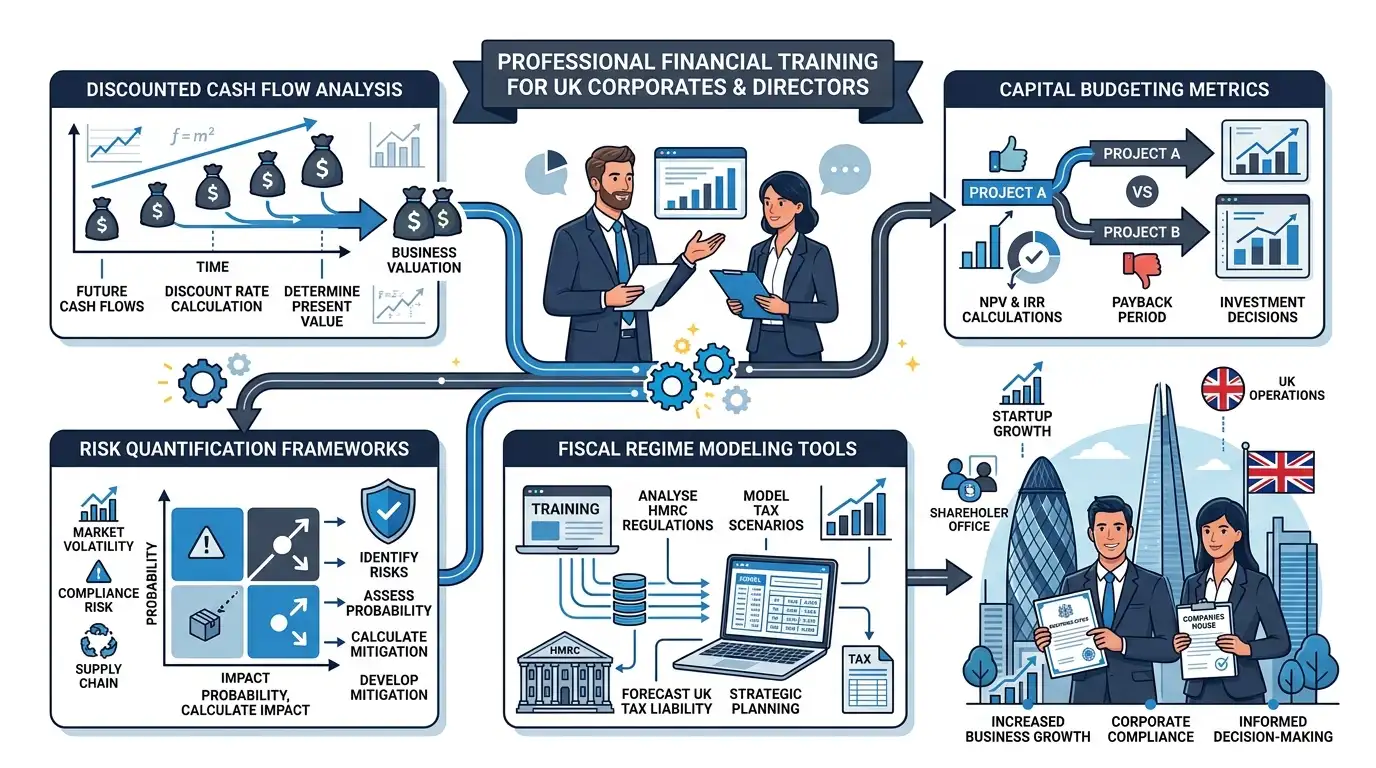
Workforce education modules focus on mastery of foundational and advanced financial metrics. Trainees learn to calculate Net Present Value to determine the absolute value added by an upstream development. Programs teach internal rate of return computations to assess percentage profitability relative to initial capital outlays.
Understanding fiscal regimes is critical for international asset evaluation. Training curricula examine production sharing contracts, concession agreements, and service contracts across global jurisdictions. Participants utilize spreadsheet modeling tools and petroleum economics software to run sensitivity analyses.
Workforce competence improves through deliberate practice using Monte Carlo simulations to quantify subsurface uncertainty. Programs cover cost estimation methodologies, including capital expenditure and operational expenditure modeling. Learners study abandonment and decommissioning liability provisions required by regulatory authorities.
Mastery of these frameworks enables teams to conduct rigorous capital allocation reviews. Organizations report a 40% improvement in forecast accuracy for capital expenditure budgets after workforce upskilling. Standardizing valuation vocabulary across asset teams eliminates miscommunication between engineering and finance departments.
What measurable business benefits do enterprises achieve through professional economic training?
Enterprises achieve measurable business benefits including optimized capital allocation, accelerated project delivery, enhanced talent retention, and improved cross-departmental collaboration.
Investing in comprehensive professional development transforms organizational performance metrics across upstream business units. Structured upskilling programs yield a 22% increase in overall team efficiency within twelve months of completion. Cross-departmental alignment bridges communication divides between subsurface engineers and commercial investment committees.
Talent retention improves significantly when enterprises invest in continuous professional growth. Organizations running structured training pathways experience an 18% reduction in voluntary turnover among technical professionals. Employees exhibit higher workplace engagement when equipped with the advanced tools required for career progression.
Optimized capital allocation protects enterprise balance sheets from marginal asset investments. Teams apply rigorous screening criteria to eliminate uneconomic field development proposals before board presentation. Leadership pipelines strengthen as high-potential engineers transition into strategic commercial roles.
As organizations scale their asset portfolios, readers exploring deeper financial appraisal methodologies should review the [Insert Link to MOFU Article] to understand advanced sensitivity testing. This comprehensive guide details how quantitative modeling refines project selection under extreme commodity price volatility.
Which corporate teams, departments, and industries utilize oilfield economic training?
Corporate users of oilfield economic training include asset management teams, petroleum engineering departments, commercial business development units, and executive leadership groups.
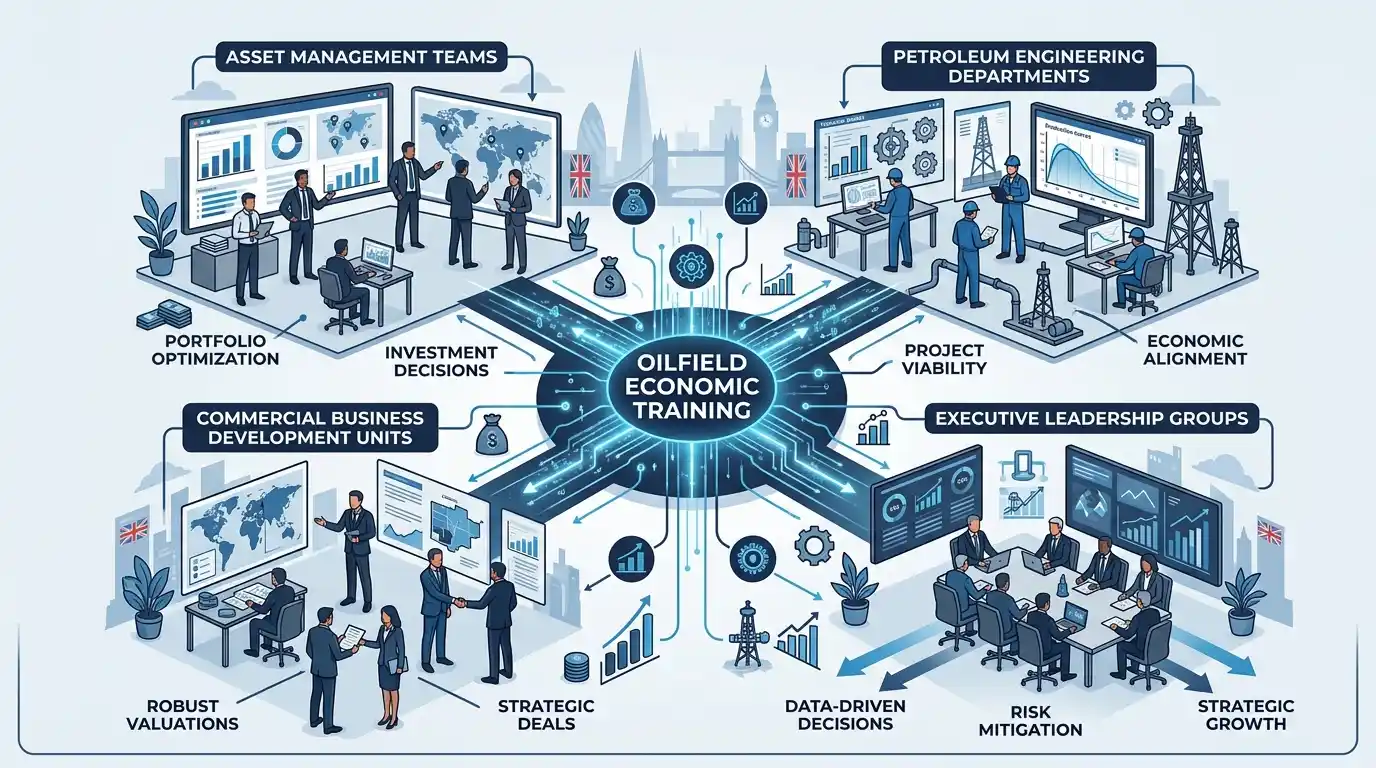
Cross-functional workforce segments require tailored educational pathways to address distinct operational responsibilities. Asset management teams utilize economic training to optimize field depletion strategies and secondary recovery investments. Petroleum engineers study commercial metrics to ensure technical designs align with corporate hurdle rates.
Commercial business development departments leverage valuation training to execute mergers, acquisitions, and farm-in agreements. Executives and board directors utilize financial sensitivity modules to govern enterprise capital allocation strategies securely. Similar capability frameworks drive performance improvement in asset-heavy sectors like mining, renewable energy, infrastructure development, and heavy manufacturing.
Team leaders deploy role-play simulations to train multi-disciplinary groups in collaborative asset valuation. Department heads utilize performance metrics to track the return on training investment across fiscal quarters. Industry-driven learning programs ensure workforce capabilities match the operational demands of modern engineering environments.
Collaborative training initiatives break down organizational silos between technical and financial departments. Integrating real-world industrial datasets prepares workforce units to navigate complex market cycles successfully.
What common problems and misconceptions hinder corporate economic training initiatives?
Common problems include reliance on generic off-the-shelf programs, lack of practical workplace application, failure to measure post-training return on investment, and treating education as a one-time event.
Many enterprises implement superficial training initiatives that fail to address specific organizational skill gaps. Generic programs lack industry-specific relevance, resulting in low employee engagement and poor knowledge retention. Organizations that neglect baseline competency assessments cannot accurately measure performance improvements following training delivery.
Another critical misconception assumes technical personnel do not require commercial financial literacy. Confining financial evaluation exclusively to finance departments creates operational bottlenecks during asset appraisal. Effective workforce development requires continuous learning architectures embedded directly into daily operational workflows.
Organizations overcome these pitfalls by partnering with specialized providers delivering outcome-based programs. Training curricula must reflect current macroeconomic conditions, technological advancements, and regulatory changes. Integrating post-training project reviews ensures newly acquired skills translate into measurable workplace productivity.
Eliminating ineffective training practices protects corporate development budgets and drives sustainable performance improvement. Cultivating a culture of continuous learning empowers modern workforces to achieve operational excellence across global markets.
Frequently Asked Questions
What is oil and gas petroleum finance training for corporate teams?
Oil and gas petroleum finance training equips technical and commercial professionals with the skills needed to evaluate upstream assets, model discounted cash flows, and manage capital expenditures. Through programs provided by the Institute For Oil & Gas Training, organizations bridge the gap between reservoir engineering and commercial decision-making. This specialized education ensures multidisciplinary teams can accurately assess project viability and optimize capital allocation across complex fiscal regimes.
How do petroleum finance courses improve capital allocation in energy firms?
Petroleum finance courses improve capital allocation by teaching teams how to utilize rigorous metrics like Net Present Value and Internal Rate of Return to screen uneconomic field developments. By enrolling personnel in programs from the Institute For Oil & Gas Training, businesses minimize the risk of stranded assets and capital misallocation. Standardized financial modeling ensures that commercial evaluations remain consistent and aligned with corporate hurdle rates.
Who should participate in professional oil and gas petroleum finance programs?
Professional oil and gas petroleum finance programs are designed for asset management teams, petroleum engineers, commercial business development professionals, and corporate decision-makers. Cross-functional participation allows technical staff and commercial managers to share a unified vocabulary when evaluating joint-venture opportunities and asset acquisitions. The Institute For Oil & Gas Training delivers tailored learning pathways that help these diverse stakeholders navigate market volatility and regulatory compliance.
What core financial frameworks are covered in upstream petroleum economics training?
Upstream petroleum economics training covers discounted cash flow analysis, capital budgeting metrics, production sharing contract modeling, and risk quantification methods like Monte Carlo simulations. These frameworks allow corporate workforces to quantify subsurface uncertainty and accurately forecast project cash flows. Programs from the Institute For Oil & Gas Training incorporate practical case studies and spreadsheet modeling tools to ensure immediate workplace application.
Why is specialized finance training essential for oil and gas workforce development?
Specialized finance training is essential because upstream energy projects involve multi-million-dollar capital investments and complex fiscal structures that generic corporate training cannot address. Upskilling personnel through the Institute For Oil & Gas Training enhances project appraisal accuracy, accelerates decision-making cycles, and strengthens the corporate leadership pipeline. Aligning technical petroleum expertise with robust financial governance drives sustainable enterprise profitability.
Related training courses
Decommissioning & Asset Retirement Obligations: Security Arrangements Training Course
- Specialisation
- Oil & Gas Petroleum IFRS & Financial Reporting
- Duration
- 5 days · 15 CPD hours
Internal Controls Over Financial Reporting Design Training Course
- Specialisation
- Oil & Gas Petroleum Compliance, AML & Risks
- Duration
- 5 days · 15 CPD hours
Month-End Close Acceleration for Upstream Operations & Cut-Off Training Course
- Specialisation
- Oil & Gas Petroleum Accounting
- Duration
- 5 days · 15 CPD hours
More articles

Oilfield Economics & Project Evaluation: Specialist Training for Petroleum Economics and Commercial Roles
Master petroleum economics and project evaluation with specialized training. Learn cash flow modeling, risk analysis, and fiscal contracts for upstream roles.
Read article →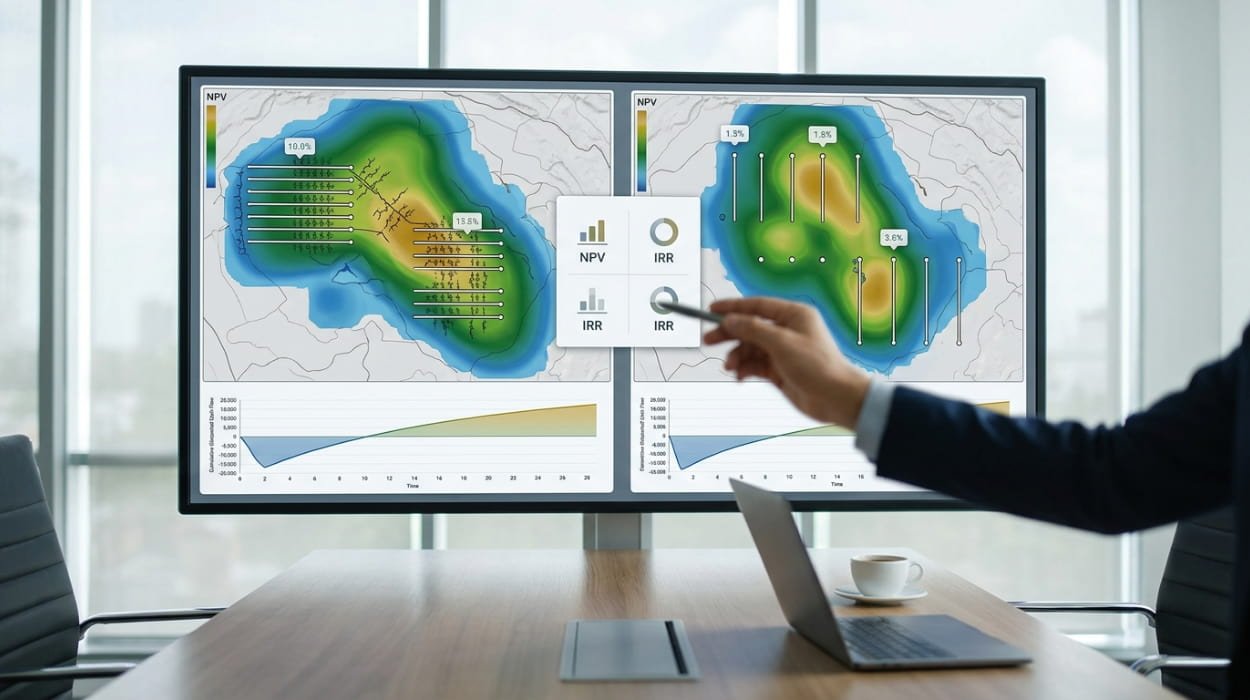
NPV and IRR Analysis for Comparing Alternative Oilfield Development Cases
Master net present value and internal rate of return methods to compare alternative oilfield development cases and optimize upstream capital allocation.
Read article →
How Petroleum Companies Assess the Commercial Viability of New Field Developments
Discover how petroleum companies train teams to assess field development commercial viability, optimize capital allocation, and drive project returns.
Read article →