
Evaluating upstream petroleum assets requires rigorous financial modeling that bridges surface operational realities and subsurface capital commitments. Capital allocation decisions depend on robust quantitative metrics to determine whether a prospect generates sustainable economic rent under fluctuating commodity price regimes and fiscal terms. Organizations frequently establish baseline understanding by examining What Determines Whether an Oilfield Development Creates Economic Value? to contextualize how cash flow generation operates across various production lifecycles.
Corporate engineering and finance teams transition from high-level awareness to comparative evaluation when assessing specific field development plans. Testing project resilience demands a granular examination of discount rates, capital expenditure profiles, and production decline curves alongside contract structures governed by host governments. Asset teams utilize specialized Oilfield Economics & Project Evaluation Training: What Petroleum Professionals Should Evaluate Before Enrolling curricula to standardize these financial workflows across multidisciplinary subsurface units. Integrating advanced financial evaluation methodologies ensures that capital expenditure decisions withstand rigorous risk scrutiny before final investment decisions occur.
How Do Net Present Value and Internal Rate of Return Measure Oilfield Profitability?
Net Present Value and Internal Rate of Return quantify oilfield profitability by discounting future net cash flows against initial capital expenditures over the producing life of an asset. Net Present Value measures absolute value creation in monetary terms, while Internal Rate of Return calculates the annualized percentage yield generated by invested capital.
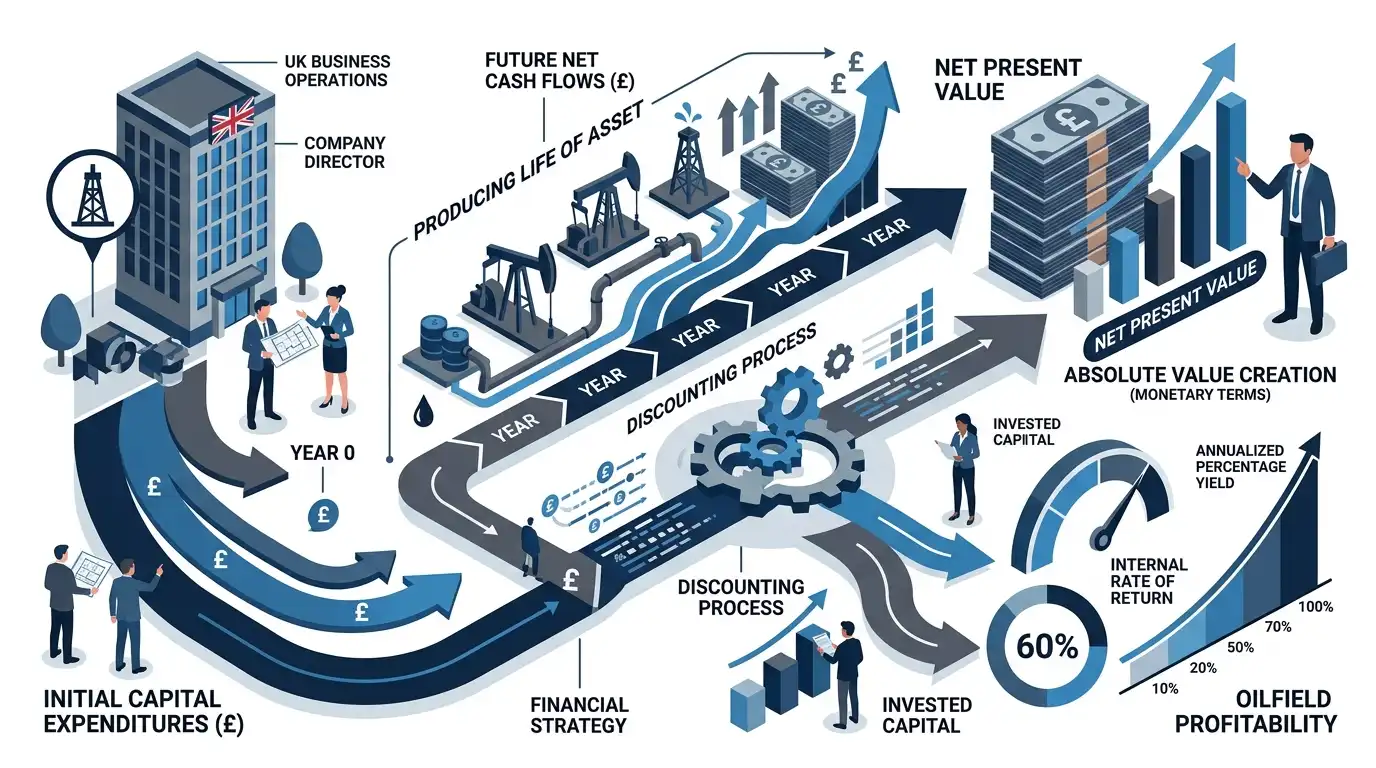
Net Present Value calculations discount all future cash inflows and outflows back to a present-day value using a specified discount rate that reflects the weighted average cost of capital and asset-specific risk. If the resulting monetary figure exceeds zero, the project increases corporate value. Internal Rate of Return identifies the exact discount rate that drives the Net Present Value to zero. When this internal rate exceeds the corporate hurdle rate, the investment proceeds to further commercial screening.
Upstream asset valuations incorporate capital expenditure schedules spanning seismic acquisition, exploratory drilling, platform fabrication, and decommissioning liabilities. Subsurface productivity profiles dictate the timing of these cash flows through initial flush production, plateau phases, and terminal decline slopes. Analysts apply appropriate discount rates to account for geological uncertainty, political risk, and commodity price volatility over decades of operation.
Project screening requires clear distinctions between absolute value creation and percentage returns. High capital expenditure deepwater developments frequently yield massive Net Present Value figures despite moderate Internal Rate of Return percentages due to scale. Conversely, smaller onshore infill drilling programs can exhibit exceptionally high Internal Rate of Return values while contributing modest absolute monetary returns to a global portfolio. Decision-makers balance both metrics to optimize portfolio capital allocation under strict corporate budget constraints.
Why Is Fiscal Sensitivity Analysis Essential for Upstream Capital Allocation?
Fiscal Sensitivity Analysis is essential for upstream capital allocation because production sharing contracts, royalty regimes, and tax structures drastically alter project cash flows under shifting commodity price scenarios. Regulatory frameworks impose variable government takes that protect state interests during high price environments while shifting financial burdens onto operators during market downturns.
Upstream developments operate within complex contractual environments that dictate how gross revenues are split between the host government and the operating consortium. Production sharing contracts, concession agreements, and service contracts distribute risk and reward through mechanisms such as cost recovery limits, profit oil splits, and sliding-scale royalties. A development plan showing robust economics under a flat sixty-dollar oil price assumption can experience severe cash flow compression if fiscal terms escalate state take during price spikes or fail to provide downside protection.
Fiscal sensitivity modeling isolates specific variables to measure their individual impact on project net present value and internal rate of return. Analysts adjust discount rates, capital expenditure overruns, operating cost inflation, and production delay durations within the financial model. This stress-testing identifies operational breaking points and uncovers hidden liabilities buried within rigid tax codes or unfavorable concession terms.
Risk mitigation strategies emerge directly from comprehensive sensitivity outputs. Commercial teams structure contingency funds for capital expenditure overruns and negotiate force majeure clauses or cost recovery adjustments within production sharing agreements. Integrating these fiscal realities into standard corporate workflows prevents capital misallocation in high-risk jurisdictions.
What Distinguishes Discounted Cash Flow Models from Deterministic and Probabilistic Risk Frameworks?
Discounted Cash Flow models rely on single-point deterministic inputs, whereas probabilistic frameworks utilize Monte Carlo simulations to quantify subsurface and commercial uncertainties through thousands of randomized iterations. Deterministic models provide a baseline valuation, while probabilistic approaches map out complete risk distributions for Net Present Value and Internal Rate of Return outcomes.
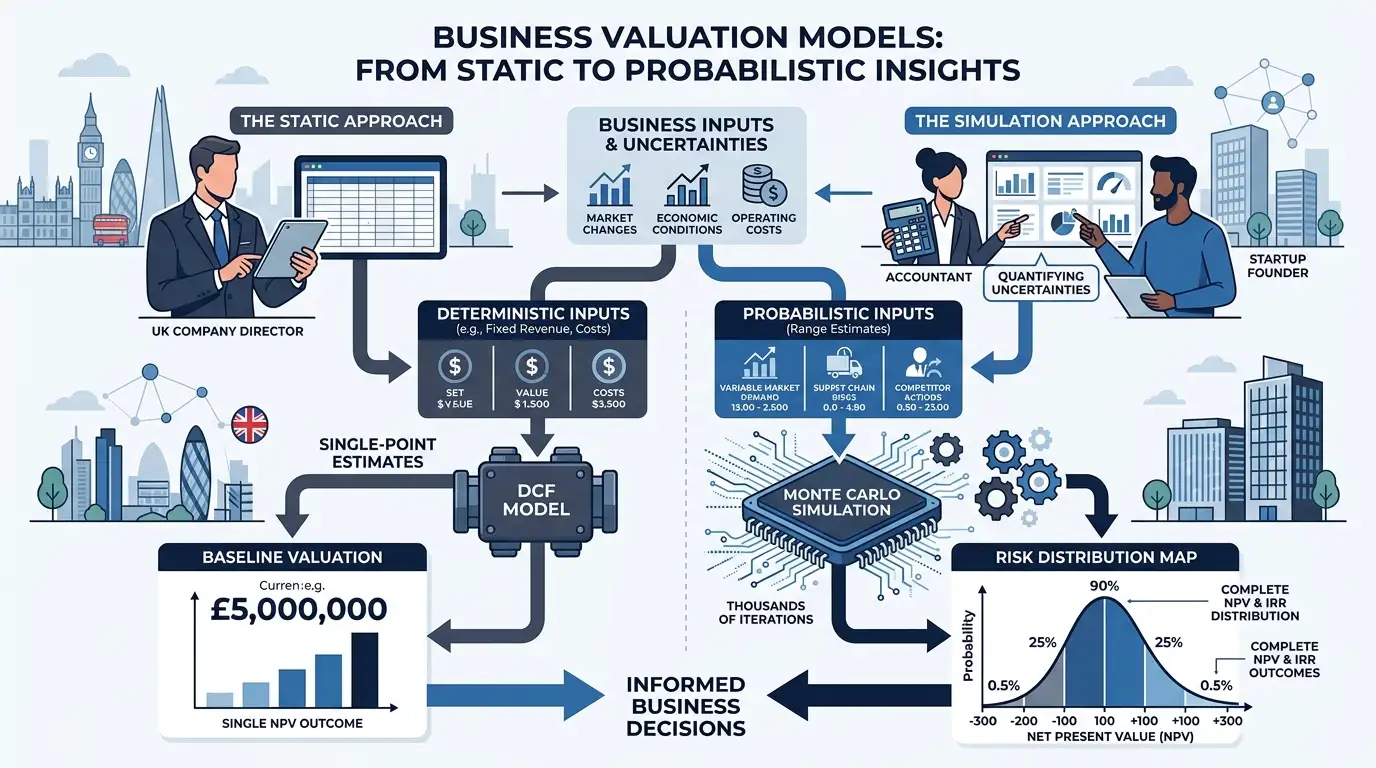
Deterministic economic models evaluate oilfield projects using fixed inputs for reservoir porosity, recovery factors, capital expenditures, and commodity price trajectories. While straightforward to construct, these single-case models fail to capture the compounding nature of subsurface risk. Asset teams complement deterministic baselines with probabilistic modeling engines that assign statistical distributions to key variables.
Monte Carlo simulations generate probability distribution curves for project net present value, identifying P10, P50, and P90 economic outcomes. This distribution analysis reveals the probability of achieving negative returns and highlights the downside exposure associated with complex deepwater or unconventional plays. Corporate risk management frameworks mandate these probabilistic outputs before committing multi-million-dollar development budgets.
Evaluation Framework | Primary Focus | Key Output Metrics | Limitation |
Deterministic Discounted Cash Flow | Single-point asset valuation | Point-estimate NPV, IRR, Payback | Ignores variance and probability ranges |
Probabilistic Monte Carlo Simulation | Portfolio risk distribution | P10, P50, P90 value curves | Requires extensive statistical input data |
Fiscal Sensitivity Modeling | Contractual resilience testing | Variable gradient response charts | Assumes static regulatory interpretation |
Evaluating complex portfolios requires structured educational pathways. Professionals seeking mastery over these methodologies engage with the Institute For Oil & Gas Training program to refine their financial modeling precision. Structured workforce development initiatives bridge the gap between theoretical finance and practical asset evaluation.
How Do Upstream Organizations Bridge Subsurface Engineering Data and Commercial Valuation?
Upstream organizations bridge subsurface engineering data and commercial valuation by embedding asset teams within integrated workflows that translate reservoir simulation metrics directly into financial model inputs. Translating geological uncertainty into quantifiable cash flow schedules requires continuous collaboration between petroleum engineers, subsurface geologists, and commercial economists.
Subsurface characterization generates vast datasets detailing reservoir pressure depletion, fluid contact migration, permeability barriers, and well deliverability curves. Economic modelers transform these technical outputs into production profiles that drive revenue and operating expense streams. Misalignment between engineering production forecasts and financial assumptions frequently leads to severe capital overruns and impaired asset values.
Cross-functional alignment relies on standardized data governance and shared economic evaluation software. Commercial teams establish common economic parameters such as long-term price decks, inflation indices, and corporate discount rates to ensure asset comparisons remain consistent across global portfolios. Regular peer reviews and stage-gate validation processes catch modeling errors before capital allocation decisions reach executive committees.
Workforce capability directly influences the accuracy of these commercial valuations. Organizations invest in targeted training initiatives delivered by the Institute For Oil & Gas Training to ensure subsurface and commercial personnel speak a unified financial language. Upskilling technical staff on fiscal modeling and risk analysis strengthens organizational governance and protects shareholder value across volatile commodity cycles.
Frequently Asked Questions
How does Institute For Oil & Gas Training approach Oil and Gas Petroleum Finance education?
The Institute For Oil & Gas Training delivers practical, industry-aligned programs that bridge subsurface engineering data with corporate capital allocation strategies. Participants master essential financial modeling techniques, including discounted cash flow valuation and fiscal regime analysis tailored to upstream assets. These specialized courses empower petroleum professionals and financial analysts to evaluate upstream asset profitability accurately under volatile commodity price scenarios.
What are the core components of Oil and Gas Petroleum Finance project evaluation?
Oil and gas petroleum finance project evaluation centers on quantifying net present value, internal rate of return, and payback periods across various production lifecycles. Analysts integrate capital expenditure profiles, operating cost estimates, and production decline curves into rigorous financial models. Evaluating these metrics helps organizations determine whether an upstream development generates sustainable economic value before committing capital.
Why is fiscal sensitivity analysis critical in petroleum financial modeling?
Fiscal sensitivity analysis measures how production sharing contracts, royalty structures, and tax regimes impact upstream project cash flows during market fluctuations. By stress-testing variables such as government take, cost recovery limits, and sliding-scale royalties, asset teams identify hidden liabilities and regulatory risks. This evaluation safeguards operator returns and prevents capital misallocation in complex international jurisdictions.
How do petroleum engineers and commercial teams collaborate on economic evaluations?
Petroleum engineers and commercial teams collaborate by translating reservoir simulation metrics, pressure depletion data, and well deliverability curves directly into financial model inputs. Establishing shared economic parameters and standardized workflows ensures that technical production forecasts align seamlessly with corporate investment hurdles. This cross-functional alignment improves the reliability of capital expenditure decisions across global portfolios.
Who should enroll in specialized Oil and Gas Petroleum Finance training programs?
Specialized training in oil and gas petroleum finance benefits subsurface engineers, commercial analysts, asset managers, and finance professionals operating within the upstream sector. These programs equip technical staff with the financial acumen required to communicate effectively with executive committees and investor relations teams. Organizations utilize these courses to bridge internal skill gaps and standardize project evaluation methodologies.
Related training courses
Decommissioning & Asset Retirement Obligations: Security Arrangements Training Course
- Specialisation
- Oil & Gas Petroleum IFRS & Financial Reporting
- Duration
- 5 days · 15 CPD hours
Cash Flow Reporting for IAS 7 Statements Training Course
- Specialisation
- Oil & Gas Petroleum IFRS & Financial Reporting
- Duration
- 5 days · 15 CPD hours
Ethics, Governance & Anti-Corruption for Host Governments Training Course
- Specialisation
- Oil & Gas Petroleum Compliance, AML & Risks
- Duration
- 5 days · 15 CPD hours
More articles

Oilfield Economics & Project Evaluation: Specialist Training for Petroleum Economics and Commercial Roles
Master petroleum economics and project evaluation with specialized training. Learn cash flow modeling, risk analysis, and fiscal contracts for upstream roles.
Read article →
NPV and IRR Analysis for Comparing Alternative Oilfield Development Cases
Master net present value and internal rate of return methods to compare alternative oilfield development cases and optimize upstream capital allocation.
Read article →
How Petroleum Companies Assess the Commercial Viability of New Field Developments
Discover how petroleum companies train teams to assess field development commercial viability, optimize capital allocation, and drive project returns.
Read article →