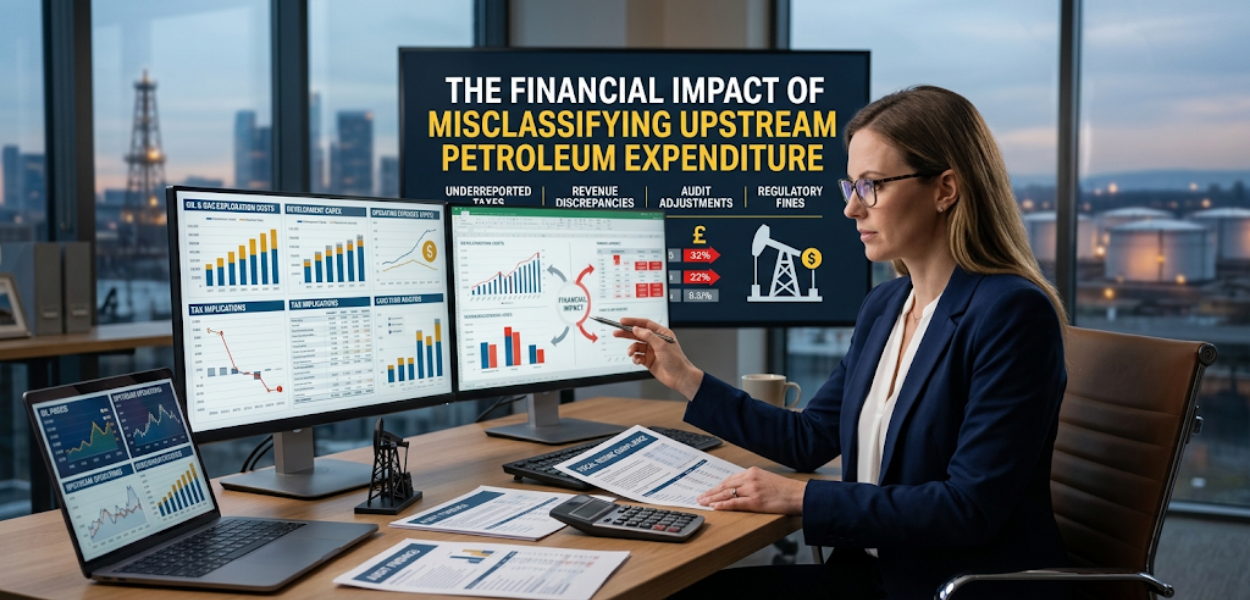
Misclassifying upstream petroleum expenditure changes how oil and gas companies measure assets, costs, profits, reserves-related economics, and field performance. Upstream expenditure covers exploration, appraisal, development, production, abandonment, and other activities connected with finding and producing hydrocarbons. Each expenditure category follows different accounting, reporting, approval, and control requirements.
For organisations, the issue is not limited to an accounting entry. Incorrect classification affects management reports, statutory reporting, joint venture statements, project evaluations, cost recovery calculations, and group reporting. Finance teams, petroleum accountants, field managers, auditors, and commercial professionals therefore need a shared understanding of petroleum industry accounting fundamentals.
Structured professional development helps organisations establish this shared understanding. Training in Oil & Gas Petroleum Accounting connects accounting principles with operational activities, licence agreements, concession structures, operator responsibilities, and corporate reporting requirements.
Why does upstream petroleum expenditure classification matter to business performance?
Correct expenditure classification determines whether costs are treated as assets, production expenses, development costs, exploration costs, or other recognised categories, directly affecting financial statements, project economics, statutory reporting, management decisions, and performance measurement.
Upstream petroleum projects generate expenditure across several stages. Exploration identifies potential resources. Appraisal evaluates discoveries. Development establishes production infrastructure. Production generates hydrocarbons and associated operating costs. Abandonment and decommissioning address assets at the end of their productive life.
These activities do not create identical accounting outcomes. A development well and a production operating expense serve different business purposes. Recording both under one classification reduces the accuracy of financial information.
The financial effect appears in several areas. Capitalising an expenditure that should be expensed increases reported assets and reduces current-period expenses. Expensing a cost that qualifies for capitalisation reduces current-period profit and understates asset values.
The effect also extends to depreciation, depletion, amortisation, impairment analysis, project profitability, tax calculations, and management reporting.
For example, a development project with £50 million of incorrectly classified expenditure can produce materially different financial results depending on whether the amount is capitalised or recognised as an expense. The timing of profit recognition changes even when the underlying cash expenditure remains identical.
How does upstream cost classification work across petroleum operations?
Upstream cost classification connects each expenditure item to its operational purpose, contractual basis, accounting treatment, reporting requirement, and asset lifecycle stage through documented rules, approvals, evidence, and periodic review.
The classification process starts with identifying the business activity that generated the expenditure. Finance teams then establish whether the activity relates to exploration, appraisal, development, production, transportation, abandonment, corporate support, or another function.
The second step is reviewing the underlying documentation. Purchase orders, contracts, invoices, work programmes, well records, licence documents, joint operating agreements, and project approvals provide evidence for classification.
The third step involves applying the organisation's accounting policy. Group accounting policies define how qualifying costs are recognised, measured, capitalised, depreciated, depleted, amortised, impaired, or expensed.
The fourth step connects the accounting treatment with reporting obligations. NOC accounting refers to accounting practices used by national oil companies. IOC reporting requirements refer to reporting requirements applied by international oil companies within their corporate structures. Both environments require consistent classification, although reporting frameworks and internal policies differ.
The fifth step involves review. Finance managers, petroleum accountants, commercial teams, and technical personnel examine unusual or material transactions. This creates a control point before costs enter financial statements or partner reports.
Training programmes use case-based learning to reproduce these decisions. Participants classify expenditure records, analyse supporting documents, examine field scenarios, and assess the reporting consequences of different treatments.
Which skills are required to prevent expenditure misclassification?
Organisations need petroleum accounting knowledge combined with operational understanding, contractual interpretation, financial analysis, documentation control, reporting discipline, and communication between finance, technical, commercial, and management teams.
Technical accounting knowledge alone does not resolve every upstream classification issue. A petroleum accountant needs to understand what the expenditure represents operationally.
For example, an invoice for drilling services does not provide sufficient context by itself. The accounting treatment depends on whether the drilling activity relates to exploration, appraisal, development, or production.
Key workforce skills include:
Petroleum accounting fundamentals
Employees need to understand exploration expenditure, appraisal costs, development expenditure, production costs, depletion, depreciation, amortisation, impairment, and abandonment obligations.
Contract interpretation
Licence agreements, production-sharing arrangements, concession accounting, joint operating agreements, and other contractual structures influence cost ownership and reporting responsibilities.
Operator and non-operator roles
An operator manages defined operational activities on behalf of participating parties. A non-operator holds an interest but does not manage the operation. Their accounting records require different information flows and controls.
Financial analysis
Finance professionals need to connect classification decisions with asset balances, profit, cash flow, project economics, and performance indicators.
Documentation and controls
Classification requires evidence. Strong documentation supports internal review, external audit, statutory reporting, and partner reporting.
These skills are best developed through practical exercises rather than theoretical instruction alone. Simulations, assessments, case studies, and structured classification exercises allow employees to practise decisions against realistic petroleum transactions.
How should organisations implement training for upstream expenditure classification?
An effective corporate learning process starts with a skills-gap assessment, maps accounting competencies to job responsibilities, delivers practical learning, tests classification decisions, and measures workplace performance through defined financial and operational KPIs.
The first stage is a skills-gap assessment. HR and L&D teams identify which roles influence expenditure classification. These roles include petroleum accountants, finance managers, project controllers, auditors, commercial analysts, field managers, and joint venture professionals.
The second stage maps competencies to responsibilities. A junior accountant requires foundational knowledge. A finance manager requires stronger policy interpretation and review skills. A project controller requires the ability to connect project expenditure with budgets and asset structures.
The third stage establishes the learning format. Workshops support group problem-solving. Online modules provide standardised technical content. Hybrid learning combines digital instruction with instructor-led case analysis.
The fourth stage introduces practical classification exercises. Employees review fictional invoices, contracts, work orders, field activities, and project records. They classify expenditure and explain the accounting rationale.
The fifth stage uses assessments. Participants receive scenarios involving ambiguous expenditure, shared facilities, development activities, production operations, and licence-related obligations.
The sixth stage evaluates workplace application. Organisations track classification corrections, audit findings, reporting adjustments, close-cycle delays, and reconciliation issues.
A useful corporate learning framework therefore connects learning input → applied competency → accounting accuracy → reporting quality → business outcome.
This implementation approach becomes particularly important when organisations compare different development methods and accounting frameworks. A structured discussion of upstream cost classification decisions for development assets, production costs and field reporting provides the appropriate next-stage context when employees need to move from basic awareness to practical evaluation.
What are the key components of an upstream petroleum accounting training programme?
A complete programme combines petroleum accounting principles, expenditure classification, contractual structures, financial reporting, operational case studies, digital analysis, assessments, and workplace application so employees can connect accounting treatment with real petroleum activities.
The first component is petroleum accounting fundamentals. Employees establish a common terminology for upstream activities and financial treatment.
The second component is expenditure classification. Training distinguishes exploration, appraisal, development, production, and abandonment expenditure through practical transaction examples.
The third component is contractual accounting. Participants examine licence agreements, concession accounting, joint operating arrangements, and cost-sharing structures.
The fourth component is reporting. Employees examine statutory reporting obligations, group accounting policies, management reporting, and partner reporting.
The fifth component is financial analysis. Training examines how classification affects profit, assets, depreciation, depletion, amortisation, impairment, budgets, and project performance.
The sixth component is technology. Spreadsheet analysis, enterprise resource planning systems, accounting databases, and reporting platforms support transaction review and cost monitoring.
The seventh component is assessment. Employees complete classification exercises and explain why a particular treatment applies.
The eighth component is workplace application. Participants connect course cases with their organisation's expenditure structures, approval processes, reporting cycles, and control requirements.
What financial problems result from incorrect upstream expenditure classification?
Incorrect classification distorts asset values, expenses, profit, project economics, depreciation, depletion, impairment analysis, tax reporting, partner statements, and management information, creating additional reconciliation work and increasing the risk of reporting adjustments.
The first problem is inaccurate asset recognition. Costs recorded as capital assets without sufficient basis increase reported asset balances.
The second problem is incorrect expense recognition. Costs that should be recognised immediately as expenses are deferred through inappropriate capitalisation.
The third problem concerns depreciation and depletion. Capitalised costs influence the amount and timing of depreciation, depletion, and amortisation.
The fourth problem affects impairment analysis. Asset values that do not accurately represent recoverable economic benefits create unreliable impairment assessments.
The fifth problem affects project evaluation. Managers use project costs to evaluate budgets, production economics, investment performance, and development decisions. Incorrect classification reduces the reliability of these measurements.
The sixth problem affects partner reporting. Joint ventures require consistent reporting between operators and non-operators. Classification differences create reconciliation requirements and disputes over cost allocation.
The seventh problem concerns audit and statutory reporting. Inconsistent classification creates additional review requirements and increases the volume of correcting entries.
These problems demonstrate why classification is a business-control issue rather than a narrow bookkeeping activity.
How can organisations measure the business impact of accounting training?
Organisations can measure training impact through classification accuracy, audit adjustments, reporting-cycle time, reconciliation volume, policy compliance, employee assessment results, and financial control performance before and after training.
Training ROI requires measurable indicators. Attendance alone does not demonstrate business impact.
Classification accuracy provides one direct KPI. Organisations can measure the percentage of reviewed transactions correctly classified before and after training.
Audit adjustments provide another indicator. A reduction in classification-related adjustments demonstrates stronger application of accounting policies.
Reporting-cycle time measures operational efficiency. If finance teams spend fewer hours correcting cost classifications, monthly and quarterly reporting becomes more efficient.
Reconciliation volume also provides evidence. Fewer unresolved differences between operator and non-operator records indicate stronger cost reporting processes.
Assessment scores measure knowledge acquisition. Organisations can establish a target such as 85% or higher for scenario-based classification assessments.
Employee application provides a further measure. Managers can review whether employees correctly apply classification principles to actual transactions during the following 3 to 6 months.
A balanced KPI framework therefore measures both learning and business outcomes.
Where is upstream petroleum expenditure training most useful?
The training applies across finance, accounting, audit, project controls, commercial management, joint venture operations, field management, and corporate reporting functions within organisations operating petroleum assets or supporting upstream projects.
Finance departments use the training to improve cost recognition and reporting controls.
Project controls teams use it to connect expenditure with approved budgets and project stages.
Audit teams use it to understand the operational basis behind accounting entries.
Commercial teams use it to interpret cost obligations under contractual arrangements.
Joint venture teams use it to understand operator and non-operator reporting requirements.
Field management teams benefit from understanding how operational activities affect financial records.
L&D departments use the competency framework to identify skill gaps and build targeted learning pathways.
The approach also applies across industries and organisations with complex capital projects, such as energy, infrastructure, mining, engineering, and utilities, where operational expenditure classification influences financial reporting.
What common misconceptions lead to poor training outcomes?
Generic accounting training does not address petroleum-specific classification decisions because upstream expenditure depends on operational stages, contractual structures, reporting frameworks, asset lifecycles, and organisational accounting policies.
One misconception is that general accounting knowledge is sufficient. Petroleum expenditure requires sector-specific operational understanding.
Another misconception is that a single classification rule applies to every transaction. The correct treatment depends on the nature and purpose of the expenditure and the applicable accounting policy.
A third misconception is that software eliminates classification risk. Enterprise systems process the rules entered by users. Incorrect coding produces incorrect outputs at scale.
A fourth misconception is that training success equals attendance. Completion records do not measure whether employees can classify complex transactions correctly.
A fifth misconception is that financial teams can resolve all classification issues independently. Technical, commercial, legal, and operational information often provides essential context.
A sixth misconception is that ROI only means financial savings. Training impact also appears through fewer reporting corrections, faster close processes, stronger controls, improved compliance, and better decision-quality information.
Effective learning therefore uses real-world cases, simulations, assessments, workshops, online modules, and workplace evaluation rather than generic presentations.
How does better classification support long-term workforce capability?
Consistent expenditure classification creates a shared financial language across technical and corporate teams, strengthens reporting discipline, reduces avoidable corrections, and develops workforce capability around accurate, evidence-based petroleum accounting decisions.
A strong capability model connects accounting knowledge with operational context. Employees understand not only what an accounting treatment is, but why it applies to a particular petroleum activity.
This supports collaboration between finance, engineering, operations, commercial, audit, and management teams. Shared terminology reduces communication gaps during project reviews and reporting cycles.
It also supports leadership development. Managers who understand classification principles can review financial information with greater context and challenge inconsistencies before they affect formal reporting.
The long-term objective is therefore organisational capability. Training becomes part of the control environment rather than an isolated learning event.
For oil and gas organisations, this approach supports integrity in financial information, practical application of accounting policies, innovation in learning delivery, collaboration across functions, and measurable operational impact.
Related training courses
Upstream Cost Classification for Recoverability & JV Chargeability Training Course
- Specialisation
- Oil & Gas Petroleum Accounting
- Duration
- 5 days · 15 CPD hours
Inventory & Materials Accounting: Drilling Consumables & Stock Training Course
- Specialisation
- Oil & Gas Petroleum Accounting
- Duration
- 5 days · 15 CPD hours
Inventory & Materials Accounting for Hydrocarbon Stock Valuation Training Course
- Specialisation
- Oil & Gas Petroleum Accounting
- Duration
- 5 days · 15 CPD hours
More articles

Oilfield Economics & Project Evaluation: Specialist Training for Petroleum Economics and Commercial Roles
Master petroleum economics and project evaluation with specialized training. Learn cash flow modeling, risk analysis, and fiscal contracts for upstream roles.
Read article →
NPV and IRR Analysis for Comparing Alternative Oilfield Development Cases
Master net present value and internal rate of return methods to compare alternative oilfield development cases and optimize upstream capital allocation.
Read article →
How Petroleum Companies Assess the Commercial Viability of New Field Developments
Discover how petroleum companies train teams to assess field development commercial viability, optimize capital allocation, and drive project returns.
Read article →