

An inaccurate production forecast directly impairs petroleum capital allocation, cash flow projections, and corporate financial stability. Energy companies frequently face significant budget variances when field decline rates deviate from static spreadsheet assumptions. Operational uncertainty, unquantified downtime, and incorrect decline curve extrapolation create systemic financial risk across upstream portfolios. The Institute For Oil & Gas Training developed the Production Forecasting & Decline Curve Analysis for Budgeting Training Course to solve these structural technical gaps. To understand the operational drivers behind financial misalignments, explore why production forecasting is essential for accurate oil and gas budgeting. This specialized program bridges the gap between reservoir engineering workflows and corporate budget requirements. Participants transition from deterministic, isolated estimation practices to structured forecasting frameworks. The curriculum equips asset team members to produce audit-ready volumetric outputs for corporate reporting cycles.
What is this course and what problem does it solve?
This course provides a technical framework for aligning reservoir decline curve analysis with financial budgeting requirements. It resolves capital misallocation, budget variance, and volume estimation errors by standardising decline curve workflows, downtime accounting, and probabilistic production forecasting techniques across corporate planning teams.
The primary problem in upstream budgeting is the disconnection between technical subsurface models and commercial corporate models. Subsurface engineering teams focus on ultimate recovery metrics, whereas finance departments require deterministic, time-stamped cash flow schedules. When subsurface specialists fail to convert reservoir decline dynamics into realistic volume inputs, financial plans encounter significant operational shortfalls. Unrealistic exponential decline assumptions regularly overestimate short-term field yields, causing artificial liquidity spikes followed by abrupt revenue deficits.
This training program systematically targets and eliminates these corporate operational errors. The Institute For Oil & Gas Training provides structured technical methodologies that standardise data processing across multivariant asset bases. Practitioners learn to reconcile Arps decline equations with operational reality, accounting for wellhead choke changes, artificial lift transitions, and surface infrastructure limits. Integrating these technical parameters into corporate planning tools drastically reduces variance between projected and actual financial numbers.
Furthermore, corporate finance teams frequently struggle to interpret technical reservoir parameters without contextual training. The Production Forecasting & Decline Curve Analysis for Budgeting Training Course equips non-engineering planning professionals with technical auditing skills. Delegates gain the analytical capability to scrutinise production profiles, evaluate historical forecast bias, and validate underlying technical assumptions before budget consolidation.
Why is this training course structured this way?
The curriculum uses a linear learning model, progressing from empirical decline physics to complex corporate financial consolidation. This design ensures delegates build fundamental reservoir diagnostic skills before applying advanced decline curve models, probabilistic forecasting techniques, and budget variance reconciliation workflows within corporate asset management.
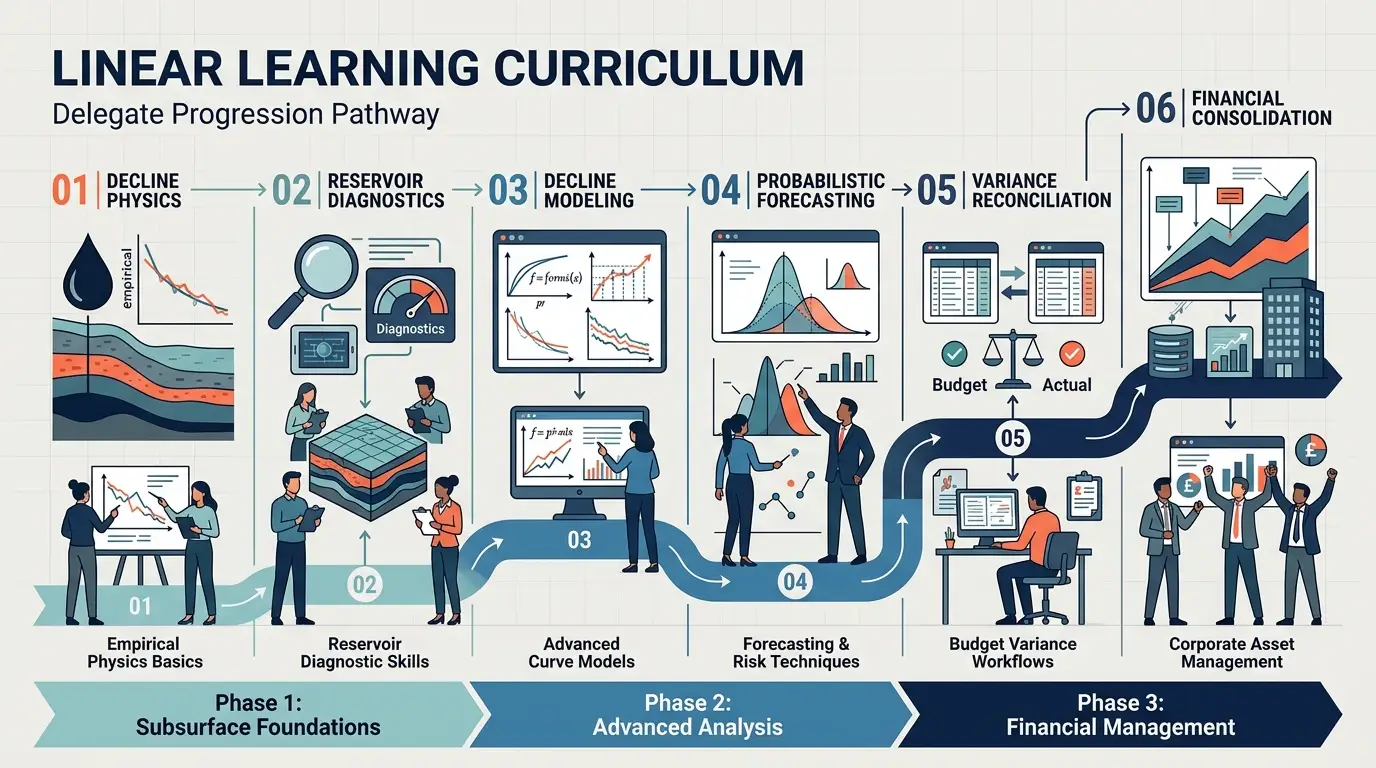
Upstream forecasting requires a rigorous, multi-tiered educational framework. The program starts with diagnostic plot analysis to establish basic empirical competency. Engineers and financial analysts must identify flowing regime changes, boundary-dominated flow conditions, and transient pressure effects before attempting decline parameter selection. Skipping these technical foundations results in incorrect decline exponent selection, invalidating subsequent budget allocations.
The middle phase of the curriculum introduces field-level operational complexity. Production profiles rarely follow uninhibited decline curves; mechanical interventions, well workovers, and infrastructure bottlenecks alter baseline field behavior. The curriculum systematically incorporates operational uplift factors into baseline forecasting models. Participants evaluate infill and workover uplift alongside downtime and deferment assumptions to maintain realistic rolling volume reforecast workflows throughout the operating year.
The final structural phase focuses on corporate financial integration. Subsurface outputs must align with corporate accounting frameworks, reserves reporting standards, and governance protocols. Delegates practise converting technical oil, gas, and water forecasts into standardized financial inputs. For a comprehensive overview of analytical frameworks, read how to use production forecasts and decline curve analysis to improve petroleum budget accuracy. The Institute For Oil & Gas Training structures this training progression to guarantee that technical precision directly translates into corporate financial integrity.
What will participants learn in this course?
Participants learn to apply advanced Arps and modified decline methodologies, execute production efficiency and uptime calculations, build volume forecast to revenue bridge models, perform forecast bias analysis, and align technical reserves projections with corporate annual budgeting frameworks.
Module 1: Diagnostic Data Processing & Decline Fundamentals
Identification of boundary-dominated flow versus transient flow regimes.
Standardisation of historical production data, accounting for shut-in periods and choke adjustments.
Application of exponential, hyperbolic, and harmonic Arps equations to historical production datasets.
Selection of b-factor constraints to avoid unphysical reserve overestimation in low-permeability reservoirs.
Diagnostic plot usage including log-log production rate versus time and rate versus cumulative production.
Module 2: Operational Adjustments & Field Constraints
Integration of downtime and deferment assumptions into baseline technical production forecasts.
Quantification of production efficiency and uptime metrics across complex offshore and onshore facilities.
Modeling infill and workover uplift to isolate baseline production decline from incremental field development.
Adjusting decline models for artificial lift installations, pressure maintenance, and fluid handling limits.
Implementation of rolling volume reforecast systems to capture dynamic operational changes.
Module 3: Corporate Budgeting & Financial Alignment
Construction of a robust volume forecast to revenue bridge for executive presentation.
Execution of forecast bias analysis to identify systematic over-forecasting or under-forecasting trends.
Ensuring strict reserves to production alignment between SPE-PRMS standards and annual budget metrics.
Probabilistic forecasting methods (P10, P50, P90) applied to capital investment decisions.
Scenario modeling for oil and gas price volatility, field deferment, and delayed capital projects.
How is this course delivered to organizations?
The course is delivered through instructor-led classroom workshops, live virtual learning sessions, hybrid formats, or customized on-site corporate programs. Delivery includes hands-on software exercises, real-world field case studies, technical diagnostic assignments, and practical budget reconciliation simulations.
The Institute For Oil & Gas Training offers flexible delivery formats designed to fit corporate scheduling requirements without compromising technical depth. The instructor-led classroom environment provides an immersive experience where cross-functional team members collaborate directly on complex datasets. Live virtual formats utilize dedicated digital learning platforms, allowing remote international subsurface and finance teams to join real-time interactive technical modules.
Every delivery channel uses a practical, software-agnostic teaching approach. Delegates use standard industry calculation tools, statistical packages, and specialized decline curve software to execute real-world workflows. Interactive case studies use actual, anonymized producing field datasets from various global basins. This practical focus ensures delegates acquire immediately applicable operational skills rather than theoretical concepts.
Training progress is systematically monitored using structured competency assessments. Participants complete initial baseline diagnostic tests, practical mid-course exercises, and a comprehensive final technical project. The practical capstone project requires participants to take a raw production history dataset, perform complete decline curve analysis, adjust for planned operational downtime, and construct an audit-ready corporate production budget.
What measurable results can organizations expect?
Organizations achieve reduced budget-to-actual volume variance, improved capital allocation accuracy, standardized decline forecasting workflows across operational business units, enhanced auditability for reserves reporting, and accelerated technical development across asset management teams.
Implementing these standardized forecasting workflows delivers immediate operational benefits to corporate planning cycles. By eliminating ungrounded, subjective decline assumptions, asset teams consistently lower annual volume variance below target thresholds. This technical predictability stabilizes corporate cash flow modeling, prevents emergency capital realignments, and protects corporate liquidity during commodity price downturns.
The corporate impact of this training program extends directly into human resources development and cross-departmental efficiency. Human resource teams utilizing the Institute For Oil & Gas Training framework establish clear, objective competency baselines across engineering and commercial departments. Cross-functional alignment improves significantly as subsurface engineers, financial planners, and budget managers speak a unified technical language.
Furthermore, corporate governance and audit compliance improve dramatically following program implementation. Corporate governance boards require clear visibility into underlying asset assumptions before approving annual capital budgets. Standardized decline curve workflows ensure every line item in the production budget can be traced directly back to empirical reservoir diagnostics and documented operational assumptions.
How does course enrollment work for teams and individuals?
Enrollment involves a formal candidate assessment, structural prerequisites verification, corporate booking options for intact teams, and an executive completion pathway leading to corporate competency certification issued by the training institute.
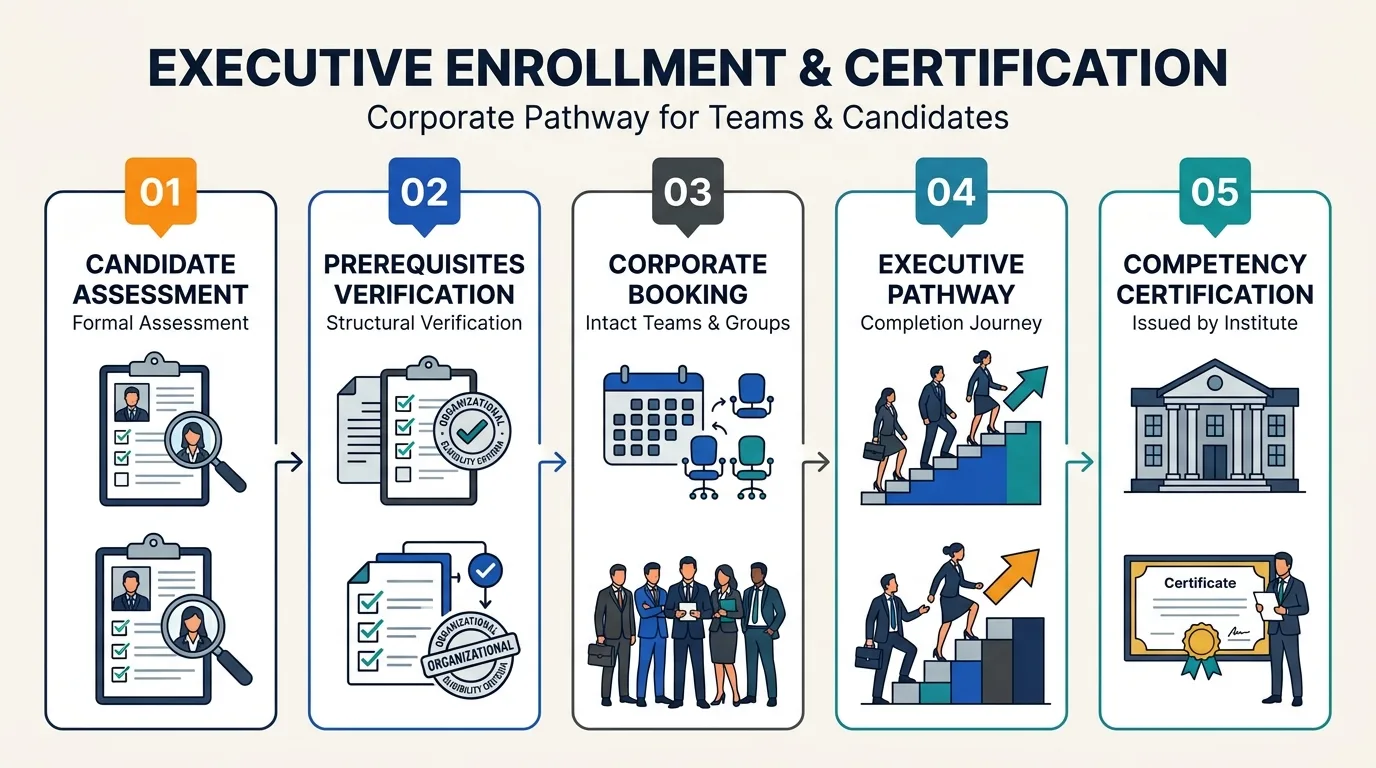
Entry Requirements and Prerequisites
Candidates must hold a Bachelor of Science or equivalent degree in engineering, geoscience, finance, economics, or business administration. A basic understanding of upstream oil and gas operations and practical experience with spreadsheet applications (such as Microsoft Excel) are strictly required. Previous exposure to decline curve analysis or corporate budgeting cycles is helpful but not mandatory for technical entry.
Corporate & Individual Registration Process
Application Submission: Candidates or corporate HR representatives submit a formal application detailing technical background and learning objectives.
Prerequisite Assessment: The technical advisory panel at the Institute For Oil & Gas Training reviews the applicant's background to ensure appropriate course placement.
Customisation & Data Integration (Corporate Bookings): For enterprise bookings, instructors coordinate with asset leads to incorporate company-specific data templates and operational guidelines.
Course Execution: Delegates complete the practical training modules across the chosen delivery format (classroom, virtual, or hybrid).
Assessment & Certification: Participants complete practical assessments and the comprehensive capstone forecasting project to earn their official certificate.
Organizations seeking to upgrade technical capabilities, reduce budget variance, and align asset team workflows can apply for course access today.
Frequently Asked Questions
What does oil and gas petroleum financial analysis involve?
Oil and gas petroleum financial analysis evaluates the economic viability, fiscal terms, and capital expenditure of upstream, midstream, and downstream energy projects. It integrates technical production profiles with financial modeling, cash flow forecasting, and sensitivity analysis to guide investment decisions. Through specialized corporate instruction, Institute For Oil & Gas Training prepares professionals to conduct rigorous Oil and Gas Petroleum Financial Analysis for strategic portfolio management.
Why is specialized financial analysis critical for petroleum projects?
Petroleum investments involve high capital intensity, long project lifecycles, volatile commodity pricing, and complex fiscal regimes such as production sharing contracts and royalty agreements. Standard financial models often fail to account for technical field decline rates, decommissioning liabilities, and geological risk profiles. Applying tailored Oil and Gas Petroleum Financial Analysis methodologies developed by Institute For Oil & Gas Training ensures accurate break-even calculations, risk-adjusted valuation, and reliable capital allocation.
Who should undertake oil and gas financial analysis training?
This discipline is essential for finance managers, corporate planners, investment bankers, commercial analysts, and petroleum engineers involved in upstream asset valuation. Cross-functional teams require a shared understanding of fiscal terms, net present value calculation, and economic limit determination to assess field economics accurately. Programs delivered by Institute For Oil & Gas Training help multidisciplinary teams master Oil and Gas Petroleum Financial Analysis concepts to streamline corporate budgeting and governance workflows.
How does fiscal regime structure impact petroleum asset evaluation?
Fiscal regime structures—such as concessionary systems, service contracts, and production sharing agreements—determine how revenues, costs, and profits are split between operators and host governments. Analysts must account for cost recovery limits, profit oil splits, and local tax obligations to model net cash flows accurately. Institute For Oil & Gas Training incorporates international fiscal system modeling into its Oil and Gas Petroleum Financial Analysis curriculum to prepare professionals for global asset evaluations.
What are the key metrics used in petroleum financial modeling?
Key evaluation metrics include Net Present Value (NPV), Internal Rate of Return (IRR), Payback Period, Expected Monetary Value (EMV), and Finding and Development (F&D) costs. These metrics allow analysts to compare competing capital projects under varying oil price scenarios and operational discount rates. Learning how to standardize these indicators through Oil and Gas Petroleum Financial Analysis courses at Institute For Oil & Gas Training enables organizations to maintain audit-ready financial projections.
Related training courses
Produced Water Treatment and Reuse Training Course
- Specialisation
- Oil & Gas Water Treatment and Management
- Duration
- 5 days · 15 CPD hours
Root Cause Failure Analysis (RCFA) Training Course
- Specialisation
- Oil & Gas Reliability and Maintenance Management
- Duration
- 5 days · 15 CPD hours
Process Safety Risk Assessment Training Course
- Specialisation
- Oil & Gas Process Safety Management
- Duration
- 5 days · 15 CPD hours
More articles

Cost per Barrel KPI Design Training for Petroleum Operations Professionals
Evaluate the KPI Design for Petroleum Operations Cost per Barrel Training Course. Review modules, outcomes, and enrolment details.
Read article →
How to Measure and Evaluate Cost per Barrel to Improve Oil and Gas Operational Efficiency
Learn how to measure and evaluate cost per barrel in petroleum operations to optimize operating costs, uptime, and financial KPI accuracy.
Read article →
Why Cost per Barrel Is a Critical KPI for Petroleum Operations
Learn how Cost per Barrel impacts upstream profitability, operational efficiency, capital allocation, and workforce training in oil and gas.
Read article →