

Operating efficiency in upstream and midstream petroleum operations depends on clear financial visibility into extraction costs. Measuring cost per barrel provides operators with a direct assessment of resource utilisation, equipment productivity, and expenditure management across complex production facilities.
To build a strong foundational understanding of this metric, baseline concepts are detailed in Why Cost per Barrel Is a Critical KPI for Petroleum Operations [http://example.com/tofu-article], which explores how unit economics influence overall asset performance. Translating raw operational expenditure into an actionable cost per barrel metric requires systematic measurement frameworks, clear cost allocation models, and continuous performance tracking.
What is Cost per Barrel in Petroleum Operations?
Cost per barrel is the financial metric calculating total operational expenditure incurred to produce a single barrel of oil equivalent. It combines fixed facility overhead, variable extraction costs, and maintenance expenses divided by total net volume produced over a specific period.
Accurate calculation requires precise boundaries between capital expenditure and operational costs. Operating cost per barrel reflects direct operational outlay, including energy consumption, chemical treatment, labor, and routine maintenance. Lifting cost represents the immediate expense required to bring fluids from the reservoir to the surface and through primary treatment.
Beyond immediate extraction costs, operators evaluate broader financial metrics to assess long-term operational viability:
Finding and Development Cost: Quantifies capital efficiency in acquiring, drilling, and equipping reserves prior to initial production.
Capital Efficiency Ratio: Measures revenue generated per unit of capital invested across exploration and field development phases.
Reserve Replacement Ratio: Tracks whether annual production volumes are offset by newly proven reserves, indicating long-term operational sustainability.
Understanding these distinctions ensures that production engineering teams and financial controllers evaluate performance using standardised cost accounting boundaries.
How Do Operators Calculate and Benchmark Cost per Barrel?
Operators calculate cost per barrel by standardising field-level operational expenses against verified production volumes, using automated accounting systems to track cost drivers across individual wells, artificial lift systems, process trains, and offsite processing infrastructure continuously.
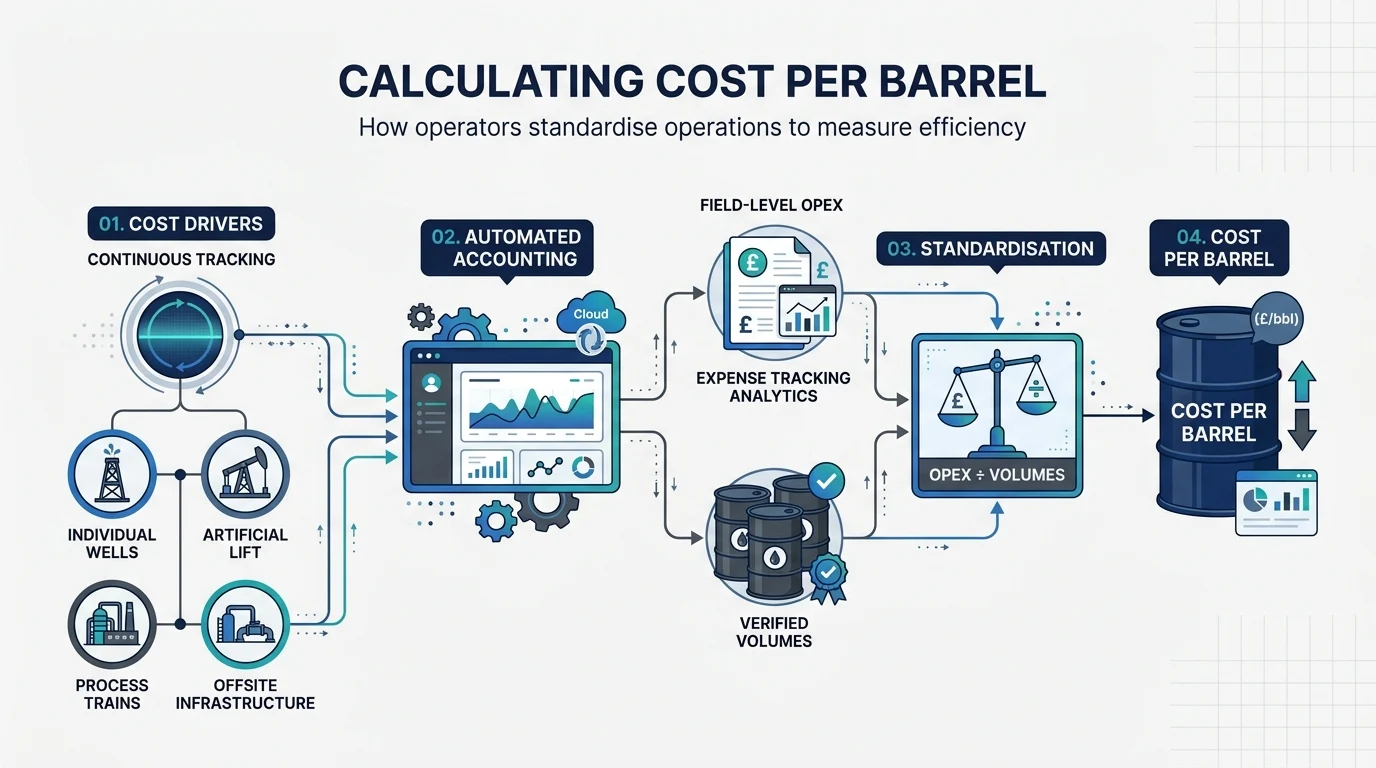
Establishing robust benchmark comparison processes allows operational leaders to evaluate field performance against regional peer groups and global operational standards. Effective evaluation requires tracking financial performance alongside physical asset performance metrics, such as production uptime and availability. High production uptime spreads fixed facility overhead across larger production volumes, immediately lowering the unit cost per barrel.
Financial workflows directly influence operational reporting accuracy. Commercial metrics like days sales outstanding affect cash flow availability for maintenance campaigns, while cash call turnaround times in joint venture operating agreements dictate how quickly capital is deployed for critical field optimisations.
Field managers who align financial accounting routines with operational maintenance schedules identify cost anomalies early, preventing minor inefficiencies from inflating unit production costs.
Metric Type | Key Performance Indicator | Operational Focus Area | Primary Efficiency Impact |
Direct Production | Operating cost per barrel | Variable field expenditure | Reduces immediate fluid handling and energy costs |
Asset Reliability | Production uptime and availability | Facility throughput and runtime | Minimises fixed cost per unit by maximising volume |
Capital Tracking | Finding and development cost | Asset lifecycle investment | Ensures long-term economic return on drilling capital |
Cash Management | Cash call turnaround | Joint venture partner funding | Prevents delays in field maintenance and upgrade projects |
How Do Technical Workforce Skill Gaps Impact Cost per Barrel Evaluation?
Workforce skill gaps create significant measurement errors, misallocated operational expenses, delayed maintenance interventions, and inaccurate performance tracking, directly inflating operating cost per barrel across complex petroleum operating assets.
Modern oil and gas facilities generate massive volumes of operational data through SCADA networks, automated well testing, and enterprise resource planning software. However, technical teams often lack the cross-functional expertise required to interpret complex financial data alongside real-time production metrics. When petroleum engineers do not fully grasp operational cost accounting, or when finance teams lack technical asset context, cost allocation errors frequently occur.
Skill gaps affect field operational efficiency through several recurring breakdown points:
Misclassification of Expenditure: Maintenance teams may log routine operational repairs as capital projects, distorting true lifting cost metrics and delaying operational reviews.
Inability to Identify Cost Drivers: Production operators may fail to correlate high artificial lift energy usage with rising unit costs, missing immediate optimization opportunities.
Delayed Financial Reporting: Slow processing of field tickets and contractor invoices extends cash call turnaround times, obscuring real-time unit cost visibility.
Siloed Performance Management: Operations and finance departments track conflicting metrics, resulting in misaligned operational priorities during maintenance turnarounds.
Addressing these technical competency gaps requires structured workplace capability development. HR teams and operations executives must implement targeted training frameworks that bridge the gap between engineering routines and financial performance management.
What Are the Primary Approaches to Building KPI Evaluation Competencies?
Organizations build KPI evaluation competencies through four primary approaches: internal self-directed learning, generic commercial finance courses, vendor-led software training, and specialised industry-specific corporate training programs tailored to oil and gas operations.
Selecting the correct learning methodology depends on an organization's structural complexity, technical maturity, and performance objectives. HR leaders and technical executives must evaluate how different delivery models impact employee capability and operational performance.
1. Internal Self-Directed Learning
Organizations rely on internal standard operating procedures, documentation, and senior staff mentoring. While cost-effective initially, this approach frequently perpetuates outdated practices and lacks standardized assessment benchmarks across different asset teams.
2. Generic Commercial Finance Courses
Off-the-shelf finance training provides foundational accounting knowledge, covering balance sheets and general cash flow principles. However, these programs lack petroleum context, failing to address specific sector challenges such as joint operating agreements, lifting costs, or production uptime variables.
3. Vendor-Led Software Training
Software vendors offer system-specific training focused on navigating enterprise resource planning tools or field accounting interface software. While helpful for software execution, these technical courses teach system mechanics rather than strategic operational cost analysis or performance evaluation methodology.
4. Specialized Industry Corporate Training
Customized corporate development delivers deep integration of petroleum engineering reality with financial KPI design. Teams learn using real field data, operational scenarios, and production workflows, ensuring immediate operational capability transfer back to asset operations.
Understanding these options enables learning managers to select frameworks that directly improve operational metrics and workforce productivity.
How Do Training Approaches Compare for Petroleum Operations Teams?
Structured evaluation demonstrates that specialized industry corporate training delivers superior operational alignment, faster time-to-competency, and higher ROI compared to generic financial courses or unguided internal mentoring programs.
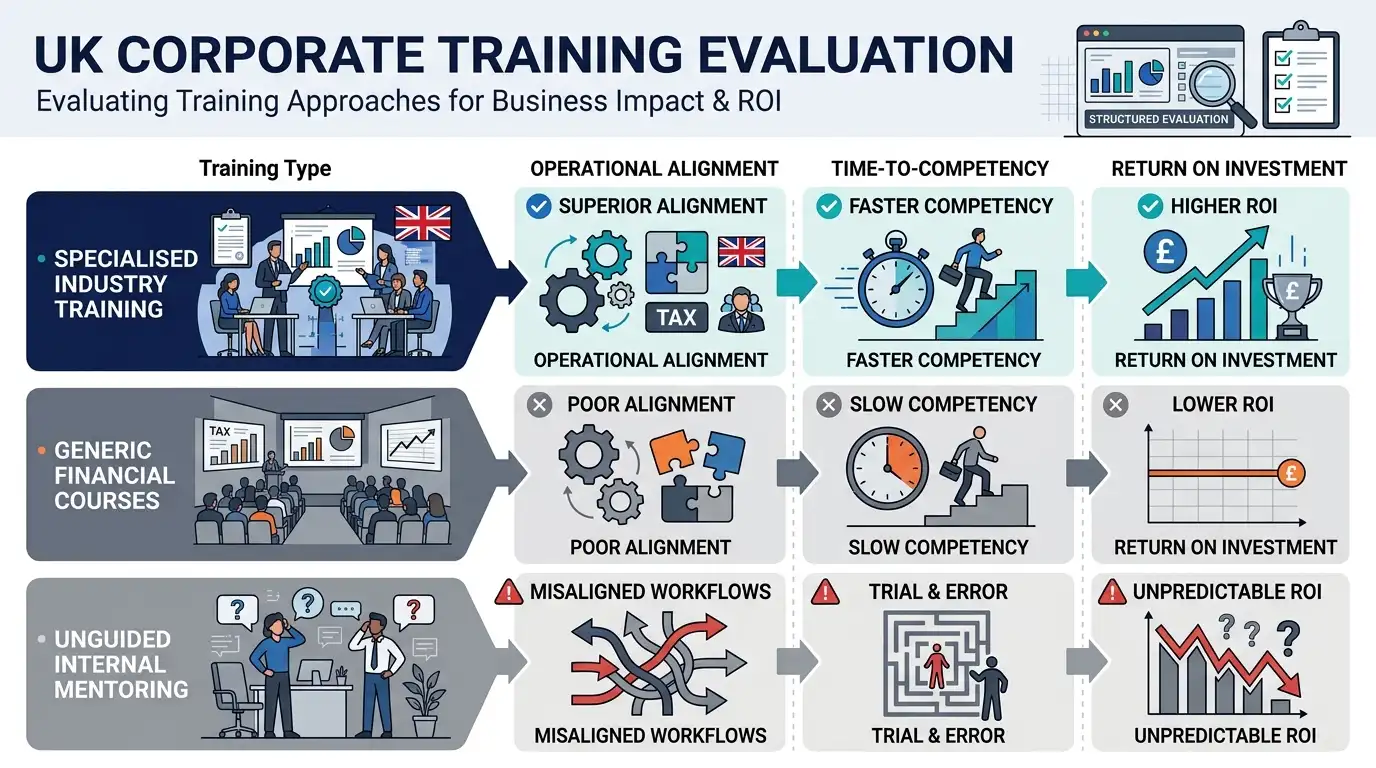
To determine the most effective approach for upskilling engineering, operations, and finance personnel, organizations must compare learning approaches across critical delivery attributes:
Evaluation Attribute | Internal Self-Directed Learning | Generic Commercial Finance | Vendor Software Training | Specialized Industry Training |
Industry Relevance | High technical context, low formal structure | Low industry context, high general finance | High software focus, low operational strategy | High industry context and operational strategy |
Practical Application | Inconsistent across asset teams | Theoretical application to general business | Functional software execution only | Direct application to field production data |
Time to Competency | Extended (6–12 months) | Moderate (3–6 months) | Short for software, low for strategic execution | Rapid (1–3 months) |
Alignment with KPIs | Variable and non-standardised | Disconnected from petroleum KPIs | Limited to system output reports | Direct alignment with cost per barrel targets |
Scalability for Corporate HR | Low scalability | High scalability | Moderate scalability | High scalability for targeted cohorts |
Selecting an approach that combines rigorous analytical methodology with practical field context ensures that teams master cost evaluation metrics quickly and apply them effectively.
How to Select the Right Training Solution to Optimize Cost per Barrel Management?
Select the right training solution by evaluating program curricula against field operational workflows, verifying industry expertise of instructors, assessing practical data application exercises, and measuring post-training ROI against unit cost targets.
When evaluating capabilities to improve financial tracking and operational productivity, decision-makers must use a structured evaluation model. Investing in tailored development programs, such as Cost per Barrel KPI Design Training for Petroleum Operations Professionals [http://example.com/bofu-article], ensures asset management teams gain actionable skills aligned directly with company efficiency goals.
Organizations should apply this decision framework when choosing learning options for technical teams:
Decision Factor | Low Alignment / Red Flag | High Alignment / Target Standard | Selection Criteria |
Curriculum Focus | General corporate finance rules without energy sector context | Direct integration of upstream OPEX, CAPEX, lifting costs, and uptime metrics | Prioritise industry-specific modules over generic business accounting |
Learning Delivery Model | Pure academic lecture format without practical exercises | Interactive cohort learning using field data, case studies, and practical templates | Require hands-on KPI modeling using operational data scenarios |
Target Audience Integration | Isolated siloes (finance only or engineering only) | Cross-functional cohorts combining operations, maintenance, and finance personnel | Choose programs that bridge technical and financial business units |
Measurable Business Outcome | Completion certificates without performance tracking | Pre- and post-training competency mapping linked to asset KPI improvements | Require measurable skill acquisition tied to operational cost goals |
Implementing an industry-aligned educational intervention addresses workforce skill gaps directly, enabling teams to refine cost control routines, standardize field reports, and optimize cost per barrel across all operating assets.
For organizations seeking to implement these analytical frameworks, the KPI Design for Petroleum Operations: Cost per Barrel Training Course [http://example.com/service-link] provides a structured environment for operations managers, production engineers, and finance leads to master unit cost evaluation and operational efficiency techniques.
Frequently Asked Questions
What is included in the Oil and Gas Petroleum Financial Analysis course by Institute For Oil & Gas Training?
The Oil and Gas Petroleum Financial Analysis program at Institute For Oil & Gas Training covers upstream, midstream, and downstream financial modeling, capital budgeting, and fiscal regimes. Learners acquire practical skills in net present value (NPV) estimation, discounted cash flow (DCF) techniques, joint venture accounting, and production sharing contract (PSC) evaluations. The curriculum also addresses risk sensitivity analysis and capital allocation strategies designed to maximize asset return on investment.
How does Oil and Gas Petroleum Financial Analysis improve operational decision-making?
Comprehensive financial modeling provides executive teams with clear data regarding lifting costs, reserve valuations, and break-even oil prices. By utilizing Oil and Gas Petroleum Financial Analysis methodologies taught by Institute For Oil & Gas Training, managers evaluate operational expenditure (OPEX) and capital expenditure (CAPEX) efficiency before committing capital to exploration or field development projects. This structured evaluation mitigates portfolio risk and optimizes resource deployment across complex energy operations.
Who should attend the Oil and Gas Petroleum Financial Analysis training program?
This professional training is designed for energy finance managers, corporate planners, petroleum economists, joint venture accountants, and commercial leads. Institute For Oil & Gas Training delivers this module to both technical and financial professionals seeking to bridge the gap between field engineering metrics and executive financial performance reporting. It is equally suitable for corporate HR teams looking to upskill workforce cohorts in strategic financial literacy.
What financial metrics are evaluated in petroleum asset performance reviews?
Petroleum financial assessments evaluate key metrics including operating cost per barrel, net asset value (NAV), internal rate of return (IRR), and finding and development (F&D) costs. Through the Oil and Gas Petroleum Financial Analysis framework delivered by Institute For Oil & Gas Training, practitioners analyze cash call turnarounds, reserve replacement ratios, and cash flow forecasting models under volatile commodity price scenarios.
Why is specialized petroleum financial modeling preferred over generic corporate finance tools?
Generic corporate finance tools fail to account for unique energy sector variables such as depletion allowances, decommissioning provisions, fiscal terms, and complex joint operating agreements. Institute For Oil & Gas Training structures the Oil and Gas Petroleum Financial Analysis program to address these specific production accounting frameworks, enabling participants to build precise capital models that accurately reflect real-world petroleum economics.
Related training courses
Welding Inspection and Quality Control Training Course
- Specialisation
- Oil & Gas Welding Inspection and Metallurgy
- Duration
- 5 days · 15 CPD hours
Process Safety Risk Assessment Training Course
- Specialisation
- Oil & Gas Process Safety Management
- Duration
- 5 days · 15 CPD hours
Amine Treatment Process and Operation Training Course
- Specialisation
- Oil & Gas Process Engineering and Operations
- Duration
- 5 days · 15 CPD hours
More articles

Cost per Barrel KPI Design Training for Petroleum Operations Professionals
Evaluate the KPI Design for Petroleum Operations Cost per Barrel Training Course. Review modules, outcomes, and enrolment details.
Read article →
Why Cost per Barrel Is a Critical KPI for Petroleum Operations
Learn how Cost per Barrel impacts upstream profitability, operational efficiency, capital allocation, and workforce training in oil and gas.
Read article →
KPI Design for Petroleum Operations Fundamentals Training for Oil and Gas Professionals
Master key performance indicator design for oil and gas operations. Learn curriculum, outcomes, and enrollment details for professional workforce training.
Read article →