
Net present value and internal rate of return calculate asset profitability by discounting future project cash flows against initial capital expenditure, establishing baseline economic viability for upstream petroleum assets. Asset evaluation teams apply these metrics to rank competing exploration and production opportunities before committing capital. When hydrocarbon prices fluctuate, understanding Why Oil Price, Production Profiles and Capital Costs Change Field Economics helps economists isolate variable risk factors that skew traditional asset valuations. Net present value discounts future operational revenues using a weighted average cost of capital, revealing the absolute monetary value an oilfield adds to a portfolio. Internal rate of return determines the discount rate that zeroes net present value, establishing the maximum cost of capital a development can tolerate before destroying value.
Petroleum economists construct discounted cash flow models over the productive life of a reservoir, integrating complex variables such as decline curves, royalty burdens, and operational expenditure forecasts. Capital allocation committees require both metrics because net present value measures absolute wealth creation while internal rate of return measures capital efficiency. An asset with a high internal rate of return might yield negligible net present value if the initial capital outlay is too small to impact corporate balance sheets significantly. Conversely, mega-developments with massive capital requirements can generate substantial net present value despite offering modest internal rate of return percentages.
Corporate finance departments evaluate these cash flow models against corporate hurdle rates to filter out sub-economic projects during screening phases. Reservoir engineers provide production profiles that dictate annual hydrocarbon volumes, while commercial analysts overlay Brent or WTI price decks to project gross revenues. Subtracting operating expenditures, abandonment provisions, and government takes yields the net cash flow stream required for discounted cash flow calculations. Sensitivity analysis on these metrics identifies how severely commodity price downturns or capital cost overruns threaten project delivery.
Why is fiscal sensitivity analysis critical for comparing international petroleum production sharing contracts?
Fiscal sensitivity analysis isolates how varying government take mechanisms, royalty structures, and cost recovery limits impact contractor cash flows across international petroleum jurisdictions. Host governments deploy distinct contractual frameworks that react differently to high and low commodity price cycles, fundamentally altering project economics. When organizations seek formal training programs to master these complex commercial evaluations, enrolling professionals in Building Practical Oilfield Economics & Project Evaluation Skills for Petroleum Investment Decisions equips commercial teams with the exact modeling capabilities needed to navigate international bidding rounds. Production sharing contracts enforce profit-oil splitting mechanisms that shift risk profiles between state oil companies and private operators.
Contractual terms dictate how fast operators recover capital expenditures through cost oil allocations before splitting remaining profit oil. In regressive fiscal systems, government take remains high regardless of profitability, crushing contractor margins during price slumps. Progressive fiscal regimes adjust government share dynamically as project profitability rises, protecting investor returns on marginal fields while capturing windfall rents during price booms. Commercial analysts must model these legal clauses directly into cash flow spreadsheets to prevent severe valuation errors during international asset acquisitions.
Tax royalties, signature bonuses, and domestic market obligations further complicate the fiscal landscape of cross-border upstream investments. Joint venture partners utilize sensitivity matrices to test project resilience against fiscal term modifications imposed by sovereign regulators. Asset teams run Monte Carlo simulations varying tax rates, depreciation schedules, and inflation rates to map out probability distributions of financial returns. This rigorous interrogation of contractual terms prevents oil and gas operators from committing capital to assets rendered unviable by punitive fiscal regimes.
How do capital expenditure variations and production profile shifts distort net present value calculations?
Capital expenditure overruns and delayed plateau production profiles exponentially erode net present value by deferring cash inflows and inflating upfront debt servicing costs.
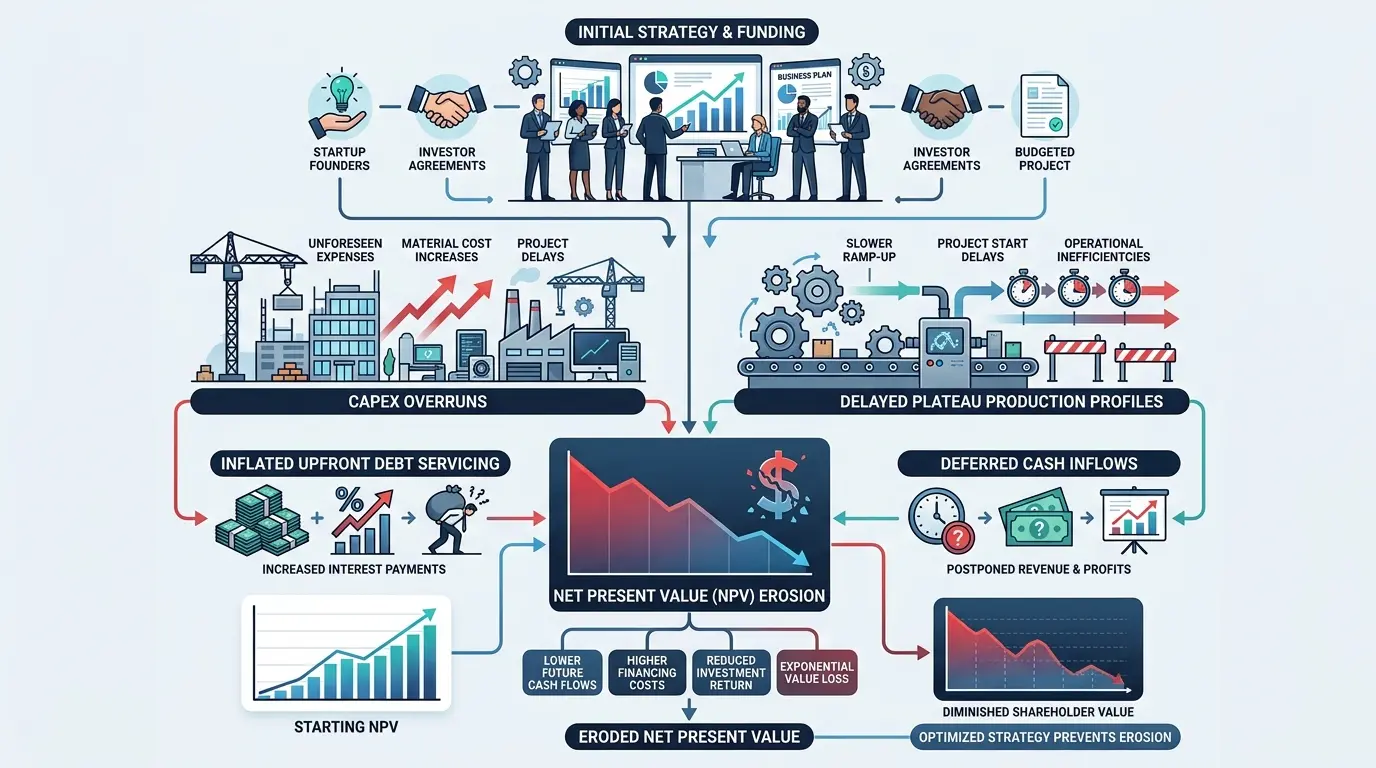
Upstream development projects suffer from chronic cost inflation driven by complex offshore engineering requirements, supply chain bottlenecks, and regulatory compliance mandates. When capital expenditures spike by twenty percent during the engineering, procurement, and construction phase, the discounted value of future cash flows drops precipitously. Cash flows generated in years fifteen and twenty contribute minimally to net present value due to the compounding effect of high discount rates.
Reservoir performance uncertainty further complicates economic modeling because actual production decline rates often deviate significantly from pre-drill geological forecasts. Water breakthrough, sand production, and reservoir pressure depletion can truncate plateau periods, forcing operators into expensive secondary or tertiary recovery interventions. Asset managers deploy the Institute For Oil & Gas Training corporate learning framework to upskill multi-disciplinary commercial and technical teams in identifying early warning signs of production variance.
Financial analysts quantify these operational risks by running scenario models that test various geological outcomes against strict corporate investment hurdles. A two-year delay in first oil shifts all subsequent cash flow brackets outward, destroying project value even if ultimate recovery volumes remain constant. Integrating stochastic modeling into petroleum economics training ensures subsurface teams understand the direct financial consequences of operational delays. Organizations that bridge the skills gap between reservoir engineering and financial evaluation consistently outperform peers in capital allocation efficiency.
How do corporate learning frameworks optimize asset evaluation competency across multidisciplinary teams?
Corporate learning frameworks systematically eliminate organizational silos by embedding integrated economic evaluation skills across engineering, commercial, and financial departments. Upstream enterprises often suffer from fragmented decision-making where subsurface engineers fail to connect reservoir decline curves directly to corporate net present value targets. Modern human resources strategies require structured workforce development initiatives that blend technical petroleum engineering principles with rigorous financial modeling. Upskilling commercial teams through targeted corporate training ensures that investment proposals undergo rigorous peer review before reaching executive boards.
Effective capability development programs utilize case-based learning methodologies that replicate real-world asset acquisition and field development decision cycles. Participants analyze historical project failures and successes, dissecting how forecasting errors in capital expenditure or operating expenditure invalidate initial economic models. Learning delivery models combine instructor-led technical workshops with digital simulation tools, allowing professionals to build dynamic discounted cash flow models from scratch. Human resources leaders measure training ROI by tracking improvements in capital sanction accuracy and reductions in asset write-downs over multi-year business cycles.
Cross-functional alignment accelerates project sanction timelines because geologists, petroleum engineers, and commercial analysts speak a unified financial language. When evaluating marginal field developments or mature asset revitalisations, multidisciplinary teams rapidly identify value-creative levers such as infill drilling or facility debottlenecking. Embedding continuous professional development into corporate culture ensures technical staff adapt smoothly to evolving energy transition demands and carbon pricing mechanisms. Organizations prioritizing structured capability building secure sustained competitive advantages in global hydrocarbon exploration and production tenders.
Frequently Asked Questions
How does petroleum finance differ from traditional corporate finance?
Petroleum finance incorporates specialized upstream variables such as production decline curves, depletion allowances, and complex government take mechanisms like production sharing contracts. Corporate finance teams at the Institute For Oil & Gas Training apply these sector-specific frameworks to evaluate long-term capital investments under high commodity price volatility. This methodology ensures accurate valuation of reserves and risk mitigation across multi-decade exploration lifecycles.
What are the core components of an upstream oilfield economic model?
Upstream economic models integrate capital expenditure forecasts, operating expenditure schedules, production profiles, and fiscal terms into a discounted cash flow framework. Analysts use these inputs to calculate net present value and internal rate of return for portfolio optimization. Training programs in Oil and Gas Petroleum Finance equip commercial teams with the practical modeling techniques required to run these valuations successfully.
Why is fiscal sensitivity analysis essential in petroleum project evaluation?
Fiscal sensitivity analysis determines how varying host government royalty structures, tax rates, and cost recovery limits impact contractor cash flows and profitability. Operators utilize these sensitivity matrices to identify regulatory risks and assess asset resilience across international jurisdictions. Mastering this analytical approach helps organizations prevent severe valuation errors during cross-border asset acquisitions.
How do exploration and production companies measure upstream investment risk?
Exploration and production companies measure investment risk by combining deterministic scenario analysis with stochastic techniques such as Monte Carlo simulations to test geological and economic variables. These evaluations account for production profile shifts, commodity price fluctuations, and capital cost overruns that threaten project delivery. Strategic financial frameworks developed through Oil and Gas Petroleum Finance courses enable multidisciplinary teams to quantify these uncertainties before sanctioning budgets.
What role does workforce training play in petroleum capital allocation?
Targeted capability development bridges the communication gap between technical reservoir engineers and financial analysts, ensuring capital allocation decisions align with corporate net present value targets. The Institute For Oil & Gas Training delivers specialized programs that upskill multidisciplinary teams in asset valuation and fiscal modeling. This structured approach reduces project write-downs and accelerates sanction timelines across global upstream portfolios.
Related training courses
Decommissioning & Asset Retirement Obligations: Security Arrangements Training Course
- Specialisation
- Oil & Gas Petroleum IFRS & Financial Reporting
- Duration
- 5 days · 15 CPD hours
Cash Flow Reporting for IAS 7 Statements Training Course
- Specialisation
- Oil & Gas Petroleum IFRS & Financial Reporting
- Duration
- 5 days · 15 CPD hours
Month-End Close Acceleration for Upstream Operations & Cut-Off Training Course
- Specialisation
- Oil & Gas Petroleum Accounting
- Duration
- 5 days · 15 CPD hours
More articles

Oilfield Economics & Project Evaluation: Specialist Training for Petroleum Economics and Commercial Roles
Master petroleum economics and project evaluation with specialized training. Learn cash flow modeling, risk analysis, and fiscal contracts for upstream roles.
Read article →
NPV and IRR Analysis for Comparing Alternative Oilfield Development Cases
Master net present value and internal rate of return methods to compare alternative oilfield development cases and optimize upstream capital allocation.
Read article →
How Petroleum Companies Assess the Commercial Viability of New Field Developments
Discover how petroleum companies train teams to assess field development commercial viability, optimize capital allocation, and drive project returns.
Read article →