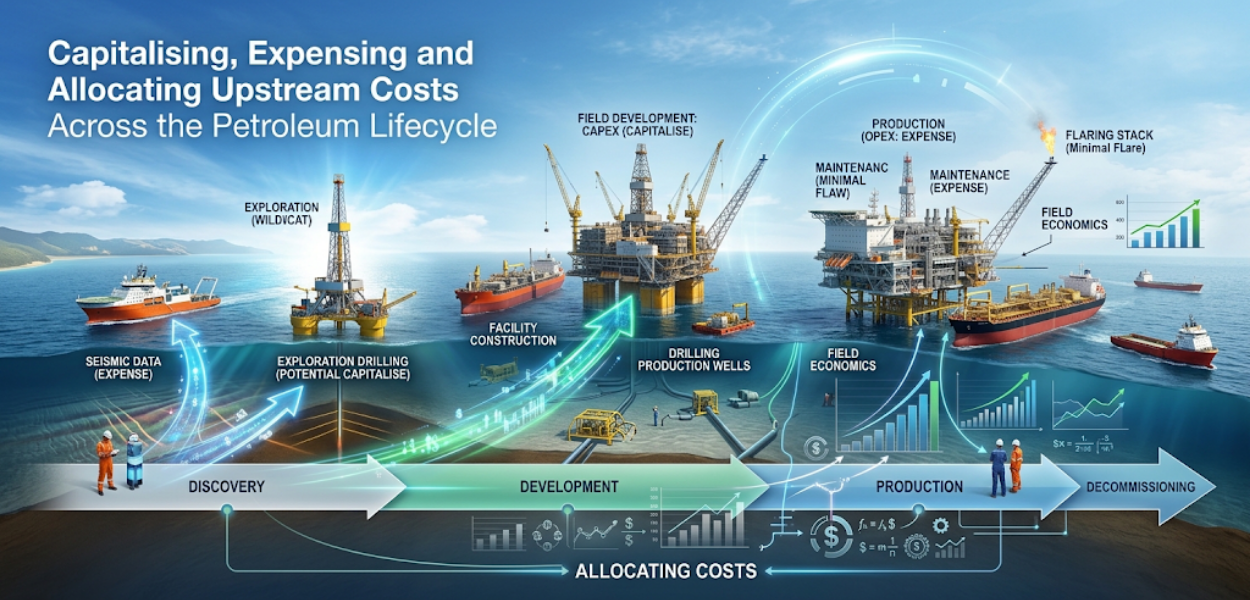
Upstream petroleum accounting requires organisations to determine how exploration, appraisal, development and production costs are classified, measured and allocated across the asset lifecycle. The distinction between capitalised and expensed costs affects asset values, earnings, depletion, depreciation and amortisation, impairment assessments and field-level performance reporting.
Understanding why upstream cost classification matters when assessing field performance helps finance teams connect accounting treatment with operational outcomes. Cost classification is not simply a bookkeeping exercise. It establishes how expenditure moves through financial statements and how managers interpret the economic performance of wells, fields and development projects.
How should upstream costs be classified across the petroleum lifecycle?
Upstream costs are classified according to the activity that creates, evaluates, develops or operates an oil and gas asset, with capital expenditure generally creating or enhancing future economic benefits and operating expenditure supporting current-period activities.
The petroleum lifecycle begins with exploration and progresses through appraisal, development, production and eventual abandonment or decommissioning. Each stage generates different types of expenditure.
Exploration costs include geological studies, seismic surveys, acreage evaluation, exploratory drilling and related technical activities. Appraisal expenditure focuses on determining the size, quality and commercial potential of a discovery. Development expenditure relates to preparing a commercially viable field for production.
Production costs arise after an asset enters operation. They include activities required to extract, process and maintain production. Abandonment and decommissioning expenditure relates to the retirement of facilities and restoration obligations.
The accounting treatment depends on the applicable accounting framework and the organisation's established capitalisation policy. A cost is not automatically capitalised simply because it relates to an oil and gas project. The accounting team evaluates the nature, purpose and expected economic benefit of the expenditure.
This distinction becomes important when several activities occur simultaneously. A field development programme can contain capital expenditure for new infrastructure, operating expenditure for existing production and exploration or appraisal expenditure for additional reserves.
Accurate classification therefore requires finance teams to connect invoices, purchase orders, work orders and project codes with the underlying petroleum activity.
What determines whether an upstream cost is capitalised or expensed?
Capitalisation normally applies when expenditure relates to an asset or activity that meets the applicable recognition criteria, while expenditure that relates to current operations, unsuccessful activities or non-qualifying costs is recognised as an expense under the relevant accounting framework.
A capitalisation policy establishes the organisation's rules for identifying costs that enter the asset base. The policy normally defines qualifying expenditure, asset boundaries, cost components, depreciation or depletion treatment and supporting documentation.
Capitalised costs affect the balance sheet initially. They are subsequently recognised through depletion, depreciation and amortisation, impairment or disposal depending on the asset and accounting requirements.
Expensed costs affect the income statement in the period in which they are recognised. This creates an important timing difference between expenditure and profit recognition.
Exploration provides one of the more complex examples. Under a successful-efforts approach, certain unsuccessful exploration activities can result in immediate recognition of expensed exploration costs, while qualifying costs associated with successful discoveries and development activities are capitalised.
The accounting treatment therefore changes the timing of reported expenditure without changing the underlying cash movement. A finance manager reviewing field performance needs to understand this distinction before interpreting cost trends.
A rise in reported expenses does not automatically indicate deterioration in operational efficiency. It can reflect exploration activity, unsuccessful drilling or changes in accounting treatment.
How are exploration and dry hole costs treated?
Exploration and dry hole accounting requires organisations to distinguish successful discoveries from unsuccessful activities, apply the selected accounting framework consistently and determine whether expenditure remains recoverable or requires recognition in profit or loss.
A dry hole is an exploratory or development well that does not encounter commercially producible quantities of hydrocarbons. Its accounting treatment depends on the accounting method and the circumstances surrounding the expenditure.
Under successful-efforts accounting, the cost of an unsuccessful exploratory well is generally recognised as an expense when the well is determined to be unsuccessful. Successful wells and qualifying development expenditure remain within the asset base.
This creates a direct relationship between drilling outcomes and reported financial performance.
A company drilling several exploration wells can therefore record significant expenditure before commercial reserves are established. Some expenditure becomes part of the asset base, while unsuccessful activities can be charged against current earnings.
The distinction also affects management reporting. Finance teams need to separate geological and exploration risk from production performance when presenting field results to senior management.
Dry hole accounting should therefore be supported by clear well status records, technical conclusions and accounting documentation. Finance professionals working with petroleum assets need enough operational understanding to interpret the accounting consequences of drilling results accurately.
How does cost allocation work across upstream projects and fields?
Upstream cost allocation assigns expenditure to the appropriate field, well, project, asset or operational activity so that financial reporting reflects where resources are consumed, and performance can be assessed against budgets, production and development objectives.
Cost allocation becomes increasingly important when organisations operate several assets simultaneously. Shared geological studies, engineering services, drilling resources, facilities and corporate functions can support more than one project.
A cost centre pooling approach groups expenditure according to defined organisational or operational structures. The allocation basis then determines how shared costs are distributed.
Direct costs are normally easier to assign. A drilling invoice connected to a specific well can be coded directly to that well. Shared engineering support requires an allocation methodology.
Possible allocation drivers include engineering hours, equipment usage, headcount, production volumes, project expenditure or documented service consumption. The selected basis needs to reflect the underlying economic relationship.
Poor allocation creates distorted field economics. One asset can appear more expensive than another simply because shared costs were assigned inconsistently.
For management reporting, allocation should therefore be transparent and repeatable. Finance teams need to maintain clear relationships between the source transaction, cost centre, project code and final asset or field classification.
This is particularly relevant for organisations using integrated enterprise resource planning systems. The accounting structure should support operational reporting rather than create a separate financial view that managers cannot reconcile with field activity.
How do capitalised costs affect depletion, depreciation and amortisation?
Capitalised upstream expenditure is subsequently recognised through depletion, depreciation and amortisation based on the nature of the asset and applicable accounting requirements, connecting historical investment with the financial cost of producing future petroleum output.
Depletion, depreciation and amortisation translate capitalised asset values into periodic expense.
Depletion commonly applies to mineral interests and producing petroleum reserves. The calculation reflects the consumption of the economic resource as hydrocarbons are produced.
Depreciation applies to tangible infrastructure such as production facilities, processing equipment and other qualifying property. Amortisation applies to certain intangible assets.
The timing and measurement of these charges influence reported production costs and profitability.
A field with substantial development investment can carry significant capitalised assets before production reaches its expected level. As production begins, the asset base is progressively consumed through applicable depreciation or depletion methods.
This creates a connection between capital expenditure decisions and future income statement charges.
For management teams, the implication is important. Current-period profit cannot always be assessed independently from previous investment decisions. High capital expenditure today can establish the asset base that generates future production, while inadequate investment can affect future capacity and operating performance.
Finance professionals therefore need to understand both the initial capitalisation decision and the subsequent consumption of the asset.
How do impairment and ceiling tests affect capitalised upstream assets?
Impairment and ceiling tests evaluate whether recognised upstream asset values remain supportable under the applicable accounting framework, using information about reserves, production, prices, costs and expected economic benefits.
The impairment of oil and gas assets becomes relevant when indicators show that the carrying amount of an asset or asset group is no longer recoverable.
Changes in commodity prices, reserve estimates, production profiles, development plans and operating costs can affect asset recoverability.
The ceiling test is associated with specific accounting requirements and evaluates whether capitalised costs exceed an applicable ceiling based on recognised measures of future economic benefits.
These tests demonstrate why upstream accounting cannot operate independently from petroleum engineering and commercial analysis.
Reserve estimates influence expected production. Production influences future cash generation. Commodity prices influence revenue expectations. Operating costs influence project economics. Accounting teams therefore depend on reliable technical and commercial inputs when evaluating asset values.
An impairment or ceiling-test adjustment can materially affect reported earnings and asset values. The accounting result should therefore be interpreted alongside the operational event that generated it.
For workforce planning, this creates a skill requirement. Finance professionals need sufficient petroleum knowledge to question unusual movements, understand technical assumptions and communicate financial effects to asset managers.
Which upstream costs require the closest accounting judgement?
The highest judgement areas typically involve exploration expenditure, unsuccessful wells, shared project costs, asset boundaries, development expenditure, recoverability assessments and the transition between exploration, development and production activities.
Exploration is difficult because technical results evolve as information becomes available. A seismic programme can identify a prospect without establishing commercial viability. A well can produce geological information while failing to establish commercial reserves.
Development expenditure also requires careful classification. Infrastructure that creates future production capacity has a different economic role from routine maintenance performed on an existing facility.
Shared expenditure creates another judgement area. A common processing facility can support multiple fields, requiring a consistent basis for assigning costs to the assets benefiting from the facility.
Asset boundaries also matter. A field can contain wells, pipelines, processing facilities and support infrastructure with different useful lives and accounting treatments.
Finally, recoverability assessments require coordination between finance, reservoir engineering, production, commercial and management teams.
These decisions are strongest when the organisation has documented accounting policies, clear approval procedures and defined responsibilities across departments.
How should organisations evaluate upstream cost allocation methods?
An effective allocation method should be traceable, economically relevant, consistently applied and capable of producing financial information that managers can reconcile with operational activity, budgets, production data and project objectives.
The first evaluation criterion is traceability. Every allocated cost should have a documented source and allocation basis.
The second is relevance. The allocation driver should represent the relationship between the expenditure and the assets receiving the cost.
Consistency is equally important. Changing allocation methods without a documented reason can make year-on-year field comparisons difficult.
Reconciliation is another practical test. Finance reports should reconcile with project budgets, procurement records, production systems and asset registers.
Finally, the method should support management decisions. If cost allocation produces numbers that cannot be connected to operational activity, its usefulness is limited.
For B2B organisations, these requirements also influence workforce development. HR and learning teams need to identify whether accounting staff understand petroleum operations, financial reporting and cost structures as an integrated system rather than as isolated accounting topics.
A specialist learning programme becomes relevant when internal skill gaps affect classification accuracy, reporting consistency or communication between finance and operational teams. For professionals evaluating structured learning options, Petroleum Industry Accounting Fundamentals training for upstream finance and accounting roles provides a decision-stage pathway for developing knowledge across core petroleum accounting concepts.
What should finance teams learn to manage upstream cost classification effectively?
Finance teams need integrated knowledge of petroleum operations, accounting principles, cost classification, asset valuation, allocation methods and financial reporting so they can translate operational activity into consistent and decision-useful financial information.
Technical accounting knowledge alone does not fully address upstream challenges.
A finance professional working with exploration and production assets needs to understand why expenditure occurs, where it belongs in the petroleum lifecycle and what operational event supports the accounting treatment.
A structured Oil & Gas Petroleum Accounting programme can address this capability by connecting petroleum activities with accounting processes, cost classification and financial reporting.
The learning approach should cover exploration and appraisal expenditure, development costs, production accounting, capitalisation policies, expensed exploration costs, dry hole accounting, asset allocation, depletion, depreciation and amortisation, impairment and relevant testing requirements.
For HR and L&D teams, effectiveness should be measured through observable workplace outcomes. These include improved coding accuracy, fewer classification exceptions, faster reconciliation, stronger communication between finance and technical teams and more consistent application of accounting policies.
Learning delivery can combine instructor-led sessions, practical case exercises, accounting scenarios and organisation-specific examples. The objective is not simply knowledge retention. It is the ability to apply accounting principles to petroleum business situations.
How can organisations connect upstream accounting training with business performance?
Training becomes operationally valuable when learning objectives correspond with actual accounting workflows, reporting responsibilities and performance gaps, allowing organisations to measure whether improved capability strengthens classification, allocation, reporting quality and financial decision-making.
Organisations should begin with a skills-gap assessment.
The assessment can examine recurring accounting adjustments, audit findings, coding errors, reconciliation delays and misunderstandings between finance and technical teams.
Learning objectives can then be aligned with these gaps.
For example, a team experiencing inconsistent exploration-cost treatment requires a stronger understanding of capitalisation and expensing principles. A team struggling with field reporting requires stronger cost allocation and cost centre structures.
Measurement should continue after training. Managers can compare error rates, review-cycle duration, reconciliation exceptions and policy compliance before and after learning interventions.
The same approach applies to individual professionals. A learner can evaluate whether training improves the ability to interpret upstream expenditure, explain accounting treatment and connect financial results with petroleum operations.
This creates a direct relationship between professional development and workplace performance.
What is the practical decision path for upstream cost accounting capability?
The decision should begin with the organisation's accounting framework and current skill gaps, then assess required technical competencies, practical application, delivery method and measurable workplace outcomes before selecting an appropriate professional development approach.
The first step is identifying which parts of the petroleum lifecycle create the greatest accounting challenge.
The second is determining whether the issue concerns policy knowledge, operational understanding, system usage or cross-functional communication.
The third is mapping the gap to required competencies. These can include capitalisation, expensing, cost allocation, asset valuation, impairment, depletion and financial reporting.
The fourth is selecting a learning format that matches the workforce. Instructor-led corporate training supports discussion and case analysis. Online delivery supports distributed teams. Blended learning combines structured instruction with workplace application.
The fifth is defining measurement criteria before training begins.
This approach prevents training decisions from being based solely on course titles. It connects the learning intervention with a specific business requirement.
For upstream finance and accounting teams, the central capability is the ability to classify, allocate and report petroleum costs consistently across the asset lifecycle. That capability supports clearer field reporting, stronger asset analysis and more reliable financial information.
Related training courses
Upstream Cost Classification for Recoverability & JV Chargeability Training Course
- Specialisation
- Oil & Gas Petroleum Accounting
- Duration
- 5 days · 15 CPD hours
Inventory & Materials Accounting: Drilling Consumables & Stock Training Course
- Specialisation
- Oil & Gas Petroleum Accounting
- Duration
- 5 days · 15 CPD hours
Inventory & Materials Accounting for Hydrocarbon Stock Valuation Training Course
- Specialisation
- Oil & Gas Petroleum Accounting
- Duration
- 5 days · 15 CPD hours
More articles

Oilfield Economics & Project Evaluation: Specialist Training for Petroleum Economics and Commercial Roles
Master petroleum economics and project evaluation with specialized training. Learn cash flow modeling, risk analysis, and fiscal contracts for upstream roles.
Read article →
NPV and IRR Analysis for Comparing Alternative Oilfield Development Cases
Master net present value and internal rate of return methods to compare alternative oilfield development cases and optimize upstream capital allocation.
Read article →
How Petroleum Companies Assess the Commercial Viability of New Field Developments
Discover how petroleum companies train teams to assess field development commercial viability, optimize capital allocation, and drive project returns.
Read article →