
Economic attractiveness in petroleum assets is the financial viability of an oilfield project determined by net present value, internal rate of return, and cash flow generation across varying fiscal regimes, commodity price cycles, and operating cost structures.
Organizations evaluate upstream investments through rigorous financial modeling and workforce capability assessments. Corporate decision-makers analyze whether capital expenditure yields positive returns under strict regulatory frameworks. Team leaders across commercial departments examine cost-recovery mechanisms, production-sharing agreements, and concession contracts to determine asset value.
Workforce capability directly influences project economic outcomes. Employees who lack commercial acumen miscalculate capital allocation risks, leading to cost overruns exceeding 30% on major infrastructure projects. Organizations deploy professional training frameworks to equip cross-functional teams with advanced economic evaluation techniques.
Learners acquire practical competencies through methodologies like case-based learning, interactive financial simulations, and structured assessments. Training programs address critical employee skill gaps in asset valuation, risk mitigation, and fiscal terms interpretation.
Enterprise development programs utilize blended delivery formats, combining intensive workshops, asynchronous online modules, and hybrid learning sessions. Organizations targeting workforce transformation implement these structured learning initiatives to accelerate leadership pipelines and enhance operational efficiency.
Teams in sectors such as energy, mining, and heavy infrastructure apply these analytical frameworks to stabilize revenue streams during market volatility. Evaluating complex contract variables requires testing government take and tax structures. Professionals utilize advanced analytical tools during asset appraisal.
Organizations examine these core variables through Fiscal Sensitivity Analysis for Petroleum Projects: Testing Government Take, Tax and Contract Variables to understand how regulatory adjustments impact project cash flows and long-term capital preservation. This evaluation phase marks the transition from broad awareness to deep technical assessment.
How Is Commercial Training Designed and Delivered in Corporate Environments?
Corporate training is delivered through a systematic instructional design process encompassing training needs analysis, curriculum development, multi-modal execution, and measurable performance evaluation tied directly to organizational key performance indicators.
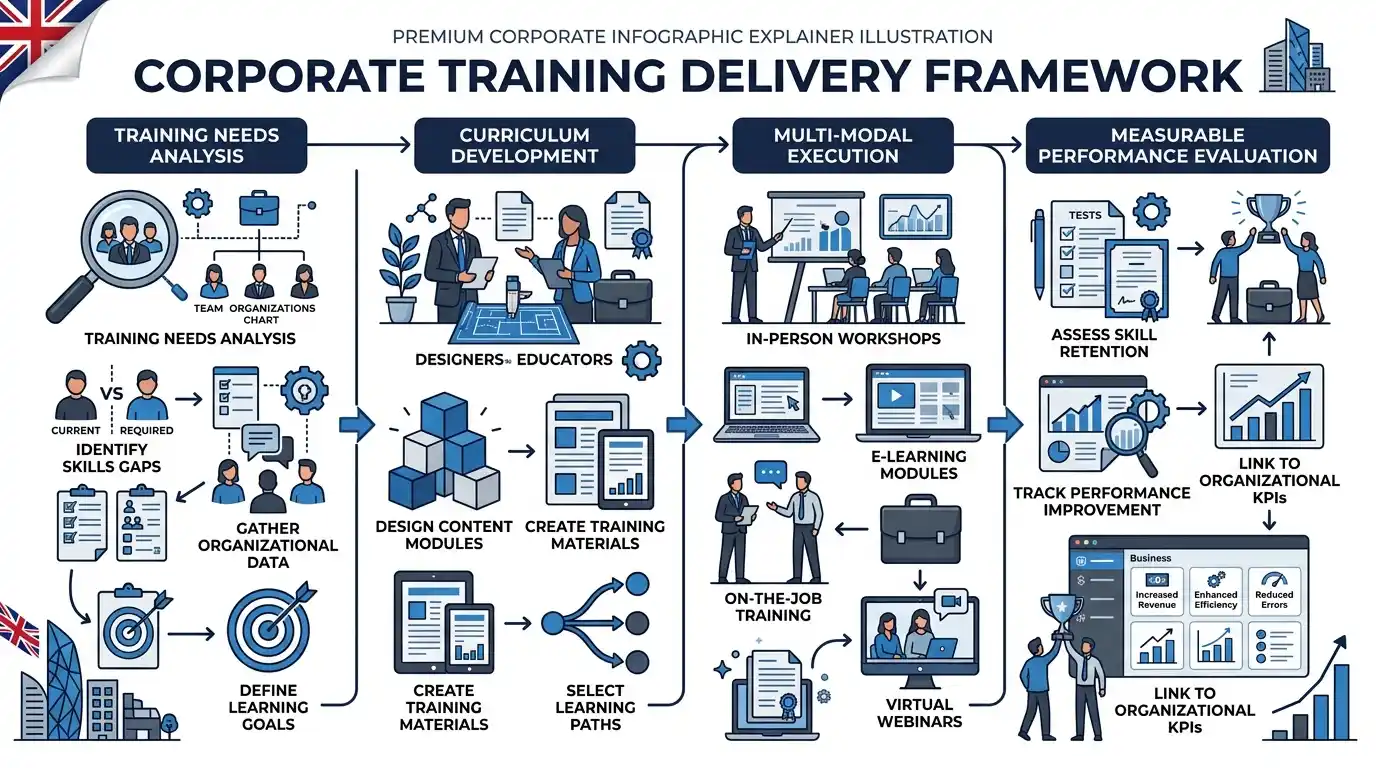
L&D professionals design targeted programs by conducting comprehensive skill gap assessments across technical departments. Organizations establish baseline metrics to measure current workforce competencies against industry standards. Training managers collaborate with subject matter experts to build curriculum tracks focusing on risk management, financial modeling, and strategic negotiation.
Delivery mechanisms adapt to modern workplace constraints. Corporations utilize instructor-led workshops, digital self-paced online modules, and immersive hybrid learning models. Instructional designers incorporate experiential learning tools such as computer-based simulations and real-world case studies to reinforce theoretical concepts.
Workforce development initiatives rely on structured learning methodologies to drive knowledge retention. Teams participate in role-play exercises, collaborative problem-solving sessions, and formative assessments. These methods ensure that employees translate abstract economic principles into daily operational decisions.
Measurable outcomes validate training investments. Organizations track performance improvements through key performance indicators, including a 25% reduction in project appraisal errors, a 20% increase in cross-functional collaboration efficiency, and an 85% employee retention rate among high-potential talent.
Workforce transformation strategies require continuous reinforcement. Structured professional development fosters a culture of excellence, integrity, and innovation within engineering and commercial teams. Businesses align training outcomes with strategic growth objectives to secure competitive advantages in complex global markets.
What Key Components Drive Effective Professional Development Programs?
Effective professional development programs include competency frameworks, practical toolkits, multi-format delivery structures, continuous assessment protocols, and clear alignment with corporate strategic objectives.
Competency frameworks define the baseline knowledge required for specific professional roles. Organizations establish clear milestones for career progression, ensuring that staff members acquire advanced technical and commercial skills systematically. Training content integrates industry-standard software, financial valuation models, and project management toolkits.
Delivery formats maintain operational flexibility. Companies deploy modular workshops lasting 3 to 5 days, intensive executive coaching sessions, and continuous digital learning paths. Instructional strategies emphasize real-world application over passive theory, ensuring that participants solve authentic business challenges during training sessions.
Assessment protocols measure individual and team growth. Organizations utilize pre-training diagnostic evaluations, practical project assignments, and post-training competency checks. These metrics provide objective data regarding skill acquisition and behavioral change in the workplace.
Corporate alignment ensures that learning initiatives produce tangible value. Training programs support strategic initiatives by developing resilient leadership pipelines and fostering cross-departmental collaboration. Institutions focused on professional excellence deliver programs that emphasize practical utility and immediate workplace impact.
Workforce development strategies address specific industry challenges. Teams in sectors such as oil and gas, petrochemicals, and renewable energy utilize specialized training modules to navigate regulatory complexities and fiscal uncertainties. Structured learning builds institutional capability, safeguarding capital investments across volatile economic cycles.
How Do Organizations Implement Strategic Training for Measurable Business Outcomes?
Organizations implement strategic training by securing executive sponsorship, integrating learning management systems, aligning curricula with operational metrics, and evaluating return on investment through systematic performance tracking.
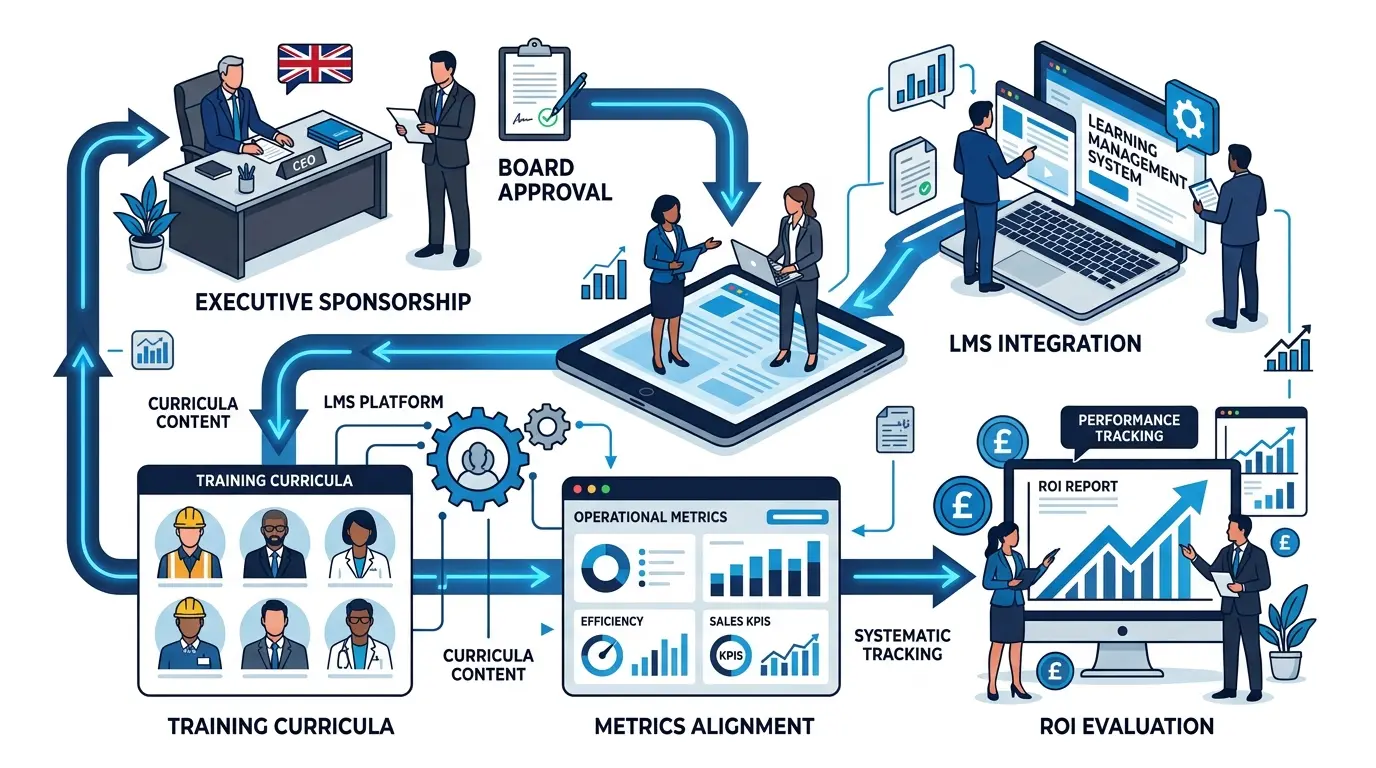
Implementation begins with executive commitment. Business leaders define overarching organizational goals, identifying critical capability gaps that hinder commercial performance. Human resources directors partner with department heads to design customized learning paths for multidisciplinary teams.
Integration of learning infrastructure supports scale. Corporations deploy enterprise learning management systems to track course completion rates, monitor participant engagement, and archive training resources. Automated reporting tools generate analytics regarding workforce progress and skill acquisition velocity.
Performance tracking links learning directly to financial returns. Organizations measure return on investment by analyzing reduced project delivery times, minimized capital allocation errors, and enhanced asset valuation accuracy. Companies report productivity increases exceeding 18% following the deployment of targeted commercial training initiatives.
Continuous improvement sustains program effectiveness. L&D professionals review participant feedback, manager evaluations, and operational performance metrics quarterly. Curriculum updates reflect evolving industry standards, technological advancements, and regulatory modifications.
Successful workforce transformation relies on collaborative execution. Organizations foster environments where continuous learning drives innovation and operational excellence. Structured professional development equips teams with the confidence and competence required to manage complex capital projects successfully.
What Common Problems and Misconceptions Undermine Corporate Training?
Common problems undermining corporate training include reliance on generic course content, absence of measurable return on investment, poor alignment with operational goals, and passive delivery methods that fail to drive behavioral change.
Many organizations invest in off-the-shelf training programs that lack industry-specific context. Generic courses fail to address the complex regulatory, fiscal, and technical realities faced by modern engineering and commercial teams. Employees dismiss theoretical training that offers no direct application to their daily responsibilities.
Another critical issue is the lack of rigorous evaluation metrics. Organizations frequently treat training as an administrative checkbox rather than a strategic investment. When companies fail to measure pre- and post-training performance, calculating return on investment becomes impossible.
Ineffective delivery methods further diminish training value. Relying exclusively on passive lectures leads to low knowledge retention and minimal engagement. Modern workforce development requires active learning methodologies, including simulations, collaborative workshops, and practical problem-solving exercises.
Overcoming these pitfalls requires a strategic shift toward customized, outcome-based education. Organizations must design programs that target specific skill gaps, utilize multi-modal delivery formats, and tie outcomes directly to business performance indicators. Cultivating a rigorous approach to professional development ensures sustainable workforce capability and long-term commercial success.
Frequently Asked Questions
What is Oil and Gas Petroleum Finance?
Oil and gas petroleum finance is a specialized financial discipline focused on managing capital expenditures, asset valuation, risk analysis, and cash flow modeling for upstream, midstream, and downstream energy projects. The Institute For Oil & Gas Training delivers professional training programs that help corporate teams master petroleum fiscal regimes, capital allocation, and project economic evaluations. This expertise enables organizations to navigate commodity price volatility and secure high-value investments.
How Do Petroleum Fiscal Regimes Impact Oil and Gas Finance?
Petroleum fiscal regimes dictate how economic rents, taxes, royalties, and government takes are shared between host governments and energy corporations. Programs by the Institute For Oil & Gas Training educate commercial teams on testing contract variables, production-sharing agreements, and concession models. Understanding these regulatory structures allows financial analysts to accurately forecast net present values and asset profitability.
What Methods Are Used to Evaluate Upstream Project Economics?
Upstream project economics are evaluated using discounted cash flow modeling, internal rate of return calculations, expected monetary value assessments, and decision tree analysis. The Institute For Oil & Gas Training utilizes practical case-based learning and financial simulations to teach professionals how to appraise exploration and production assets. These methods equip corporate teams to mitigate financial exposure under diverse market conditions.
Why Is Risk Management Crucial in Energy Project Financing?
Energy project financing involves enormous capital outlays, long development timelines, and high exposure to geopolitical and commodity price fluctuations. The Institute For Oil & Gas Training addresses these challenges by training decision-makers in volumetric uncertainty modeling and probabilistic risk assessment. Effective risk management prevents sub-optimal capital allocation and protects long-term corporate revenue streams.
How Does Professional Training Improve Corporate Decision-Making in Petroleum Finance?
Professional training bridges critical employee skill gaps by combining technical commercial frameworks with real-world corporate applications. The Institute For Oil & Gas Training equips finance and non-finance personnel with the analytical tools needed to optimize asset performance and streamline project execution. Targeted skill development directly enhances organizational efficiency, leadership pipelines, and overall return on investment.
Related training courses
Management Reporting for Board & Monthly Reports Training Course
- Specialisation
- Oil & Gas Petroleum IFRS & Financial Reporting
- Duration
- 5 days · 15 CPD hours
Payment Controls & Treasury Governance for JV Disbursements Training Course
- Specialisation
- Oil & Gas Petroleum Treasury, Cash and Banking
- Duration
- 5 days · 15 CPD hours
Automation of JV & PSC Reporting: Process Candidates Training Course
- Specialisation
- Oil & Gas Petroleum Digital Finance & Automation
- Duration
- 5 days · 15 CPD hours
More articles

Why NPV Alone Does Not Capture the Full Risk of an Oilfield Investment
Discover why Net Present Value misses oilfield risks. Learn how advanced risk training and fiscal sensitivity analysis improve capital allocation decisions.
Read article →
Developing Oilfield Economics & Project Evaluation Capability Through Specialist Industry Training
Master oilfield economics, fiscal regimes, and project evaluation with specialized training. Improve asset valuation and capital budgeting accuracy.
Read article →
Fiscal Sensitivity Analysis for Petroleum Projects: Testing Government Take, Tax and Contract Variables
Master fiscal sensitivity analysis for upstream petroleum projects by testing government take, tax regimes, and contract variables to protect project ROI.
Read article →