

Oil and gas organisations face significant exposure to shifting regulatory policies, evolving carbon pricing mechanisms, and changing market demand patterns. Evaluating transition risks requires a systematic assessment of capital allocation strategies, asset impairment exposures, and long-term commodity price decks across multiple decarbonisation pathways.
To establish a resilient operational model, executive teams must integrate carbon price assumptions into traditional corporate financial planning frameworks. A comprehensive understanding of Why Energy Transition and Carbon Costs Matter in Oil and Gas Financial Planning allows finance and risk leaders to establish baseline exposure metrics before evaluating complex multi-variable scenarios.
How Do Carbon Price Assumptions Impact Capital Reallocation Decisions?
Carbon price assumptions directly alter internal rate of return calculations, capital expenditure thresholds, and long-term project viability across upstream and downstream asset portfolios. Incorporating dynamic carbon penalties forces organisations to reprioritise low-carbon investments and adjust reserve evaluation models.
Upstream project economics depend heavily on regional and global regulatory carbon pricing mechanisms. When corporate risk managers apply elevated carbon price decks, capital shifts away from high-emissions, long-payback projects toward short-cycle assets or low-carbon ventures.
Portfolio managers utilise emissions cost modelling to stress-test existing assets against aggressive net-zero timelines. High emissions intensity assets experience lower Net Present Value (NPV) margins, prompting strategic divestments or increased capital allocation toward carbon capture, utilisation, and storage (CCUS) infrastructure.
Integrating transition risk disclosures into capital planning ensures compliance with international reporting frameworks such as the Task Force on Climate-related Financial Disclosures (TCFD). Financial institutions increasingly require these stress tests before extending project finance or corporate debt facilities to energy producers.
Strategic resource allocation requires continuous monitoring of dynamic regulatory frameworks. Companies that adjust internal carbon fee structures maintain stronger balance sheets, lower capital costs, and superior long-term portfolio resilience during periods of rapid policy enforcement.
What Frameworks Measure Stranded Asset Risk Under Demand Destruction Scenarios?
Stranded asset risk is evaluated through probabilistic scenario analysis, asset retirement obligation stress testing, and discounted cash flow adjustments under rapid demand destruction profiles. These frameworks identify economic obsolescence prior to physical asset exhaustion.
Demand destruction scenarios model sudden structural declines in global hydrocarbon consumption driven by rapid electrification, policy interventions, and technological substitution. Evaluating asset viability under these parameters requires quantifying the threshold at which operating expenditures exceed declining revenue streams.
Risk assessment teams apply accelerated depreciation schedules to assets displaying elevated carbon intensity. Front-loading depreciation aligns book value reductions with declining cash flows, reducing the impact of sudden impairment charges on financial statements.
Portfolio resilience testing incorporates variable demand elasticity curves across crude oil, natural gas, and refined products. Natural gas assets often demonstrate different impairment trajectories compared to heavy crude assets under intermediate decarbonisation pathways.
Technical and commercial teams must collaborate to assess facility-level breakeven points inclusive of future carbon liabilities. Accurate quantification prevents over-capitalisation in brownfield expansions that risk premature abandonment prior to achieving projected investment returns.
How Should Organisations Compare Training Approaches for Transition Risk Modelling?
Organisations evaluate transition risk training approaches by measuring curriculum technical depth, industry-specific scenario relevance, practical software integration, and measurable workforce capability improvements. Practical, scenario-based learning models yield faster operational integration than generic macro-level sustainability courses.

Evaluation Attribute | Generic Sustainability Seminars | Internal Policy Workshops | Specialized Scenario Planning Training |
Technical Depth | High-level concepts, limited financial integration | Company-specific policies, restricted broader methodology | Advanced financial, risk, and emissions modelling mechanics |
Practical Application | Case study reading without model manipulation | Discussion of existing internal procedures | Hands-on scenario creation and stress-test execution |
Cross-Functional Alignment | Low; targets general awareness | Moderate; focused on specific operational teams | High; unifies finance, technical, and executive decision-making |
Implementation Speed | Broad knowledge, slow skill application | Immediate internal compliance, limited innovation | Rapid deployment of practical risk evaluation frameworks |
Measurement Metrics | Attendance tracking | Internal compliance checklists | Validated modeling competency and project evaluation output |
Corporate learning departments must select methodologies that bridge the gap between abstract macro-economic transition targets and practical asset-level valuation techniques. Generic executive overviews fail to equip finance managers with technical calculation skills required for complex portfolio stress testing.
Internal policy workshops inform employees of compliance requirements but lack broader industry benchmarking methodologies. Professionals trained exclusively on internal guidelines miss external market shifts and evolving international risk modelling standards.
Specialized professional development programs focus directly on mathematical model construction, dynamic price deck application, and regulatory disclosure alignment. Dedicated instructional programs build immediate technical competency across operational and financial analysis units.
Structured professional development programs, such as the Scenario Planning for Energy Transition & Carbon Cost Training Course, allow commercial teams to master complex risk modelling techniques through practical industry case studies. Practical application ensures rapid skill transfer to active corporate financial models.
Executive evaluation of learning frameworks prioritises practical output over theoretical instruction. Choosing interactive, practical training models guarantees that risk managers apply dynamic carbon pricing and scenario mechanics immediately to strategic planning workflows.
What Methodology Optimises Portfolio Resilience Testing Across Diverse Asset Classes?
Optimising portfolio resilience testing requires establishing baseline carbon intensity metrics, applying dynamic price decks across multiple transition trajectories, and executing iterative stress tests across unhedged production profiles.
Establishment of asset-level carbon intensity baselines serves as the core foundation for accurate portfolio testing. Teams map direct Scope 1 operational emissions alongside Scope 2 energy purchases to determine baseline liability per barrel of oil equivalent (BOE).
Applying static carbon prices yields inaccurate risk forecasts. Effective stress testing applies dynamic escalation curves reflecting potential carbon tax implementations, regional emissions trading system (ETS) expansions, and import border adjustments.
Iterative testing models evaluate combined shocks involving simultaneous hydrocarbon price declines and carbon penalty increases. Multi-variable stress testing highlights vulnerabilities hidden during single-variable sensitivity analyses.
Commercial strategies adjust based on stress test outcomes. High-emission assets facing severe margin compression receive priority for decarbonisation capital expenditure, operational optimization, or structured asset sale programs.
How Do HR and Business Leaders Select the Right Scenario Planning Solution?
Selecting the optimal scenario planning solution involves assessing organizational workforce skill gaps, evaluating learning delivery frameworks, matching training content to corporate asset profiles, and establishing clear return on investment criteria.
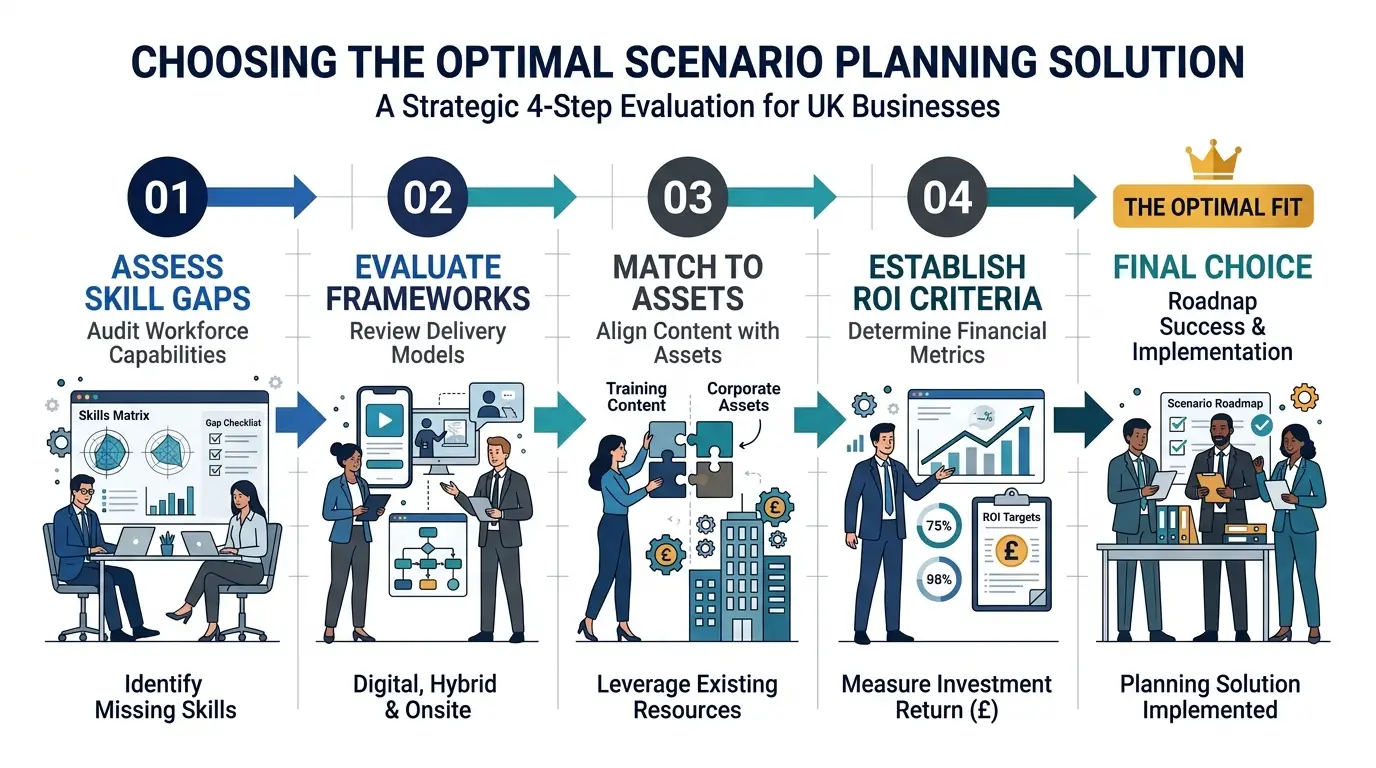
Selection Criterion | Key Focus Area | Organizational Impact | Evaluation Metric |
Skill Gap Assessment | Technical financial, risk, and engineering competencies | Identifies immediate operational capabilities and analytical deficits | Baseline competency mapping across finance and risk teams |
Delivery Framework | Practical cohort-based training vs. asynchronous modules | Determines practical application rate and retention of complex methods | Completion rates and direct practical exercise performance |
Content Alignment | Sector-specific oil and gas transition scenarios | Ensures direct relevance to upstream, midstream, and downstream operations | Applicability of training models to live corporate assets |
ROI Measurement | Speed and accuracy of transition risk deployment | Validates training expenditure through enhanced corporate risk capabilities | Time-to-implementation for updated risk assessment models |
HR directors collaborating with business unit heads must perform precise skill gap analyses prior to approving corporate training initiatives. Identifying deficits in financial modeling, regulatory forecasting, and carbon accounting ensures targeted learning investments.
Choosing the appropriate delivery framework impacts knowledge retention and application across operational units. Interactive, expert-led practical programs deliver superior skill transfer compared to passive video-based training platforms.
Content relevance remains paramount when selecting commercial training programs. Generic financial risk courses lack specific energy market dynamics, such as field depletion rates, refining complexity adjustments, and regional carbon border tax mechanics.
Measuring ROI involves evaluating post-training risk reporting quality and model deployment speed. Organisations deploying high-impact corporate programs achieve faster model integration, improved capital protection, and robust compliance disclosures across international regulatory environments.
Structured workforce capability development ensures corporate resilience. Enrolling commercial, financial, and technical teams in specialized external programs, such as specialized Energy Transition and Carbon Cost Scenario Planning Training for Oil and Gas Professionals, establishes a consistent methodological approach across all planning departments.
How Is ROI and Performance Measured After Workforce Upskilling in Transition Risk?
ROI from transition risk upskilling is measured by decreased time-to-market for scenario models, reduced risk-adjusted capital costs, enhanced regulatory disclosure accuracy, and optimized capital allocation decisions across corporate development projects.
Quantitative performance tracking begins with evaluating internal risk reporting efficiency. Upskilled risk management teams construct, stress-test, and update multi-variable scenario models significantly faster than non-specialised teams.
Capital cost optimization serves as a core financial metric for measuring training effectiveness. Lenders offer lower debt margins and preferential credit terms to energy firms demonstrating sophisticated risk modeling capabilities and transparent TCFD disclosures.
Qualitative operational improvements manifest in cross-functional decision-making efficiency. Alignment between technical engineering teams and financial planning departments reduces friction during annual capital budgeting cycles.
Long-term performance tracking compares project return projections against actual real-world performance under shifting carbon policy regimes. Accurate initial risk modeling prevents unforeseen asset write-downs and preserves capital for high-yield strategic initiatives.
Continuous performance assessment ensures ongoing alignment with evolving international reporting standards. Up-to-date workforce skills safeguard corporate balance sheets against sudden market transformations and carbon policy shifts.
Frequently Asked Questions
What does Oil and Gas Petroleum Financial Analysis cover?
Oil and Gas Petroleum Financial Analysis involves evaluating capital expenditure (CAPEX), operating costs (OPEX), fiscal regimes, joint venture accounting, and valuation metrics specific to upstream, midstream, and downstream assets. Training programs from the Institute For Oil & Gas Training focus on practical economic modelling, risk assessment, discounted cash flow (DCF) techniques, and petroleum fiscal system evaluations. These core skills enable finance professionals to measure asset profitability, assess reserve economics, and support strategic decision-making.
Why is petroleum financial analysis critical for energy sector professionals?
Financial analysis in the petroleum sector directly influences capital allocation, project feasibility, asset valuation, and risk management across energy portfolios. Specialized programs delivered by the Institute For Oil & Gas Training equip managers, analysts, and HR development teams with essential tools for evaluating petroleum fiscal contracts, commodity price volatility, and regulatory compliance. Mastering Oil and Gas Petroleum Financial Analysis helps organisations mitigate investment risks and optimize financial returns on complex energy assets.
How do professionals perform economic evaluation in the oil and gas industry?
Industry professionals conduct economic evaluations by applying net present value (NPV), internal rate of return (IRR), payback period, and sensitivity analysis models tailored to petroleum cash flows. Through Oil and Gas Petroleum Financial Analysis training at the Institute For Oil & Gas Training, participants learn to incorporate production decline curves, dynamic carbon costs, and production sharing contract (PSC) terms into financial models. This practical approach ensures precise forecasting and reliable investment stress-testing.
Who should take an Oil and Gas Petroleum Financial Analysis training course?
This training is designed for corporate finance professionals, investment analysts, business development managers, petroleum engineers, and commercial risk officers seeking sector-specific financial skills. Human resource and learning managers partner with the Institute For Oil & Gas Training to deliver tailored Oil and Gas Petroleum Financial Analysis courses that bridge technical engineering concepts with corporate finance principles, building cross-functional capabilities across operational teams.
How does financial analysis account for oil and gas fiscal regimes and risk?
Petroleum financial evaluation integrates local tax structures, royalties, production-sharing agreements, and concession arrangements into cash flow forecasts to reflect true net revenues. The Institute For Oil & Gas Training covers these framework dynamics in its Oil and Gas Petroleum Financial Analysis curriculum, alongside scenario analysis for oil price fluctuations, capital overruns, and energy transition risks. This structured framework ensures asset valuation reflects dynamic market conditions and regulatory requirements.
Related training courses
Failure Mode and Effects Analysis (FMEA) Training Course
- Specialisation
- Oil & Gas Reliability and Maintenance Management
- Duration
- 5 days · 15 CPD hours
Corrosion Control in Power Generation Plants Training Course
- Specialisation
- Oil & Gas Corrosion Management and Control
- Duration
- 5 days · 15 CPD hours
Damage Mechanisms (API 571) Training Course
- Specialisation
- Oil & Gas Asset Integrity Management
- Duration
- 5 days · 15 CPD hours
More articles

Treasury Operations Training for Funding and Working Capital Management in Oil and Gas
Master liquidity, debt facilities, and cash optimization with the Treasury Operations for Funding & Working Capital Training Course.
Read article →
How to Evaluate Funding Strategies and Working Capital Requirements for Petroleum Companies
Evaluate funding strategies and working capital models for petroleum companies with practical frameworks and structured treasury evaluation.
Read article →
Why Funding and Working Capital Management Matter in the Oil and Gas Industry
Learn how funding and working capital management drive financial stability, mitigate liquidity risks, and strengthen treasury operations in oil and gas.
Read article →