

Petroleum financial planning requires rigorous quantitative modeling to evaluate capital allocation across volatile commodity cycles, dynamic reservoir performance, and shifting geopolitical conditions. Upstream and downstream corporate finance teams must move beyond deterministic single-point forecasts to construct probabilistic multi-scenario frameworks. These frameworks evaluate project economics across varying oil prices, capital expenditure overruns, production decline curves, and fiscal regime changes. By establishing structured scenario design methodologies, corporate planners measure downside risks, calculate upside option values, and stress-test corporate cash flows against extreme market events.
Modern energy corporate finance relies on robust scenario modeling to safeguard liquidity while optimizing capital deployment across multi-year field development projects. Understanding why scenario planning matters for oil and gas financial decision making enables finance leaders to structure capital expenditure decisions around tangible uncertainty thresholds rather than static base assumptions. Integrating probability distributions into financial models converts unpredictable market variables into actionable risk parameters. Consequently, planning teams establish precise financial buffers, calibrate debt covenants, and align reserve replacement strategies with broader corporate objectives.
What Is the Core Structure of a Petroleum Scenario Planning Framework?
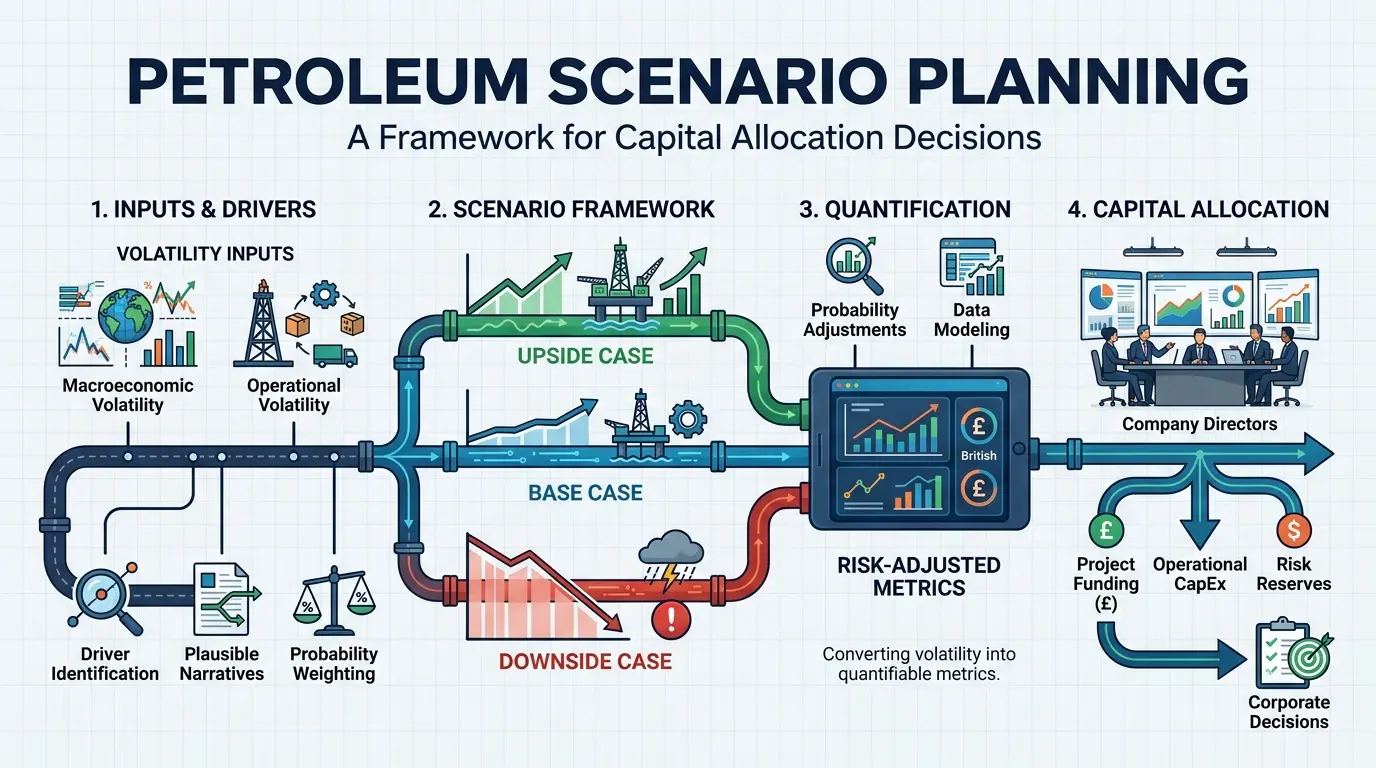
A petroleum scenario planning framework structured around base, upside, and downside cases relies on driver identification, plausible narrative construction, and probability weighting. This structure converts macroeconomic and operational volatility into quantifiable risk-adjusted metrics for corporate capital allocation decisions.
Driver Identification and Base Case Assumptions
Driver identification forms the foundation of any quantitative financial model in the energy sector. Finance professionals categorize drivers into external macroeconomic variables and internal operational parameters. Macroeconomic variables include Brent and West Texas Intermediate (WTI) spot prices, natural gas Henry Hub benchmarks, refining crack spreads, foreign exchange rates, and inflation indices for oilfield services. Operational parameters encompass initial production rates, exponential or hyperbolic decline curve exponents, drilling duration, capital expenditure per well, lease operating expenses, and planned facility turnaround durations.
Base case assumptions represent the P50 median estimate, where a 50 percent probability exists that the actual outcome exceeds or falls short of the target. Financial planners construct the base case using forward curve pricing, consensus inflation expectations, and central engineering estimates for reservoir recovery. The base case serves as the corporate baseline for measuring net present value (NPV), internal rate of return (IRR), payback period, and debt service coverage ratios (DSCR). Evaluating this baseline against external stress factors reveals the structural sensitivity of the asset portfolio.
Plausible Narrative Construction for Upside and Downside Cases
Plausible narrative construction translates complex market dynamics and technical risk factors into concrete, alternative financial runs. An upside case models favorable operational and market convergence, such as unexpected reservoir permeability, successful lateral extension, sustained commodity price appreciation, or technological breakthroughs reducing lifting costs. The upside scenario reflects a P10 outcome, representing an optimistic threshold where only a 10 percent probability exists of exceeding the modeled cash flow figures.
Downside cases model stress conditions, reflecting P90 probabilistic assumptions where there is a 90 percent likelihood that actual performance will equal or exceed the projection. Downside narratives combine low commodity pricing with operational delays, cost inflation, premature water breakthrough, or regulatory compliance penalties. Integrating narrative construction into financial models prevents planners from using arbitrary linear adjustments, ensuring that upside and downside cases reflect interconnected physical and market realities.
Probability Weighting and Risk Aggregation
Probability weighting assigns statistical frequencies to base, upside, and downside outcomes to determine expected monetary value (EMV). Analysts calculate the EMV of a development project by multiplying the discounted net cash flow of each scenario by its assigned probability of occurrence:
$$\text{EMV} = \sum_{i=1}^{n} P(S_i) \times \text{NPV}(S_i)$$
Where $P(S_i)$ is the assigned probability of scenario $i$, and $\text{NPV}(S_i)$ is the discounted net cash flow under scenario $i$.
Risk aggregation consolidates single-asset probability distributions across a diversified corporate portfolio. Through Monte Carlo simulations, financial analysts run thousands of iterations, varying inputs across correlated distributions to generate a continuous probability density function for portfolio returns.
How Do Finance Teams Differentiate Between Base, Upside, and Downside Scenarios?
Finance teams differentiate scenarios by setting distinct technical and macroeconomic input parameters across deterministic or probabilistic thresholds. This differentiation establishes clear operational boundaries, enabling executives to evaluate asset performance under varied market cycles and operational stress levels.
Scenario Attribute | Base Case (P50) | Upside Case (P10) | Downside Case (P90) |
Commodity Price Assumption | Strip / Consensus Curve | +20% to +35% Premium | -25% to -45% Discount |
Production Profile | P50 Engineering Estimate | P10 High Recovery / Flow Rate | P90 Low Recovery / Early Decline |
CAPEX / OPEX Variance | Budget Baseline | -5% to -10% Efficiency Gains | +15% to +30% Cost Inflation |
Fiscal / Regulatory Friction | Current Tax / Royalty Regime | Tax Incentives / Subsidies | Higher Royalties / Carbon Tax |
Primary Valuation Metric | Target Corporate NPV / IRR | Maximum Free Cash Flow | Breakeven Price / Payback Period |
Establishing Base Case Metrics
The base case reflects standard operating conditions and serves as the baseline for performance tracking. Capital budgeting models rely on base case inputs to allocate annual corporate funding across business units. Financial analysts evaluate the base case against corporate hurdle rates, ensuring the project generates returns above the weighted average cost of capital (WACC).
Uncertainty in base case modeling arises when teams rely on static pricing or unadjusted historical costs. Robust financial planning updates base case parameters quarterly, incorporating realized well performance and adjusted service contract rates.
Evaluating Upside Potential and Strategic Options
Upside case evaluation quantifies the economic benefits of favorable operational developments and market tailwinds. Strategic option evaluation within upside modeling identifies opportunities to expand capital deployment when market conditions improve. If commodity prices exceed the base threshold by 20 percent, the strategic option may involve accelerating infill drilling, expanding processing facility capacity, or executing farm-in agreements.
Upside modeling evaluates how operational leverage amplifies equity returns. By fixing structural overhead while revenue increases, teams calculate the incremental margin expansion generated across variable production tiers.
Stress-Testing Downside Risk and Survival Thresholds
Downside case evaluation identifies structural vulnerabilities, minimum liquidity requirements, and insolvency thresholds. Downside models apply compound stress scenarios, combining low commodity pricing with elevated field operating expenses and production downtime. The objective is to determine the asset's economic limit—the point at which operating revenue no longer covers lease operating expenses and production taxes. [
Financial teams use downside modeling to evaluate corporate debt covenant compliance. Stress testing verifies whether net cash flows maintain required interest coverage ratios under low pricing regimes, preventing forced asset liquidations or credit rating downgrades during market downturns.
What Framework Evaluates Corporate Investment Decisions Under High Volatility?
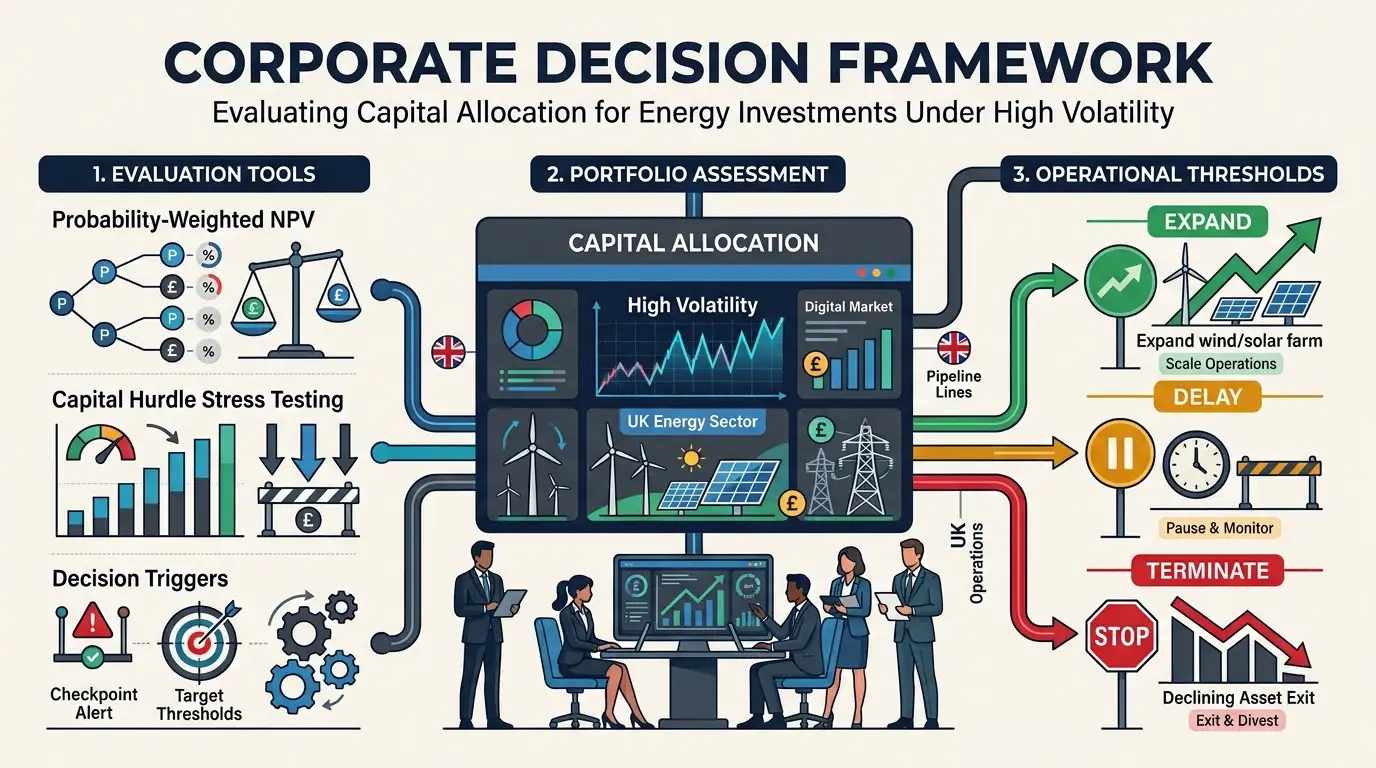
A corporate decision framework uses probability-weighted net present value, capital hurdle stress testing, and decision triggers to evaluate capital allocation under high volatility. This framework establishes clear operational thresholds for expanding, delaying, or terminating energy investments.
Stage-Gate Capital Allocation Framework
Petroleum operators use stage-gate processes to manage capital allocation across exploration, appraisal, development, and production phases. At each gate, financial planning teams evaluate updated scenario models against strategic performance benchmarks.
Gate 1: Exploration Evaluation — Focuses on downside risk containment and geological success probabilities ($P_g$).
Gate 2: Appraisal Optimization — Refines base case reservoir boundaries and evaluates economic feasibility across volumetric ranges.
Gate 3: Development Sanction — Demands rigorous stress-testing of downside capital expenditure overruns and pricing weakness before committing major capital.
Gate 4: Production Management — Tracks real-time cash generation against scenario targets to guide tertiary recovery and operational optimization.
Establishing Decision Triggers and Contingency Planning
Decision triggers establish pre-defined operational actions based on real-world market or technical indicators. Instead of relying on ad-hoc adjustments during market disruptions, corporate boards approve conditional operational responses tied directly to scenario thresholds.
Contingency planning integrates operational options directly into the financial model. If WTI prices fall below 50 USD per barrel for two consecutive quarters, the pre-approved decision trigger may automatically reduce capital expenditure by halting uncommitted completion activities, deferring exploratory drilling, and restructuring service contract rates.
Conversely, if commodity prices exceed 85 USD per barrel alongside stable drilling performance, the decision trigger permits the release of additional capital for infrastructure debottlenecking.
Integrating Risk Management and Hedging Strategies
Scenario planning dictates the corporate risk mitigation and derivative hedging strategy. Financial modeling reveals the volume of production required to be hedged using swaps, collars, or put options to secure corporate debt obligations and critical capital budgets.
By identifying the exact downside price floor where cash flow turns negative, finance teams purchase downside price protection (e.g., put options) covering baseline operational expenses and fixed debt service. This approach maintains upside participation while eliminating terminal downside risks during unexpected market downturns.
How Can Energy Organizations Build Practical Financial Modeling Capability?
Energy organizations build financial modeling capability by implementing structured corporate learning programs, updating financial governance frameworks, and adopting integrated planning software. Organizations address skill gaps through practical, industry-driven instruction that connects quantitative techniques directly to capital allocation outcomes.
Addressing Enterprise Skill Gaps in Energy Finance
Corporate HR teams and finance directors face ongoing challenges upskilling financial planning and analysis (FP&A) professionals. Mid-level analysts often possess standard financial modeling skills but lack deep domain knowledge in petroleum fiscal regimes, production decline curves, and probabilistic risk analysis. This skill deficit leads to oversimplified financial models that miscalculate downside risks or fail to capture structural option values.
To resolve these skill gaps, corporate learning programs shift from generic corporate finance concepts to hands-on, industry-driven instruction. Training programs for financial analysts focus on integrating reservoir engineering inputs, commercial contract structures, and complex commodity derivatives directly into corporate financial models. Analysts master probabilistic modeling, scenario narrative design, and sensitivity analysis tailored specifically to the energy sector.
Organizations seeking structured professional development invest in targeted external instruction, such as dedicated Scenario Planning Training for Oil and Gas Financial Analysis Professionals, to establish standardized modeling methodologies across cross-functional planning teams. Providing finance teams with dedicated instruction in Scenario Planning for Base, Upside & Downside Cases Training Course accelerates skill development, aligns project evaluation across corporate units, and improves the reliability of capital allocation proposals submitted to executive boards.
Delivery Models and Corporate Learning Frameworks
Human resource leaders evaluate multiple learning delivery models to optimize training ROI and operational performance. Corporate teams select learning pathways based on organizational scale, team dispersion, and technical complexity requirements:
In-Person Executive Workshops: Intensive, lab-based workshops focusing on complex portfolio modeling, tailored to an organization's specific asset base and capital structures.
Live Virtual Classrooms: Interactive, instructor-led digital sessions offering multi-region delivery for global finance teams without requiring international travel expenditure.
Blended Learning Systems: Asynchronous technical modules combined with live case-study reviews, maximizing knowledge retention while minimizing downtime for active finance teams.
Measuring Training ROI and Business Outcomes
Organisations measure the business impact of specialized financial training through tangible governance and performance improvements:
Model Accuracy and Variance Reduction: Measuring the reduction in variance between projected scenario baseline assumptions and realized operational cash flows.
Decision Cycle Speed: Quantifying the efficiency gains in capital budgeting cycles, enabling teams to complete multi-scenario stress tests in days rather than weeks.
Risk Mitigation Effectiveness: Evaluating portfolio resilience during commodity downturns, measuring whether pre-defined decision triggers successfully preserved liquidity and prevented debt covenant breaches.
By aligning financial modeling expertise with broader corporate governance, oil and gas organizations convert scenario planning from a periodic forecasting exercise into a continuous, risk-adjusted strategic advantage.
Frequently Asked Questions
What is covered in Oil and Gas Petroleum Financial Analysis training?
Oil and Gas Petroleum Financial Analysis training covers capital allocation models, cash flow forecasting, reserve valuation, and fiscal regime evaluations tailored to upstream and downstream operations. Participants learn to evaluate base, upside, and downside scenarios alongside risk mitigation techniques to support corporate financial decisions. The curriculum delivered by Institute For Oil & Gas Training integrates real-world industry datasets to ensure practical skill development for finance professionals.
Who should attend an Oil and Gas Petroleum Financial Analysis course?
This program is designed for corporate finance managers, FP&A analysts, commercial advisors, and HR leaders seeking to upskill their financial planning teams. It is particularly beneficial for professionals in the energy sector who need to master project economics, risk-adjusted valuation, and commodity price hedging strategies. Institute For Oil & Gas Training crafts the learning experience to bridge knowledge gaps between petroleum engineering inputs and executive financial governance.
How does petroleum financial analysis differ from standard corporate finance?
Petroleum financial analysis accounts for unique industry factors such as commodity price volatility, geological field decline rates, complex fiscal regimes, and capital-intensive development timelines. Standard corporate finance models often fail to capture the probabilistic nature of reserve recovery and multi-year exploration risk. Training with Institute For Oil & Gas Training equips analysts with specialized methodologies like Monte Carlo simulations and decision-trigger frameworks essential for accurate energy portfolio management.
How long does it take to complete Oil and Gas Petroleum Financial Analysis training?
Training duration typically ranges from short intensive three-day executive workshops to flexible multi-week blended learning programs depending on corporate requirements. Institute For Oil & Gas Training offers both live virtual sessions and structured in-person delivery models to accommodate global workforce schedules. The flexible learning pathways ensure finance teams acquire operational skills without disrupting ongoing commercial operations.
What is the ROI of Oil and Gas Petroleum Financial Analysis training for organizations?
Organizations achieve measurable return on investment through reduced financial modeling error rates, faster investment sanctioning cycles, and enhanced risk mitigation during market downturns. Upskilling financial teams enables accurate downside stress-testing and optimal capital allocation across volatile market cycles. Institute For Oil & Gas Training delivers practical, outcome-driven instruction that directly aligns financial planning capabilities with strategic corporate objectives.
Related training courses
Failure Mode and Effects Analysis (FMEA) Training Course
- Specialisation
- Oil & Gas Reliability and Maintenance Management
- Duration
- 5 days · 15 CPD hours
Damage Mechanisms (API 571) Training Course
- Specialisation
- Oil & Gas Asset Integrity Management
- Duration
- 5 days · 15 CPD hours
Oil and Gas Injection Water Treatment Training Course
- Specialisation
- Oil & Gas Water Treatment and Management
- Duration
- 5 days · 15 CPD hours
More articles

Treasury Operations Training for Funding and Working Capital Management in Oil and Gas
Master liquidity, debt facilities, and cash optimization with the Treasury Operations for Funding & Working Capital Training Course.
Read article →
How to Evaluate Funding Strategies and Working Capital Requirements for Petroleum Companies
Evaluate funding strategies and working capital models for petroleum companies with practical frameworks and structured treasury evaluation.
Read article →
Why Funding and Working Capital Management Matter in the Oil and Gas Industry
Learn how funding and working capital management drive financial stability, mitigate liquidity risks, and strengthen treasury operations in oil and gas.
Read article →